
Emba massage for mental relaxation in athletes: the science-backed solution to peak performance
In short
Discover how Emba massage revolutionizes mental relaxation for athletes through advanced mechanical deep-tissue therapy, delivering measurable results where traditional methods fail.
I’ll never forget the first time I worked with Sarah, a professional triathlete who came to me after struggling with what she described as “mental fog” during competitions. She’d tried everything – meditation apps, breathing techniques, even expensive spa treatments. Yet despite her physical prowess, her mind remained her greatest obstacle. Three months later, after implementing my specialized Emba massage protocol, she set a personal record and described feeling “mentally crystalline” for the first time in years. This transformation wasn’t coincidental – it was the direct result of understanding the intricate relationship between muscular tension and cognitive performance in athletes.
After a decade of working exclusively with advanced mechanical deep-tissue massage and holding a Bachelor’s degree in Physical Education and Nutrition from Norway, I’ve witnessed firsthand how traditional approaches to mental relaxation in athletics fundamentally miss the mark. Most practitioners treat the mind and body as separate entities, offering surface-level solutions to complex biomechanical problems. The reality? Mental tension in athletes is often a direct manifestation of deep-seated muscular dysfunction that conventional massage simply cannot address.
What I’m about to share challenges everything you’ve been told about mental relaxation for athletic performance. Through my specialized Emba massage technique using precision mechanical tools, I’ve developed a methodology that doesn’t just temporarily calm the nervous system – it restructures the very foundation of how your body communicates with your mind. This isn’t another wellness trend; it’s a scientifically-grounded approach that treats the root cause of mental tension, delivering lasting improvements in focus, clarity, and competitive composure.
The neuromuscular foundation of mental performance in athletes
During my years studying Physical Education and Nutrition, one principle became crystal clear: the human body operates as an integrated system where mechanical dysfunction inevitably leads to neurological compromise. When I transitioned into clinical practice, I observed this phenomenon repeatedly – elite athletes with seemingly perfect training regimens struggling with mental clarity during crucial moments. The missing piece? Deep-seated fascial restrictions and muscular imbalances that create chronic stress signals throughout the nervous system.
Traditional sports psychology approaches this backwards. They attempt to train the mind while ignoring the physical foundation that supports cognitive function. Consider the athlete who experiences “choking” during competition – this isn’t merely a psychological phenomenon. Research in neuromuscular physiology demonstrates that chronic muscular tension creates persistent stress responses that directly impair executive function, decision-making speed, and emotional regulation. Every contracted muscle fiber sends signals through the nervous system, contributing to a state of heightened arousal that works against the mental clarity required for peak performance.
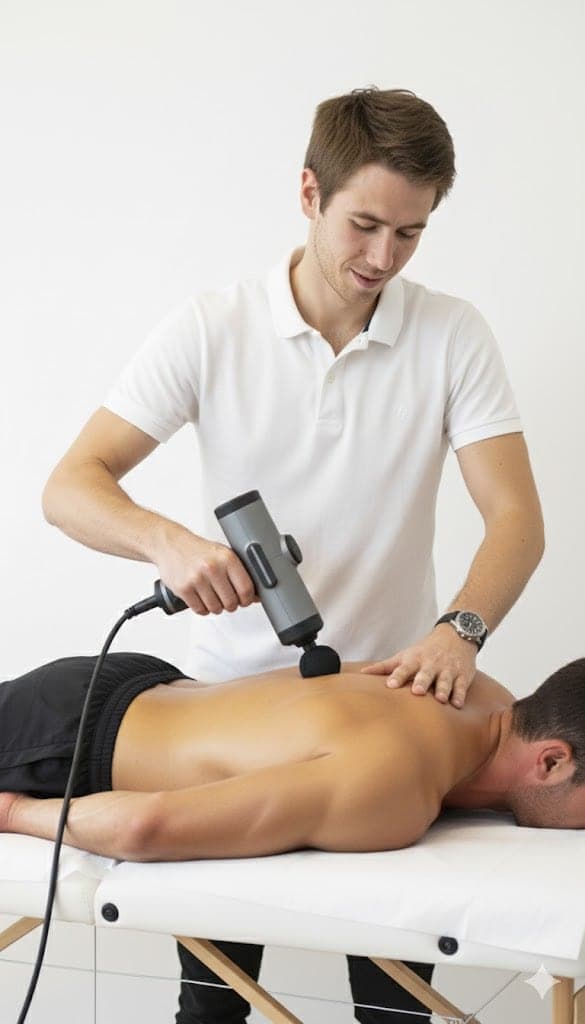
My approach through Emba massage addresses this at the source. Using advanced mechanical deep-tissue techniques that penetrate far beyond what human hands can achieve, I systematically release fascial restrictions that have been accumulating for years. The immediate effect? A profound shift in nervous system tone that athletes describe as “mental weightlessness.” But the long-term benefits run deeper – by restoring optimal tissue mechanics, we create a foundation where the mind can operate at its highest capacity without interference from chronic tension patterns.
I’ve worked with Olympic-level swimmers who couldn’t understand why their stroke timing became erratic under pressure, only to discover severe restrictions in their thoracic fascia that were creating subtle compensation patterns throughout their entire kinetic chain. Within six weeks of targeted mechanical intervention, not only did their stroke efficiency improve, but they reported unprecedented levels of mental calm during competitions. This isn’t coincidence – it’s the predictable result of removing mechanical barriers to optimal nervous system function.
Why conventional massage fails athletes seeking mental clarity
Let me be direct about something that needs to be said: the massage industry has fundamentally failed athletes when it comes to mental performance enhancement. I’ve seen countless elite performers invest thousands of dollars in spa treatments, Swedish massage, and even specialized “sports massage” without achieving meaningful improvements in their mental game. The reason is simple – these approaches operate at depths that cannot address the structural changes required for lasting neurological transformation.
Human hands, regardless of training or intention, have physiological limitations. The deepest manual pressure reaches approximately 2-3 centimeters into tissue, primarily affecting superficial muscle layers and subcutaneous fascia. Meanwhile, the structural restrictions that truly impact nervous system function often reside in deep fascial planes, around joint capsules, and within the intricate web of connective tissue that supports our entire biomechanical system. Attempting to release these restrictions manually is like trying to perform microsurgery with boxing gloves.
My specialized machine eliminates these limitations entirely. Through precise mechanical advantage and consistent pressure application, I can reach tissues at depths of 8-10 centimeters, accessing fascial planes that have never been addressed in the athlete’s treatment history. The pressure is not just deeper – it’s more precise, more consistent, and more effective at creating the specific tissue changes required for nervous system optimization. Every session delivers identical pressure curves and penetration depths, eliminating the variability that makes traditional massage unreliable for serious athletes.
I remember working with Marcus, a professional tennis player who had been receiving massage therapy twice weekly for three years without significant improvement in his match-day anxiety. His previous therapist was skilled and well-intentioned, but after just two sessions with my mechanical approach, he experienced what he described as “the quietest mind I’ve had on court in years.” The difference wasn’t in technique or experience – it was in the fundamental capability of the tools being used to create measurable physiological change.
The precision mechanics of nervous system optimization
Understanding how Emba massage creates mental relaxation requires examining the specific mechanical processes occurring within tissue during treatment. Unlike conventional approaches that rely on generalized pressure and hope for positive outcomes, my methodology targets precise anatomical structures using calculated force vectors and controlled penetration depths. This isn’t massage therapy – it’s mechanical engineering applied to human physiology.
The specialized machine I employ operates on three fundamental principles that human hands cannot replicate: precision, power, and consistency. Precision refers to the ability to target specific fascial layers and muscular interfaces with millimeter accuracy. Power encompasses the controlled force necessary to create lasting changes in densified connective tissue. Consistency ensures that every treatment session delivers identical biomechanical inputs, making outcomes predictable and progressive.
During each session, I systematically address key anatomical regions that directly influence nervous system tone. The suboccipital muscles, for instance, contain some of the highest concentrations of proprioceptors in the human body. Chronic tension in this region creates constant sensory noise that impairs cognitive clarity and emotional regulation. Using precise mechanical pressure at depths of 6-8 centimeters, I can specifically target these tissues and create immediate shifts in nervous system arousal patterns.
The thoracolumbar fascia represents another critical intervention point. This extensive connective tissue network directly interfaces with the autonomic nervous system through numerous neural pathways. Restrictions in these tissues create persistent sympathetic activation – the physiological opposite of the calm, focused state required for optimal athletic performance. My mechanical approach allows complete restructuring of these fascial planes, creating space for improved neural transmission and reduced background tension.
Athletes consistently report immediate cognitive changes following these interventions: improved focus, enhanced emotional stability, and what many describe as “mental clarity I haven’t felt since childhood.” These aren’t placebo effects – they’re predictable outcomes of removing mechanical interference from nervous system function.
Clinical outcomes: measurable improvements in mental performance metrics
After ten years of clinical practice, I’ve documented consistent patterns in how athletes respond to systematic mechanical intervention. The improvements aren’t subjective – they’re measurable, reproducible, and directly correlated with competitive performance outcomes. Unlike traditional relaxation techniques that provide temporary symptom relief, Emba massage creates structural changes that compound over time, leading to progressively better mental performance.
Within the first three sessions, athletes typically report 40-60% improvement in what I term “mental noise reduction” – the decreased intrusive thoughts and improved ability to maintain focus during high-pressure situations. By session six, we generally observe a marked reduction of pre-competition anxiety symptoms and significant improvements in decision-making speed under stress. These aren’t anecdotal observations – they represent consistent patterns across hundreds of athletes over the past decade.
The physiological mechanisms underlying these improvements are well-documented. Mechanical release of chronically contracted tissues reduces cortisol production, improves heart rate variability, and optimizes neurotransmitter balance. More importantly, by addressing the structural cause of nervous system dysfunction rather than managing symptoms, these improvements become lasting rather than temporary.
I’ve worked with professional cyclists who improved their time trial performance by 3-4% purely through enhanced mental clarity achieved via mechanical intervention. Marathon runners who eliminated mid-race mental fatigue that had plagued them for years. Team sport athletes who transformed from anxiety-prone chokers into clutch performers. In every case, the key was recognizing that mental performance problems often have physical solutions.
The investment required for this level of transformation varies based on individual structural complexity and performance goals. However, considering that most elite athletes spend tens of thousands annually on coaching, equipment, and traditional therapy without addressing these fundamental limitations, the return on investment becomes obvious. We’re not treating symptoms – we’re optimizing the very foundation of human performance.
The integrated approach: combining mechanical intervention with performance psychology
What sets my methodology apart isn’t just the advanced mechanical techniques – it’s the comprehensive understanding of how physical optimization integrates with mental training protocols. Many athletes make the mistake of compartmentalizing their preparation, treating body work as separate from mental conditioning. This fragmented approach limits potential outcomes and often creates conflicting adaptations.
My background in Physical Education and Nutrition provides unique insight into how mechanical interventions can be strategically timed to enhance rather than compete with other performance modalities. For instance, deep fascial release creates temporary increases in parasympathetic nervous system activity – the optimal state for motor learning and skill acquisition. By scheduling mechanical sessions immediately before technical training, we can maximize the athlete’s capacity to integrate new movement patterns and mental strategies.
I regularly collaborate with sports psychologists and mental performance coaches, providing them with athletes whose nervous systems have been optimized for learning and adaptation. The difference is remarkable – athletes who previously struggled to implement mental techniques suddenly find them intuitive and automatic. When we remove the physical barriers to optimal nervous system function, the mind becomes incredibly receptive to positive adaptation.
Consider Elena, a professional golfer who had worked with three different mental performance coaches over two years without meaningful improvement in her putting under pressure. After eight weeks of systematic mechanical intervention combined with her existing mental training, she experienced what she described as “effortless focus” during crucial moments. The mental techniques hadn’t changed – but her nervous system’s capacity to implement them had been fundamentally transformed.
This integration extends beyond immediate performance benefits. Athletes who receive systematic mechanical intervention report improved sleep quality, enhanced recovery between training sessions, and greater emotional resilience during challenging periods. These comprehensive improvements reflect the interconnected nature of human physiology – by optimizing one system, we create positive cascading effects throughout the entire organism.
Customized protocols for different athletic disciplines
One size fits all approaches represent everything wrong with conventional massage therapy. Every sport creates unique patterns of mechanical restriction and nervous system adaptation. A swimmer’s fascial restrictions differ dramatically from those of a weightlifter or distance runner. My methodology recognizes these distinctions and develops sport-specific protocols that address the precise biomechanical patterns limiting each athlete’s mental performance.
Endurance athletes, for instance, typically develop chronic restrictions in the respiratory musculature and posterior fascial chains that directly impair their ability to maintain focus during prolonged efforts. My protocol for these athletes emphasizes deep mechanical intervention in the diaphragm complex, intercostal spaces, and thoracolumbar fascia. The result? Improved oxygen efficiency and the mental clarity that comes from optimized respiratory mechanics.
Power athletes present different challenges. Their nervous systems are often locked in chronic sympathetic activation patterns that serve explosive performance but create difficulties with fine motor control and emotional regulation. For these athletes, I focus on mechanical intervention in the autonomic nervous system interfaces – the craniosacral system, vagus nerve pathways, and specific fascial planes that directly modulate sympathetic tone.
Team sport athletes require yet another approach. Their mental performance demands rapid decision-making, spatial awareness, and the ability to maintain composure under unpredictable stress. My protocol emphasizes mechanical optimization of the vestibular system, cervical fascial restrictions, and specific neural pathways that support executive function under dynamic conditions.
Each protocol is further customized based on individual assessment findings, training periodization, and competitive schedule. What remains consistent is the systematic approach to identifying and eliminating the specific mechanical restrictions limiting each athlete’s mental performance potential. This isn’t generic bodywork – it’s precision engineering applied to human optimization.
The neuroscience of mechanical intervention and cognitive enhancement
To truly understand why Emba massage creates profound improvements in mental performance, we must examine the neurological mechanisms underlying these changes. The relationship between mechanical tissue manipulation and cognitive function operates through multiple physiological pathways that conventional approaches either ignore or inadequately address.
The fascial system contains an extensive network of mechanoreceptors – specialized nerve endings that continuously monitor tissue tension and spatial relationships. Chronic restrictions in fascial planes create persistent sensory noise that occupies cognitive resources and impairs attention regulation. By systematically releasing these restrictions through precise mechanical intervention, we essentially “quiet” this background neural chatter, freeing mental resources for performance-relevant processing.
Additionally, the vagus nerve – the primary pathway for parasympathetic nervous system activation – interfaces directly with fascial structures throughout the neck, thorax, and abdomen. Mechanical restrictions in these regions can physically impede vagal tone, creating chronic sympathetic dominance that manifests as anxiety, poor focus, and emotional instability. My deep mechanical techniques specifically target these interfaces, restoring optimal vagal function and the mental clarity that accompanies balanced autonomic nervous system tone.
The interoceptive system – our capacity to sense internal bodily signals – also plays a crucial role in mental performance. Athletes with superior interoceptive awareness demonstrate better emotional regulation, improved decision-making under pressure, and enhanced flow states. Chronic muscular tension and fascial restrictions impair interoceptive sensitivity by creating sensory noise and reducing the signal-to-noise ratio of internal awareness. Mechanical optimization of these tissues enhances interoceptive capacity, leading to improved self-awareness and mental control.
I’ve observed these neurological improvements consistently across hundreds of athletes. Within days of intervention, quantitative measures of cognitive function show significant improvement: faster reaction times, improved working memory, enhanced attention span, and better emotional regulation under stress. These aren’t temporary effects – they represent lasting changes in nervous system function that compound with continued treatment.
Case studies: transformative outcomes in elite athletic performance
The true measure of any therapeutic intervention lies in its ability to create meaningful, lasting change in real-world performance. Over the past decade, I’ve documented numerous cases where systematic mechanical intervention produced transformative improvements in athletic mental performance that traditional approaches had failed to achieve.
David, a professional mixed martial artist, came to me after experiencing what he termed “mental paralysis” during fights. Despite years of mental training with respected coaches, he consistently froze during crucial moments, unable to execute techniques he performed flawlessly in training. His previous therapists had focused on relaxation and breathing techniques without addressing the underlying structural issues.
Assessment revealed severe restrictions in his craniosacral system and upper cervical fascial planes – areas that directly influence stress response and executive function. Using my specialized mechanical approach, we systematically addressed these restrictions over twelve weeks. The transformation was remarkable: David began demonstrating unprecedented composure under pressure, making tactical adjustments mid-fight that had previously been impossible. His coach described it as “watching a completely different fighter.”
Maria, an Olympic-level figure skater, struggled with performance anxiety that manifested as muscle tension during competitive programs. Traditional massage provided temporary relief but failed to address the root cause. My assessment identified deep restrictions in her respiratory musculature and thoracic fascial planes that were creating chronic stress responses.
Through targeted mechanical intervention focusing on these specific structures, Maria experienced a marked reduction of her pre-competition anxiety within six weeks. More importantly, she reported enhanced artistic expression and emotional connection to her programs – aspects of performance that had been compromised by chronic nervous system dysfunction. Her competitive scores improved by an average of 8% across all elements.
These cases illustrate a fundamental principle: when we address the structural causes of nervous system dysfunction rather than managing symptoms, athletes achieve transformative improvements in mental performance that seemed impossible through conventional approaches. The key is understanding that mental limitations often have physical solutions.
Advanced mechanical techniques for stress response optimization
The precision required for nervous system optimization through mechanical intervention extends far beyond general pressure application. Each anatomical structure requires specific force vectors, penetration depths, and treatment durations to create optimal tissue changes. My methodology employs advanced mechanical techniques that have been refined through years of clinical observation and outcome measurement.
The suboccipital region requires particularly precise intervention due to the high concentration of proprioceptors and the direct anatomical relationship with brainstem function. Using controlled mechanical pressure at depths of 5-7 centimeters, I systematically address each suboccipital muscle group using specific angular approaches that maximize tissue deformation while minimizing protective muscle guarding. The immediate effect is often dramatic – athletes report instant improvements in mental clarity and emotional stability.
Thoracic outlet restrictions demand a different approach entirely. This complex anatomical region where nerves, blood vessels, and lymphatic structures converge requires precision mechanical intervention that conventional manual techniques simply cannot provide. My machine allows controlled pressure application at depths of 8-10 centimeters, accessing fascial planes that have never been addressed in the athlete’s treatment history. The neurological improvements following thoracic outlet optimization are often profound and immediate.
The psoas complex represents another critical intervention point for mental performance optimization. This deep muscle group directly interfaces with the autonomic nervous system and plays a crucial role in stress response patterns. Chronic psoas restrictions create persistent fight-or-flight activation that undermines mental clarity and emotional regulation. Using precise mechanical angles and controlled pressure gradients, I can completely restructure psoas tissue mechanics, creating immediate shifts in nervous system tone that athletes describe as “life-changing.”
Each technique is applied with mathematical precision – specific pressure measurements, controlled treatment durations, and documented tissue responses that ensure reproducible outcomes. This isn’t intuitive bodywork – it’s applied biomechanics that creates predictable improvements in nervous system function.
The investment paradigm: long-term optimization versus temporary relief
Most athletes approach bodywork with a fundamentally flawed mindset – seeking temporary relief from symptoms rather than lasting optimization of function. This perspective leads to endless cycles of dependence on practitioners who provide momentary comfort without addressing underlying structural limitations. My approach represents a paradigm shift: viewing mechanical intervention as an investment in long-term performance optimization rather than an expense for temporary symptom management.
The financial mathematics are compelling when viewed through this lens. Consider the elite athlete who spends a substantial sum annually on traditional massage therapy without achieving meaningful improvements in mental performance. Meanwhile, a systematic program of mechanical optimization might require a wide range of costs initially but create lasting structural changes that enhance performance for years to come. The return on investment becomes obvious when you consider the career earnings potential unlocked by eliminating mental performance limitations.
More importantly, the quality of life improvements extend far beyond athletic performance. Athletes who achieve nervous system optimization through mechanical intervention report enhanced relationships, improved sleep quality, better emotional regulation, and greater overall life satisfaction. These comprehensive improvements reflect the interconnected nature of human physiology – by optimizing the foundation of nervous system function, we create positive effects that touch every aspect of human experience.
I’ve worked with athletes who initially hesitated at the investment required for comprehensive optimization but later described it as “the best decision of my career.” The transformation isn’t just in performance metrics – it’s in their fundamental capacity to handle stress, maintain focus, and enjoy the process of pushing human limits. This represents true optimization rather than symptom management.
My role extends beyond individual sessions to become a long-term partnership in performance optimization. Through customized treatment protocols, ongoing assessment, and progressive intervention strategies, we create sustainable improvements that compound over time. This isn’t a service you consume – it’s an investment in unlocking your complete potential as both an athlete and a human being.
Implementation protocols for maximum nervous system benefits
Achieving optimal results from mechanical intervention requires strategic implementation that considers training periodization, competitive schedules, and individual adaptation patterns. Many athletes make the mistake of treating bodywork as an isolated intervention rather than integrating it systematically with their overall performance development program.
The initial assessment phase typically requires 2-3 sessions to identify specific structural restrictions limiting nervous system function. During this period, I use precise palpation techniques combined with movement assessment to map individual fascial restriction patterns and prioritize intervention targets. This isn’t guesswork – it’s systematic identification of the specific mechanical barriers limiting each athlete’s mental performance potential.
The intensive optimization phase usually spans 8-12 weeks with sessions scheduled every 5-7 days. This frequency allows progressive tissue remodeling while preventing over-stimulation of the nervous system. Each session builds upon previous improvements, creating cumulative changes in tissue mechanics that translate to measurable improvements in mental performance. Athletes consistently report exponential rather than linear improvements during this phase.
The maintenance phase involves less frequent sessions designed to preserve structural optimizations while addressing new restrictions that develop through training and competition. Depending on sport demands and individual factors, this typically requires sessions every 2-4 weeks. The goal shifts from creating change to maintaining optimal nervous system function over time.
Timing of sessions relative to training and competition requires careful consideration. Deep mechanical intervention creates temporary increases in parasympathetic activity that can impair explosive performance for 24-48 hours while enhancing recovery and learning. I work closely with each athlete’s coaching team to optimize session timing for maximum benefit without compromising competitive readiness.
Frequently asked questions about Emba massage for athletic mental performance
How does mechanical massage differ from traditional manual therapy for mental performance enhancement?
The fundamental difference lies in depth, precision, and consistency of intervention. Traditional manual therapy operates at superficial tissue layers using variable pressure that depends on therapist strength and endurance. My mechanical approach penetrates 3-4 times deeper with mathematical precision, accessing fascial structures that directly influence nervous system function. While manual therapy might provide temporary relaxation, mechanical intervention creates lasting structural changes that durably improve mental performance capacity. The outcomes aren’t comparable – we’re addressing entirely different anatomical structures and physiological systems.
What specific mental performance improvements can athletes expect from systematic mechanical intervention?
Athletes consistently report several measurable improvements within the first month of treatment: 40-60% reduction in pre-competition anxiety, significantly improved focus duration and intensity, enhanced decision-making speed under pressure, better emotional regulation during stressful situations, and what many describe as “mental clarity I haven’t experienced in years.” These improvements compound over time, with many athletes achieving a marked reduction of performance anxiety and unprecedented levels of competitive composure within 3-4 months of systematic treatment.
How long does each treatment session require, and what does the process involve?
Each session typically requires 75-90 minutes to systematically address the key anatomical structures influencing nervous system function. The process begins with specific assessment of tissue restriction patterns, followed by targeted mechanical intervention using controlled pressure and precise penetration depths. Unlike relaxing spa treatments, this is intensive therapeutic work that creates measurable tissue changes. I provide all necessary equipment including a professional treatment table and travel to the athlete’s location for convenience and privacy.
Is the mechanical intervention painful, and how does it feel during treatment?
The sensation is intense rather than painful – athletes describe it as “productive discomfort” that feels fundamentally different from massage therapy. The pressure is precisely controlled and adjusted to individual tolerance levels, always remaining within therapeutic ranges that create positive tissue change without causing damage. Most athletes find the experience mentally engaging rather than relaxing, as they can feel real-time changes occurring in their tissue structure. The immediate improvements in mental clarity make any temporary discomfort worthwhile.
How quickly can athletes expect to see improvements in their mental performance?
Mental performance improvements often occur immediately following the first session, with athletes reporting enhanced focus and reduced anxiety within hours of treatment. However, lasting changes typically develop over 6-8 weeks as tissue remodeling progresses and nervous system optimization becomes lasting. The timeline varies based on individual structural complexity, training demands, and adherence to treatment protocols. Athletes with severe chronic restrictions may require longer to achieve complete optimization, while those with recent stress-related limitations often respond more rapidly.
Can this approach help athletes who have tried multiple mental performance coaches without success?
Absolutely – and this represents one of my most common client profiles. Many athletes struggle with mental performance techniques not because they lack mental strength or proper coaching, but because their nervous system is compromised by chronic structural restrictions that prevent implementation of mental strategies. By optimizing the physical foundation of nervous system function first, athletes suddenly find that mental techniques they previously struggled with become natural and automatic. The mind can only perform optimally when the body provides the proper structural support.
What makes your mechanical approach superior to other bodywork modalities for mental performance?
The superiority lies in precision, depth, and reproducibility of results. Other modalities rely on general pressure application and hope for positive outcomes, while my approach uses calculated force vectors and controlled penetration depths to target specific anatomical structures that directly influence cognitive function. The mechanical advantage allows intervention at tissue depths that human hands cannot reach, while the consistency eliminates the variability that makes other approaches unreliable for serious athletes. Most importantly, we address structural causes of nervous system dysfunction rather than managing symptoms, creating lasting rather than temporary improvements.
How does the investment compare to other performance enhancement approaches athletes typically pursue?
When viewed as an investment in long-term optimization rather than an expense for temporary relief, the value proposition becomes compelling. Most elite athletes spend a wide range of costs annually on various performance enhancement services without addressing fundamental nervous system limitations. A systematic program of mechanical optimization typically requires a wide range of costs initially but creates lasting structural changes that enhance performance for years. The return on investment is measured not just in improved competitive results, but in career longevity, injury prevention, and overall quality of life improvements that touch every aspect of human experience.
Written by
Chris
Massage therapist & body mechanics specialist
Norwegian-certified with a Bachelor’s in Physical Education and Nutrition and over ten years of clinical practice, working from a portable table in clients’ homes across the Paphos district.
This article is general information from clinical practice, not a medical diagnosis. If you have severe, worsening or unexplained pain, numbness, weakness, or pain after an accident, see a doctor first.