Relaxation Massage for Cyclists in Kato Pafos: Mental Performance Through Mechanical Precision
In short
Discover how advanced mechanical deep-tissue massage addresses the neurological impact of cycling stress in Kato Pafos, improving mental focus and performance through systematic fascial release and parasympathetic activation.
During my first year working with competitive cyclists in Scandinavia, I observed something that fundamentally changed how I approach what most people call “relaxation massage.” A regional champion came to me complaining not about muscle soreness—that was expected—but about what he described as “mental fog” during races. His decision-making had become sluggish. His ability to read the peloton, to anticipate attacks, to judge his effort distribution—all compromised. Traditional sports massage hadn’t resolved it. Rest days hadn’t resolved it. What resolved it was addressing the neurological burden his fascial system was placing on his central nervous system.
This is what genuine relaxation massage for cyclists in Kato Pafos should accomplish: not temporary relief, but systematic restoration of the neurological conditions that enable peak mental performance. After a decade of specializing in advanced mechanical deep-tissue work and holding a Bachelor’s degree in Physical Education and Nutrition from Norway, I’ve learned that what cyclists interpret as “needing to relax” is actually their nervous system signaling chronic mechanical dysfunction.
Why Traditional Relaxation Massage Fails Cyclists: Understanding the Stress-Tension Cycle
Let me be direct about a common misconception in the massage industry. Most therapists approach cyclist treatment as though the primary issue is muscular fatigue. They apply Swedish massage techniques—long, flowing strokes designed to increase circulation and induce temporary relaxation. The client feels better for 24 to 48 hours, then the tension returns. This isn’t because the massage was poorly executed; it’s because the approach addresses symptoms rather than mechanical causes.
When you cycle through the hills around Kato Pafos—whether you’re training on the coastal routes or climbing toward the mountains—your body generates specific patterns of mechanical stress. The hip flexors shorten and tighten from the pedaling motion. The thoracic spine compresses from the forward riding position. The posterior chain—hamstrings, glutes, lower back—develops protective tension patterns from the repetitive hip extension movement. These aren’t just “tight muscles.” They’re fascial restrictions that create persistent afferent input to your central nervous system.
Here’s what actually happens at the neurological level: Mechanoreceptors in your fascia continuously send signals to your brain about tissue tension and position. When fascia becomes chronically restricted—which occurs in every cyclist who trains seriously—these receptors essentially “shout” at your nervous system constantly. Your brain must allocate processing resources to manage this incoming signal load. This is the neurological foundation of what you experience as mental fatigue, difficulty concentrating, and reduced stress tolerance.
The Parasympathetic Deficit in Endurance Athletes
Cyclists develop what I call a parasympathetic deficit. You train your sympathetic nervous system extensively—the “fight or flight” response that enables you to push through intervals, sprint for town signs, maintain threshold efforts. But the parasympathetic nervous system—responsible for recovery, digestion, tissue repair, and mental clarity—becomes systematically suppressed. This isn’t about training volume alone. I’ve worked with amateur cyclists who train 10 hours weekly and professional athletes logging 25+ hours. The parasympathetic deficit appears in both groups when mechanical dysfunction persists.
What determines whether you develop this deficit isn’t primarily training stress; it’s whether your fascia can return to neutral positioning between efforts. When it cannot—when restrictions lock your tissues in patterns of tension—your nervous system never fully transitions into parasympathetic dominance. You remain in a semi-stressed state continuously. This manifests as:
- Difficulty falling asleep despite physical exhaustion
- Waking during the night with racing thoughts
- Irritability and shortened emotional tolerance
- Reduced ability to focus during technical sections of rides
- Diminished enjoyment of cycling itself
- Compromised decision-making under physical stress
Traditional relaxation massage attempts to induce parasympathetic activation through sensory stimulation—the pleasant feeling of hands moving over skin, the warm environment, the quiet atmosphere. This creates temporary nervous system downregulation. However, because the underlying fascial restrictions remain, mechanoreceptor input continues unchanged. The parasympathetic activation doesn’t persist beyond the treatment session.
The Mechanical Approach to Neurological Relief: Why Depth and Precision Matter
After completing my degree and spending several years applying conventional massage techniques, I reached a professional crisis point. My clients reported temporary improvement, but I wasn’t delivering the lasting results I’d committed to achieving. I began studying fascial biomechanics more intensively, examining research on mechanotransduction—how mechanical forces translate into cellular and neurological responses. The evidence pointed clearly toward a conclusion the massage industry often resists: genuine therapeutic change requires mechanical forces that exceed what human hands can consistently deliver.
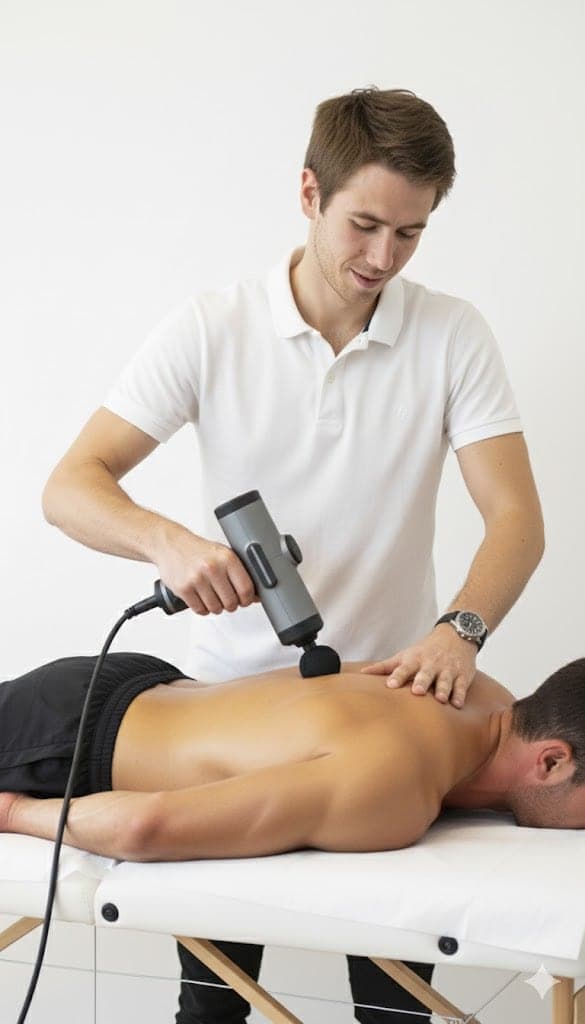
This realization led me to develop my current method, which uses a specialized mechanical tool capable of delivering precision, power, and consistency that manual techniques cannot match. I need to be explicit about why this matters for cyclists specifically seeking stress reduction and improved mental focus.
Depth: Reaching the Fascial Layers That Control Neurological Input
Your fascial system exists in multiple layers. Superficial fascia sits just beneath the skin—this is what most massage affects. Deep fascia surrounds and interpenetrates muscles. Visceral fascia connects to your organs. The deepest fascial structures attach directly to bone and form continuous networks that coordinate movement patterns across your entire body.
In cyclists, the most significant restrictions develop in deep and visceral fascia. The psoas major, for example—your primary hip flexor—originates from the lumbar vertebrae and travels deep within your abdominal cavity before inserting on your femur. When this muscle develops chronic shortening and its fascial envelope becomes restricted, it creates persistent mechanical tension on your lumbar spine and generates constant proprioceptive signaling to your nervous system. No amount of superficial Swedish massage will affect this tissue. Human hands, applied with maximum pressure, cannot consistently reach and release these structures without exhausting the therapist.
The mechanical tool I use can. I can precisely control the depth of penetration, sustaining focused pressure on specific fascial restrictions for the duration necessary to induce mechanical release. This isn’t about applying maximum force; it’s about applying the exact force required for the specific tissue restriction, maintained for the specific duration that tissue requires to yield.
Precision: Targeting Patterns Rather Than Random Areas
Cyclists develop predictable fascial restriction patterns based on biomechanics. If I examine ten experienced cyclists, I’ll find variations in severity, but the fundamental patterns remain consistent. The illiotibial band tightens from repetitive hip flexion and extension. The thoracolumbar fascia develops restrictions from the forward-flexed spine position. The plantar fascia and posterior tibialis restrict from continuous foot plantarflexion on the pedal.
But here’s what matters for mental performance: these restrictions don’t exist in isolation. They’re interconnected through fascial continuities called myofascial meridians or anatomy trains. When I release restriction in your plantar fascia, I’m affecting tension patterns that extend through your posterior chain all the way to your suboccipital muscles—the small muscles at the base of your skull. These suboccipital muscles have extraordinary mechanoreceptor density. When they’re held in chronic tension by fascial restrictions originating in your lower body, they generate disproportionate neurological noise.
This is why cyclists often report that their “neck and shoulders” feel tense, and they assume this comes from handlebar position. Partially true—but the primary driver is often distal fascial restriction creating compensatory tension patterns. When I systematically release the entire posterior chain using precise mechanical intervention, the suboccipital tension resolves as a secondary effect. This produces immediate and dramatic improvements in mental clarity because I’ve reduced the mechanoreceptor input burden to the brain.
Consistency: Eliminating Therapist Variability
I’ll share something most massage therapists won’t admit: human hands have off days. We experience fatigue. Our pressure application varies based on dozens of factors—our own stress level, how many clients we’ve already treated that day, subtle variations in positioning. For a cyclist seeking relaxation massage in Kato Pafos as part of a training program, this variability is unacceptable. You need consistent mechanical input to achieve consistent neurological results.
The mechanical tool eliminates this variability. Every session delivers identical force application when treating identical tissues. This consistency is essential for the cumulative effect I’m pursuing—progressive fascial release that systematically restores neutral tissue positioning and reduces baseline mechanoreceptor signaling. After three to four sessions following my protocol, most cyclists report that their “normal” state feels fundamentally different. They’re not just relaxed after treatment; they’re existing in a different neurological baseline characterized by reduced ambient stress.
The Cyclist’s Mental Performance Protocol: How Systematic Fascial Release Improves Focus
Let me describe what actually happens during treatment and why it produces superior results for mental performance compared to traditional relaxation massage.
Initial Assessment: Mapping Your Specific Restriction Pattern
I travel to your location in Kato Pafos with my professional bench and all necessary equipment. The first session begins with systematic assessment. I’m examining your tissue quality, identifying specific restrictions, and mapping how these restrictions interact to create your unique pattern. For cyclists, I’m particularly focused on:
- Hip flexor length and fascial quality
- Thoracic spine mobility and posterior chain tension
- Respiratory mechanics and diaphragm function
- Suboccipital tension and cranial base mobility
- Lower extremity fascial continuity from foot to hip
This assessment reveals where your nervous system is experiencing the greatest mechanical burden. A competitive cyclist I worked with last season in Cyprus demonstrated severe restriction in his right psoas and corresponding thoracolumbar fascia. He’d attributed his difficulty concentrating during races to “mental weakness.” The reality was that his fascial restrictions were creating continuous nociceptive input—pain signaling—that his conscious mind had learned to suppress, but which still consumed neurological processing capacity.
Progressive Mechanical Release: Working Systematically Through Restriction Layers
Treatment proceeds systematically, not randomly. I begin with more superficial restrictions, preparing tissues for deeper work. This isn’t gentleness for comfort’s sake—though comfort matters—it’s biomechanical necessity. Fascia releases in layers. Attempting to force through superficial restriction to reach deep tissue simply creates protective muscle guarding and yields poor results.
As I work deeper, I’m adjusting the mechanical tool’s intensity precisely to match tissue response. This is where the control becomes critical. With cyclists, I often encounter tissues that initially resist mechanical input, then suddenly yield as the fascial restriction releases. This yield point—the moment when restricted tissue returns to neutral length—produces immediate local and systemic effects.
Locally, blood flow increases dramatically. Mechanoreceptors reset their baseline signaling. The muscle tissue associated with the released fascia can now contract and relax through its full range without mechanical impediment. Systemically, your nervous system registers reduced threat input from that area. This contributes to progressive parasympathetic activation that builds throughout the session.
Respiratory Integration: The Missing Element in Standard Relaxation Massage
Here’s something I’ve learned that distinguishes results-oriented treatment from standard relaxation massage: respiratory mechanics determine your capacity to maintain parasympathetic dominance. Cyclists develop restricted breathing patterns from the forward-flexed riding position. Your diaphragm—the primary respiratory muscle—attaches to your lumbar spine, ribs, and sternum. When surrounding fascia restricts, diaphragm excursion becomes limited. You shift toward accessory respiratory muscles in your neck and upper chest.
This creates a vicious cycle. Accessory respiratory muscle use activates the sympathetic nervous system—it’s part of the stress response. So even when you’re resting, if your breathing mechanics remain compromised, you’re generating low-level sympathetic activation continuously. During my sessions, I specifically address the fascial restrictions limiting diaphragm function. I release the psoas, quadratus lumborum, and intercostal restrictions that prevent full respiratory excursion.
The result is immediately observable. Clients spontaneously breathe more deeply. Their breathing rate decreases. They report feeling “like they can finally take a full breath.” This isn’t psychological; it’s mechanical restoration of respiratory function, which enables sustained parasympathetic activation and produces the profound relaxation and mental clarity cyclists seek.
Results You Can Measure: What Improved Mental Performance Actually Looks Like
I’m results-oriented, so let me be specific about the outcomes cyclists experience when fascial restrictions are systematically addressed rather than temporarily soothed.
Immediate Effects: Post-Session Changes
Immediately following treatment, most cyclists report:
| Neurological Change | Experienced As | Mechanical Cause |
|---|---|---|
| Reduced mechanoreceptor input | “Mental quiet” and reduced racing thoughts | Released fascial restrictions no longer generating excessive proprioceptive signaling |
| Parasympathetic activation | Deep physical and mental relaxation | Decreased sympathetic tone from reduced nociceptive input |
| Improved respiratory mechanics | Feeling of breathing freely and deeply | Released diaphragm and intercostal restrictions |
| Enhanced proprioception | Better body awareness and coordination | Normalized mechanoreceptor signaling providing accurate position information |
These aren’t placebo effects. They’re direct mechanical consequences of specific tissue changes. When I release your psoas, your diaphragm function improves—this is anatomical fact, not subjective experience. When I release posterior chain restrictions, suboccipital tension decreases—this occurs through fascial continuity, not magical thinking.
Cumulative Effects: Multi-Session Protocol Results
Single sessions produce measurable change, but I design treatment as a progressive protocol, not isolated interventions. After three to four sessions addressing your complete restriction pattern, cyclists consistently report:
- Sleeping through the night without waking, and feeling genuinely rested upon waking
- Maintaining focus during long training rides without experiencing mental fatigue
- Making better tactical decisions during group rides and races
- Recovering more quickly between hard training efforts
- Experiencing cycling as enjoyable rather than merely challenging
- Reduced irritability and improved stress tolerance in daily life
These outcomes reflect fundamental changes in your neurological baseline. You’re not learning to “cope with stress better” through massage—you’re reducing the mechanical sources of stress that burden your nervous system. This is the distinction between symptomatic treatment and causal treatment.
Performance Metrics: Quantifiable Improvements
For cyclists who track training data, the improvements become quantifiable. Heart rate variability—a measure of parasympathetic nervous system function—typically improves within two weeks of beginning systematic fascial release work. Resting heart rate often decreases slightly. Perceived exertion during training at identical power outputs decreases, indicating improved mechanical efficiency and reduced neurological burden.
I worked with a masters cyclist preparing for a stage race in the Troodos Mountains. Before treatment, his training data showed declining performance despite increased training volume—a classic sign of accumulating mechanical restriction and neurological burden. After implementing the complete protocol over four weeks, his functional threshold power increased by 8% without additional training stress. The improvement came from removing the mechanical impediments that had been forcing his body to work inefficiently and generating excessive neurological noise.
Why Location Matters: Relaxation Massage for Cyclists in Kato Pafos Specifically
Kato Pafos presents specific conditions that make advanced mechanical massage particularly valuable for cyclists. The combination of year-round riding conditions, challenging terrain, and the international cycling community creates unique demands.
Year-Round Training Stress
Unlike cyclists in northern climates who experience forced off-seasons, those riding in Kato Pafos can train consistently throughout the year. This is advantageous for fitness development but creates cumulative mechanical stress if fascial restrictions aren’t systematically addressed. The mild winters mean you’re never forced into complete rest that would allow passive resolution of tissue restrictions.
I’ve observed that cyclists who relocate to Cyprus for winter training camps often develop acute restriction patterns within three to four weeks if they don’t implement systematic bodywork. The combination of increased training volume, unfamiliar climbing demands, and inadequate recovery protocols creates rapid accumulation of mechanical dysfunction.
Terrain-Specific Demands
The routes around Kato Pafos offer everything from flat coastal rides to substantial climbing. This variety is excellent for comprehensive fitness development but creates diverse mechanical stresses. Climbing generates intense hip flexor and quadriceps work. Descending requires sustained isometric contraction of the posterior chain for bike control. Flat, windy coastal riding demands continuous power output with minimal recovery.
Each of these generates specific fascial restriction patterns. Systematic treatment must address the complete pattern, not just the obviously sore areas. When I work with cyclists based in Kato Pafos, I adjust the protocol based on their typical route selection and training focus.
The Competitive Environment
Kato Pafos attracts serious cyclists—professionals training during the European off-season, competitive age-groupers, and dedicated amateurs pursuing ambitious goals. This creates a competitive training environment where the psychological pressure to perform combines with significant physical training stress. The mental performance aspect of relaxation massage becomes particularly critical in this context.
When you’re training alongside faster riders, attempting to hold wheels on climbs, or preparing for events that represent months of preparation, mental clarity and stress management aren’t luxuries—they’re performance necessities. The mechanical approach I use directly addresses the physiological sources of performance anxiety and mental fatigue that accumulate under competitive training stress.
The Investment Framework: Understanding Value Beyond Hourly Rates
I need to be direct about something the massage industry generally avoids discussing: professional bodywork is an investment in sustainable performance, not an expense for temporary relief. The distinction matters fundamentally for how you approach treatment selection.
The True Cost of Inadequate Treatment
Traditional relaxation massage costs less per session than advanced mechanical work. This appears economically rational until you examine the actual outcome value. If you spend €50 for a massage that provides 48 hours of relief before tension returns to baseline, you’re purchasing temporary symptom suppression. You’ll require regular ongoing sessions indefinitely to maintain even this limited benefit.
If instead you invest €120 per session in systematic mechanical treatment that progressively resolves the causal restrictions over four to six sessions, you’ve purchased lasting improvement. Your baseline changes. The time between required maintenance sessions extends from weekly to monthly to quarterly. The total cost over a training season is lower, and the performance benefit is dramatically higher.
But the real cost of inadequate treatment isn’t financial—it’s the training time and competitive opportunities lost to compromised performance. A cyclist operating under chronic mechanical restriction and neurological burden isn’t just uncomfortable; they’re training less effectively, recovering more slowly, and competing below their potential. The accumulated cost over a season or career is enormous.
What You’re Actually Purchasing
When you engage my services in Kato Pafos, you’re not purchasing relaxation massage by the hour. You’re investing in:
- Systematic assessment of your specific mechanical restriction pattern
- Progressive treatment protocol designed to resolve causal dysfunction
- Expertise developed over a decade of specialization in advanced bodywork
- Mechanical intervention capability that exceeds what manual techniques can deliver
- Ongoing monitoring and protocol adjustment based on your response
- Knowledge transfer so you understand your body’s mechanical requirements
This is a partnership approach. I’m not providing a service you consume passively; I’m working with you to optimize your mechanical function for the specific demands of your cycling goals. The relationship extends beyond individual sessions to comprehensive support for your training program.
Common Questions From Cyclists Seeking Advanced Bodywork
How is this different from sports massage I’ve received before?
Sports massage typically focuses on increasing blood flow to muscles and providing temporary relief from acute soreness. It’s applied relatively superficially and aims to facilitate recovery between training sessions. The mechanical approach I use targets fascial restrictions in deep tissue layers, working systematically to resolve chronic dysfunction rather than managing acute symptoms. The treatment depth, precision, and systematic progression distinguish it completely from standard sports massage techniques.
Will the treatment be painful?
Discomfort during deep tissue work is common and indicates we’re reaching restricted tissue. However, I distinguish carefully between therapeutic discomfort—the sensation of restricted fascia being released—and pain that indicates tissue damage or protective guarding. You maintain communication throughout treatment, and I adjust intensity continuously to stay within therapeutic ranges. Most clients describe the sensation as “intense but satisfying” rather than painful. The relief following restriction release is immediate and unmistakable.
How many sessions will I need?
Initial assessment typically reveals the restriction pattern severity. Most cyclists benefit from an initial series of four sessions over two to three weeks, addressing different components of their restriction pattern systematically. After this foundation, maintenance frequency depends on training volume and intensity. Competitive cyclists training 15+ hours weekly often schedule sessions every two to three weeks during heavy training blocks. Recreational riders might need monthly sessions. The goal is progressive improvement toward mechanical optimization, not dependency on frequent treatment.
Can I continue training between sessions?
Yes, and you should. Light to moderate training between sessions helps tissues integrate the mechanical changes from treatment. I typically recommend reducing training intensity for 24 hours post-session to allow optimal tissue response, but normal training resumes after that. Many cyclists report that training feels markedly different after treatment—pedaling feels smoother, power delivery more efficient, recovery faster. These changes indicate improved mechanical function that enhances training quality.
Do you only work with competitive cyclists?
No. The mechanical principles apply to anyone experiencing fascial restriction and neurological burden from cycling, regardless of competitive level. Recreational cyclists pursuing personal goals, touring cyclists managing long-distance demands, indoor cyclists training intensively—all develop restriction patterns that benefit from systematic treatment. The protocol adjusts to your specific pattern and goals, not to your competitive category.
Why do you travel to clients rather than working from a fixed location?
Convenience is part of the value I provide. Cyclists in Kato Pafos often maintain demanding training schedules and don’t want to spend additional time traveling to appointments. By bringing professional equipment to your location, I eliminate this friction. You can receive treatment in your accommodation, then rest appropriately afterward without additional logistics. For visiting cyclists on training camps, this is particularly valuable—you maintain focus on training without disrupting your schedule for bodywork appointments.
What should I expect to feel after the first session?
Most cyclists experience profound relaxation immediately following treatment—this reflects parasympathetic activation from reduced mechanoreceptor input. You may feel slightly fatigued for several hours as your nervous system adjusts to the changed mechanical environment. By the following day, most report feeling “lighter,” with improved range of motion and reduced ambient tension. Mental clarity typically improves noticeably—you’ll likely sleep better that night and wake feeling more refreshed than usual. Some temporary soreness in treated areas is normal as tissues adapt; this typically resolves within 24-48 hours.
How do I know if I need this type of work versus standard massage?
If you’ve received regular massage that provides temporary relief but doesn’t produce lasting change in your baseline tension levels, you likely have chronic fascial restrictions requiring deeper mechanical intervention. If you experience mental fatigue, difficulty concentrating during rides, disrupted sleep despite physical exhaustion, or persistent tension that doesn’t resolve with rest and standard recovery methods, these indicate neurological burden from mechanical dysfunction. If your performance has plateaued despite consistent training, or you’re experiencing recurring pain patterns that conventional treatment hasn’t resolved, systematic fascial release is likely necessary.
The Practitioner Background: Why My Approach Differs
I need to explain why my method differs fundamentally from what most massage therapists provide, because understanding this distinction helps you make informed treatment decisions.
My Bachelor’s degree in Physical Education and Nutrition provided comprehensive education in biomechanics, physiology, and human performance. This academic foundation shapes how I conceptualize treatment. I don’t think about massage as applying techniques to make clients feel better temporarily. I think about mechanical dysfunction as a solvable engineering problem—identifying the specific restrictions compromising function, determining the precise mechanical interventions needed to resolve them, and implementing a systematic protocol that produces measurable, lasting results.
Over ten years of professional practice, I’ve specialized exclusively in this mechanical approach. I’ve deliberately narrowed my focus rather than offering the broad menu of services typical in the massage industry. This specialization has enabled me to refine assessment precision, treatment protocols, and outcome measurement far beyond what generalist practice allows.
The specialized mechanical tool I use represents a commitment to results over tradition. The massage industry resists mechanical intervention tools, preferring to emphasize the “healing power of human touch.” This sounds appealing but ignores biomechanical reality. Human hands have limitations. They fatigue. They cannot sustain the precise forces necessary to release deep fascial restrictions without exhausting the therapist. They introduce variability that compromises treatment consistency.
I use the tool because it delivers superior results. This is the only criterion that matters to me professionally. When I can provide deeper, more precise, more consistent mechanical intervention that produces better outcomes for clients, the fact that it challenges massage industry norms is irrelevant. You’re not paying me to conform to industry expectations; you’re investing in results.
Beginning the Protocol: Next Steps for Cyclists in Kato Pafos
If you’re a cyclist in Kato Pafos experiencing mental fatigue, stress accumulation, or performance limitations despite adequate training, the mechanical approach I’ve described offers systematic resolution rather than temporary relief.
The first step is honest self-assessment. Are you experiencing genuine mechanical dysfunction—persistent tension, sleep disruption, mental fog, performance plateau—or simply normal training fatigue that resolves with rest? If symptoms persist despite adequate recovery time, or if you’ve tried conventional massage without lasting improvement, you’re likely dealing with chronic fascial restriction requiring systematic intervention.
Initial consultation involves detailed discussion of your training demands, restriction symptoms, previous treatment attempts, and performance goals. This conversation helps me understand your specific pattern and design an appropriate protocol. Assessment during the first session reveals the mechanical reality of your restrictions and guides treatment progression.
The commitment required is straightforward: participate in the initial four-session protocol over two to three weeks, maintain communication about how you’re responding, and follow the modified training guidelines during this foundation period. This relatively brief initial investment establishes whether the mechanical approach addresses your specific dysfunction pattern effectively.
Most cyclists know intuitively whether their current state represents optimal function. If you’re not sleeping well, if training feels harder than it should, if you’re mentally fatigued disproportionate to physical training load, if recovery takes longer than it did previously—these signals indicate mechanical dysfunction burdening your nervous system. The question isn’t whether treatment might help; it’s whether you’re willing to invest in systematic resolution rather than continuing to manage symptoms inadequately.
Final Perspective: Relaxation as Performance Optimization
I’ll close with the perspective that guides my practice: genuine relaxation for cyclists isn’t about feeling calm temporarily. It’s about removing the mechanical sources of neurological burden so your nervous system can function optimally under training and competitive stress.
When your fascia is systematically unrestricted, when mechanoreceptors are generating appropriate rather than excessive signaling, when your respiratory mechanics function efficiently, when your baseline neurological state reflects parasympathetic dominance rather than chronic sympathetic activation—this creates the foundation for peak mental performance. You can focus completely during technical descents because your brain isn’t allocating processing capacity to managing mechanical dysfunction. You can make sound tactical decisions late in races because mental fatigue doesn’t compound physical effort. You can sustain motivation through demanding training blocks because you’re sleeping well and recovering effectively.
This is what relaxation massage for cyclists in Kato Pafos should deliver: not temporary relief from tension, but systematic optimization of the mechanical factors that determine your neurological function and mental performance. It’s the difference between treating symptoms and resolving causes. Between purchasing temporary comfort and investing in lasting improvement. Between accepting limitation and pursuing your actual potential.
The mechanical approach I’ve described represents a fundamentally different paradigm than traditional massage. It requires different tools, different expertise, different time investment, and different financial commitment. It also produces fundamentally different results—the kind that compound over seasons and careers rather than dissipating within days.
For cyclists serious about performance optimization, this distinction makes the decision straightforward. You can continue managing symptoms inadequately with conventional approaches, or you can systematically resolve the mechanical dysfunction limiting your potential. The choice reflects how seriously you take your cycling and your willingness to invest appropriately in the body that makes it possible.
Written by
Chris
Massage therapist & body mechanics specialist
Norwegian-certified with a Bachelor’s in Physical Education and Nutrition and over ten years of clinical practice, working from a portable table in clients’ homes across the Paphos district.
This article is general information from clinical practice, not a medical diagnosis. If you have severe, worsening or unexplained pain, numbness, weakness, or pain after an accident, see a doctor first.