
Massage Therapy for Stress Relief Emba: Advanced Mechanical Deep-Tissue Solutions
In short
Discover how specialized massage therapy in Emba addresses stress at its mechanical root through advanced deep-tissue techniques, delivering lasting relief beyond temporary relaxation.
I see it every week in Emba. A high-performing professional walks into my treatment space carrying tension so deeply embedded in their shoulders and neck that it has become their new normal. They’ve tried yoga. They’ve tried meditation apps. They’ve had countless “relaxing” spa massages. Yet the stress remains, manifesting as chronic muscular tension, restricted movement, and diminished performance in every aspect of their lives.
This is because most people fundamentally misunderstand what stress relief actually requires from a mechanical perspective. Stress doesn’t just live in your mind—it creates measurable, physical adaptations in your fascial tissue, your muscular architecture, and your entire kinetic chain. After a decade specializing in body mechanics with a degree in Physical Education and Nutrition from Norway, I’ve learned that authentic stress relief demands precision intervention at the tissue level, not surface-level relaxation.
Massage therapy for stress relief in Emba should represent more than temporary comfort. When approached with clinical rigor and mechanical expertise, it becomes a systematic intervention that addresses the physiological manifestations of chronic stress, restoring optimal function and fundamentally improving how your body responds to daily demands.
Understanding Stress from a Mechanical Perspective
The relationship between psychological stress and physical tension represents a bidirectional pathway that most practitioners fail to address comprehensively. When your sympathetic nervous system activates in response to deadlines, financial pressure, or relationship challenges, your body initiates a cascade of physiological responses. Cortisol levels elevate. Blood flow redistributes. Most significantly for our purposes, your musculature enters a state of sustained contraction.
I’ve treated executives in Emba who maintain shoulder elevation 3-4 centimeters above anatomical neutral without conscious awareness. Their trapezius muscles have adapted to chronic loading patterns, creating trigger points, fascial adhesions, and compensatory movement strategies that perpetuate the stress cycle even when the original psychological stressor has resolved.
This is where conventional approaches fail. A sixty-minute Swedish massage might temporarily reduce subjective stress perception, but it does nothing to address the architectural changes in your soft tissue. The fascial restrictions remain. The trigger points persist. Within 48 hours, you’re back to baseline tension levels, wondering why the benefits were so fleeting.
The Physiological Markers of Chronic Stress
When I assess new clients in Emba, I’m looking for specific indicators that reveal the true extent of stress-induced tissue adaptation:
- Restricted thoracic spine mobility limiting respiratory efficiency
- Hypertonic cervical musculature creating forward head posture
- Fascial adhesions in the shoulder girdle restricting scapular movement
- Trigger point networks in the paraspinal muscles referring pain to seemingly unrelated areas
- Decreased tissue pliability indicating chronic inflammation and poor recovery capacity
These aren’t subjective observations. They’re measurable dysfunction that requires targeted mechanical intervention. I recently worked with a financial consultant whose chronic stress had created such severe restriction in his pectoralis minor that his shoulder internal rotation was limited by 35 degrees compared to normative values. He’d been treating his “stress” with mindfulness meditation—which has value—but his body needed mechanical liberation first.
Why Traditional Massage Fails for Genuine Stress Relief
I need to be direct about this because I see too many people in Emba investing time and money into approaches that cannot possibly deliver lasting results. The standard massage industry operates on a fundamentally flawed model when it comes to stress relief.
A therapist using manual techniques faces inherent limitations. Human hands fatigue. Pressure application becomes inconsistent. Most critically, even the strongest practitioner cannot access the deeper fascial layers where chronic stress-induced tension truly resides. They work the superficial tissue, create temporary parasympathetic activation, and send you home feeling relaxed but mechanically unchanged.
I spent my first three years in this profession using traditional manual techniques. I was good at it. Clients would fall asleep on the table. They’d leave feeling wonderful. Then they’d return three days later with the same patterns, the same restrictions, the same complaints. The work wasn’t addressing causation—it was managing symptoms.
The Consistency Problem
Beyond depth limitations, manual therapy introduces a variable that undermines systematic progress: human inconsistency. Your therapist has good days and challenging days. Their energy levels fluctuate. One session might deliver 8 kilograms of pressure to that stubborn trigger point in your levator scapulae; the next session only reaches 5 kilograms because they’re fatigued from previous appointments.
This variability prevents the progressive overload necessary for genuine tissue remodeling. Lasting stress relief requires consistent, targeted pressure that systematically breaks down adhesions, restores fascial glide, and resets your neuromuscular patterns. Manual techniques simply cannot provide this level of precision repeatedly.
Advanced Mechanical Deep-Tissue Massage: A Superior Approach
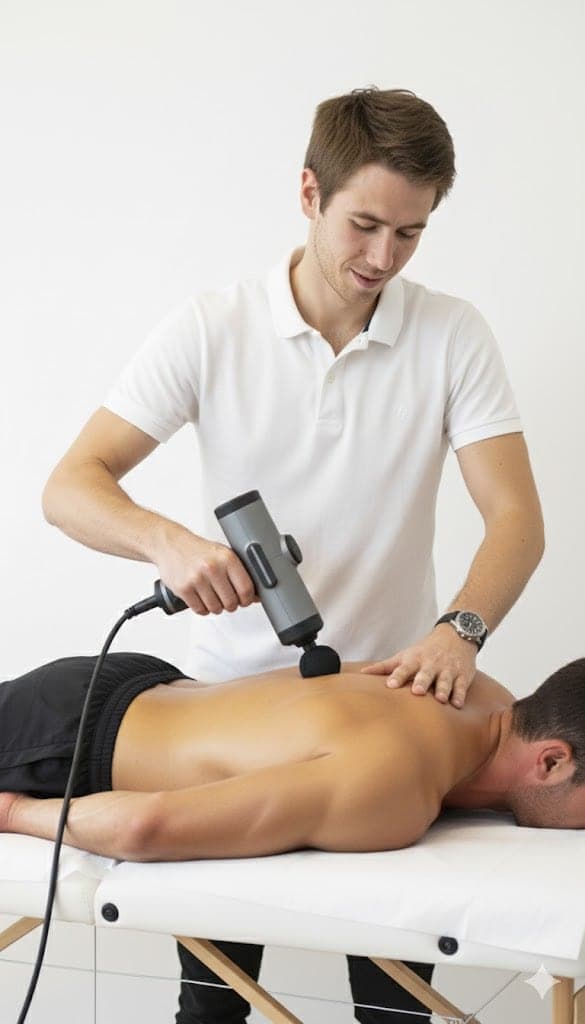
My methodology represents a complete departure from conventional massage therapy for stress relief in Emba. I use a specialized mechanical device that delivers precision, power, and consistency that human hands cannot replicate. This isn’t a massage gun you can buy online—it’s a professional-grade tool that allows me to work with clinical exactitude at depths and intensities matched precisely to your tissue’s needs.
The machine permits me to access the deep fascial layers where chronic stress creates lasting architectural changes. I can maintain consistent pressure for extended periods, systematically working through restrictive tissue without the fatigue limitations that compromise manual techniques. More importantly, I can precisely calibrate intensity based on real-time tissue response, ensuring optimal therapeutic effect while maintaining complete safety.
When I work with a stressed executive in Emba, I’m not trying to help them “relax”—I’m systematically restoring mechanical function to tissues that have adapted to months or years of sustained tension. This requires power, precision, and time working at depths where real change occurs.
How the Mechanical Advantage Translates to Results
Let me explain what this means practically. When addressing the upper trapezius tension pattern common in chronically stressed individuals, manual pressure might reach the superficial and middle muscle layers. My specialized equipment accesses the deeper attachments, the fascial interfaces between muscle groups, and the trigger point complexes that refer pain throughout the shoulder and neck region.
I control every variable: penetration depth, pressure application angle, treatment duration for specific points, and the progressive intensity curve as tissue releases. This level of control means each session builds systematically on the previous one. We’re not starting over each time—we’re progressively remodeling your tissue architecture toward optimal function.
| Treatment Aspect | Traditional Manual Massage | Advanced Mechanical Deep-Tissue |
|---|---|---|
| Maximum Working Depth | Superficial to middle tissue layers | Deep fascial planes and attachments |
| Pressure Consistency | Variable (therapist fatigue) | Precisely controlled and sustained |
| Treatment Focus | General relaxation | Specific mechanical dysfunction |
| Result Duration | 24-72 hours | Progressive, cumulative improvement |
| Tissue Remodeling | Minimal | Systematic architectural change |
The Treatment Process: What to Expect
When you work with me for massage therapy for stress relief in Emba, you’re entering a partnership focused on lasting results, not temporary symptom management. I travel to your location with a professional treatment bench and everything required to deliver clinical-grade intervention in the comfort of your space.
The initial assessment takes approximately thirty minutes. I evaluate your movement patterns, identify restriction areas, test tissue quality, and map the mechanical manifestations of your stress. A businessman I worked with last month was convinced his stress was “all mental,” but his assessment revealed severe restrictions in his hip flexors, thoracic spine, and shoulder complex—all creating compensatory patterns that perpetuated his stress response.
Based on this assessment, I design a customized treatment protocol. This isn’t a standardized routine applied to everyone. Your tissue has unique adaptation patterns based on your stress history, occupational demands, and movement habits. The protocol addresses your specific mechanical dysfunctions with targeted interventions.
Progressive Treatment Sessions
Each session typically runs 60-90 minutes, though initial treatments often require additional time to address accumulated restrictions properly. I work systematically through priority areas, using the mechanical advantage of my equipment to access deep tissue structures while monitoring your response continuously.
The intensity is substantial—this is clinical work, not spa treatment. However, I maintain complete control throughout. We can adjust from light pressure for sensitive areas to powerfully deep work for dense athletic tissue. The beauty of the mechanical approach is this precision; I’m never guessing at pressure levels or hoping my hands can deliver what your tissue requires.
Clients in Emba consistently report that the first 24-48 hours post-treatment feel different from anything they’ve experienced with conventional massage. There’s often some muscle soreness—evidence of genuine tissue work—but accompanied by a noticeable reduction in chronic tension patterns. Your body has been holding these stress patterns for months or years; releasing them creates both immediate relief and an adjustment period as your system recalibrates.
Beyond Symptom Management: Addressing Root Causes
The fundamental principle distinguishing my approach from conventional massage therapy for stress relief in Emba is this: I treat causes, not symptoms. When you experience shoulder tension from stress, the tension itself isn’t the problem—it’s a symptom of deeper mechanical dysfunction.
Perhaps your thoracic spine mobility is restricted from hours at a desk, forcing your shoulder girdle to compensate. Maybe old injuries created movement limitations that your body adapted to, increasing baseline muscular tension. Possibly your breathing mechanics are compromised, preventing the natural parasympathetic activation that occurs with proper diaphragmatic function.
These root causes persist regardless of how relaxed you feel after a standard massage. They continue generating the symptoms you’re trying to escape. My methodology involves identifying these causative factors through thorough assessment, then systematically addressing them with targeted mechanical intervention.
The Investment Perspective
I position this work as an investment in your long-term health and performance, not an expense for temporary relief. The distinction matters. When you invest in systematic tissue remodeling and mechanical optimization, you’re building lasting capacity for stress resilience. Your body functions better. Your movement quality improves. Your pain decreases durably.
A client I’ve worked with for six months—a healthcare professional experiencing severe stress-related tension—initially questioned the investment. She’d been spending similar amounts monthly on various relaxation services that provided brief relief. After our third session, her chronic headaches reduced by 70%. By month four, they were essentially eliminated. Now she maintains with monthly optimization sessions, but the debilitating daily tension that had defined her life for years is simply gone.
That’s not an expense—it’s one of the most valuable investments she’s made in her quality of life.
Stress Relief and Performance Enhancement
An underappreciated aspect of proper stress management is the performance enhancement that accompanies genuine tissue optimization. When your body isn’t constantly fighting against restriction, adhesions, and chronic tension, you have substantially more capacity for everything else.
I work with athletes in Emba who initially seek massage therapy for stress relief but discover that addressing their mechanical restrictions transforms their training capacity. When we eliminate the compensatory patterns created by stress-induced tension, their bodies move more efficiently. Recovery improves. Performance metrics increase.
This applies equally to non-athletic performance. Executives report better focus when they’re not unconsciously managing chronic neck tension throughout meetings. Parents describe more patience with their children when they’re not depleted by the constant energy drain of fighting against their own restricted tissue.
The Neurological Component
Beyond the direct mechanical benefits, deep tissue work influences your nervous system’s stress response patterns. Chronic muscular tension maintains sympathetic nervous system activation—your body interprets the physical tension as evidence that threats persist, keeping you in a state of sustained alertness.
When we systematically reduce this mechanical tension, we interrupt that feedback loop. Your nervous system receives new information: the threat has passed, sustained high alert is unnecessary. This isn’t achieved through a single relaxing massage—it requires progressive reduction of the physical tension patterns until your baseline state shifts.
I’ve measured this shift in clients through observable markers: decreased resting heart rate, improved heart rate variability, better sleep quality, and reduced requirement for stress management medications. These aren’t subjective improvements—they’re measurable changes in physiological function.
Customized Treatment Plans for Lasting Results
The path to genuine stress relief through massage therapy in Emba requires customization based on your unique presentation. I don’t offer standardized packages or one-size-fits-all protocols. After comprehensive assessment, I design a treatment plan that addresses your specific mechanical dysfunctions, respects your schedule and recovery capacity, and progresses systematically toward lasting improvement.
For someone with acute stress-related tension, we might begin with twice-weekly sessions for three weeks, systematically working through accumulated restrictions. As your tissue responds and remodels, we space treatments to weekly, then bi-weekly, eventually transitioning to monthly maintenance once optimal function is restored.
An entrepreneur I worked with needed intensive intervention initially—her stress levels and corresponding tissue restrictions were severe. We did eight sessions in four weeks, each progressively deeper as her tissue adapted. By week five, her baseline tension had decreased dramatically. We shifted to weekly sessions, then moved to monthly optimization. She now maintains excellent mechanical function with minimal intervention, having built genuine stress resilience at the tissue level.
The Partnership Approach
This work succeeds when approached as a dedicated partnership rather than a transactional service exchange. I’m invested in your long-term results. Between sessions, I provide guidance on movement practices, positioning strategies, and self-care approaches that support the tissue remodeling we’re achieving through treatment.
You’re not just receiving massage therapy for stress relief in Emba—you’re gaining a specialist focused on optimizing your body’s mechanical function for sustainable high performance and quality of life. I bring a decade of experience and university-level education in body mechanics to every session. You bring commitment to the process and trust in a methodology that works deeper than conventional approaches.
Frequently Asked Questions
How is this different from regular deep tissue massage available at spas?
The difference is fundamental, not incremental. Spa-based deep tissue massage uses manual techniques that cannot access the fascial depths where chronic stress creates lasting restriction. My specialized mechanical approach delivers precisely controlled pressure at depths that hands cannot reach, while maintaining consistency that manual work cannot provide. Additionally, I’m working from a clinical perspective focused on lasting mechanical correction, not temporary relaxation.
Will the treatment be painful?
You’ll experience significant sensation during treatment—this is clinical work addressing deep tissue restrictions, not light relaxation massage. However, there’s a crucial distinction between productive therapeutic discomfort and counterproductive pain. I maintain complete control over intensity, adjusting constantly based on your tissue’s response. Many clients describe it as “intense but satisfying,” and the relief that follows confirms the value of working at appropriate depths.
How quickly will I see results for stress-related tension?
Most clients notice measurable reduction in chronic tension patterns within 48 hours of their first session. However, lasting results require progressive treatment. Tissue that has adapted to months or years of stress doesn’t durably remodel from a single intervention. Typically, significant sustained improvement becomes apparent after 4-6 sessions, with optimization continuing over 3-4 months depending on your starting condition.
Do you only treat stress, or can this help with chronic pain?
The mechanical dysfunctions created by chronic stress are often indistinguishable from those causing chronic pain—they’re frequently the same underlying restrictions and adhesions. My methodology addresses the root mechanical causes whether you’re experiencing them as “stress tension” or “chronic pain.” The distinction is primarily in how you label the symptoms; the treatment approach focuses on restoring optimal tissue function regardless.
How often do I need treatment sessions?
Treatment frequency is customized based on your tissue condition and goals. Initially, most clients benefit from 1-2 sessions weekly to create momentum in tissue remodeling. As your body responds, we space sessions progressively further apart. Once optimal function is restored, many clients maintain with monthly sessions, though some prefer more or less frequent maintenance depending on their stress levels and physical demands.
Why do you travel to clients instead of having a fixed location?
I’ve found that stressed professionals in Emba benefit significantly from treatment in their own space. It eliminates travel time, reduces logistical stress, and allows you to rest immediately post-treatment without navigating traffic. I bring a professional treatment bench and all necessary equipment, creating a clinical environment wherever is most convenient for you. This approach aligns with my philosophy of removing barriers to your optimal health.
Can this help with stress-related sleep problems?
Absolutely. Poor sleep quality often results from sustained muscular tension preventing your nervous system from downregulating properly. When we systematically reduce the mechanical tension patterns throughout your body—particularly in the neck, shoulders, and back—your nervous system receives clear signals that it’s safe to enter recovery states. Clients consistently report substantially improved sleep quality as their tissue restrictions resolve.
What makes you qualified to provide this specialized treatment?
I hold a Bachelor’s degree in Physical Education and Nutrition from Norway and have ten years of professional experience specializing in body mechanics. I’m not a general massage therapist who occasionally does deep work—this advanced mechanical approach is my exclusive focus. My education in movement science, combined with a decade of clinical experience and ongoing specialization in mechanical tissue intervention, positions me to deliver results that conventional massage cannot approach.
Taking the Next Step Toward Lasting Relief
If you’re experiencing stress-related tension in Emba and you’re tired of temporary solutions that fail to address the underlying mechanical dysfunction, you now understand why conventional massage hasn’t provided lasting results. The tissue adaptations created by chronic stress require systematic intervention at depths and with precision that only specialized mechanical approaches can deliver.
I work with professionals, athletes, and individuals who are ready to invest in lasting improvement rather than ongoing symptom management. The process requires commitment—tissue remodeling doesn’t happen instantly—but the results represent genuine transformation in how your body functions and how you experience daily life.
The difference between managing stress symptoms and resolving the mechanical manifestations of stress determines whether you spend years cycling through temporary relief or build lasting resilience that fundamentally improves your quality of life. I’ve dedicated my career to providing the latter through advanced mechanical deep-tissue methodology that treats causes, not symptoms.
Your body has adapted to stress by creating specific, measurable restrictions in your soft tissue architecture. Those restrictions perpetuate your stress response, limit your performance, and diminish your quality of life. They won’t resolve through meditation apps or relaxation massages, regardless of how frequently you receive them. They require targeted mechanical intervention delivered with clinical precision—exactly what my specialized approach provides.
Written by
Chris
Massage therapist & body mechanics specialist
Norwegian-certified with a Bachelor’s in Physical Education and Nutrition and over ten years of clinical practice, working from a portable table in clients’ homes across the Paphos district.
This article is general information from clinical practice, not a medical diagnosis. If you have severe, worsening or unexplained pain, numbness, weakness, or pain after an accident, see a doctor first.