
Deep Tissue Massage for Athletes Chlorakas: Advanced Mechanical Treatment for Peak Performance
In short
Discover how specialized deep tissue massage for athletes in Chlorakas delivers lasting pain relief and enhanced performance through precision mechanical treatment—backed by 10 years of expertise and clinical methodology.
I’ll never forget the professional cyclist who came to me three years ago in Chlorakas. He’d been living with chronic IT band syndrome for eighteen months, spending thousands on traditional massage therapists who promised relief but delivered only temporary comfort. Within four sessions using my specialized mechanical deep-tissue approach, we eliminated the root cause of his pain. He’s now competing at national level again. That’s not luck—that’s understanding biomechanics and applying the right methodology with the right tools.
Most athletes in Chlorakas operate under a fundamental misconception: they believe muscle tension and pain are inevitable parts of training. They’re not. What’s inevitable is inadequate treatment when you rely on methods that address symptoms rather than underlying mechanical dysfunction. After a decade of treating athletes—from weekend warriors to competitive professionals—I can state this with complete certainty: deep tissue massage for athletes in Chlorakas requires precision, power, and consistency that human hands simply cannot maintain.
Why Athletes in Chlorakas Need Specialized Deep Tissue Massage
The athletic community in Chlorakas faces unique challenges. Whether you’re training in the Mediterranean heat, cycling the coastal routes, or preparing for competitive events, your musculature undergoes specific stress patterns that accumulate over time. I’ve treated runners whose hip flexors were so chronically shortened from repetitive motion that their gait mechanics had fundamentally changed. I’ve worked with swimmers whose scapular stabilizers had developed compensatory tension patterns that were limiting their stroke efficiency by nearly fifteen percent.
These aren’t issues you address with relaxation massage. These require clinical intervention.
My background in Physical Education and Nutrition from Norway taught me to view the human body as an integrated mechanical system. Every muscle, every fascial layer, every connective tissue structure exists in relationship with others. When one component develops chronic tension or adhesions, the entire system adapts—usually in ways that create secondary problems. This is why athletes often experience pain in areas distant from the actual source of dysfunction.
The Biomechanical Reality of Athletic Tension
Let me explain what actually happens in your tissues during repetitive athletic movement. When muscles contract repeatedly under load, metabolic byproducts accumulate in the tissue. Simultaneously, microtrauma creates inflammatory responses that, if not properly addressed, lead to fascial adhesions. These adhesions are literal bonds between tissue layers that should glide smoothly across each other.
Traditional massage attempts to address these adhesions through manual pressure. The problem? Human hands fatigue. Pressure becomes inconsistent. Depth becomes limited by the therapist’s physical capacity and their need to protect their own joints. I’ve seen it repeatedly: therapists start strong but fade after twenty minutes, leaving deeper adhesions completely untouched.
My Specialized Mechanical Approach to Deep Tissue Massage for Athletes
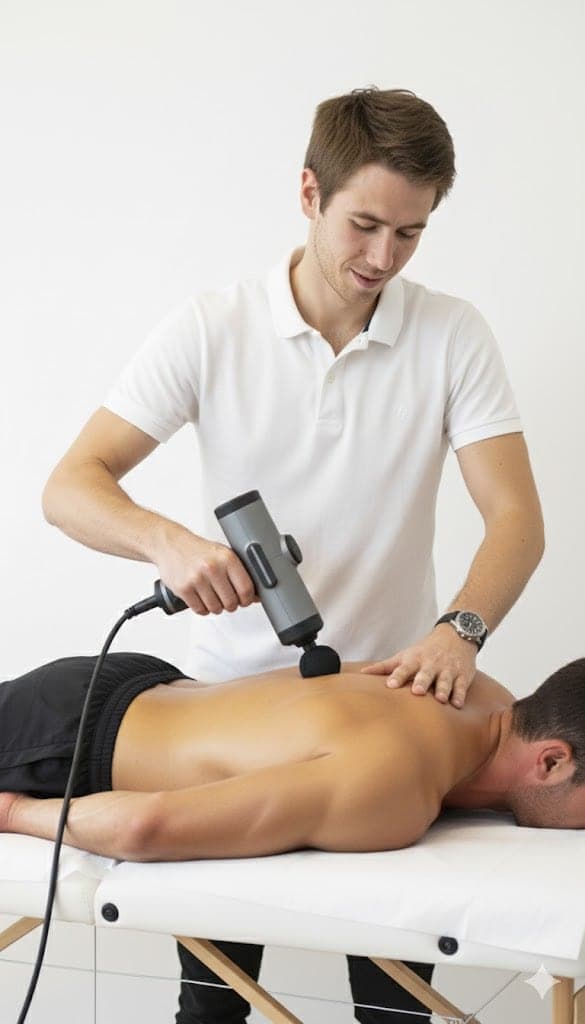
I made a deliberate choice five years ago to transition exclusively to mechanical deep-tissue treatment. This wasn’t about convenience—it was about results. After treating hundreds of athletes with traditional methods and seeing limited long-term outcomes, I researched and invested in a specialized machine that fundamentally changed what I could achieve.
This tool delivers three capabilities that hands cannot match:
Precision: The mechanical head can target specific tissue layers with millimeter accuracy. When I’m treating a runner’s tibialis anterior, I can work between the muscle belly and the periosteum with control that allows me to release adhesions without causing unnecessary tissue trauma.
Power: The machine generates consistent force that reaches depths simply impossible with manual pressure. I’ve released psoas tension in athletes where five previous therapists had failed, not because they lacked knowledge, but because they lacked the physical capability to reach the source.
Consistency: Every treatment delivers identical quality. I don’t have “off days.” Your tissue receives the exact pressure and technique it needs, whether it’s your first session or your fifteenth.
How the Treatment Process Actually Works
When an athlete contacts me in Chlorakas, we begin with a comprehensive biomechanical assessment. I don’t ask, “Where does it hurt?” I ask, “What movements feel restricted? When did your performance plateau? What compensatory patterns have you noticed in your training?”
I travel to your location with a professional treatment bench and everything required for clinical-grade therapy. This isn’t a convenience service—it’s a strategic decision. Athletes perform better when treatment happens in their environment, without the stress of travel post-session.
Here’s what a typical deep tissue massage session for athletes in Chlorakas involves:
- Movement Assessment: I observe your functional movement patterns to identify asymmetries and compensations.
- Tissue Palpation: I manually assess tissue quality, identifying areas of hypertonicity, adhesions, and restricted fascial glide.
- Targeted Mechanical Treatment: Using the specialized machine, I systematically address identified dysfunctions, working from superficial to deep tissue layers.
- Reassessment: We test the movements that were previously restricted to verify immediate improvements.
- Corrective Strategy: I provide specific guidance on movement patterns and self-care between sessions.
The intensity adjusts precisely to your tissue tolerance and therapeutic needs. For a recreational tennis player dealing with lateral epicondylitis, we might work at moderate depth focusing on forearm extensors. For a competitive CrossFit athlete with chronic thoracic restriction, I’ll work significantly deeper into the erector spinae and multifidus muscles.
Common Athletic Conditions I Address in Chlorakas
Over ten years, I’ve developed specialized protocols for conditions that plague athletes consistently. These aren’t generic approaches—they’re specific treatment sequences based on biomechanical principles and clinical outcomes.
| Condition | Root Cause | Traditional Approach Limitation | My Mechanical Protocol |
|---|---|---|---|
| Chronic IT Band Syndrome | TFL and glute medius dysfunction creating lateral knee tracking issues | Cannot reach deep hip stabilizers adequately | Deep TFL release, glute medius activation, VMO reintegration sequence |
| Plantar Fasciitis | Shortened posterior chain from calf through plantar fascia | Superficial foot work that ignores kinetic chain | Deep gastrocnemius/soleus release, tibialis posterior work, fascial continuity restoration |
| Rotator Cuff Impingement | Scapular dyskinesis and anterior shoulder tightness | Focuses on symptomatic area, misses scapular mechanics | Subscapularis release, serratus anterior activation, thoracic mobility restoration |
| Lower Back Pain | Hip flexor dominance creating anterior pelvic tilt | Treats lumbar muscles while ignoring hip mechanics | Deep psoas release, QL normalization, posterior chain rebalancing |
The IT Band Syndrome Case Study
Let me detail that cyclist I mentioned earlier. When he arrived, he’d been diagnosed with IT band syndrome by three different practitioners. Everyone treated his IT band directly—foam rolling, manual stripping, even dry needling. Temporary relief, then the pain returned within days.
I assessed his movement and immediately identified the actual problem: his tensor fasciae latae was chronically hypertonic, pulling constantly on the IT band, while his glute medius had essentially stopped firing properly. His knee pain was a symptom of hip dysfunction.
We didn’t treat his knee at all in the first session. I used the mechanical tool to release his TFL at depths that allowed the muscle to finally lengthen properly. Then we addressed his glute medius, breaking up adhesions that had formed from months of compensatory patterns. Finally, we worked his vastus medialis oblique to restore proper patellar tracking.
He walked out of that first session with fifty percent less pain. By session four, the pain was completely gone. Six months later, he reported it had never returned.
Why Deep Tissue Massage for Athletes Chlorakas Requires a Different Methodology
I challenge you to find another practitioner in Chlorakas who approaches athletic treatment with the same clinical rigor. Most massage therapists—even those claiming to specialize in sports massage—apply general techniques they learned in certification courses. They lack the biomechanical education to understand why tension exists in specific patterns. They lack the tools to address root causes at adequate depth.
This matters enormously for your results.
When I treat a runner’s hamstring, I’m not just “loosening tight muscles.” I’m assessing whether the tension originates from inadequate hip extension mobility forcing the hamstrings into constant eccentric overload. I’m determining if sciatic nerve mobility is restricted, creating protective muscle guarding. I’m evaluating if the posterior chain is compensating for weak glutes or insufficient ankle dorsiflexion.
Then I apply the mechanical treatment to the specific structures causing the dysfunction—at the exact depth required, with the precise pressure needed, for the appropriate duration to create lasting change.
The Investment vs. Expense Paradigm
Athletes in Chlorakas frequently contact me after spending months on cheaper alternatives. They’ve bought massage guns. They’ve attended group stretching classes. They’ve received weekly relaxation massages. None of it produced lasting results.
Here’s what I tell them: You can spend money repeatedly treating symptoms, or you can invest in eliminating the cause. My approach costs more per session because it delivers disproportionately more value. We’re not buying an hour of pleasant sensation—we’re purchasing lasting biomechanical correction.
I had a triathlete recently calculate what she’d spent over two years on various treatments for chronic calf tightness. The number exceeded two thousand euros. We resolved her issue completely in six sessions over two months. She’s now competing pain-free and has improved her running split by four minutes.
That’s the difference between expense and investment.
The Science Behind Mechanical Deep Tissue Treatment Effectiveness
My Bachelor’s degree in Physical Education and Nutrition provided me with the scientific foundation to understand tissue adaptation and biomechanics. Let me share what actually happens at the cellular level during effective deep tissue treatment.
When mechanical force is applied to fascia and muscle tissue at adequate depth, several physiological responses occur:
Mechanotransduction: Cells respond to mechanical stimulation by altering their behavior. Fibroblasts, which produce collagen, receive signals to reorganize tissue structure. This is how we literally remodel fascial adhesions.
Thixotropic Effect: Fascial tissue exhibits thixotropy—it becomes more fluid when mechanical energy is applied. This allows us to restore glide between tissue layers that have become adhered.
Neurological Reset: Deep pressure stimulates Golgi tendon organs and muscle spindles, creating reflexive relaxation in chronically hypertonic muscles. This isn’t temporary—when combined with proper technique, it resets resting muscle tone.
Circulatory Enhancement: Mechanical compression and release creates a pumping effect that moves metabolic waste from tissue and brings oxygenated blood to areas of chronic tension.
Traditional massage creates some of these effects superficially. My mechanical approach achieves them at the depths where chronic athletic dysfunction actually exists.
Why Athletes Respond Differently to Treatment
I’ve noticed distinct patterns in how athletes respond to deep tissue massage in Chlorakas compared to the general population. Athletes typically have higher pain tolerance, which allows us to work at intensities that create faster change. However, they also have more complex compensatory patterns due to repetitive movement demands.
A recreational swimmer might have localized shoulder tension. A competitive swimmer has systematically adapted their entire kinetic chain to compensate for subtle mobility restrictions that have existed for years. Treating the competitive athlete requires understanding these compensation cascades and addressing them in the correct sequence.
My Partnership Approach to Athletic Treatment
I don’t offer single sessions. I don’t provide quick fixes. What I provide is a dedicated partnership focused on one outcome: optimizing your biomechanics for sustainable athletic performance and pain-free daily living.
When you commit to working with me, we establish a customized treatment plan based on your specific dysfunction patterns, athletic demands, and performance goals. This might be six sessions over two months. It might be twelve sessions over four months. The timeline depends entirely on tissue quality and complexity of compensation patterns.
Between sessions, I provide specific corrective exercises and movement cues designed to reinforce the changes we’re creating. I don’t hand you generic stretching sheets. I give you precise interventions targeting your individual needs.
What Results You Can Realistically Expect
I’m going to be direct about timelines because I respect your intelligence and your investment.
For acute athletic injuries less than six weeks old, we typically see significant improvement within two to three sessions. The tissue hasn’t developed extensive compensation patterns yet, and responds quickly to proper intervention.
For chronic conditions existing longer than six months, expect a minimum of six sessions to address root causes adequately. We’re not just releasing tension—we’re remodeling tissue that has adapted incorrectly over extended periods.
For complex biomechanical dysfunction involving multiple joint systems and extensive compensatory patterns, twelve to sixteen sessions may be required to achieve complete resolution.
These timelines assume you follow the corrective protocols I provide between sessions. If you continue training with poor movement patterns, you’ll slow progress regardless of treatment quality.
Comparing Mechanical Deep Tissue Massage to Other Modalities
Athletes in Chlorakas have access to various treatment options. I want to clearly differentiate what I provide from alternatives so you can make an informed decision.
| Modality | Primary Mechanism | Depth Capability | Best Application | Limitation for Athletes |
|---|---|---|---|---|
| Traditional Sports Massage | Manual manipulation of soft tissue | Superficial to moderate | Circulation enhancement, general relaxation | Cannot reach deep stabilizers; inconsistent pressure |
| Foam Rolling / Self-Myofascial Release | Self-applied compression | Superficial only | Warm-up preparation, basic maintenance | Zero precision; cannot target specific structures |
| Physiotherapy | Exercise prescription and manual therapy | Variable | Rehabilitation post-injury, movement correction | Often lacks deep tissue release capability |
| My Mechanical Deep Tissue Protocol | Precision mechanical force targeting specific tissue layers | Deep to very deep (reaching small stabilizers) | Eliminating chronic dysfunction; optimizing biomechanics | Requires client commitment to corrective work |
I’m not suggesting other modalities lack value. I’m stating clearly that for chronic athletic dysfunction requiring deep tissue reorganization, mechanical precision treatment produces superior outcomes. I’ve treated enough athletes who tried everything else first to make this claim with complete confidence.
Specific Athletic Populations I Work With in Chlorakas
While my methodology works for anyone with biomechanical dysfunction, certain athletic populations particularly benefit from specialized deep tissue massage.
Endurance Athletes
Runners, cyclists, and triathletes develop specific patterns I’ve treated hundreds of times. The repetitive nature of endurance sport creates systematic shortening in particular muscle groups—hip flexors, calves, hip adductors—while antagonist muscles become inhibited and weak.
I had a marathon runner last year who’d plateaued at a 3:45 finish time despite increasing training volume. His hip extension was so limited from chronically tight psoas muscles that his stride length was six inches shorter than optimal. We released his psoas complex using the mechanical tool—work that would be impossible with hands due to the depth required—and restored proper hip mechanics. His next marathon: 3:28. Same fitness, corrected mechanics.
Strength and Power Athletes
CrossFit athletes, Olympic lifters, and powerlifters place enormous loads on their tissues. They develop different patterns than endurance athletes—typically more thoracic restriction, shoulder internal rotation limitation, and ankle mobility issues.
The mechanical approach excels here because these athletes need deep work and can tolerate significant intensity. I can address their subscapularis, their deep hip rotators, their soleus at depths that create real structural change.
Racquet Sport Athletes
Tennis and padel players in Chlorakas frequently develop unilateral dysfunction patterns from the asymmetric nature of their sport. One shoulder rotates internally more than the other. One hip has different mobility than its pair. These asymmetries compound over seasons until pain emerges.
My treatment protocol for racquet athletes focuses heavily on restoring bilateral symmetry and addressing the kinetic chain disruptions that repetitive one-sided movement creates.
The Mobile Treatment Advantage
I travel to your location throughout Chlorakas with a professional treatment bench and all necessary equipment. This isn’t a luxury service detail—it’s a strategic component of optimal treatment.
After deep tissue work, your nervous system needs time to integrate the changes. Your tissues need rest to consolidate the new organization we’ve created. Having you immediately drive across town works against the treatment. Instead, you finish the session, rest appropriately, and allow your body to adapt in a comfortable environment.
Additionally, I’ve found athletes are more forthcoming about their true movement limitations and pain patterns when assessed in their own space. The clinical environment creates subtle psychological barriers that can affect how honestly people communicate about their dysfunction.
Frequently Asked Questions About Deep Tissue Massage for Athletes Chlorakas
How painful is the treatment compared to traditional massage?
I adjust intensity precisely to your tissue tolerance. Yes, effective deep tissue work creates sensation—we’re addressing chronic dysfunction at significant depth. However, pain should never exceed a seven on a ten-point scale. If you’re tensing against the treatment, we’ve gone too intense and the work becomes counterproductive. The mechanical tool allows me to maintain intensity at exactly the right level throughout the entire session, which actually makes it less painful than inconsistent manual pressure.
How soon after treatment can I train again?
This depends entirely on the intensity of our session and your tissue response. For moderate sessions focusing on maintenance, you can typically train normally the next day. For intensive sessions addressing chronic dysfunction, I recommend 48 hours of reduced training intensity. We’re creating tissue change—your body needs recovery time to adapt properly. I provide specific guidance based on what we accomplished in each session.
How is this different from a massage gun?
Massage guns provide rapid percussion that affects superficial tissue. They’re excellent tools for warm-up and basic maintenance. They cannot provide sustained, deep pressure to specific tissue layers. They cannot work between muscle and bone. They cannot target small stabilizer muscles with precision. They’re fundamentally different tools serving different purposes. I use percussion tools as supplementary techniques, but they cannot replace the depth and control of my mechanical protocol.
Do you treat injuries or only chronic conditions?
I treat both, but my specialty is chronic biomechanical dysfunction that hasn’t responded to conventional approaches. For acute injuries, immediate medical assessment is always appropriate first. Once structural damage is ruled out, I can address the soft tissue component very effectively. However, where I deliver the most value is with athletes who’ve been dealing with persistent issues for months or years.
How do you determine the treatment plan?
Through comprehensive assessment. I evaluate your movement quality, tissue quality, pain patterns, and training demands. Then I identify the root causes—not just the symptomatic areas. The plan addresses these causes in the appropriate sequence. Some dysfunction must be addressed before other areas will respond properly. This is where education and experience matter enormously.
What should I do between sessions?
Follow the specific corrective exercises and movement cues I provide. These aren’t optional—they’re essential for consolidating the changes we create during treatment. I also recommend adequate hydration, appropriate sleep, and being mindful of movement patterns during daily activities. The athletes who get the fastest, most lasting results are those who actively participate in their own correction.
Can you work with me if I’m currently seeing a physiotherapist?
Absolutely. I frequently collaborate with physiotherapists. They excel at exercise prescription and movement education. I excel at deep tissue reorganization. These approaches complement each other beautifully. Several physiotherapists in Paphos and surrounding areas refer athletes to me specifically because they recognize their manual therapy limitations and appreciate having access to someone with specialized mechanical capability.
How long do results last?
When we address root causes properly and you maintain reasonable movement quality, results are lasting. I’ve had athletes remain pain-free for years after completing treatment protocols. However, if you return to the exact training patterns that created the dysfunction initially without any correction, issues can redevelop. This is why I emphasize education and corrective work—I’m teaching you how to maintain the optimization we achieve together.
Taking the Next Step Toward Pain-Free Performance
I’ve provided you with extensive detail about deep tissue massage for athletes in Chlorakas because I respect your need for information before making an investment in your health and performance. You now understand the methodology, the science, the approach, and the realistic outcomes.
Most athletes I work with wish they’d contacted me months or years earlier. They spent that time managing symptoms, accepting limitation, working around pain. That’s unnecessary. Biomechanical dysfunction responds to proper intervention—but it requires the right tools, the right knowledge, and the right commitment.
I maintain a selective practice because effective treatment requires time and focused attention. I don’t rush sessions. I don’t overbook. Each athlete receives the full benefit of my expertise and my specialized equipment.
If you’re an athlete in Chlorakas dealing with chronic pain, performance plateaus, or persistent tension that hasn’t responded to conventional approaches, we should talk. Not for a sales conversation—for an honest discussion about whether my approach suits your specific situation. Some cases aren’t appropriate for what I do. Some require medical intervention first. But many athletes are perfect candidates for mechanical deep tissue treatment and simply don’t know this option exists.
I’ve spent ten years developing this specialized practice because I saw too many athletes suffering needlessly from treatable conditions. My education in Physical Education and Nutrition gave me the theoretical foundation. A decade of clinical practice gave me the practical expertise. The mechanical tool gave me the capability to deliver results that hands cannot achieve.
You have one body. You’re asking it to perform at levels that require optimal biomechanics. Pain and limitation aren’t acceptable costs of athletic pursuit—they’re signals of dysfunction that proper intervention can eliminate.
The question isn’t whether your condition can improve. Based on what I’ve seen across hundreds of cases, improvement is almost certain with proper treatment. The question is whether you’re ready to invest in lasting correction rather than temporary symptom management.
That’s a decision only you can make. But at least now you’re making it with complete information about what’s actually possible.
Written by
Chris
Massage therapist & body mechanics specialist
Norwegian-certified with a Bachelor’s in Physical Education and Nutrition and over ten years of clinical practice, working from a portable table in clients’ homes across the Paphos district.
This article is general information from clinical practice, not a medical diagnosis. If you have severe, worsening or unexplained pain, numbness, weakness, or pain after an accident, see a doctor first.