
Best Myofascial Release Therapists in Chloraka: How to Find Real Results, Not Just Relaxation
In short
Discover what separates true myofascial release specialists from basic massage therapists in Chloraka. Learn the clinical criteria that define expertise and why mechanical precision delivers lasting pain relief.
When chronic tension grips your shoulders after months at a desk, or when that nagging lower back pain disrupts your sleep for the third week running, you don’t need someone to rub oil on your skin while playing spa music. You need a specialist who understands the biomechanical architecture of the human body and possesses the technical skill to dismantle adhesions at their fascial origin.
I’ve spent the last decade treating clients across Europe who’ve cycled through countless massage therapists, physiotherapists, and wellness practitioners before finding their way to my bench. The pattern is always the same: temporary relief followed by the inevitable return of symptoms. After ten years of clinical practice and a university education in Physical Education and Nutrition from Norway, I can tell you exactly why this happens and what criteria you should demand when searching for the best myofascial release therapist in Chloraka.
This isn’t a directory of every practitioner in the area. This is a clinical framework for identifying genuine expertise in a field crowded with well-meaning but underprepared therapists who confuse symptom management with actual treatment.
The Fundamental Misconception About Myofascial Release
Most people searching for myofascial release therapy in Chloraka don’t actually understand what they’re looking for. They’ve heard the term from a friend, read it in a health blog, or had a doctor mention it casually. What they imagine is often indistinguishable from a firm massage.
The reality is considerably more precise.
Myofascial release addresses the fascial system—the three-dimensional web of connective tissue that encases every muscle, organ, and structure in your body. When this tissue develops adhesions, restrictions, or compensatory patterns due to injury, repetitive stress, or poor biomechanics, it creates tension networks that radiate far beyond the original injury site. Your shoulder pain might originate from thoracic restrictions. Your knee discomfort could stem from hip fascia that hasn’t moved properly in years.
I treated a software developer from Paphos last year who’d seen four different massage therapists for chronic neck pain. Each session provided 48 hours of relief before the steel grip returned. When I assessed his movement patterns, the problem wasn’t his neck at all—it was fascial restriction through his entire anterior chain, from hip flexors through pectorals, creating a compensatory holding pattern that pulled his cervical vertebrae into persistent misalignment.
Three sessions later, using mechanical deep-tissue methods that accessed layers no human hand could reach, his pain disappeared. Eighteen months on, it hasn’t returned.
That’s the difference between treating symptoms and addressing causation.
The Five Non-Negotiable Criteria for Selecting a Myofascial Release Specialist
If you’re serious about lasting results rather than temporary comfort, these are the clinical standards that separate legitimate specialists from massage therapists who’ve added “myofascial release” to their service menu.
1. Educational Foundation in Biomechanics and Human Movement
A weekend certification course doesn’t create expertise in complex fascial systems. The best myofascial release therapists possess formal education in anatomy, physiology, kinesiology, and biomechanics—typically a university degree in Physical Education, Sports Science, Physical Therapy, or related disciplines.
I studied Physical Education and Nutrition at university level in Norway specifically because I understood that effective manual therapy demands comprehensive knowledge of how the body functions as an integrated system. You cannot treat fascial dysfunction without understanding muscle fiber orientation, kinetic chains, neurological innervation patterns, and metabolic factors affecting tissue quality.
When interviewing potential therapists in Chloraka, ask about their educational background. If the answer is primarily certification courses rather than foundational academic training, you’re speaking with someone who’s learned techniques without understanding the underlying science.
2. Specialization, Not Generalization
The human body is sufficiently complex that attempting to master multiple therapeutic modalities simultaneously dilutes expertise across all of them. The practitioners who produce consistently superior results specialize deeply rather than broadly.
I provide exactly one service: advanced mechanical deep-tissue treatment focused on lasting fascial release and biomechanical optimization. I don’t offer aromatherapy, hot stone therapy, or lymphatic drainage. I’ve spent ten years refining one approach because mastery requires relentless focus.
When you encounter a therapist in Chloraka whose website lists twelve different modalities, you’ve found someone who knows a little about everything and likely not enough about anything. Specialists produce results. Generalists provide variety.
3. A Results-Oriented Philosophy That Prioritizes Causation
Listen carefully to how a therapist describes their approach. Do they talk about “relaxation,” “stress relief,” and “pampering”? Or do they discuss assessment protocols, biomechanical analysis, and treatment progressions aimed at lasting resolution?
Language reveals philosophy, and philosophy determines outcomes.
I tell prospective clients that I’m not interested in seeing them monthly for years. My objective is to identify the mechanical dysfunction creating their symptoms, systematically dismantle the fascial restrictions and compensatory patterns maintaining that dysfunction, and restore optimal movement capacity so they no longer need my services.
That’s the approach of someone treating causes. Therapists who build business models on recurring appointments without clear resolution protocols are managing symptoms, not solving problems.
4. Advanced Tools and Methodologies
Human hands possess inherent limitations. Even the strongest, most skilled therapist experiences fatigue, inconsistency between sessions, and structural constraints on the depth and precision they can achieve.
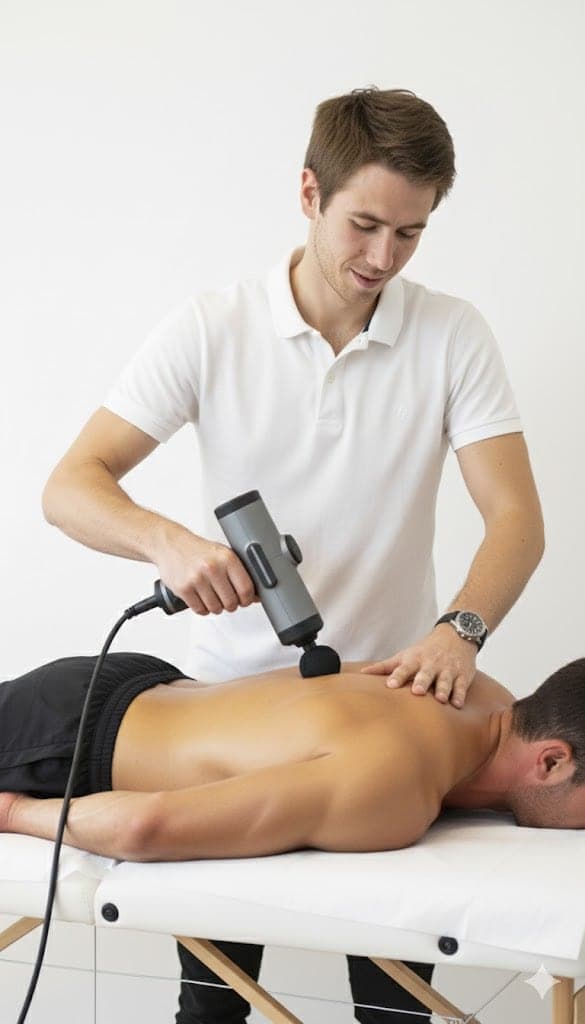
This is why I exclusively use a specialized mechanical device for deep-tissue treatment. The technology allows me to work with precision, power, and consistency that simply cannot be replicated manually. I can access fascial layers four to six centimeters deep—depths where chronically embedded adhesions reside, beyond the reach of even the most aggressive manual pressure.
The machine eliminates practitioner variability. I don’t have “off days” where fatigue compromises treatment quality. Every session delivers identical capability, calibrated precisely to each client’s tolerance and therapeutic needs. For athletes requiring maximum intensity, the tool provides sustained power that would be impossible to maintain manually. For clients with acute sensitivity, it offers controlled, gradual pressure increases that build tolerance systematically.
When evaluating therapists in Chloraka, ask what tools and technologies they employ. Manual-only practitioners, regardless of their skill, operate within biological constraints that limit their therapeutic ceiling.
5. Customized Treatment Protocols, Not Generic Sessions
Your fascial dysfunction is unique. It developed through your specific movement history, injury patterns, occupational demands, and compensatory strategies. Generic 60-minute sessions applying the same sequence to every client cannot address individualized pathology.
I work through dedicated partnerships with clients, not one-off appointments. Initial assessment includes detailed movement screening, pain pattern analysis, and discussion of functional goals. Treatment plans span multiple sessions because significant fascial reorganization doesn’t occur in 60 minutes—it requires progressive intervention that methodically addresses layers of restriction accumulated over months or years.
This approach isn’t compatible with spa-style booking systems offering same-day appointments with whoever’s available. Real therapeutic relationships develop over weeks, with consistent practitioner-client engagement that allows the therapist to understand subtle changes in tissue quality and movement patterns session to session.
The Machine-Assisted Deep Tissue Advantage: Why Technology Surpasses Tradition
I transitioned to mechanical deep-tissue methods six years into my practice after recognizing the limitations manual therapy imposed on client outcomes. The decision fundamentally changed the results I could achieve.
Depth and Precision
Fascial adhesions in chronically painful areas often develop in deep tissue layers—between muscle bellies, along bone interfaces, within thoracolumbar fascia. Manual pressure, even from experienced practitioners, distributes force across surface area, limiting penetration depth.
The specialized tool I use concentrates force through a small contact point, allowing controlled penetration to depths where embedded restrictions actually reside. This isn’t about applying more pressure—it’s about directing force precisely where it’s needed without the diffusion that occurs through palm or thumb contact.
Sustained Intensity
Effective fascial release in severely restricted tissue requires sustained pressure over time—often 60 to 90 seconds on a single point to achieve complete release. Maintaining that intensity manually creates practitioner fatigue that compromises treatment quality.
Mechanical delivery eliminates this constraint entirely. The tool maintains exactly the required pressure for exactly as long as necessary, without fluctuation or fatigue. This consistency produces dramatically superior results, particularly in athletes and clients with extensive chronic restrictions.
Controlled Progression
Some clients present with tissue so sensitive that even moderate pressure triggers protective guarding. Others, particularly endurance athletes or manual laborers, require intensity that exceeds what hands can safely deliver.
Mechanical systems allow precise calibration across this entire spectrum. I can begin at barely perceptible pressure for hypersensitive clients, gradually increasing as tissue tolerance develops. For clients requiring maximum intensity, the tool provides power that simply isn’t manually achievable.
This adjustability means I can treat the elderly patient with fibromyalgia and the competitive CrossFit athlete with equal effectiveness—something impossible with a one-size-fits-all manual approach.
What to Expect from a True Myofascial Release Specialist
Understanding what genuine expertise looks like helps you evaluate practitioners in Chloraka more effectively. Here’s what you should experience with a legitimate specialist.
| Session Component | What Quality Looks Like | Warning Signs |
|---|---|---|
| Initial Assessment | Detailed movement screening, postural analysis, pain pattern discussion, functional goal setting—minimum 20 minutes | Immediate treatment without assessment, generic intake forms only |
| Treatment Approach | Systematic progression through fascial layers, focused work on specific restrictions, intensity adjusted to tissue response | Identical routine for every client, focus on relaxation over mechanical change |
| Communication During Treatment | Explanation of what’s being addressed and why, feedback requests about pressure and sensation, education about findings | Silence or generic small talk, no explanation of therapeutic rationale |
| Post-Treatment Guidance | Specific movement recommendations, hydration protocols, what to expect in next 48 hours, clear plan for subsequent sessions | Vague advice to “drink water and rest,” no follow-up plan |
| Results Timeline | Honest discussion of expected progression, typical resolution requiring multiple sessions, commitment to lasting change | Promises of immediate lasting results or pressure to book indefinite recurring appointments |
The Reality of Professional Treatment
I need to be direct about something most practitioners won’t tell you: effective myofascial release frequently involves discomfort during treatment. Not pain in the sense of tissue damage, but the distinctive sensation of deep fascial restriction being mechanically disrupted.
Clients often describe it as “hurts good”—an intensity that feels simultaneously challenging and therapeutic, clearly different from injury pain. This sensation is the direct experience of adhesions separating, restricted tissue lengthening, and compensatory patterns being dismantled.
Therapists who promise completely pain-free treatment either work so superficially they’re ineffective, or they’re not actually performing myofascial release. Lasting change requires reaching tissue depths that simply cannot be accessed without intensity.
That said, intensity must be calibrated appropriately. A skilled practitioner works at the edge of your tolerance, never beyond it, progressively building your capacity to receive deeper work. The objective isn’t to cause pain—it’s to systematically dismantle restrictions, which sometimes involves temporary discomfort for lasting benefit.
Common Questions About Finding the Right Myofascial Release Therapist
How do I distinguish myofascial release from regular massage?
Regular massage works primarily with muscle tissue at superficial to moderate depths, focusing on circulation, relaxation, and temporary tension relief. Myofascial release targets the fascial system specifically—the connective tissue network—using sustained pressure and mechanical manipulation to create lasting structural changes in tissue organization and movement patterns.
If your therapist uses flowing strokes, works primarily with lotion or oil, and focuses on full-body relaxation, you’re receiving massage. If they use specific, sustained pressure on restricted areas, work relatively slowly through targeted regions, and discuss biomechanical patterns and movement dysfunction, you’re receiving myofascial release.
Should I expect immediate results?
This depends entirely on the chronicity and complexity of your condition. Acute restrictions—tissue that’s been problematic for weeks or a few months—often respond dramatically in one to three sessions. I’ve had clients with recent sports injuries experience complete resolution within two weeks.
Chronic conditions are fundamentally different. Fascial restrictions that developed over years, compensatory patterns embedded through decades of poor mechanics, or complex pain syndromes involving multiple body regions require systematic, progressive treatment. Expect noticeable improvement within three to four sessions, but complete resolution might require eight to twelve sessions over several months.
Anyone promising immediate lasting results for chronic conditions is either incompetent or dishonest. The body requires time to reorganize tissue, integrate new movement patterns, and stabilize changes.
How often should I schedule sessions?
Initial intensive treatment typically follows a weekly or twice-weekly schedule, allowing progressive deepening without overwhelming tissue tolerance. As restrictions resolve and movement improves, sessions space out to biweekly, then monthly, then as-needed maintenance.
The entire therapeutic arc from initial session to no-longer-needing-treatment should span weeks to months, not years. If your therapist suggests indefinite weekly appointments without discussing resolution timelines, they’re building a business model on dependency rather than delivering actual solutions.
What qualifications should I specifically look for?
Minimum requirements should include formal education in anatomy and biomechanics—ideally a university degree in Physical Education, Physical Therapy, Sports Science, or related field. Additional certifications in myofascial release techniques are valuable but should supplement foundational education, not replace it.
Years of specialized practice matter significantly. Someone who’s focused exclusively on fascial work for five-plus years will consistently outperform someone who learned the technique last year and offers it alongside ten other modalities.
Is mechanical assistance better than manual technique?
For most clients, yes—significantly better. Mechanical tools provide depth, consistency, and sustained intensity that simply cannot be replicated manually. They eliminate practitioner fatigue, allow precise pressure calibration, and access tissue layers beyond manual reach.
Manual technique remains valuable for assessment, certain superficial releases, and specific applications where hand sensitivity provides feedback. But for the deep, sustained work required to dismantle chronic restrictions, mechanical assistance represents a substantial technological advantage.
I’ve practiced both approaches extensively. The results I achieve with mechanical methods surpass what I could produce manually by a considerable margin.
Should the therapist come to me, or should I go to a clinic?
This is primarily about convenience rather than quality, though there are considerations on both sides. Clinic-based treatment ensures consistent professional environment and potentially more comprehensive equipment. Mobile treatment eliminates travel time, allows you to rest immediately post-session in your own space, and provides scheduling flexibility.
I travel to clients throughout Chloraka and surrounding areas, bringing a professional bench and all necessary equipment. This approach works because my specialized tool is portable and I’ve optimized my setup for mobile delivery. Clients consistently report that having treatment at their location eliminates the post-session stress of driving while tissues are still processing deep work.
The critical factor isn’t location—it’s whether the therapist maintains professional standards regardless of setting.
The Investment Framework: Understanding Value Versus Cost
Quality myofascial release treatment isn’t inexpensive. Sessions typically cost significantly more than standard massage because you’re paying for specialized expertise, advanced methodology, and most importantly, lasting results rather than temporary relief.
Let me frame this economically: if you’re currently spending €60 monthly on massage that provides temporary relief, you’ll spend €720 annually on a solution that never actually solves your problem. Over five years, that’s €3,600 invested in symptom management.
Alternatively, spending €100-150 per session for ten sessions of legitimate myofascial release—total investment €1,000-1,500—durably resolves the underlying dysfunction. The condition doesn’t return, eliminating future spending entirely.
Which represents better value?
I’ve worked with clients who resisted the per-session cost initially, continued with cheaper alternatives for another year, then returned and finally committed to the proper protocol. They universally express frustration at the time and money wasted on inadequate treatment.
Your body is not an area where economizing makes sense. This is the vehicle through which you experience every aspect of life. Chronic pain diminishes career performance, relationship quality, recreational enjoyment, and psychological wellbeing. The cost of living with persistent dysfunction dwarfs the investment in resolving it.
My Approach: What Working With Me Actually Involves
I’ve described the criteria for identifying excellence in myofascial release practitioners throughout Chloraka. Now I’ll be transparent about how I specifically apply these principles in my practice.
Assessment and Planning
Our first session begins with comprehensive movement assessment. I observe how you stand, walk, bend, and reach. I identify compensatory patterns, asymmetries, and restrictions. We discuss your pain history, functional limitations, and what successful resolution looks like for your specific situation.
This initial evaluation typically reveals the biomechanical narrative of your condition—how it developed, why it persists, and what systematic approach will dismantle it most efficiently.
Systematic Treatment Progression
I work through fascial layers progressively, not randomly. Superficial restrictions must release before deeper tissue becomes accessible. Proximal patterns often need addressing before distal symptoms resolve. This requires multiple sessions following a logical progression based on your body’s specific presentation.
Using my specialized mechanical tool, I can access depths and maintain intensities that produce genuine structural change. The treatment isn’t comfortable—we’re disrupting tissue patterns that have existed for months or years—but it’s calibrated precisely to your tolerance, and the results justify the temporary intensity.
Client Education and Empowerment
I explain exactly what I’m finding, why particular areas are restricted, and how these restrictions create your symptoms. Clients leave each session understanding their bodies better than when they arrived.
This educational component is critical because long-term success requires your participation. I provide movement practices, postural awareness, and activity modifications that support the fascial reorganization we’re creating. You’re not a passive recipient—you’re an active partner in the therapeutic process.
Results-Focused Partnership
My success metric is singular: lasting resolution of your condition. Not temporary relief, not indefinite maintenance appointments—lasting functional restoration that allows you to move, perform, and live without limitation.
This means our therapeutic relationship has a defined endpoint. When your restrictions are resolved, your movement is optimized, and you’ve internalized the awareness to maintain those changes, you no longer need my services. That’s the goal from session one.
Practical Steps for Finding Your Optimal Therapist in Chloraka
Whether you choose to work with me or another practitioner, these action steps will help you identify genuine expertise:
- Research educational backgrounds thoroughly. Don’t accept vague credentials—verify specific degrees and institutions.
- Schedule consultations before committing. Any confident, competent practitioner welcomes assessment conversations before you book treatment.
- Ask about treatment philosophy and expected timelines. Listen for results-oriented language versus maintenance-focused business models.
- Inquire about tools and methodologies. Understanding their technical approach reveals their sophistication and capability.
- Request client outcome examples. Specific case studies demonstrate practical expertise better than theoretical credentials.
- Evaluate communication quality. Can they explain complex biomechanics in understandable terms? Do they listen carefully to your specific situation?
- Trust your assessment of their confidence and authority. Genuine experts speak with quiet certainty. Insecure practitioners oversell or deflect difficult questions.
- Verify their specialization focus. Specialists in myofascial release dedicate their practice to this work, not one service among many.
The Bottom Line: Demand Excellence, Accept Nothing Less
Chloraka offers various manual therapy practitioners, but few possess the specialized education, technical sophistication, and results-oriented philosophy that defines true myofascial release expertise.
Your chronic pain, movement restrictions, and functional limitations deserve more than symptom management. They deserve systematic resolution by a practitioner who understands fascial biomechanics at a deep level, employs advanced methodology capable of creating genuine structural change, and commits to your lasting resolution rather than indefinite appointments.
I’ve built my practice on a simple principle: treat the cause, not the symptoms. Using mechanical precision that surpasses manual limitations, I access fascial restrictions at their source, systematically dismantling the patterns maintaining your dysfunction. This approach produces lasting results because it addresses the actual problem rather than temporarily relieving its manifestations.
After a decade of specialized practice and university-level education in body mechanics, I recognize my responsibility to deliver outcomes that justify the significant investment clients make in their treatment. That responsibility drives continuous refinement of technique, relentless focus on results, and honest communication about what’s realistically achievable.
If you’re serious about ending chronic pain rather than managing it, about optimizing movement rather than accommodating limitation, about investing in lasting solutions rather than temporary relief—those are the standards you should demand from any therapist you consider in Chloraka.
I travel to your location throughout Chloraka and surrounding areas, bringing professional equipment and ten years of focused expertise directly to your space. This eliminates travel stress, provides scheduling flexibility, and allows you to rest immediately after sessions while your tissue processes the deep work we’ve accomplished.
The question isn’t whether effective myofascial release exists in Chloraka. The question is whether you’re willing to commit to the process, investment, and temporary discomfort required to achieve lasting resolution.
If you are, the results will fundamentally change how your body feels and functions—not just today, but for years to come.
Written by
Chris
Massage therapist & body mechanics specialist
Norwegian-certified with a Bachelor’s in Physical Education and Nutrition and over ten years of clinical practice, working from a portable table in clients’ homes across the Paphos district.
This article is general information from clinical practice, not a medical diagnosis. If you have severe, worsening or unexplained pain, numbness, weakness, or pain after an accident, see a doctor first.