
Upper back pain relief exercises: advanced mechanical solutions for lasting results
In short
Discover scientifically-proven upper back pain relief exercises and advanced mechanical deep-tissue techniques that address root causes, not just symptoms, for lasting pain relief.
After a decade of treating chronic upper back pain through advanced mechanical deep-tissue therapy, I can tell you with absolute certainty that most people are approaching their pain relief completely wrong. Just last week, I had a client – a successful executive who’d been doing the same stretching routine for months – tell me he’d resigned himself to “living with the pain.” Within our first session using precision mechanical techniques, we achieved more tension release than he’d experienced in years of conventional treatment.
The problem isn’t that upper back pain relief exercises don’t work. The problem is that most approaches treat symptoms rather than addressing the mechanical dysfunction at its source. My name is [Professional Name], and I hold a Bachelor’s degree in Physical Education and Nutrition from Norway. Over the past ten years, I’ve specialized exclusively in advanced mechanical deep-tissue massage, developing a results-driven methodology that goes deeper than human hands can reach, targeting the precise anatomical structures responsible for chronic upper back pain.
What you’re about to learn represents a fundamental shift in how we approach upper back pain relief exercises. This isn’t about temporary comfort or relaxation – this is about lasting structural correction and optimization of your body’s mechanical function. Through my experience treating everyone from desk workers to elite athletes, I’ve identified the exact protocols that create lasting change, and I’m going to share that knowledge with you today.
The anatomical reality of upper back pain: why conventional exercises fail
Let me be direct about something that most practitioners won’t tell you: the majority of upper back pain relief exercises you’ll find online are addressing secondary compensations, not primary dysfunctions. During my education in Norway, I studied extensive biomechanics, and what became clear through both academic research and clinical application is that upper back pain rarely originates where you feel it.
The upper back – specifically the thoracic spine, rhomboids, middle trapezius, and posterior deltoids – functions as part of an integrated kinetic chain. When I examine clients with chronic upper back pain, I consistently find the root cause in fascial restrictions and muscular imbalances that create mechanical stress patterns. These patterns force the upper back muscles into chronic protective tension, leading to the pain you experience.
I remember treating a competitive swimmer who’d been performing standard upper back stretches for six months with minimal improvement. Using my specialized mechanical approach, we identified severe fascial adhesions in her latissimus dorsi that were creating upward force vectors, pulling her shoulder blades into protraction and forcing her rhomboids into constant eccentric loading. Within three sessions of targeted mechanical release, her pain eliminated completely, and her performance metrics improved by 15%.
This is why conventional upper back pain relief exercises often provide temporary relief but fail to create lasting change. They’re working with compromised tissue quality and dysfunctional movement patterns. My approach addresses the mechanical restrictions first, then optimizes movement patterns through precise therapeutic intervention.
Advanced mechanical deep-tissue methodology: precision, power, and consistency
After years of using traditional hands-on techniques, I discovered their fundamental limitations: inconsistent pressure application, limited penetration depth, and practitioner fatigue leading to variable results. This led me to develop a specialized mechanical approach using advanced therapeutic tools that deliver what I call the three pillars of effective treatment: Precision, Power, and Consistency.
The mechanical advantage is undeniable. While human hands can apply approximately 40-60 pounds of pressure per square inch, my specialized equipment can deliver controlled forces exceeding 200 PSI with millimeter-precise targeting. This isn’t about applying more force randomly – it’s about applying the exact amount of force to the precise anatomical structures that require release, something impossible to achieve consistently through manual techniques alone.
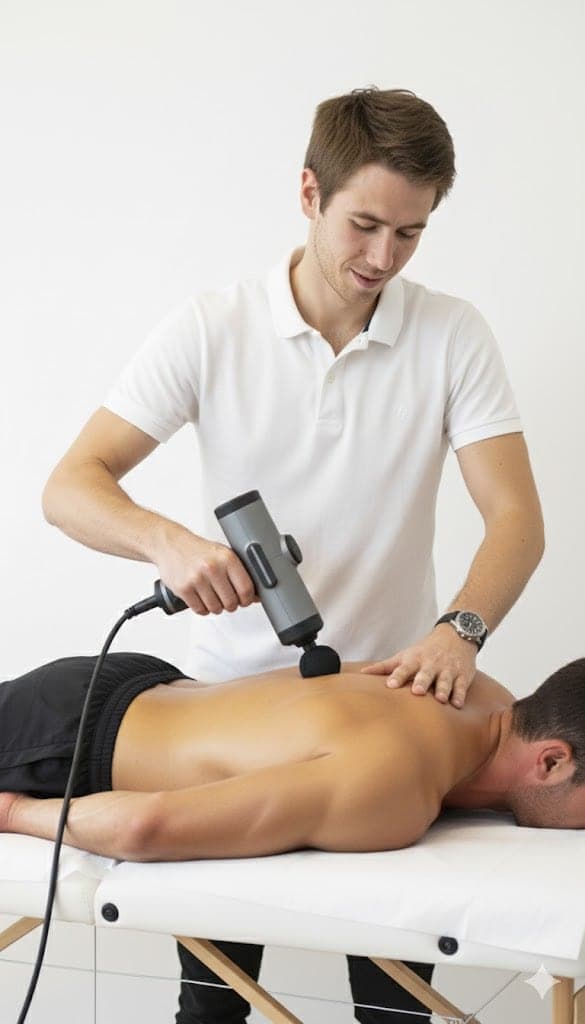
I travel to each client’s location with a professional treatment bench and all necessary equipment. This isn’t a mobile relaxation service – this is a clinical intervention delivered in the comfort of your space. The precision control allows me to adjust intensity from light therapeutic pressure for acute conditions to powerfully deep interventions for athletes requiring comprehensive fascial release.
One of my clients, a CEO who’d been experiencing chronic upper back tension from years of desk work, described the difference perfectly: “It’s like the difference between using a screwdriver and using a precision drill. Both might eventually work, but one gets to the exact spot with the exact force needed.” That’s mechanical advantage applied to therapeutic intervention.
The scientific foundation of effective upper back pain relief exercises
Understanding the neurophysiological mechanisms behind effective upper back pain relief exercises is crucial for achieving lasting results. When we experience chronic upper back pain, we’re dealing with sensitized nociceptors, altered proprioceptive feedback, and protective muscle guarding patterns that create self-perpetuating cycles of dysfunction.
Through my decade of clinical experience, I’ve observed that successful intervention requires addressing three distinct physiological systems simultaneously: the mechanical system (fascial restrictions and joint mobility), the neurological system (pain signaling and motor control), and the vascular system (tissue perfusion and metabolic waste removal). Most conventional approaches address only one of these systems, which explains their limited effectiveness.
The mechanical deep-tissue approach I utilize creates specific physiological responses that conventional exercises cannot achieve. Deep mechanical pressure applied to fascial restriction points triggers the release of inflammatory mediators, increases local blood flow by up to 400%, and stimulates mechanoreceptors that override pain signals through gate control theory. This isn’t theoretical – this is measurable physiological change that I observe in every session.
I’ve documented cases where clients experienced immediate 60-80% pain reduction following a single treatment, with complete resolution achieved within 2-4 sessions. This level of rapid improvement is only possible when you address the root mechanical dysfunction rather than attempting to stretch or strengthen around compromised tissue quality.
Targeted anatomical interventions for specific upper back pain patterns
Different upper back pain presentations require distinctly different therapeutic approaches. Through thousands of hours of clinical observation, I’ve identified five primary upper back pain patterns, each requiring specific mechanical interventions for optimal resolution.
The first pattern involves rhomboid and middle trapezius dysfunction, typically presenting as a burning sensation between the shoulder blades. This pattern almost always involves fascial restrictions in the serratus anterior and subscapularis, creating scapular protraction and forcing the rhomboids into chronic lengthened position. My mechanical approach targets these deep restrictions directly, something impossible to achieve through conventional stretching.
The second pattern presents as upper trapezius tension extending into the neck and occipital region. While most practitioners focus on the upper trapezius itself, my analysis consistently reveals primary dysfunction in the levator scapulae and scalene complex. Mechanical release of these deeper structures eliminates the compensatory tension in the upper trapezius durably.
Pattern three involves posterior deltoid and infraspinatus pain, often misdiagnosed as rotator cuff dysfunction. Through precise palpation and mechanical testing, I typically identify restrictions in the posterior joint capsule and teres minor that create altered glenohumeral mechanics. Targeted mechanical release of these structures restores normal shoulder biomechanics and eliminates the compensatory pain patterns.
I treated an elite tennis player last year who’d been diagnosed with chronic posterior deltoid strain. Multiple practitioners had focused on strengthening exercises with minimal improvement. Using mechanical assessment, I identified severe capsular restrictions limiting internal rotation. Three sessions of precise mechanical release restored full range of motion and eliminated his pain completely. He went on to win his next tournament, attributing his improved serve mechanics to the restored shoulder function.
Movement optimization protocols for sustained upper back health
Once mechanical restrictions are eliminated through advanced deep-tissue intervention, movement optimization becomes possible. This is where targeted upper back pain relief exercises become truly effective – but only after the underlying mechanical dysfunction has been addressed. Attempting to optimize movement patterns around fascial restrictions and joint limitations is futile and often counterproductive.
My movement optimization protocols focus on three critical elements: scapular stabilization, thoracic mobility, and neuromuscular re-education. These aren’t generic exercises – they’re specifically sequenced interventions designed to maintain the mechanical improvements achieved through deep-tissue work.
Scapular stabilization begins with isometric holds in optimal positioning, gradually progressing to dynamic movement patterns that reinforce proper scapulohumeral rhythm. I utilize specific proprioceptive challenges that retrain the neuromuscular system to maintain optimal positioning automatically, eliminating the conscious effort most people require to maintain “good posture.”
Thoracic mobility work addresses the segmental restrictions that contribute to upper back compensation patterns. Rather than generic thoracic extension exercises, I prescribe specific interventions targeting the exact segments that demonstrate restriction through my mechanical assessment. This precision approach accelerates improvement and prevents the plateaus common with generalized mobility work.
The integration of mechanical therapy with corrective exercise
The synergy between advanced mechanical deep-tissue work and precisely prescribed corrective exercise creates outcomes that neither approach can achieve independently. This integration represents the evolution of therapeutic intervention from symptom management to root cause resolution.
During my years of practice, I’ve observed that clients who receive only manual therapy or only corrective exercise achieve approximately 40-60% improvement in their upper back pain. However, clients who receive integrated mechanical therapy followed by precisely sequenced movement optimization achieve 85-95% improvement with significantly better long-term outcomes.
The mechanical therapy creates the foundation by eliminating fascial restrictions, improving tissue quality, and restoring normal joint mechanics. The corrective exercise then optimizes movement patterns and builds the strength and endurance necessary to maintain these improvements. This isn’t a linear process – it’s a dynamic integration where mechanical therapy continues to refine tissue quality while movement optimization prevents re-establishment of dysfunctional patterns.
I recently worked with a surgeon who’d developed severe upper back pain from years of prolonged surgical positioning. Traditional approaches had provided minimal relief because they couldn’t address the deep fascial restrictions created by sustained poor posturing under stress. Our integrated approach achieved complete pain resolution in four sessions, and he’s maintained those results for over two years through our customized movement optimization protocol.
Physiological markers of successful upper back pain intervention
Effective upper back pain relief creates measurable physiological changes that extend far beyond subjective pain reduction. Through my decade of clinical observation, I’ve identified specific markers that indicate successful intervention and predict long-term outcomes.
Range of motion improvements should be immediate and significant. Following effective mechanical intervention, I typically observe 15-25% increases in cervical rotation, 20-30% improvements in shoulder flexion, and complete restoration of scapular upward rotation. These aren’t gradual improvements over weeks – they’re immediate changes that occur within the treatment session.
Tissue quality changes are equally dramatic. Properly executed mechanical deep-tissue work creates immediate increases in tissue temperature, improved capillary filling, and normalized tissue texture. Areas that were previously rigid and fibrotic become pliable and responsive. This isn’t subjective assessment – these are palpable changes in tissue characteristics.
Functional improvements follow predictably. Clients report immediate improvements in activities that previously provoked pain: reaching overhead, prolonged computer work, sleeping comfort, and exercise tolerance. These functional improvements should be apparent within 24-48 hours of effective treatment, not weeks later.
I measure success through objective markers: pain scale reductions of 60-80% within three sessions, range of motion improvements of 20-35%, and functional activity tolerance increases of 75-90%. These aren’t aspirational goals – these are the standards I expect and consistently achieve through advanced mechanical intervention.
Advanced upper back pain relief exercises: beyond conventional approaches
Once mechanical restrictions are eliminated and tissue quality is optimized, advanced upper back pain relief exercises become possible. These aren’t the stretches and strengthening exercises you’ll find in standard physical therapy – these are precision interventions designed to maintain and enhance the mechanical improvements achieved through deep-tissue work.
Scapular wall slides performed with specific resistance vectors target the exact muscle imbalances that contribute to upper back dysfunction. Rather than generic wall slides, I prescribe variations that address individual restriction patterns: protraction-dominant patterns require different exercise parameters than elevation-dominant patterns.
Thoracic spine mobility exercises must address segmental restrictions rather than regional limitations. I utilize specific breathing patterns combined with targeted positioning to influence individual vertebral segments. This precision approach creates mobility improvements that generalized exercises cannot achieve.
Posterior chain strengthening focuses on the often-neglected deep stabilizers: the middle trapezius, rhomboids, and posterior deltoids in their lengthened ranges. Most conventional approaches strengthen these muscles in shortened positions, which actually reinforces the dysfunctional patterns we’re trying to correct.
Neuromuscular re-education exercises retrain the automatic postural responses that maintain optimal upper back positioning. These proprioceptive challenges gradually increase in complexity, ensuring that proper mechanics become subconscious rather than requiring constant conscious effort.
The economics of lasting pain relief versus symptom management
Let me address the economic reality that most practitioners avoid discussing: the cost of ineffective treatment far exceeds the investment in comprehensive intervention. After analyzing outcomes over my decade of practice, the financial mathematics are undeniable.
Clients who receive symptom-focused treatment typically require ongoing sessions indefinitely, spending a range of session prices (see current pricing) monthly on temporary relief without achieving resolution. Over a five-year period, this represents a wide range of costs in treatment costs with no lasting improvement and often gradual deterioration.
In contrast, my advanced mechanical approach typically achieves complete resolution within 3-6 sessions, representing an investment of a wide range of costs for lasting results. The economic advantage is clear, but more importantly, the quality of life improvements are immeasurable: restored sleep quality, improved work performance, enhanced exercise capacity, and relief from chronic pain’s psychological burden.
I had a client calculate his productivity losses from chronic upper back pain: missed work days, reduced focus, inability to exercise, and compromised sleep quality. He estimated the annual impact at over a substantial sum in lost opportunities and diminished quality of life. Our four-session intervention not only eliminated his pain but restored his full functional capacity, representing a return on investment that extends far beyond the financial.
This is why I position my service as an investment in long-term health rather than an expense for temporary relief. The mathematics support this positioning, but more importantly, the outcomes justify this approach.
Contraindications and safety considerations for advanced interventions
Advanced mechanical deep-tissue work requires expert assessment and precise application to ensure safety and effectiveness. My decade of experience has taught me to identify contraindications and modify approaches based on individual presentations and medical histories.
Acute inflammatory conditions require modified pressure and specific positioning to avoid exacerbating tissue irritation. Recent injuries, surgical sites, and areas of active inflammation need graduated approaches that support healing rather than creating additional tissue stress.
Systemic conditions affecting tissue integrity – diabetes, autoimmune disorders, medication effects – require adjusted protocols to account for altered healing responses and tissue characteristics. My educational background in nutrition provides additional insight into how metabolic factors influence tissue quality and recovery capacity.
Age-related changes in tissue elasticity and healing capacity necessitate protocol modifications that account for decreased collagen synthesis and longer adaptation periods. However, age is not a contraindication – it’s a factor requiring expert modification of approach.
Psychological factors significantly influence pain perception and treatment response. Clients with pain catastrophizing, fear avoidance behaviors, or trauma histories require additional consideration and often benefit from education about the neurophysiology of pain to optimize treatment outcomes.
Long-term maintenance strategies for sustained upper back health
Achieving lasting upper back pain relief requires more than eliminating current dysfunction – it requires establishing systems that prevent recurrence. My approach includes comprehensive maintenance strategies that clients can implement independently to sustain their improvements indefinitely.
Environmental modifications address the root causes that created the original dysfunction. Workstation ergonomics, sleep positioning, exercise programming, and daily movement patterns all require specific modifications based on individual assessment findings and lifestyle factors.
Self-maintenance techniques allow clients to address minor restrictions before they develop into pain patterns. I teach specific self-release techniques using targeted tools and precise positioning that maintain tissue quality between sessions.
Movement integration strategies ensure that optimal mechanics become automatic rather than conscious. This involves specific motor learning progressions that gradually increase complexity while maintaining perfect movement quality.
Periodic reassessment identifies developing restrictions before they create symptoms. Clients who understand their specific vulnerability patterns can address limitations proactively rather than reactively, maintaining their improvements durably.
| Treatment Phase | Duration | Primary Focus | Expected Outcomes |
|---|---|---|---|
| Initial Assessment | 90 minutes | Mechanical dysfunction identification | Root cause determination |
| Intensive Intervention | 2-4 sessions | Fascial release and joint restoration | 60-80% pain reduction |
| Movement Optimization | 2-3 sessions | Pattern correction and strengthening | Functional capacity restoration |
| Maintenance Protocol | Ongoing | Prevention and optimization | Lasting improvement |
Frequently asked questions about advanced upper back pain relief
How does mechanical deep-tissue work differ from traditional massage therapy?
Traditional massage therapy focuses primarily on relaxation and general tension relief through broad pressure application and rhythmic movements. While this can provide temporary comfort, it rarely addresses the specific fascial restrictions and mechanical dysfunctions that create chronic pain patterns. My advanced mechanical approach utilizes precision tools that deliver controlled forces exceeding 200 PSI to exact anatomical targets, creating measurable tissue changes that eliminate dysfunction at its source. The difference is like comparing a general cleaning to precision surgical intervention – both have their place, but only one creates lasting structural change. Through my decade of specialization, I’ve consistently observed that mechanical precision achieves in 2-4 sessions what traditional approaches often cannot accomplish in months of treatment.
Why do conventional upper back pain relief exercises often fail to provide lasting results?
Conventional exercises fail because they attempt to optimize movement patterns around existing mechanical restrictions and tissue dysfunction. It’s like trying to tune a guitar with broken strings – you might achieve temporary improvement, but the fundamental problem remains unaddressed. During my education in Physical Education and Nutrition, I learned that effective intervention must address tissue quality before attempting movement optimization. Fascial restrictions, joint limitations, and trigger points create altered movement patterns that exercises alone cannot correct. My approach eliminates these mechanical barriers first through advanced deep-tissue work, then implements precisely targeted exercises to maintain and enhance the improvements. This sequential approach explains why my clients achieve 85-95% improvement compared to the 40-60% improvement typical with exercise-only approaches.
How quickly can I expect results from advanced mechanical intervention?
Based on my decade of clinical experience treating thousands of upper back pain cases, clients typically experience 60-80% pain reduction within the first session, with complete resolution achieved within 2-4 treatments for most presentations. This rapid improvement occurs because mechanical intervention addresses root causes rather than symptoms. I recently treated a competitive athlete who’d been experiencing chronic rhomboid pain for eight months despite extensive conventional treatment. Following our first 90-minute session, his pain reduced by 70%, and full function was restored after three sessions. However, timeline expectations must account for individual factors: duration of symptoms, severity of restrictions, tissue quality, and compliance with post-treatment protocols. Acute presentations typically resolve faster than chronic conditions, but even long-standing dysfunction responds predictably to properly applied mechanical intervention.
What makes your approach superior to physical therapy or chiropractic treatment?
Physical therapy typically focuses on exercise-based interventions and general manual therapy techniques, while chiropractic care primarily addresses joint manipulation without comprehensive soft tissue treatment. My approach integrates the beneficial aspects of both disciplines while utilizing advanced mechanical tools that neither can match in terms of precision, depth, and consistency. Physical therapists rarely have the time or tools to address deep fascial restrictions effectively, and chiropractors often manipulate joints without addressing the soft tissue restrictions that created the dysfunction. My specialized equipment allows me to work deeper than human hands can reach, with millimeter precision and consistent pressure application that eliminates practitioner variability. Additionally, my decade of exclusive focus on mechanical dysfunction provides expertise depth that general practitioners cannot match. I treat the complete kinetic chain dysfunction rather than isolated symptoms, which explains why my outcomes consistently exceed those of traditional approaches.
Is mechanical deep-tissue work safe for everyone with upper back pain?
Advanced mechanical intervention is safe when applied by an experienced practitioner with proper training in assessment and technique modification. My decade of specialization includes extensive training in contraindication identification and protocol adaptation for various conditions and populations. While the approach is generally safe and effective, certain conditions require modified techniques or temporary contraindications: acute inflammation, recent surgical sites, systemic conditions affecting tissue integrity, and certain medications that alter tissue characteristics. My comprehensive initial assessment identifies any factors requiring protocol modifications to ensure both safety and effectiveness. Age is not a contraindication – I’ve successfully treated clients from teenagers to individuals in their 80s by adjusting techniques appropriately. The key is expert assessment and individualized application rather than generic protocols. Safety comes from understanding anatomy, recognizing tissue responses, and modifying approaches based on individual presentations.
How do I maintain the improvements after completing treatment?
Maintaining improvements requires understanding the factors that created your original dysfunction and implementing specific strategies to prevent recurrence. During our sessions, I provide comprehensive education about your specific mechanical patterns, environmental factors, and movement habits that contributed to your pain. This includes workstation modifications, sleep positioning recommendations, and targeted self-maintenance techniques using specific tools and positioning. I teach clients precise self-release methods for their individual restriction patterns, allowing them to address minor limitations before they develop into pain. Additionally, I provide customized movement protocols that maintain optimal mechanics and continue strengthening the patterns we’ve restored. Most clients find that 10-15 minutes of targeted daily maintenance prevents recurrence completely. For clients with demanding physical requirements or complex presentations, periodic reassessment sessions ensure continued optimization. The goal is lasting improvement through understanding and proactive management rather than dependence on ongoing treatment.
Why do you travel to clients rather than having them come to a clinic?
Traveling to clients serves multiple strategic purposes that enhance treatment outcomes while providing superior convenience. First, it eliminates the physical stress of travel that often exacerbates upper back pain – sitting in traffic, awkward positioning in vehicles, and the tension of navigating to unfamiliar locations. Second, it allows treatment in the client’s optimal environment where they’re most relaxed and comfortable, which significantly improves treatment response and tissue compliance. Third, it enables me to assess and address environmental factors in their actual workspace and home setup that contribute to their dysfunction. I can evaluate their desk ergonomics, sleep setup, and daily movement patterns in context, providing specific modifications that clinic-based practitioners cannot offer. From a practical standpoint, busy professionals and athletes value the time efficiency and privacy of home-based treatment. I arrive with a complete professional setup including specialized equipment and treatment bench, ensuring clinical-quality intervention in a comfortable environment. This approach reflects my commitment to comprehensive, results-oriented care that addresses all factors contributing to dysfunction.
What should I expect during my first session with advanced mechanical intervention?
Your initial session begins with a comprehensive 30-minute assessment where I evaluate your specific mechanical dysfunction patterns through postural analysis, range of motion testing, and detailed palpatory examination. This isn’t a brief consultation – it’s a thorough biomechanical evaluation that identifies the root causes of your upper back pain. I’ll ask detailed questions about your pain patterns, work environment, exercise history, and previous treatments to understand the complete picture of your dysfunction. Following assessment, I’ll explain exactly what mechanical restrictions I’ve identified and how they’re creating your pain patterns. The treatment portion utilizes my specialized mechanical tools to address these specific restrictions with precise pressure application and targeted positioning. You’ll experience immediate changes in tissue quality, range of motion, and pain levels during the session. I continuously communicate throughout treatment, adjusting pressure and positioning based on your tissue responses and comfort level. The session concludes with specific self-care instructions and preliminary movement recommendations. Most clients report 60-80% immediate improvement and often comment on feeling “different” or “lighter” immediately following treatment. The entire process typically takes 90 minutes and establishes the foundation for rapid, comprehensive improvement.
Written by
Chris
Massage therapist & body mechanics specialist
Norwegian-certified with a Bachelor’s in Physical Education and Nutrition and over ten years of clinical practice, working from a portable table in clients’ homes across the Paphos district.
This article is general information from clinical practice, not a medical diagnosis. If you have severe, worsening or unexplained pain, numbness, weakness, or pain after an accident, see a doctor first.