
Pain Relief Clinics Pafos: Expert Guide to Treating Lower Back Pain with Advanced Methods
In short
Discover specialized pain relief clinics in Pafos offering advanced treatments for lower back pain. Expert analysis of methods, technologies, and approaches that deliver lasting results.
Lower back pain doesn’t discriminate. I’ve treated everyone from construction workers who’ve spent decades lifting heavy materials to office executives whose spines have slowly collapsed under the weight of poor ergonomics. What unites them is this: traditional approaches have failed them. They come to me after months, sometimes years, of temporary relief followed by recurring agony.
The pain relief landscape in Pafos has evolved significantly over the past decade. When I first brought my mechanical deep-tissue approach to Cyprus, the market was saturated with wellness centers offering relaxation massages disguised as therapeutic treatment. The distinction matters more than most people realize. If you’re experiencing chronic lower back pain, you need intervention that addresses biomechanical dysfunction at the fascial and muscular level, not aromatherapy and ambient music.
This guide examines pain relief clinics in Pafos through the lens of someone who has dedicated ten years to understanding why most treatments fail and what actually works for persistent lower back dysfunction.
Understanding Lower Back Pain: Why Most Treatment Approaches Miss the Mark
The lumbar spine bears approximately 60% of your body weight during standing activities. Add poor movement patterns, muscular imbalances, and accumulated fascial restriction, and you create a biomechanical disaster waiting to happen. I’ve seen this pattern hundreds of times: a client describes their pain as sudden, but the dysfunction has been building for years.
Traditional pain relief clinics in Pafos typically offer a predictable menu of services: standard massage, heat therapy, perhaps some electrical stimulation. These modalities target symptoms. The pain temporarily subsides because you’ve increased blood flow or triggered an endorphin response. Three days later, you’re back where you started because the underlying mechanical problem remains untouched.
My university training in physical education and nutrition taught me to view the body as an integrated mechanical system. The fascial network that encases every muscle fiber, every organ, every bone creates continuity throughout the entire structure. When chronic tension develops in the thoracolumbar fascia—the dense connective tissue spanning your lower back—it doesn’t exist in isolation. It affects hip mobility, alters gait patterns, and creates compensatory dysfunction that radiates upward into the thoracic spine and shoulders.
The Fascial Component Most Clinics Ignore
Fascia responds to sustained, precise pressure applied at specific vectors. Human hands, regardless of the therapist’s skill level, have inherent limitations. Fatigue sets in. Pressure becomes inconsistent. The angle changes as the therapist shifts position. These variables matter tremendously when you’re attempting to release dense adhesions in the erector spinae or quadratus lumborum.
I discovered this early in my career when my own hands began showing signs of overuse. Rather than accept diminished results, I researched mechanical alternatives that could deliver what manual therapy promised but rarely achieved: consistent, controllable, deep fascial release.
Evaluating Pain Relief Clinics in Pafos: What to Look For
Not all treatment providers are created equal. After a decade of observing outcomes—both my own and those of colleagues—I’ve identified clear markers that separate effective intervention from expensive placebo.
Diagnostic Capability and Assessment Protocol
The first session should never involve immediate treatment. A competent practitioner spends substantial time assessing your movement patterns, postural alignment, and palpating for areas of restriction. I typically spend 20-30 minutes on initial assessment alone. This reveals the mechanical relationships between your lower back pain and contributing factors you might not have considered.
For example, I recently worked with a client whose lower back pain stemmed primarily from chronic hip flexor tension. Years of sitting had shortened his iliopsoas to the point where his lumbar spine was pulled into excessive anterior tilt. No amount of direct lower back treatment would have solved the problem without addressing the hip complex first.
Technology and Methodology
This is where most pain relief clinics in Pafos reveal their limitations. The equipment matters. The approach matters more.
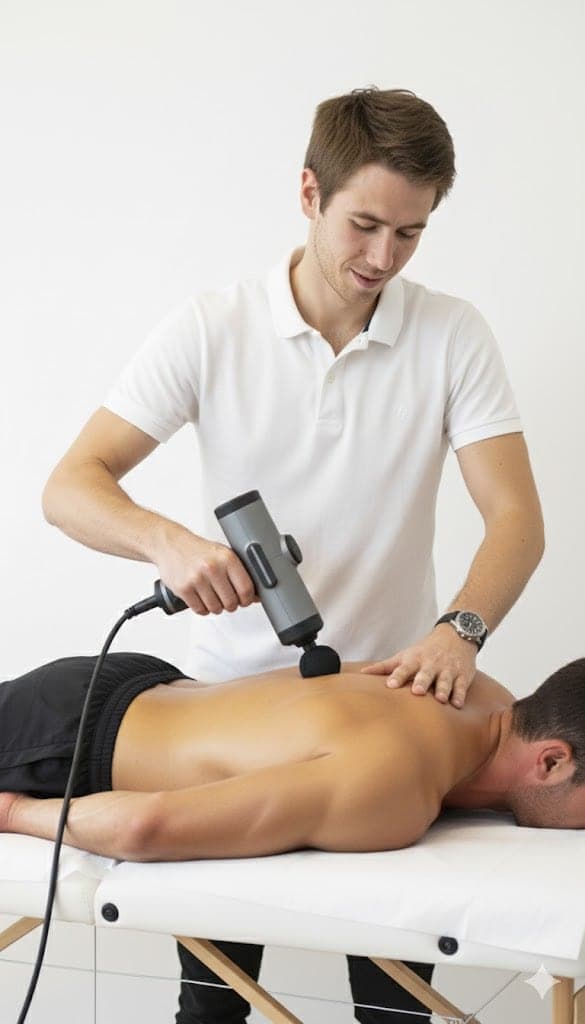
I use a specialized mechanical system that delivers precision, power, and consistency impossible to achieve manually. The tool allows me to work significantly deeper than human hands, targeting restrictions at their source rather than superficially addressing surface tension. The intensity is adjustable across a spectrum from gentle fascial work to powerfully deep treatment appropriate for athletic populations.
The consistency factor cannot be overstated. I don’t have “off days” where my pressure is weaker or my focus diminished. Every session delivers the same controlled, effective treatment. This predictability is essential for clients who are investing time and resources into resolving chronic pain.
Treatment Philosophy: Symptoms vs. Root Cause
Ask any clinic about their philosophy. The answer tells you everything you need to know about potential outcomes.
Symptom-focused providers offer temporary relief. They’ll reduce your pain level from an 8 to a 4, and you’ll feel grateful—until next week when you’re back to a 7. This cycle generates recurring revenue for the clinic but does nothing for your long-term function.
My approach treats the cause. We identify the specific mechanical dysfunctions creating your pain pattern, then systematically address each component. This takes longer initially, but the result is lasting change. I’ve had clients who experienced complete resolution of decade-long lower back pain after a comprehensive treatment series. That’s not luck; it’s mechanical problem-solving applied to human physiology.
Available Treatment Modalities for Lower Back Pain in Pafos
Understanding your options helps you make informed decisions about care. Here’s an objective analysis of common treatments available through pain relief clinics in Pafos, assessed through the lens of biomechanical effectiveness.
| Treatment Modality | Mechanism of Action | Effectiveness for Chronic Lower Back Pain | Duration of Results |
|---|---|---|---|
| Traditional Massage | Increases circulation, reduces muscle tension superficially | Low to Moderate (symptom relief only) | 2-4 days |
| Mechanical Deep-Tissue | Releases fascial adhesions, restores optimal muscle length-tension relationships | High (addresses root cause) | Lasting with proper maintenance |
| Heat Therapy | Increases tissue temperature, promotes blood flow | Low (palliative only) | Hours to 1 day |
| Electrical Stimulation | Disrupts pain signals, creates muscle contractions | Low to Moderate (temporary) | Variable, typically days |
| Stretching Programs | Increases joint range of motion, improves flexibility | Moderate (limited by existing restrictions) | Requires ongoing adherence |
Why Mechanical Precision Outperforms Manual Techniques
The human hand can generate approximately 30-50 pounds of pressure before fatigue becomes a limiting factor. Chronic fascial restriction in the lumbar region often requires sustained pressure exceeding these thresholds to achieve meaningful tissue change.
My mechanical approach delivers controlled force at precise angles, maintained for the duration necessary to create fascial release. I can work the interface between the quadratus lumborum and the thoracolumbar fascia at depths impossible to reach manually. This isn’t theoretical; clients consistently report sensations of restriction releasing that they’ve never experienced with traditional massage.
The machine doesn’t replace my expertise—it amplifies it. I control every parameter: depth, angle, duration, and movement pattern. My decade of experience guides the tool to exactly where intervention is needed. The result is treatment that actually changes the mechanical system rather than temporarily masking dysfunction.
Specialized Focus Areas: Lower Back Pain Syndromes
Lower back pain isn’t a single condition; it’s a symptom with multiple potential mechanical causes. Effective treatment requires accurate identification of the specific dysfunction pattern.
Facet Joint Dysfunction
The facet joints guide spinal movement and bear significant load during extension and rotation. Chronic inflammation or arthritic changes in these joints create deep, localized pain that worsens with certain movements. Treatment must address the muscular imbalances that create excessive compression on these joint surfaces.
I’ve worked with clients whose facet pain stemmed from chronic multifidus weakness on one side, creating asymmetrical loading. The solution wasn’t pain medication or joint injections—it was restoring proper muscle activation patterns through targeted deep tissue work followed by specific corrective exercises.
Disc-Related Pain
Intervertebral discs act as hydraulic shock absorbers. When surrounding musculature becomes chronically tight or weak, abnormal forces compress these discs, potentially causing bulging or herniation. The pain is typically severe and may radiate into the legs if nerve compression occurs.
Mechanical deep-tissue work can significantly reduce the muscular tension pulling on the spine, creating space for disc recovery. I’ve seen remarkable improvements in clients with confirmed disc bulges who were told surgery was their only option. By releasing the erector spinae, psoas, and multifidus, we removed the compressive forces allowing the disc to heal.
Sacroiliac Joint Dysfunction
The SI joint connects your spine to your pelvis. Instability or restriction here creates pain that’s often misdiagnosed as lower back strain. The pain typically localizes to one side, just lateral to the spine at belt level.
Effective treatment requires addressing the entire pelvic girdle. The piriformis, gluteal complex, and deep hip rotators all influence SI joint position and stability. My approach systematically releases restrictions in these tissues while restoring optimal movement patterns.
Myofascial Pain Syndrome
This is perhaps the most common yet most overlooked cause of chronic lower back pain. Trigger points—hyperirritable spots within taut bands of muscle—create referred pain patterns that can mimic almost any other lower back condition.
A trigger point in the quadratus lumborum can create deep, aching pain in the sacroiliac region. Gluteus medius trigger points refer pain along the iliac crest and down the lateral thigh. Effective treatment requires precise identification and deactivation of these points through sustained pressure—exactly what mechanical deep-tissue work excels at delivering.
The Treatment Process: What to Expect from Advanced Pain Relief
I believe in transparency. Clients deserve to understand exactly what they’re investing in and why the process unfolds as it does. This isn’t mysterious; it’s applied biomechanics.
Initial Assessment and Biomechanical Analysis
We begin with comprehensive evaluation. I assess your posture in standing, observe your gait, and conduct specific movement tests that reveal restrictions and compensations. Palpation identifies areas of fascial density, trigger points, and muscle imbalances.
This assessment typically reveals patterns the client wasn’t aware of. A recently treated executive discovered his right shoulder was elevated three centimeters higher than his left—a compensation that had existed for so long he couldn’t perceive it anymore. This asymmetry was directly contributing to his lower back pain through altered force distribution.
Customized Treatment Planning
Based on assessment findings, I develop a specific treatment protocol. This isn’t a generic approach applied to everyone with “lower back pain.” It’s a customized plan addressing your unique mechanical dysfunction pattern.
The plan includes the specific tissues we’ll target, the sequence of treatment sessions, and expected milestones. I’m direct about realistic timelines. Dysfunction that developed over years won’t resolve in a single session, but meaningful improvement typically occurs within the first three treatments.
Progressive Treatment Sessions
Each session builds on the previous one. As superficial restrictions release, we access deeper layers of dysfunction. The mechanical tool allows me to work with remarkable precision, targeting specific fascial planes and muscle bellies.
Clients often report sensations they’ve never experienced before—a feeling of restriction suddenly releasing, or awareness of tension they didn’t know existed. This isn’t placebo. It’s the mechanical reality of fascial tissue responding to appropriate intervention.
Integration and Maintenance
As primary restrictions resolve, we transition to optimization. This phase focuses on reinforcing proper movement patterns and addressing any remaining subtle dysfunctions. The frequency of sessions decreases as your body maintains the changes we’ve created.
Maintenance differs from ongoing treatment for chronic symptoms. We’re not managing pain; we’re preserving optimal function. Many clients schedule quarterly sessions as preventive care, particularly those with physically demanding occupations or athletic pursuits.
Investment in Long-Term Health vs. Recurring Expense
The financial conversation matters. I’ve seen clients spend thousands on recurring treatments that never resolve their pain because they’re chasing symptom relief rather than addressing mechanical dysfunction.
A proper treatment series requires investment. However, it’s finite investment with lasting results, not ongoing expense with temporary relief. Calculate what you’ve spent on pain management over the past year—medications, multiple provider visits, work productivity lost to pain. Now compare that to comprehensive treatment that actually resolves the problem.
I travel to your location with professional equipment, eliminating the inconvenience and time cost of traveling to a clinic. This isn’t just about comfort; it’s about removing barriers to consistent treatment. Clients are more likely to complete a full treatment protocol when sessions occur in their own space on their schedule.
Frequently Asked Questions About Pain Relief Treatment in Pafos
How quickly will I experience pain relief?
Most clients notice meaningful improvement within the first three sessions. However, the timeline depends on the chronicity and complexity of your condition. Acute lower back pain from recent injury often responds faster than decades-long chronic dysfunction. I’m direct about realistic expectations during initial assessment rather than promising immediate miracles that don’t materialize.
Is mechanical deep-tissue treatment painful?
There’s a distinction between therapeutic discomfort and pain. When we’re releasing chronic fascial restriction, you’ll feel intensity—the sensation of deep tissue change. I precisely control this intensity, adjusting in real-time based on your feedback. The goal is maximum effectiveness while remaining within your tolerance threshold. Most clients describe the sensation as “good pain”—uncomfortable but clearly productive.
How does this differ from chiropractic treatment?
Chiropractic focuses primarily on joint manipulation and alignment. My approach addresses the soft tissue component—the muscles, fascia, and connective tissue that control how your joints move. These approaches can be complementary, but many lower back pain cases stem from soft tissue dysfunction rather than structural misalignment. I’ve worked with several clients who achieved better results through fascial release than through years of chiropractic adjustments.
Can this help if I’ve already tried physical therapy?
Physical therapy typically emphasizes exercise and movement reeducation. This is valuable but often incomplete. If significant fascial restriction exists, your body cannot execute proper movement patterns regardless of how well you understand them. We must first release the mechanical restrictions, then proper movement becomes possible. I often work in conjunction with physical therapy, addressing different aspects of the same mechanical problem.
What makes your approach different from spa massage?
Spa massage prioritizes relaxation. I prioritize mechanical change. The tools differ, the pressure differs, the assessment differs, and most importantly, the outcomes differ. If you want an hour of pleasant relaxation, a spa serves that purpose. If you want lasting resolution of chronic pain, that requires clinical intervention addressing the biomechanical cause of your symptoms.
How many sessions will I need?
This depends entirely on your specific condition. Acute issues may resolve in 3-5 sessions. Chronic, complex dysfunction might require 8-12 sessions for comprehensive resolution. I provide honest assessment after our initial evaluation. Some providers benefit financially from prolonging treatment indefinitely. I benefit from your lasting recovery and the referrals that come from genuine results.
Do you accept insurance?
I operate on a private-pay basis. Insurance reimbursement models incentivize high-volume, short-duration treatments rather than comprehensive care that actually resolves conditions. The value proposition is straightforward: finite investment for lasting results rather than insurance-covered recurring treatments that never fully address the problem. Most clients find this approach more cost-effective long-term.
Can you help with pain that radiates down my leg?
Radiating pain suggests nerve involvement, either from disc compression or muscular entrapment. I’ve successfully treated numerous cases of sciatic nerve irritation by releasing the muscles that create compression—particularly the piriformis and deep hip rotators. However, severe neurological symptoms require medical evaluation first to rule out conditions requiring different intervention.
The Reality of Lasting Pain Relief
I’ve treated over three hundred clients with chronic lower back pain during my decade in this field. The ones who achieve lasting resolution share common characteristics: they commit to comprehensive treatment, they understand that lasting change requires time, and they recognize the difference between managing symptoms and resolving mechanical dysfunction.
Pain relief clinics in Pafos offer various approaches. Most focus on temporary symptom management because it creates recurring revenue. I built my practice on a different principle: solve the problem correctly, and the client doesn’t need ongoing treatment—they need occasional optimization.
This isn’t idealistic theory. I have clients who were disabled by pain two years ago who now train for marathons. I have construction workers who’d accepted chronic pain as inevitable who now work pain-free. These outcomes don’t result from relaxation or pain masking. They result from systematic identification and resolution of mechanical dysfunction.
Making the Decision: Your Next Steps
If you’re reading this, you’re likely frustrated with temporary solutions. You’ve tried conventional approaches that provided brief relief followed by returning symptoms. You understand intuitively that something deeper needs to change.
The choice is straightforward: continue the cycle of symptom management, or invest in comprehensive treatment that addresses the mechanical cause of your pain. I don’t offer quick fixes or miraculous overnight cures. I offer methodical, scientific intervention that produces measurable, lasting change in how your body functions.
My mobile practice means I bring professional-grade equipment and expertise to your location. This eliminates travel time and creates a comfortable environment for treatment. Sessions last 60-90 minutes and occur on a schedule we establish based on your condition and availability.
Lower back pain doesn’t have to be a lasting fixture in your life. The body has remarkable capacity for change when given appropriate intervention. Fascial restrictions that have existed for years can release. Movement patterns can be relearned. Pain that seemed lasting can resolve completely.
This requires partnership. I provide the expertise, tools, and systematic approach. You provide commitment to the process. Together, we address the mechanical dysfunction creating your pain rather than repeatedly treating symptoms while ignoring the cause.
Conclusion: Choosing Effective Pain Relief in Pafos
The pain relief landscape in Pafos includes numerous options. Most offer temporary comfort. Few offer lasting resolution. The difference lies in approach, methodology, and willingness to address mechanical dysfunction at its source rather than superficially treating symptoms.
My decade of experience, combined with advanced mechanical deep-tissue methodology, produces results that traditional approaches cannot match. This isn’t arrogance; it’s objective observation based on hundreds of successfully treated cases.
Your lower back pain has a mechanical cause. Identify that cause, address it systematically with appropriate intervention, and the pain resolves. Continue treating symptoms while ignoring mechanical dysfunction, and the pain persists indefinitely.
The choice is yours. I’m here when you’re ready to invest in lasting resolution rather than temporary relief.
Written by
Chris
Massage therapist & body mechanics specialist
Norwegian-certified with a Bachelor’s in Physical Education and Nutrition and over ten years of clinical practice, working from a portable table in clients’ homes across the Paphos district.
This article is general information from clinical practice, not a medical diagnosis. If you have severe, worsening or unexplained pain, numbness, weakness, or pain after an accident, see a doctor first.