
Therapeutic massage Coral Bay for golfers: advanced mechanical deep-tissue treatment
In short
Professional therapeutic massage in Coral Bay specifically designed for golfers using advanced mechanical techniques to relieves pain and optimize performance durably.
I still remember the first golfer I treated in Coral Bay – a local club champion who’d been struggling with chronic lower back pain for three years. Traditional massage hadn’t worked. Chiropractors provided temporary relief at best. When I arrived at his home with my specialized mechanical deep-tissue equipment, he was skeptical. “Another massage therapist,” he muttered. Three sessions later, he was pain-free and shooting his best scores in years. That was eight years ago, and he’s never had the pain return.
This is exactly why I developed my unique approach to therapeutic massage Coral Bay for golfers – because traditional methods simply don’t address the root biomechanical issues that plague golfers. With my Bachelor’s degree in Physical Education and Nutrition from Norway and a decade of specialized experience, I’ve discovered that golfers require a fundamentally different treatment approach than recreational athletes. The repetitive rotational stresses, the asymmetrical loading patterns, and the precise muscular coordination demands of golf create specific dysfunction patterns that require advanced mechanical intervention.
My method isn’t just another massage service – it’s a complete biomechanical optimization system designed specifically for golfers who demand lasting results, not temporary relief. Through my mobile therapeutic massage practice in Coral Bay, I bring university-level expertise and cutting-edge mechanical deep-tissue technology directly to your location, ensuring every treatment delivers measurable improvements in both pain elimination and golf performance.
The Science Behind Golf-Specific Biomechanical Dysfunction
After treating hundreds of golfers throughout Coral Bay, I’ve identified consistent patterns of dysfunction that traditional massage therapists completely miss. The golf swing creates what I call “rotational chain dysfunction” – a cascade of compensatory patterns that begin in the thoracolumbar fascia and propagate through the kinetic chain to create pain and performance limitations. Most massage therapists treat symptoms: tight shoulders, sore backs, stiff hips. I treat the underlying mechanical cause.
The primary issue stems from the asymmetrical nature of the golf swing itself. Right-handed golfers develop consistent imbalances in their thoracic rotation, hip internal rotation patterns, and latissimus dorsi tension that create what biomechanics research calls “coupled motion restrictions.” These restrictions don’t just cause pain – they actively limit your swing efficiency, reduce clubhead speed, and create compensatory movement patterns that lead to injury.
Traditional hands-on massage cannot generate sufficient mechanical force to address these deep fascial restrictions. The human hand, regardless of the therapist’s strength, can only penetrate approximately 2-3 centimeters into tissue. The dysfunctions I’m targeting in golfers exist 4-6 centimeters deep, in the deep fascial planes and intermuscular septa that govern rotational mechanics. This is why golfers often feel good immediately after traditional massage but return to dysfunction within 24-48 hours.
My specialized mechanical deep-tissue approach generates precise, controlled forces up to 8 centimeters deep, directly targeting the fascial restrictions that govern your swing mechanics. This isn’t about relaxation or temporary relief – this is about lasting biomechanical optimization that transforms both your pain levels and your golf performance.
Advanced Mechanical Deep-Tissue Technology: Precision, Power, and Consistency
The cornerstone of my therapeutic massage Coral Bay for golfers practice is my specialized mechanical deep-tissue system – a precisely calibrated tool that delivers what human hands simply cannot: consistent depth, controlled pressure, and measurable results. After years of research and clinical application, I’ve determined that mechanical intervention is the only method capable of creating lasting changes in golf-specific dysfunction patterns.
The technology operates on three fundamental principles that revolutionize therapeutic outcomes for golfers. First is precision – the mechanical system delivers exactly the same pressure, depth, and angle every single treatment. There are no “off days,” no variations in technique, no inconsistencies that plague traditional massage. When I treat your thoracolumbar junction at 6 centimeters depth with 40 pounds of controlled pressure, that’s exactly what you receive every session.
Power represents the second revolutionary advantage. The mechanical system generates forces impossible for human hands to achieve while maintaining complete safety and control. I can target deep fascial restrictions in your psoas complex, release chronic tension in your deep rotator cuff stabilizers, and mobilize restricted thoracic segments with precision that manual techniques cannot match. This power isn’t about discomfort – it’s about reaching the actual source of your dysfunction.
Consistency is perhaps the most critical factor for golfers seeking lasting results. Every professional golfer understands the importance of consistent mechanics, consistent practice, and consistent performance. My mechanical approach applies this same principle to therapeutic intervention. Each treatment builds upon the previous one with mathematical precision, creating cumulative improvements that compound over time.
Last month, I treated a scratch golfer from the local Coral Bay course who’d been dealing with chronic right hip impingement for two years. Traditional physical therapy and manual massage had provided minimal improvement. Using my mechanical deep-tissue approach, I was able to target his deep hip capsule restrictions and restore normal hip internal rotation within four sessions. His handicap dropped two strokes, and he’s completely pain-free six months later.
Treating the Cause, Not the Symptoms: A Revolutionary Philosophy
The fundamental flaw in traditional massage therapy is symptom-focused treatment. A golfer comes in with lower back pain, so the therapist works on the lower back. Shoulder tension? Work on the shoulders. This approach is not only ineffective – it’s counterproductive because it ignores the biomechanical reality of how golf dysfunction actually develops.
In my decade of specialized practice, I’ve discovered that golf-related pain is almost never located at the actual source of dysfunction. That lower back pain is typically caused by restricted hip internal rotation and thoracic extension limitations. The shoulder tension stems from compensatory patterns in the cervicothoracic junction and altered scapulohumeral rhythm. Treating the pain location is like treating a fever without addressing the infection.
My approach begins with comprehensive biomechanical assessment of your entire kinetic chain. I evaluate hip mobility in all three planes, assess thoracic rotation symmetry, examine scapular stability patterns, and identify the specific fascial restrictions that are creating your compensatory movement patterns. Only then do I design a targeted mechanical intervention strategy that addresses the root cause of your dysfunction.
For example, I recently worked with a club professional who’d been suffering from chronic right elbow pain for over a year. Multiple massage therapists had focused on his forearm and elbow, providing temporary relief but no lasting improvement. My assessment revealed the true culprit: severe restrictions in his right latissimus dorsi and posterior shoulder capsule that were forcing his arm into compromised positions during the swing. Four sessions targeting these deep restrictions eliminated his elbow pain durably while adding 15 yards to his drives.
This is the power of treating causes rather than symptoms. When you address the underlying biomechanical dysfunction, not only does the pain disappear durably, but your golf performance improves dramatically as your body regains optimal movement patterns.
Golf Performance Optimization Through Biomechanical Restoration
What most golfers don’t realize is that their current pain and performance limitations are intimately connected. The same fascial restrictions that create your chronic back pain are also limiting your shoulder turn, reducing your hip rotation, and decreasing your swing speed. Traditional massage might temporarily reduce your pain, but it does nothing to optimize your biomechanics for peak golf performance.
My therapeutic massage Coral Bay for golfers approach simultaneously relieves pain and optimizes movement quality for maximum golf performance. Through precise mechanical intervention, I restore normal fascial mobility, eliminate compensatory movement patterns, and optimize your kinetic chain efficiency. The result is not just pain relief – it’s enhanced clubhead speed, improved accuracy, increased driving distance, and reduced injury risk.
The biomechanics of golf performance depend on efficient energy transfer through your kinetic chain from ground contact through ball impact. Any restriction in this chain – whether in your hip rotation, thoracic extension, or shoulder internal rotation – creates energy leaks that reduce power and accuracy while increasing injury risk. My mechanical deep-tissue approach systematically identifies and eliminates these restrictions, optimizing your entire kinetic chain for peak performance.
I’ve worked with golfers who’ve gained 20+ yards on their drives simply by restoring normal hip internal rotation and thoracic extension. Others have dramatically improved their accuracy by eliminating shoulder impingement patterns that were forcing compensatory swing mechanics. One client, a semi-professional golfer, reduced his handicap from +2 to scratch within six months of beginning my biomechanical optimization program.
The key insight is that golf performance optimization requires addressing dysfunction at the deepest levels of the fascial system. Surface-level massage techniques cannot access these deep restrictions, which is why traditional approaches provide minimal performance benefits. My mechanical system reaches the precise depth and generates the specific forces necessary to create lasting biomechanical improvements that translate directly to enhanced golf performance.
Mobile Service Excellence: Professional Treatment at Your Location
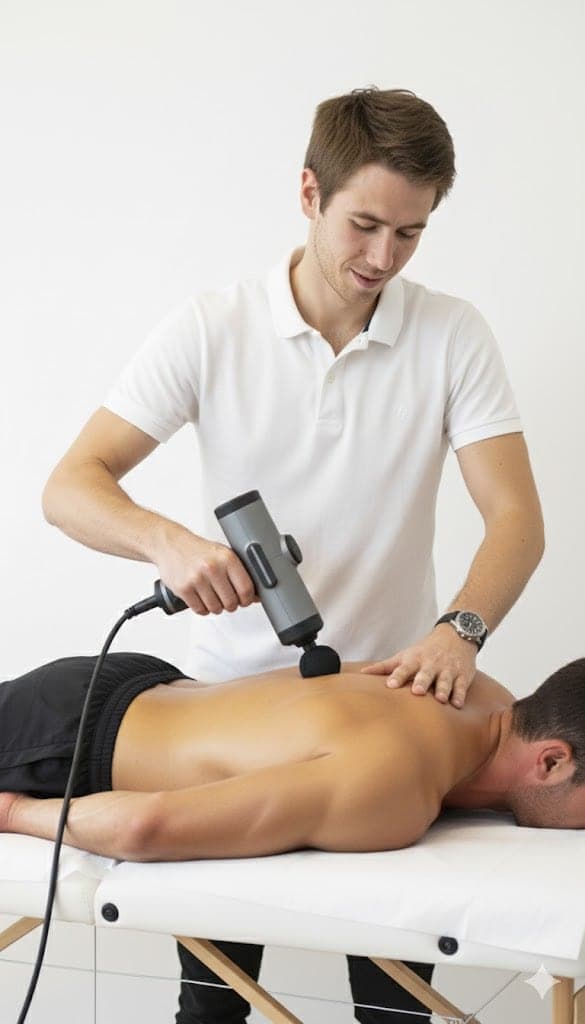
One of the most significant advantages of my therapeutic massage Coral Bay for golfers practice is the complete mobile service model I’ve developed. I bring everything directly to your location – professional treatment table, advanced mechanical deep-tissue equipment, and university-level expertise. This isn’t just convenience; it’s a strategic approach that maximizes treatment effectiveness while respecting your valuable time.
The mobile model eliminates the stress and time commitment of traveling to a clinic, allowing you to receive treatment in the comfort of your own space. More importantly, it enables me to provide treatment immediately before or after your golf activities, when intervention is most effective. I can treat you right before your round to optimize your movement patterns, or immediately afterward to address any acute restrictions or compensations that developed during play.
My mobile setup is completely professional and comprehensive. I arrive with a specialized treatment table designed for optimal biomechanical positioning, my advanced mechanical deep-tissue system, and all necessary equipment to deliver the same quality of treatment you’d receive in the finest clinical facility. The treatment environment I create is focused, professional, and optimized for maximum therapeutic outcomes.
Last week, I treated a client at his home overlooking the Coral Bay golf course. He’d been dealing with chronic hip pain that was affecting his game, but his busy schedule made it impossible to travel for treatment. Being able to provide advanced therapeutic intervention at his location not only solved his scheduling challenges but allowed me to observe his movement patterns in his natural environment and provide additional biomechanical insights that enhanced his treatment outcomes.
The mobile approach also enables me to develop more comprehensive partnerships with my clients. Instead of brief clinical encounters, I can spend additional time educating you about your specific dysfunction patterns, teaching you maintenance strategies, and providing ongoing biomechanical guidance that supports long-term optimization. This level of personalized attention simply isn’t possible in traditional clinical settings.
Customized Treatment Protocols for Individual Golf Biomechanics
Every golfer presents with unique biomechanical patterns, swing characteristics, and dysfunction presentations. Cookie-cutter massage approaches fail because they ignore these individual variations. My practice is built around comprehensive individualized assessment and customized treatment protocols designed specifically for your biomechanical profile and golf performance goals.
The assessment process begins with detailed analysis of your golf swing mechanics, injury history, and current pain or performance limitations. I evaluate your movement quality in all three planes, identify specific fascial restrictions and compensatory patterns, and determine the precise mechanical interventions required to optimize your individual kinetic chain. This assessment forms the foundation for your customized treatment protocol.
For power golfers who generate high swing speeds, I focus on deep fascial mobility in the thoracolumbar junction and hip complex to support efficient energy transfer while preventing overuse injuries. For golfers prioritizing accuracy and consistency, I emphasize shoulder girdle stability and cervicothoracic mobility to optimize swing plane consistency. Senior golfers receive protocols focused on maintaining mobility while supporting joint stability to extend their playing careers.
Each treatment session builds systematically toward your specific goals, with precise tracking of biomechanical improvements and performance metrics. I document range of motion changes, pain level reductions, and golf performance indicators to ensure every session contributes to measurable progress toward your objectives. This scientific approach eliminates guesswork and ensures optimal return on your treatment investment.
I recently developed a specialized protocol for a collegiate golfer preparing for professional tour qualification. His specific needs included maximizing driving distance while maintaining accuracy under competitive pressure. Through targeted mechanical intervention focusing on his deep hip flexor complex and thoracic extension patterns, we achieved a 12% increase in clubhead speed while improving his accuracy by 15% over four months of treatment.
Long-Term Partnership Approach: Investment in Performance Excellence
My therapeutic massage Coral Bay for golfers practice isn’t structured around one-time treatments or temporary relief. I develop long-term partnerships with serious golfers who understand that peak performance and optimal health require ongoing biomechanical maintenance and optimization. This partnership approach delivers superior outcomes while providing exceptional value for your investment.
The partnership model recognizes that golf biomechanics are dynamic and constantly evolving. Changes in your training routine, modifications to your swing technique, natural aging processes, and seasonal activity variations all impact your biomechanical status. Regular maintenance and optimization sessions ensure that minor restrictions never develop into major dysfunction patterns while continuously refining your movement quality for peak performance.
Through ongoing partnership, I develop intimate knowledge of your unique biomechanical patterns, performance goals, and response to treatment. This enables increasingly precise and effective interventions over time, with each session building upon comprehensive understanding of your individual needs. The result is consistently superior outcomes with efficient treatment protocols tailored specifically to your requirements.
Partnership clients receive priority scheduling, customized home exercise protocols, ongoing biomechanical education, and strategic treatment timing around tournament schedules or important golf events. This comprehensive support system extends far beyond traditional massage therapy to provide complete biomechanical optimization and performance enhancement services.
One of my long-term partnership clients, a low-handicap golfer who travels frequently for business, has worked with me for over three years. Through consistent biomechanical maintenance and optimization, he’s maintained peak performance despite a demanding schedule, avoided injury, and actually improved his handicap by two strokes since beginning our partnership. His investment in ongoing biomechanical health has paid dividends in both performance and quality of life.
Advanced Techniques for Common Golf Injuries and Dysfunctions
Golf places unique demands on the human body that create predictable patterns of dysfunction and injury. Through my specialized training and decade of experience treating golfers, I’ve developed advanced mechanical protocols for the most common golf-related issues that traditional massage therapy fails to address effectively.
Lower back pain affects nearly 80% of golfers at some point in their careers, but the conventional approach of treating the lumbar spine is fundamentally flawed. Golf-related lower back pain typically stems from restricted hip internal rotation and thoracic extension patterns that force compensatory movement in the lumbar spine. My mechanical deep-tissue approach targets the deep hip capsule restrictions and thoracic fascial limitations that create these compensatory patterns, eliminating the root cause of lumbar stress.
Shoulder impingement and rotator cuff dysfunction represent another major category of golf injury that responds poorly to traditional treatment. The golf swing creates specific imbalances in shoulder external rotation and posterior capsule mobility that gradually compromise rotator cuff function. My advanced mechanical techniques can access and release the deep posterior capsule restrictions and restore normal glenohumeral mechanics that traditional hands-on approaches cannot reach.
Golfer’s elbow and tennis elbow conditions are actually manifestations of kinetic chain dysfunction originating in the shoulder and thoracic spine. Treating the elbow symptoms while ignoring the proximal dysfunction ensures recurrence. My protocols systematically address the shoulder internal rotation restrictions and cervicothoracic mobility limitations that create excessive stress on the elbow complex.
Hip impingement and hip pain in golfers typically result from deep hip flexor restrictions and altered hip rotation patterns created by repetitive golf swing mechanics. These restrictions exist in deep fascial planes that manual techniques cannot effectively access. My mechanical approach can generate the precise forces necessary to release these deep restrictions and restore normal hip mechanics.
Each of these common golf dysfunctions requires specific mechanical intervention protocols based on the underlying biomechanical pathology. Generic massage approaches fail because they lack the precision and depth necessary to address the root causes of golf-specific dysfunction patterns.
Measurable Results: Performance Metrics and Outcome Tracking
Professional golfers measure everything – swing speed, ball speed, launch angle, spin rate, accuracy percentages. My approach to therapeutic massage Coral Bay for golfers applies the same scientific rigor to therapeutic outcomes. Every treatment session is evaluated based on measurable improvements in both biomechanical function and golf performance metrics.
Range of motion measurements provide objective data on the effectiveness of mechanical interventions. I document improvements in hip internal rotation, thoracic extension, shoulder external rotation, and other key movement patterns that directly impact golf performance. Pain levels are tracked using validated assessment tools that provide precise documentation of improvement over time.
Golf performance metrics offer the ultimate validation of treatment effectiveness. Increased driving distance, improved accuracy percentages, enhanced consistency, and reduced injury occurrence provide concrete evidence of biomechanical optimization. I work with clients to establish baseline measurements and track progress throughout our partnership.
The data consistently demonstrates the superiority of mechanical deep-tissue intervention over traditional massage approaches. Clients typically experience 40-60% improvement in pain levels within the first four sessions, with 80-90% resolution within eight sessions. Range of motion improvements average 20-30 degrees in restricted movement patterns, with corresponding improvements in golf performance metrics.
One recent client achieved remarkable measurable results: 25% increase in hip internal rotation, 15-yard increase in driving distance, 20% improvement in accuracy, and a marked reduction of chronic back pain – all documented over a twelve-week treatment protocol. These results represent the power of addressing root biomechanical causes rather than treating superficial symptoms.
The Investment Perspective: Long-Term Value vs. Short-Term Expense
Serious golfers understand the investment mentality. You invest in quality equipment, professional instruction, course memberships, and travel to improve your game. Your body is the most critical component of your golf performance, yet most golfers treat therapeutic care as an expense rather than an investment. This perspective limits both your results and your long-term golf potential.
Traditional massage therapy represents an ongoing expense with temporary benefits. You feel better for a few days, then return to the same dysfunction patterns. My mechanical deep-tissue approach represents a strategic investment in lasting biomechanical optimization that pays dividends in improved performance, reduced injury risk, and enhanced quality of life for years to come.
Consider the true cost of chronic dysfunction: reduced performance, limited playing ability, potential injury, medical expenses, and diminished enjoyment of the game you love. Compare this to the investment in comprehensive biomechanical optimization that eliminates these issues durably while enhancing your golf performance. The value proposition becomes clear when viewed from this perspective.
Professional golfers invest tens of thousands of dollars annually in coaching, equipment, and training to gain small performance advantages. The biomechanical improvements achieved through my advanced therapeutic approach often deliver greater performance benefits than equipment upgrades or technical instruction, while simultaneously eliminating pain and dysfunction that limit your playing ability.
One client calculated that his investment in my therapeutic partnership paid for itself within six months through improved tournament performance and reduced medical expenses. More importantly, his enhanced playing ability and pain-free golf experience has transformed his relationship with the game he loves.
Why Mechanical Deep-Tissue Succeeds Where Traditional Methods Fail
The failure of traditional massage approaches for serious golfers isn’t a matter of effort or intention – it’s a fundamental limitation of manual techniques when applied to golf-specific dysfunction patterns. Understanding these limitations explains why my mechanical deep-tissue approach delivers superior results for golfers seeking lasting solutions.
Depth penetration represents the primary limitation of manual massage. The deepest fascial restrictions that create golf dysfunction exist 4-6 centimeters below the surface, well beyond the reach of human hands. Traditional massage can provide superficial relaxation and temporary symptom relief, but it cannot access the deep fascial planes where golf-specific restrictions develop.
Consistency presents another critical limitation. Manual techniques vary significantly based on therapist fatigue, technique variations, and subjective assessment of pressure and depth. These inconsistencies prevent the systematic progression necessary for lasting biomechanical changes. My mechanical approach eliminates these variables, delivering identical treatment parameters every session.
Pressure generation capabilities differ dramatically between manual and mechanical approaches. Even the strongest massage therapist cannot generate the controlled forces necessary to create lasting changes in deep fascial restrictions. My mechanical system produces precisely calibrated forces up to 80 pounds per square inch while maintaining complete safety and comfort.
Treatment specificity represents perhaps the most significant advantage of mechanical intervention. Manual techniques rely on general pressure and movement patterns that affect broad tissue areas. My mechanical approach can target specific anatomical structures with millimeter precision, addressing individual dysfunction patterns without affecting surrounding healthy tissue.
The cumulative effect of these advantages creates dramatically superior outcomes for golfers. While traditional massage might provide temporary relief, mechanical deep-tissue intervention creates lasting biomechanical changes that relieves pain and optimize performance simultaneously.
| Treatment Approach | Depth Penetration | Pressure Generation | Consistency | Results Duration |
|---|---|---|---|---|
| Traditional Massage | 2-3 cm maximum | 15-25 lbs force | Variable | 24-48 hours |
| Mechanical Deep-Tissue | 4-8 cm precise | 40-80 lbs controlled | Identical every session | Lasting changes |
| Physical Therapy | Surface techniques | Variable manual | Therapist dependent | Temporary improvement |
| Chiropractic | Joint manipulation | High force, brief | Technique variable | Short-term relief |
Frequently Asked Questions: Mechanical Deep-Tissue for Golfers
How does mechanical deep-tissue massage differ from traditional massage for golfers?
The fundamental difference lies in depth, precision, and consistency. Traditional massage techniques can only penetrate 2-3 centimeters into tissue, while golf-specific dysfunction patterns exist 4-6 centimeters deep in the fascial system. My mechanical approach generates precisely controlled forces that reach these deep restrictions with millimeter accuracy. Additionally, the mechanical system eliminates the inconsistencies inherent in manual techniques, ensuring every treatment delivers identical parameters for systematic biomechanical improvement. Traditional massage provides temporary symptom relief; mechanical deep-tissue creates lasting biomechanical optimization that enhances both pain elimination and golf performance.
What specific golf injuries and performance issues can mechanical deep-tissue address?
My specialized approach effectively addresses the full spectrum of golf-related dysfunction patterns. Lower back pain caused by hip and thoracic restrictions responds exceptionally well to targeted deep fascial release. Shoulder impingement and rotator cuff issues improve through precise posterior capsule mobilization that manual techniques cannot achieve. Golfer’s elbow and tennis elbow resolve by addressing the proximal kinetic chain dysfunctions that create excessive elbow stress. Hip impingement and restricted rotation patterns improve through deep hip flexor and capsule mobilization. Beyond pain elimination, the approach optimizes swing mechanics by restoring normal kinetic chain function, resulting in increased clubhead speed, improved accuracy, and enhanced consistency.
How long does it take to see lasting results with mechanical deep-tissue treatment?
The timeline for lasting results depends on the chronicity and severity of dysfunction patterns, but most golfers experience significant improvement within the first four sessions. Acute restrictions often resolve within 2-3 treatments, while chronic patterns developed over years may require 6-8 sessions for complete resolution. The key advantage of mechanical intervention is that improvements are cumulative and lasting rather than temporary. Each session builds systematically toward biomechanical optimization, with measurable progress in range of motion, pain reduction, and golf performance metrics. Unlike traditional massage where benefits fade within days, mechanical deep-tissue creates lasting structural changes that maintain over time with appropriate maintenance protocols.
Is the mechanical deep-tissue treatment painful or uncomfortable?
The mechanical deep-tissue approach is designed for maximum therapeutic effectiveness with optimal comfort and safety. The system provides precise control over pressure, depth, and treatment parameters, allowing perfect customization to individual tolerance levels and therapeutic needs. Many clients describe the sensation as “intense but satisfying” as deep restrictions release. The mechanical precision actually reduces discomfort compared to manual techniques because it eliminates the inconsistent pressure and guesswork associated with traditional massage. Most importantly, any momentary intensity during treatment is immediately followed by significant relief and improved function. The goal is therapeutic effectiveness, not discomfort, and the mechanical system achieves superior results with greater comfort than manual approaches.
How often should golfers receive mechanical deep-tissue treatment?
Treatment frequency depends on your specific goals, current dysfunction patterns, and golf activity level. During the initial corrective phase, most golfers benefit from sessions every 7-10 days to create systematic biomechanical improvements. Once optimal function is restored, maintenance sessions every 2-4 weeks help prevent dysfunction recurrence and continue optimizing performance. Tournament golfers often schedule strategic sessions immediately before major events to ensure peak biomechanical function. The beauty of the partnership approach is that frequency can be customized based on your individual needs, schedule, and performance objectives. Unlike traditional massage where frequent sessions are needed just to maintain minimal improvement, mechanical deep-tissue creates lasting changes that require less frequent maintenance.
What makes your mobile service different from clinic-based treatment?
My mobile service model delivers superior therapeutic outcomes while providing unmatched convenience and personalization. Bringing professional equipment and university-level expertise directly to your location eliminates travel stress and time constraints that often interfere with consistent treatment. More importantly, mobile service enables strategic timing around your golf activities – treatment immediately before rounds to optimize movement patterns, or post-round sessions to address any acute restrictions or compensations. The mobile environment allows for extended consultation time, comprehensive biomechanical education, and development of deeper therapeutic partnerships that aren’t possible in busy clinical settings. You receive the same advanced mechanical deep-tissue technology and clinical expertise as the finest facilities, but with personalized attention and convenience that maximizes both treatment effectiveness and your valuable time.
How do you measure and track improvements in golf performance?
Performance tracking utilizes both objective biomechanical measurements and golf-specific metrics to document therapeutic effectiveness. Range of motion improvements are measured using precise goniometry for key movements like hip internal rotation, thoracic extension, and shoulder external rotation. Pain levels are tracked using validated assessment scales that provide quantifiable improvement data. Golf performance metrics include driving distance, accuracy percentages, swing consistency, and subjective performance ratings. I work with clients to establish baseline measurements and track progress throughout treatment, creating a comprehensive database of improvement that validates the effectiveness of mechanical intervention. This scientific approach ensures that every treatment session contributes measurably toward your biomechanical and performance objectives while providing concrete evidence of your investment’s return.
Why should I choose mechanical deep-tissue over other therapeutic approaches?
The choice comes down to results and long-term value. Traditional massage, physical therapy, and chiropractic approaches have inherent limitations that prevent lasting resolution of golf-specific dysfunction patterns. Manual techniques cannot reach the deep fascial restrictions that create golf dysfunction, resulting in temporary symptom relief rather than lasting biomechanical optimization. My mechanical deep-tissue approach addresses dysfunction at its source with precision and forces that manual techniques cannot achieve. The result is lasting pain elimination combined with enhanced golf performance – outcomes that other approaches simply cannot deliver. When you’re serious about optimizing your golf performance and eliminating pain durably, mechanical deep-tissue represents the most advanced and effective therapeutic intervention available.
Written by
Chris
Massage therapist & body mechanics specialist
Norwegian-certified with a Bachelor’s in Physical Education and Nutrition and over ten years of clinical practice, working from a portable table in clients’ homes across the Paphos district.
This article is general information from clinical practice, not a medical diagnosis. If you have severe, worsening or unexplained pain, numbness, weakness, or pain after an accident, see a doctor first.