
Deep Tissue Massage for Cyclists Coral Bay: Advanced Mechanical Treatment for Performance and Recovery
In short
Discover how specialized deep tissue massage for cyclists in Coral Bay addresses chronic muscle knots, enhances performance, and prevents injury through advanced mechanical techniques that go beyond traditional hands-on therapy.
I’ve worked with dozens of cyclists in Coral Bay over the past decade, and I can tell you with absolute certainty: most of you are riding with compromised biomechanics. You’ve adapted to muscle knots in your quads, adhesions in your hip flexors, and chronic tightness through your IT bands that you’ve simply accepted as “part of cycling.” But here’s what my ten years of specialized experience and my background in Physical Education and Nutrition from Norway have taught me—these aren’t normal conditions you need to tolerate. They’re mechanical problems with mechanical solutions.
When a competitive cyclist came to me last month complaining of persistent lateral knee pain that three different therapists couldn’t resolve, I knew exactly where to look. Within fifteen minutes of precise, mechanical deep tissue work on his vastus lateralis and IT band insertion points, we’d identified adhesions that were literally pulling his patella off-track with every pedal stroke. After four targeted sessions, he wasn’t just pain-free—he posted a personal best on his regular climb. That’s the difference between treating symptoms and addressing mechanical dysfunction at its source.
Why Cyclists in Coral Bay Develop Deep Muscle Knots
The biomechanics of cycling create a unique pattern of muscular stress that most massage therapists fundamentally misunderstand. You’re performing thousands of repetitive contractions in a fixed position, generating enormous force through a limited range of motion. This creates what I call “layered compensation patterns”—your body recruiting secondary and tertiary muscle groups to compensate for primary movers that have developed adhesions and trigger points.
Let me break down what actually happens in your muscle tissue during those long rides through Coral Bay’s varied terrain. When you’re grinding up a hill in Zone 4, your quadriceps are contracting concentrically thousands of times per hour. Each contraction produces metabolic waste products and microscopic tears in the muscle fibers. If these aren’t properly cleared and the tissue isn’t mechanically reset, they begin forming adhesions—literally cross-links between muscle fibers that weren’t meant to be connected.
The Cascade Effect of Untreated Muscle Dysfunction
Here’s where it gets worse. Those adhesions change your muscle’s mechanical properties. Instead of smooth, coordinated contractions, you’re now working with tissue that has stiff, inflexible areas. Your nervous system detects this changed tension pattern and does something clever but ultimately destructive: it recruits other muscles to compensate. Your glutes might start firing differently. Your hamstrings pick up slack. Your lower back muscles engage when they shouldn’t.
Within weeks, you’ve developed a completely altered movement pattern. You might not even notice it consciously, but I can see it immediately in how you move. More importantly, I can feel it in the tissue—those secondary compensation patterns create their own trigger points and adhesions, spreading the dysfunction throughout your kinetic chain.
| Muscle Group | Primary Dysfunction in Cyclists | Compensatory Pattern | Clinical Outcome |
|---|---|---|---|
| Quadriceps (Vastus Lateralis) | Adhesions from repetitive eccentric loading | IT band tension, altered patellar tracking | Lateral knee pain, reduced power output |
| Hip Flexors (Iliopsoas) | Chronic shortening from fixed hip angle | Anterior pelvic tilt, lumbar hyperextension | Lower back pain, reduced glute activation |
| Piriformis | Overactivation from saddle pressure | Sciatic nerve compression, altered hip rotation | Radiating leg pain, numbness in feet |
| Thoracic Erectors | Isometric loading from aero position | Restricted thoracic mobility, forward head posture | Neck pain, restricted breathing capacity |
Why Traditional Massage Fails Cyclists
I’m going to say something that might offend other massage therapists, but it needs to be said: traditional hands-on massage is fundamentally inadequate for treating the deep muscular dysfunction that cyclists develop. I’m not talking about relaxation massage—that’s fine for what it is. I’m talking about the supposedly “deep tissue” work that most therapists perform, which rarely reaches the actual pathological tissue that’s causing your problems.
The human hand, no matter how strong or skilled, has biomechanical limitations. To reach the deep layers of your quadriceps—where those adhesions are actually forming—requires sustained, precise pressure at depths that human thumbs and elbows simply cannot maintain consistently. I’ve watched therapists struggle, using their entire body weight, to penetrate tissue that my specialized mechanical tools access effortlessly within seconds.
The Variability Problem
Beyond depth, there’s the issue of consistency. Even the most experienced manual therapist has off days. Their pressure varies based on fatigue, their hand position changes slightly between sessions, and they simply cannot deliver identical treatment week after week. When you’re trying to systematically break down adhesions and restore proper tissue mechanics, this variability is unacceptable. You need precision. You need consistency. You need mechanical advantage.
That’s why I made the decision years ago to specialize exclusively in advanced mechanical deep tissue massage. The specialized equipment I use delivers pressure that’s simultaneously deeper, more precise, and infinitely adjustable compared to any hands-on technique. We’re not talking about some vibrating device or percussion gun—this is a sophisticated mechanical system that allows me to control depth, angle, and intensity with millimeter precision.
Deep Tissue Massage for Cyclists: What Actually Works
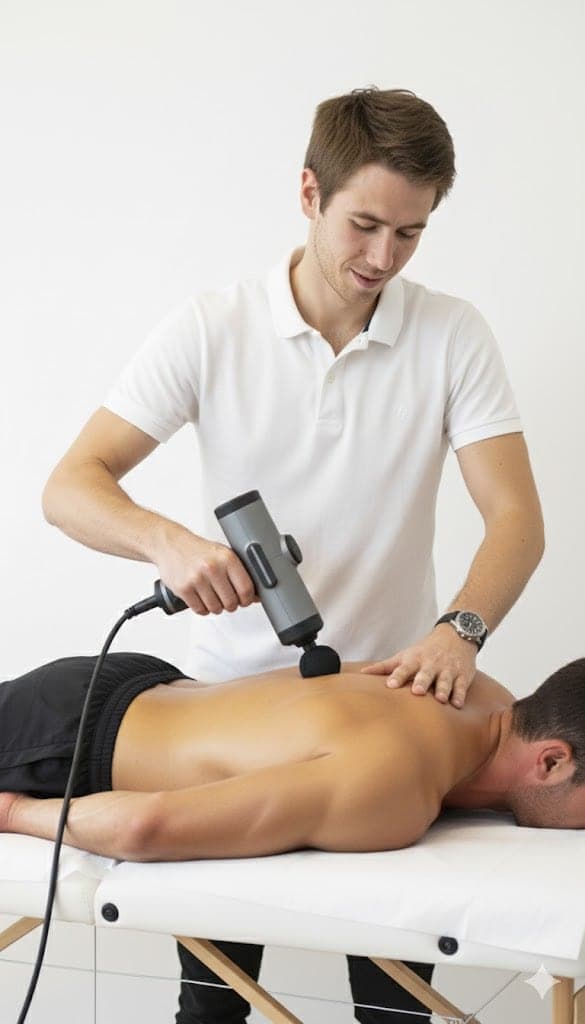
Let me walk you through what effective deep tissue treatment for cyclists in Coral Bay actually looks like, because it’s completely different from what you’ve probably experienced before. I travel to your location with a professional treatment bench and everything needed for a clinical session, because this work requires proper positioning and the right environment.
Initial Assessment and Mechanical Diagnosis
We start with a comprehensive biomechanical assessment. I’m not just asking “where does it hurt?”—I’m evaluating your entire kinetic chain. How does your pelvis move through hip flexion? What’s the actual contractile quality of your quadriceps? Are your hamstrings exhibiting normal excursion patterns, or are they locked short from years of cycling in a fixed position?
I use palpation techniques developed through ten years of specialized practice to identify exactly where the pathological tissue exists. Not surface-level tension—I’m talking about the deep fascial restrictions and muscular adhesions that are actually limiting your performance and causing your pain. This diagnostic phase isn’t rushed. It takes time to properly map your dysfunction.
Mechanical Deep Tissue Protocol for Cyclists
Once I’ve identified the problem areas, we begin the actual treatment. Using the specialized mechanical system, I work systematically through the affected tissue. The key difference you’ll notice immediately is the depth. We’re accessing layers that you’ve probably never had treated before. The tool works with consistent, controlled pressure that penetrates far beyond what hands can achieve, breaking up those adhesions at their source.
The intensity is precisely adjusted to your tolerance and the tissue’s response. For an elite cyclist with dense, hypertrophied muscle tissue, I can deliver powerfully deep pressure that would be impossible to sustain manually. For someone newer to serious cycling, we start more conservatively and progress as your tissue adapts. This adjustability is crucial—it allows us to treat the actual problem without overwhelming your nervous system’s tolerance for mechanical input.
Targeted Areas for Cycling-Specific Dysfunction
- Vastus lateralis and medialis: Addressing the quadriceps adhesions that alter patellar tracking and limit power output
- Iliopsoas complex: Releasing the hip flexor shortening that creates anterior pelvic tilt and inhibits glute activation
- Piriformis and deep hip rotators: Decompressing the sciatic nerve pathway and restoring proper hip mechanics
- IT band and lateral thigh structures: Breaking down the fascial restrictions that cause lateral knee pain
- Thoracic erector spinae: Releasing the chronic tension from maintaining aero position
The Difference Between Symptom Management and Lasting Results
Here’s what separates my approach from the endless cycle of temporary relief that most cyclists experience with traditional massage. I’m not trying to make you feel better for a few days. I’m treating the actual mechanical cause of your dysfunction, which means the results are cumulative and lasting.
When we break down a significant adhesion in your vastus lateralis, that adhesion doesn’t just re-form next week. Once the cross-linked fibers are mechanically separated and the tissue is returned to its proper sliding interface, it stays separated. Your body’s natural healing processes take over, laying down properly organized collagen and restoring normal mechanical properties.
This is why I work through dedicated partnerships with my clients, not one-off sessions. Real biomechanical change takes time and systematic progression. The first session identifies and begins addressing the primary dysfunctions. Subsequent sessions work deeper, tackle compensatory patterns, and progressively restore your entire kinetic chain to optimal function.
What Lasting Results Actually Mean
I had a cyclist tell me recently, “I’ve spent thousands of dollars on massage over the years, always needing another session, always re-developing the same problems. After working with you, I finally understand why—nobody was actually fixing anything.” That’s exactly right. Temporary relief is easy. Lasting change requires precision, depth, and a scientific understanding of what’s actually wrong with the tissue.
When I say lasting results, I mean:
- The chronic muscle knots that limited your range of motion and caused pain are mechanically broken down and don’t return
- Your biomechanical patterns are optimized, so you’re no longer creating new compensatory dysfunction
- Your power output increases because muscles are contracting efficiently through their full, unrestricted range
- Your recovery improves because tissue that’s mechanically healthy processes metabolic waste effectively
- Your injury risk decreases because you’re moving with proper mechanics, not adapted compensatory patterns
Case Study: Resolving Chronic IT Band Syndrome in a Coral Bay Triathlete
Let me share a specific case that illustrates exactly what’s possible with proper mechanical treatment. A triathlete in Coral Bay had been struggling with IT band syndrome for over eighteen months. She’d tried everything: rest, stretching, foam rolling, cortisone injections, multiple physical therapists, countless massage sessions. Nothing provided lasting relief, and she was considering giving up competitive racing.
The Actual Problem
When I assessed her, the issue was immediately apparent to me—though it had been missed by everyone else she’d seen. Yes, her IT band was tight. Yes, she had lateral knee pain. But those were symptoms, not causes. The actual problem was a massive adhesion in her vastus lateralis where it interfaces with the IT band, combined with a completely dysfunctional firing pattern in her gluteus medius that was forcing her IT band to work as a primary hip stabilizer instead of the passive tensioning structure it’s designed to be.
Traditional treatment had focused on the IT band itself—stretching it, rolling it, even needling it. But you can’t significantly lengthen the IT band—it’s an incredibly strong fascial structure. What you can do is address the muscular dysfunction around it that’s creating abnormal tension.
The Mechanical Solution
Over six sessions, we systematically broke down the quadriceps adhesions using sustained mechanical pressure at depths her previous therapists never reached. We released the fascial restrictions between her vastus lateralis and IT band. We addressed the trigger points in her tensor fasciae latae that were creating referred pain. Most importantly, we restored proper length-tension relationships to her hip abductors so her glute med could actually do its job.
The result? She’s now pain-free, has posted personal bests in two recent races, and understands her body’s mechanics well enough to maintain the improvements through proper training load management. That’s what treating the cause instead of the symptoms looks like.
Understanding the Investment in Performance Optimization
I’m going to be direct with you about something: effective deep tissue treatment for serious cyclists is an investment, not an expense. When you spend money on a lighter wheelset or aerodynamic equipment, you’re investing in marginal performance gains. When you invest in proper biomechanical treatment, you’re addressing fundamental limitations that might be costing you ten or twenty percent of your potential power output.
Think about what that actually means. If you’re currently producing 250 watts at threshold, but adhesions in your quadriceps and hip flexors are limiting your muscle recruitment and efficiency by just fifteen percent, you’re leaving nearly 40 watts on the table. No amount of training can overcome mechanical dysfunction—you’re just reinforcing dysfunctional movement patterns.
The True Cost of Ignoring Biomechanical Dysfunction
Beyond performance, consider the injury risk. Every ride you do with compensatory movement patterns is reinforcing those patterns, spreading dysfunction through your kinetic chain, and moving you closer to an overuse injury that could sideline you for months. I’ve seen it happen repeatedly—cyclists who ignored chronic tension patterns until they developed full stress fractures, severe tendinopathies, or disc herniations that required surgery.
The cyclists who work with me understand this perspective. They see the mechanical treatment not as an optional luxury, but as essential maintenance for a body they’re asking to perform at high levels. Just as you wouldn’t run your bike without maintaining the drivetrain, you can’t push your body hard without addressing the mechanical dysfunction that naturally accumulates from repetitive high-intensity activity.
| Traditional Approach | Mechanical Deep Tissue Approach |
|---|---|
| Addresses surface-level tension | Targets deep adhesions and fascial restrictions |
| Provides temporary symptom relief | Creates lasting biomechanical change |
| Inconsistent depth and pressure | Precision control of depth, angle, and intensity |
| Limited by therapist’s physical capacity | Mechanical advantage reaches inaccessible tissue |
| One-size-fits-all pressure | Infinitely adjustable from light to powerfully deep |
| Focuses on relaxation | Optimizes performance and prevents injury |
The Science Behind Mechanical Advantage in Soft Tissue Treatment
Let me explain the biomechanical principles that make mechanical deep tissue work fundamentally superior to manual techniques. This isn’t subjective—it’s physics and physiology.
Depth and Pressure Distribution
Human tissue has what we call “viscoelastic properties”—it behaves partly like a solid and partly like a fluid, depending on the rate and duration of force application. To effectively treat deep adhesions, you need sustained pressure at sufficient depth to mechanically deform the pathological tissue. The deeper the target tissue, the more force is dissipated through the overlying layers.
When a therapist uses their thumb or elbow, they’re limited by their body weight, leverage, and most critically, the size of their contact surface. The pressure they can deliver at depth is geometrically limited by these factors. My mechanical system, by contrast, concentrates force through a specifically designed contact surface, delivering therapeutic pressure to deep tissue layers while the overlying structures experience appropriate but non-damaging compression.
Consistency and Neurological Adaptation
Your nervous system is incredibly sophisticated at detecting pressure patterns. When you receive manual treatment, your body is constantly adjusting to slight variations in pressure, angle, and depth. This neurological “noise” interferes with the mechanical work we’re trying to accomplish—your muscles engage protectively in response to unpredictable stimuli.
Mechanical treatment delivers absolutely consistent pressure. Your nervous system quickly adapts to this consistent stimulus, reducing protective muscle guarding and allowing us to work deeper and more effectively. This is why I can often achieve in one mechanical session what would take three or four manual sessions to accomplish—we’re working with your neurology, not fighting against it.
Frequently Asked Questions About Deep Tissue Massage for Cyclists in Coral Bay
How is your mechanical deep tissue approach different from percussion massage guns?
Completely different mechanisms and purposes. Percussion devices deliver rapid, superficial impacts designed for general muscle stimulation and blood flow enhancement. They work perpendicular to the tissue surface and don’t provide the sustained, deep pressure necessary to break down adhesions. My mechanical system delivers controlled, sustained compression that can be held at precise depths and angles for extended periods, actually separating cross-linked fibers and restoring proper tissue mechanics. It’s the difference between tapping on a door and using a pry bar.
Will this hurt more than traditional massage?
The sensation is different, not necessarily more painful. Because we’re working deeper and more precisely on actual pathological tissue, you’ll feel more intense pressure. However, unlike the vague, spreading discomfort of traditional deep massage, this is a focused, specific sensation. Most clients describe it as “intense but satisfying”—they can feel we’re accessing the problem tissue. The adjustability is key: I can precisely control intensity to stay within your tolerance while still achieving therapeutic effect.
How many sessions will I need to see results?
This depends on the severity and duration of your dysfunction. Some acute issues—like a recent muscle strain with localized tension—might show dramatic improvement in one or two sessions. Chronic conditions that have developed over years of cycling require systematic treatment, typically six to eight sessions to fully resolve the primary dysfunction and address compensatory patterns. Remember, we’re creating lasting mechanical change, which requires time and progression.
Can this help with cycling-specific issues like saddle soreness and numbness?
Absolutely. Saddle soreness and numbness are usually caused by compression of neurovascular structures by hypertonic pelvic floor muscles or adhesions in the hip flexors and glutes that create abnormal pressure distribution. I’ve resolved countless cases of pudendal nerve compression, ischial pain, and genital numbness through targeted treatment of the deep hip rotators, pelvic floor, and proximal hamstring attachments. These are areas that traditional massage rarely addresses effectively because they require precise, deep work.
What’s the difference between your service and physical therapy?
Physical therapy typically focuses on rehabilitation exercises, movement pattern training, and sometimes manual therapy as a component. My service is specialized mechanical soft tissue work—I’m addressing the tissue restrictions that limit your movement and cause pain. These approaches are complementary, not competing. Many of my clients work with physical therapists who handle the movement re-education while I handle the advanced soft tissue work. The mechanical treatment I provide goes deeper and more precisely than what most physical therapists can deliver with manual techniques.
Do I need to stop cycling during treatment?
Usually not. In fact, I prefer you continue cycling so we can monitor how the mechanical changes we’re making translate to your performance and symptoms during actual riding. We might adjust training load or intensity during the initial treatment phases, especially if we’re addressing significant dysfunction. The goal isn’t to remove you from the activity you love—it’s to optimize your mechanics so you can perform better and ride pain-free.
How do you know where to work if the pain is in one area but the problem is elsewhere?
This is where my decade of specialized experience and education in body mechanics becomes crucial. Pain is often a poor indicator of actual dysfunction—it’s simply where your nervous system happens to be registering the problem. Through comprehensive biomechanical assessment and palpation, I identify the actual tissue restrictions, adhesions, and compensatory patterns that are creating your symptoms. For example, knee pain in cyclists is rarely about the knee itself—it’s usually about hip mechanics, quadriceps adhesions, or foot/ankle mobility affecting the entire kinetic chain.
What happens to the tissue when you break down adhesions?
When we mechanically separate adhesions, we’re literally breaking apart the pathological cross-links between muscle fibers or between muscle and fascia. This creates a controlled inflammatory response—your body recognizes the mechanical change and initiates healing processes. Over the following days, your system lays down new, properly organized collagen along the lines of functional stress. The tissue becomes more mobile, muscles can contract more efficiently, and blood flow improves. This is why results continue improving for several days after treatment.
Why do you travel to clients instead of having them come to a clinic?
Two reasons. First, serious cyclists have demanding training schedules and often limited recovery time between sessions. By coming to you, I eliminate the additional stress and time commitment of traveling to a clinic. Second, treating you in your own environment allows me to provide follow-up coaching about positioning on your bike, training load management, and other factors that might be contributing to your dysfunction. It’s a more comprehensive, partnership-based approach than a clinical transaction.
Beyond Pain Relief: Performance Optimization for Serious Cyclists
While most cyclists seek me out because they’re in pain, the real value of proper biomechanical treatment extends far beyond pain relief. Once we’ve addressed your primary dysfunctions and compensatory patterns, we enter a phase I call “performance optimization”—fine-tuning your mechanics to maximize power output, efficiency, and endurance.
Power Output and Muscle Recruitment Patterns
When your muscles are mechanically healthy—free of adhesions, with optimal length-tension relationships and proper fascial sliding interfaces—they can generate more force with less neural drive. I’ve had multiple cyclists report five to ten percent improvements in FTP after completing a treatment series, without any changes to their training program. That’s not because the massage made them “stronger”—it’s because their muscles can now contract efficiently through their full range, recruiting more motor units with better coordination.
Think about what’s happening at the cellular level. When you have adhesions in your vastus lateralis, some percentage of muscle fibers are literally stuck to neighboring fibers or to the surrounding fascia. They cannot lengthen and shorten independently. When you contract that muscle, you’re not getting full contribution from those restricted fibers. Now multiply that effect across all the muscles involved in the pedal stroke. You’re potentially losing substantial power output to mechanical inefficiency.
Recovery Enhancement and Training Adaptation
Mechanically healthy tissue recovers faster. When your muscles can move freely through their full excursion, without restriction from adhesions or fascial limitations, metabolic waste products are cleared more efficiently. Blood flow is unrestricted. The muscle can relax fully between contractions. This means you recover better between intervals, between training sessions, and between hard efforts.
I work with several competitive cyclists who’ve noticed they can handle higher training volumes after optimizing their tissue mechanics. They’re not magically more fit—their bodies are simply more mechanically efficient at managing the stress of training. Less compensation means less cumulative fatigue. Better recovery means better adaptation. It’s a performance multiplier that no training plan alone can provide.
Why Location Matters: Deep Tissue Massage for Cyclists in Coral Bay
Coral Bay presents unique challenges for cyclists that directly influence the patterns of dysfunction I treat. The terrain here—with its sustained climbs, technical descents, and exposed coastal riding—creates specific biomechanical stress patterns that manifest in predictable ways.
Climbing-Related Dysfunction
The extended climbs in this region force cyclists into prolonged periods of high-tension, low-cadence work. This creates tremendous stress on the hip flexors, particularly the iliopsoas, which must maintain hip flexion against significant resistance for extended periods. I see more hip flexor pathology in Coral Bay cyclists than anywhere else I’ve worked—chronic shortening, adhesions at the iliacus attachment, and referred pain into the anterior thigh and groin.
The quadriceps endure enormous eccentric loading during climbing as well, particularly in cyclists who tend to push big gears. Those repetitive eccentric contractions at high tension are the perfect recipe for creating the deep adhesions I spend much of my practice addressing.
Descending and Handling Stress
The technical descents and variable road conditions here also create their own pattern of dysfunction. Cyclists maintain isometric contractions throughout their trunk, shoulders, and arms for extended periods while descending. This sustained isometric loading creates trigger points and fascial restrictions through the thoracic erector spinae, upper trapezius, and levator scapulae that contribute to neck pain, headaches, and restricted thoracic mobility.
The grip tension required for controlling the bike on rough surfaces creates chronic tension through the forearm flexors and can even contribute to thoracic outlet syndrome in susceptible individuals. These are issues that non-cycling massage therapists often miss entirely because they don’t understand the sport-specific biomechanics creating the dysfunction.
Making the Decision: Is Advanced Mechanical Deep Tissue Right for You?
Not every cyclist needs the level of specialized treatment I provide. If you’re a recreational rider with no chronic pain, normal mobility, and no performance limitations, you probably don’t need intensive mechanical work. Basic maintenance massage might be perfectly adequate.
But if you recognize yourself in any of these descriptions, we should talk:
- You have chronic pain or discomfort that hasn’t resolved despite rest, stretching, or previous massage therapy
- You’ve noticed declining performance that doesn’t correspond to your training—you’re working as hard but getting slower
- You have persistent muscle knots or areas of tension that return quickly after treatment
- You experience numbness, tingling, or radiating pain during or after rides
- You’ve developed compensatory movement patterns—your position on the bike feels “off” but you can’t identify why
- You’re training seriously and want to optimize your biomechanics for competitive performance
- You’ve been told you need to “just stretch more” or “strengthen” certain muscles, but those interventions haven’t helped
These are indicators of actual mechanical dysfunction that requires skilled, precise treatment. These problems don’t resolve on their own—they progress. Every ride you do with compromised mechanics reinforces the dysfunction and increases your risk of serious injury.
The Partnership Approach
When you work with me, you’re not booking isolated massage sessions. We’re entering a therapeutic partnership with a clear goal: lasting resolution of your mechanical dysfunction and optimization of your performance capacity. This requires commitment on both sides. I bring my expertise, specialized equipment, and ten years of experience. You bring consistency, honest communication about your symptoms and training, and willingness to follow through on any recommendations I provide about training load or movement patterns.
The cyclists who get the best results are those who understand this isn’t a quick fix. We’re systematically rebuilding tissue quality and mechanical function that may have deteriorated over years. That takes time, progression, and dedicated work. But the outcome—being able to ride at your full potential, pain-free, with optimized biomechanics—is worth every bit of that investment.
Taking Action: The Next Step
If you’re serious about addressing your chronic muscle tension, improving your performance, or finally resolving pain that’s limited your cycling, the next step is straightforward. I provide in-home treatment throughout Coral Bay, bringing a professional treatment bench and all necessary equipment to your location.
During your initial session, we’ll conduct a comprehensive biomechanical assessment to identify exactly what’s limiting you. I’ll explain precisely what I find in the tissue, why it’s causing your specific symptoms, and what the treatment plan looks like to resolve it. You’ll experience the mechanical deep tissue approach firsthand and understand immediately how it differs from anything you’ve tried before.
This is your body. Your performance. Your quality of life on and off the bike. The question isn’t whether you can afford to invest in proper biomechanical treatment—it’s whether you can afford not to. Every ride you do with compromised mechanics is reinforcing dysfunction and moving you closer to injury or burnout.
I’ve spent ten years developing the expertise and methodology to provide what I consider the most effective soft tissue treatment available for serious cyclists. I’ve worked with everyone from recreational riders to professional athletes, and the results speak consistently: when you treat the actual mechanical cause of dysfunction with precision, power, and consistency, bodies respond. Pain resolves. Performance improves. Quality of life transforms.
The cyclists in Coral Bay who train and ride at the highest levels understand that optimized biomechanics aren’t optional—they’re fundamental. They’re not looking for temporary relief or superficial treatment. They’re looking for a specialist who can identify exactly what’s wrong, explain it clearly, and deliver treatment that creates lasting change.
That’s exactly what I provide. No massage theater. No pretending that light, relaxing strokes are addressing deep mechanical dysfunction. Just expert assessment, advanced mechanical treatment, and a dedicated partnership focused on getting you to your full potential on the bike.
Your body is capable of more than you’re currently experiencing. The tension patterns limiting you, the compensatory movements reducing your power output, the chronic pain affecting your training—these aren’t lasting conditions you need to accept. They’re mechanical problems with mechanical solutions. Let’s solve them.
Written by
Chris
Massage therapist & body mechanics specialist
Norwegian-certified with a Bachelor’s in Physical Education and Nutrition and over ten years of clinical practice, working from a portable table in clients’ homes across the Paphos district.
This article is general information from clinical practice, not a medical diagnosis. If you have severe, worsening or unexplained pain, numbness, weakness, or pain after an accident, see a doctor first.