
Sports Massage Specialists Pegeia: Advanced Mechanical Deep-Tissue Treatment for Athletes
In short
Looking for sports massage specialists in Pegeia? Discover how advanced mechanical deep-tissue therapy delivers lasting pain relief and enhanced athletic performance through precision treatment of body mechanics.
After a decade working with everyone from weekend warriors to professional athletes, I’ve witnessed a fundamental disconnect in how most people approach sports massage in Pegeia. They walk into treatment rooms expecting temporary relief—a quick fix before their next training session or competition. What they don’t realize is that this approach keeps them trapped in a cycle of recurring pain and suboptimal performance.
I’m not a relaxation therapist. My background is in Physical Education and Nutrition from Norway, and my practice centers on one singular objective: identifying and durably resolving the mechanical dysfunctions that limit your athletic potential. When athletes in Pegeia search for sports massage specialists, they’re often looking for someone who understands the biomechanical demands of their sport—the repetitive stress patterns, the compensatory movement strategies, the cascade of tissue restrictions that develop when the body adapts to training load.
The Problem With Traditional Sports Massage Approaches
Most sports massage specialists in Pegeia operate within a framework I abandoned years ago. They apply manual techniques that provide temporary symptom relief without addressing the underlying mechanical restrictions. Here’s what typically happens: an athlete presents with tight hamstrings, receives forty minutes of broad pressure and stretching, feels temporarily better, then returns in two weeks with the same complaint.
This isn’t a failure of effort—it’s a limitation of methodology.
Human hands, regardless of skill level, cannot consistently reach the depth required to release chronic fascial restrictions and trigger point complexes that develop in high-performance athletes. The therapist fatigues. Pressure becomes inconsistent. Deep stabilizing musculature remains untreated. The athlete experiences superficial relief while the foundational problem persists.
I’ve treated professional cyclists who spent thousands on manual therapy without resolving their chronic IT band syndrome. Tennis players who accepted shoulder impingement as “part of the sport.” Runners who believed their plantar fasciitis was lasting. In each case, the issue wasn’t the tissue itself—it was the inadequate depth and precision of previous treatment.
Why Depth Matters in Sports Massage Treatment
The athletic body develops compensation patterns that extend far beyond surface musculature. When your quadriceps are overloaded from hill running, the restriction doesn’t stay superficial—it infiltrates the vastus intermedius, affects patellar tracking, alters gait mechanics, and creates ascending dysfunction through the kinetic chain.
Treating this requires accessing tissue layers that manual pressure simply cannot reach with therapeutic precision. I’m talking about working through multiple fascial planes, releasing adhesions in deep rotator groups, addressing periosteal restrictions where muscle attaches to bone. This level of intervention demands tools that exceed human physiological limitations.
Advanced Mechanical Deep-Tissue Massage: The Scientific Alternative
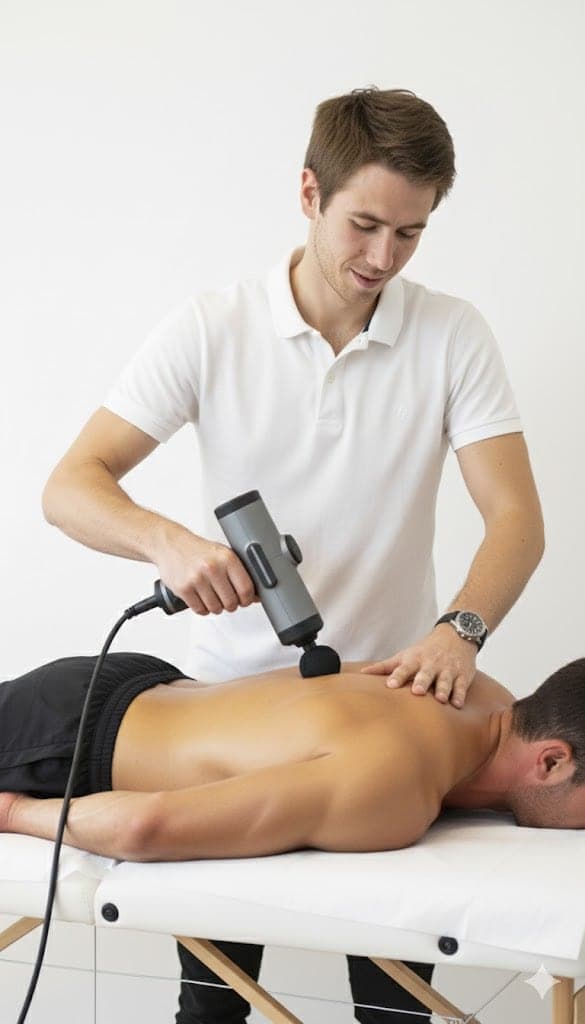
My practice utilizes specialized mechanical instrumentation that fundamentally transforms what’s possible in sports massage treatment. This isn’t about replacing clinical expertise—it’s about amplifying it through technology that delivers three critical advantages traditional methods cannot match.
Precision That Eliminates Guesswork
When I assess an athlete’s movement dysfunction, I identify specific structures requiring intervention. The mechanical system I employ allows me to target individual muscle bellies, fascial planes, and trigger point locations with millimeter-level accuracy. There’s no compensation for hand fatigue, no variation in pressure application, no approximation of depth.
I recently worked with a competitive swimmer experiencing persistent shoulder pain that limited her rotation in freestyle stroke. Manual assessment revealed restrictions in her subscapularis and anterior shoulder capsule—structures that are virtually inaccessible through traditional massage. Using mechanical intervention, I could isolate and treat these tissues with the exact pressure vectors needed to restore optimal length-tension relationships. She returned to full training capacity within three sessions.
Power That Reaches Root Causes
Athletic tissue restrictions don’t respond to superficial pressure. The chronic muscle hypertonicity, fascial densification, and trigger point activity that limit performance exist in deep stabilizing musculature—your multifidi, your deep hip rotators, your intrinsic foot muscles. Reaching these structures requires sustained pressure that exceeds what any therapist can maintain manually.
The mechanical system I use generates consistent, therapeutic force that penetrates to the tissue depth where dysfunction actually resides. This isn’t about applying more pressure—it’s about applying the right pressure to the right structure for the optimal duration. When I treat chronic hamstring tendinopathy, I’m not working the superficial hamstring belly. I’m addressing the deep muscle-tendon interface where pain-generating mechanical stress concentrates.
Consistency That Guarantees Results
Every athlete knows the frustration of receiving exceptional treatment one session, then experiencing inferior results the next because the therapist had an off day. Human performance varies. Energy fluctuates. Technique consistency suffers over multiple treatments in a single day.
Mechanical intervention eliminates this variable entirely. Your tenth treatment delivers identical precision and power as your first. There are no off days. No fatigue-induced inconsistency. No wondering whether today’s session will match last week’s breakthrough. This reliability is crucial when you’re preparing for competition or working through a structured recovery protocol.
Finding Sports Massage Specialists in Pegeia: What to Look For
If you’re searching for sports massage specialists in Pegeia, understanding the difference between relaxation therapy and performance optimization becomes essential. Most practitioners, regardless of their marketing claims, operate in the former category. They provide temporary symptom management rather than lasting mechanical correction.
| Traditional Sports Massage | Advanced Mechanical Treatment |
|---|---|
| Addresses superficial muscle tension | Targets deep fascial restrictions and trigger points |
| Provides temporary symptom relief | Resolves underlying mechanical dysfunction |
| Inconsistent pressure and depth | Precise, consistent therapeutic intervention |
| Limited by therapist fatigue | Maintains optimal treatment parameters throughout session |
| Reactive approach to pain | Proactive optimization of movement mechanics |
| One-size-fits-all sessions | Customized treatment protocols based on assessment |
My Approach to Athletic Performance Optimization
When an athlete contacts me, we don’t begin with massage. We begin with comprehensive movement assessment. I need to understand your training demands, your competition schedule, your injury history, your compensatory patterns. I analyze how your body moves, where restrictions limit optimal mechanics, what tissue adaptations have developed in response to your athletic requirements.
This assessment informs everything that follows. I’m not interested in providing generic sports massage—I’m committed to resolving the specific mechanical limitations that prevent you from performing at your potential.
The Initial Assessment Process
During our first session, I evaluate range of motion, identify movement asymmetries, palpate for tissue density changes, and test functional movement patterns relevant to your sport. A runner receives different analysis than a tennis player. A cyclist’s biomechanics require different evaluation protocols than a swimmer’s.
I’m looking for the story your tissues tell about how you move and where dysfunction has established itself. That chronic tightness in your right hip? It’s probably not a hip problem—it’s a compensation for ankle mobility restrictions or core stability deficits. Your recurring shoulder pain? Likely connected to thoracic spine rigidity and scapular dyskinesis.
Understanding these relationships allows me to design treatment protocols that address causation rather than symptoms.
Customized Treatment Protocols
No two athletes receive identical treatment in my practice. Your mechanical needs are unique, determined by your sport’s demands, your training volume, your movement history, and your performance goals. I develop individualized protocols that target your specific restrictions while supporting your training periodization.
For endurance athletes, this might mean focusing on maintaining optimal tissue quality in high-volume training blocks while preventing the fascial densification that accumulates with repetitive loading. For power athletes, treatment emphasizes maintaining muscle-tendon elasticity and addressing the localized hypertonicity that develops with maximal effort training.
I recently worked with a competitive golfer experiencing declining driving distance despite consistent training. Assessment revealed significant restrictions in his thoracic rotation and hip internal rotation—fundamental requirements for generating club head speed. Our treatment protocol focused on restoring mobility in these regions through targeted mechanical intervention. Within six weeks, he’d regained fifteen yards of driving distance and reported feeling “younger” in his movement quality.
Why Athletes in Pegeia Choose Specialized Treatment
Pegeia attracts athletes who take their performance seriously—cyclists tackling challenging terrain, runners training in excellent weather conditions, tennis players utilizing world-class facilities, swimmers accessing year-round training opportunities. These athletes don’t have time for treatment approaches that provide temporary relief without lasting results.
The Investment vs. Expense Mindset
I position my service as an investment in long-term athletic health, not a recurring expense for temporary symptom management. When you address mechanical dysfunction at its source, you’re not just treating current pain—you’re preventing future injury, optimizing movement efficiency, and extending your athletic career.
Consider the true cost of traditional massage approaches: you spend money on sessions that feel good temporarily but require constant repetition because they never resolve underlying problems. Over a year, you’ve invested significant resources without achieving lasting improvement. That’s an expense.
Advanced mechanical treatment operates differently. We target root causes, resolve mechanical restrictions durably, and establish movement patterns that support sustained performance. After completing a treatment protocol, many athletes require only periodic maintenance rather than constant intervention. That’s an investment with compounding returns.
Performance Enhancement Beyond Pain Relief
Most athletes contact me initially because something hurts. What they discover is that resolving mechanical restrictions doesn’t just relieves pain—it unlocks performance capabilities they’d forgotten they possessed.
When we restore optimal tissue quality and movement mechanics, several things happen simultaneously:
- Force production increases as muscles can contract through full, unrestricted ranges of motion
- Energy efficiency improves because the body stops compensating for movement limitations
- Injury risk decreases as load distributes appropriately through kinetic chains rather than concentrating at vulnerable points
- Recovery accelerates because tissue quality allows better nutrient delivery and waste removal
- Movement quality improves as the nervous system stops guarding against restrictions and dysfunctions
I worked with a triathlete who initially sought treatment for chronic lower back pain that appeared during long training sessions. After resolving significant hip flexor restrictions and restoring pelvic mechanics, not only did his pain disappear—his bike split improved by four minutes in his next half-ironman despite identical training. The performance gain came from eliminating mechanical inefficiencies that had limited his power transfer.
The Science Behind Mechanical Deep-Tissue Treatment
Understanding why this approach works requires examining what actually happens in athletic tissue under chronic mechanical stress. When you train consistently, your body adapts through predictable physiological processes. Muscles develop increased tone. Fascia densifies in response to repetitive loading patterns. Trigger points form in overworked tissue. Adhesions develop between tissue planes that should glide freely.
These adaptations aren’t injuries—they’re normal responses to training stress. But they accumulate. And as they accumulate, they progressively limit your movement quality and performance capacity.
Fascial Densification and Athletic Performance
Fascia—the connective tissue that surrounds and interpenetrates every structure in your body—responds to mechanical loading by changing its density and viscosity. Under repetitive stress, normally fluid and pliable fascia becomes thicker and more rigid. This densification restricts tissue gliding, limits range of motion, and alters force transmission through kinetic chains.
Manual massage provides insufficient mechanical stimulus to reverse established fascial densification. The sustained, precisely applied pressure required to restore normal tissue properties exceeds human physiological capacity. Mechanical intervention delivers the therapeutic force necessary to break down excessive fascial crosslinks and restore optimal tissue viscosity.
Trigger Point Deactivation
Trigger points—hyperirritable spots in skeletal muscle that produce localized and referred pain—develop predictably in athletes. They represent areas of sustained muscle contraction where blood flow becomes restricted, metabolic waste accumulates, and pain-producing substances concentrate.
Effective trigger point treatment requires sustained pressure at precise locations for durations that manual techniques struggle to maintain. The mechanical system I employ allows me to apply therapeutic pressure to identified trigger points with exact force levels for optimal treatment duration. This consistently deactivates trigger point activity and resolves associated pain patterns.
Restoring Optimal Length-Tension Relationships
Every muscle functions optimally at a specific length where its contractile proteins can generate maximum force. Chronic training stress, compensatory patterns, and accumulated restrictions shift muscles away from these optimal lengths. Some become chronically shortened, others chronically lengthened, and performance suffers in both cases.
Mechanical deep-tissue treatment addresses these length-tension disruptions by releasing the tissue restrictions that maintain dysfunctional muscle lengths. When we restore appropriate resting lengths, muscles regain their capacity for optimal force production and movement efficiency improves dramatically.
Specialized Treatment for Different Athletic Disciplines
Each sport creates unique mechanical demands and develops characteristic dysfunction patterns. Sports massage specialists in Pegeia need to understand these sport-specific requirements to provide truly effective treatment.
Endurance Athletes
Runners, cyclists, and triathletes accumulate tissue restrictions through high-volume repetitive movement. Common presentations include:
- IT band syndrome from repetitive hip flexion-extension
- Plantar fasciitis from accumulated foot strike stress
- Hip flexor tightness limiting stride length and running economy
- Thoracic rigidity affecting breathing mechanics and postural endurance
Treatment protocols for endurance athletes focus on maintaining tissue quality throughout high-volume training blocks, preventing the progressive fascial densification that limits movement efficiency, and addressing the specific loading patterns their sports create.
Power and Strength Athletes
Athletes involved in weightlifting, CrossFit, and explosive sports develop different restriction patterns:
- Chronic muscle hypertonicity from maximal effort contractions
- Reduced muscle-tendon elasticity affecting power production
- Joint mobility restrictions from heavy loading patterns
- Compensatory patterns developing around previous injuries
These athletes require treatment approaches that maintain tissue elasticity, prevent excessive muscle tone from limiting range of motion, and ensure force production capacity isn’t compromised by mechanical restrictions.
Racquet Sport Athletes
Tennis players and other racquet sport athletes present with characteristic upper body dysfunctions:
- Shoulder impingement from repetitive overhead mechanics
- Rotator cuff restrictions affecting serve velocity
- Thoracic rotation limitations reducing stroke power
- Forearm and wrist restrictions from grip demands
Treatment protocols emphasize maintaining shoulder complex mobility, preventing the progressive internal rotation bias that develops with overhead training, and addressing the asymmetrical loading these sports create.
Frequently Asked Questions About Sports Massage in Pegeia
How is mechanical deep-tissue treatment different from regular sports massage?
Traditional sports massage relies on manual techniques that provide temporary relief by addressing superficial muscle tension. Mechanical deep-tissue treatment uses advanced instrumentation to reach the depth where chronic restrictions actually exist—deep fascial planes, trigger point complexes, and muscle-tendon interfaces that manual pressure cannot effectively access. The result is lasting resolution of mechanical dysfunction rather than temporary symptom management.
How many treatments will I need to see results?
This depends entirely on your specific presentation. Acute issues sometimes resolve in two to three sessions. Chronic restrictions that have developed over years of training typically require six to eight sessions to completely resolve. During your initial assessment, I provide a realistic timeline based on the complexity and duration of your mechanical dysfunctions. Most athletes notice significant improvement within the first two treatments.
Is mechanical treatment more painful than manual massage?
Effective tissue work at therapeutic depths creates sensation—but sensation isn’t the same as unproductive pain. I adjust pressure precisely to your tolerance level while maintaining therapeutic effectiveness. The mechanical system allows me to work deeper than manual techniques while providing better control over intensity. Most athletes describe the sensation as “intense but productive”—they feel tissue releasing rather than experiencing pain without purpose.
Can you treat me during competition season?
Absolutely. In fact, maintaining optimal tissue quality during competition periods is crucial for performance. Treatment protocols during racing or competition seasons focus on maintaining movement quality without creating excessive soreness that might affect performance. I adjust intensity and focus based on your competition schedule, ensuring you receive the mechanical work you need without compromising your training or racing.
Do you only work with serious athletes?
While I specialize in athletic performance optimization, anyone experiencing movement-related pain or dysfunction benefits from this approach. I’ve successfully treated office workers with chronic neck tension, weekend warriors preparing for their first marathon, and professional athletes competing at international levels. The common factor is commitment to resolving problems durably rather than managing symptoms indefinitely.
How does traveling to my location work?
I bring everything needed for professional treatment directly to your home or training location in Pegeia. This includes a specialized treatment bench, all necessary equipment, and my mechanical treatment systems. You receive clinical-quality care without the inconvenience of traveling to a clinic. This arrangement is particularly valuable for athletes who prefer treatment scheduling that integrates seamlessly with their training routines.
What should I do between treatments to maintain results?
I provide specific movement protocols and self-care strategies customized to your presentation. These aren’t generic stretching routines—they’re targeted interventions that support the mechanical changes we’re creating in treatment. Following these protocols accelerates your progress and helps maintain the tissue quality improvements we achieve.
Can mechanical treatment prevent future injuries?
Injury prevention is a primary outcome of addressing mechanical dysfunction. Most athletic injuries aren’t random events—they’re predictable results of accumulated restrictions and compensatory movement patterns. When we identify and resolve these dysfunctions before they progress to injury, we’re fundamentally changing your injury risk profile. Many athletes I work with report training at higher volumes with fewer injuries than before beginning treatment.
The Long-Term Partnership Approach
I don’t view athletes as clients who come for single sessions—I build dedicated partnerships focused on long-term performance optimization. This distinction fundamentally changes how we work together.
After completing your initial treatment protocol and resolving presenting dysfunctions, we transition to a maintenance model where periodic sessions prevent new restrictions from accumulating. This proactive approach keeps you performing optimally rather than waiting until problems develop before seeking treatment.
Integrated Performance Monitoring
As we work together over time, I develop comprehensive understanding of your movement patterns, training responses, and individual biomechanical tendencies. This knowledge allows increasingly precise and efficient treatment as I anticipate where restrictions will develop based on your training load and competition schedule.
Athletes who work with me long-term consistently report that their bodies feel younger despite continued training stress. This isn’t marketing language—it’s the natural result of preventing the progressive tissue quality degradation that most athletes accept as inevitable.
Making the Decision to Invest in Your Athletic Future
If you’re searching for sports massage specialists in Pegeia, you’ve reached a decision point. You can continue pursuing temporary symptom relief through traditional approaches that provide comfort without resolution. Or you can commit to advanced mechanical treatment that addresses mechanical dysfunction at its source and durably optimizes your performance capacity.
I’ve dedicated a decade to refining this methodology because I’ve witnessed its transformative impact on athletes at every level. The runner who relieves chronic pain and discovers they can train harder than ever. The cyclist who breaks through performance plateaus they believed were genetic limitations. The tennis player who plays with movement freedom they haven’t experienced in years.
These outcomes aren’t exceptional—they’re predictable results of applying appropriate mechanical intervention to identified tissue restrictions.
Your body’s movement quality and performance capacity aren’t fixed. The limitations you currently experience aren’t lasting. With precise assessment, targeted mechanical treatment, and committed partnership, we can resolve the restrictions that limit your athletic potential and establish movement patterns that support sustained performance excellence.
The question isn’t whether advanced mechanical deep-tissue treatment can improve your performance—the evidence supporting this approach is overwhelming. The question is whether you’re ready to invest in lasting resolution rather than temporary management, in optimization rather than accommodation, in your athletic future rather than acceptance of current limitations.
I travel throughout Pegeia, bringing clinical-level treatment directly to your location. Whether you’re preparing for competition, recovering from injury, or seeking to optimize performance, we begin with comprehensive assessment and develop customized protocols that address your specific mechanical needs.
Your athletic career has a finite timeline. Every day spent training under suboptimal mechanical conditions is a day you can’t recover. Every competition entered without addressing underlying restrictions is an opportunity for performance you’ll never reclaim. This isn’t meant to create urgency through scarcity tactics—it’s the simple reality of athletic participation at any level.
Sports massage specialists in Pegeia who understand advanced mechanical treatment methodology remain limited. The gap between traditional manual approaches and what’s actually required for lasting dysfunction resolution continues to be substantial. This creates an opportunity for athletes who recognize the difference and commit to evidence-based intervention.
I’ve provided you with comprehensive understanding of how advanced mechanical deep-tissue treatment works, why it succeeds where traditional approaches fail, and what you can realistically expect from this methodology. The next step is yours. You can continue searching for conventional solutions to mechanical problems that require advanced intervention. Or you can contact me, we’ll conduct thorough assessment, and we’ll develop your customized treatment protocol.
Ten years of professional experience, education in Physical Education and Nutrition, and hundreds of successfully treated athletes have taught me one fundamental truth: your body’s mechanical restrictions aren’t lasting limitations—they’re solvable problems waiting for appropriate intervention. When we apply precise, powerful, consistent mechanical treatment to identified dysfunctions, transformation isn’t just possible—it’s inevitable.
Written by
Chris
Massage therapist & body mechanics specialist
Norwegian-certified with a Bachelor’s in Physical Education and Nutrition and over ten years of clinical practice, working from a portable table in clients’ homes across the Paphos district.
This article is general information from clinical practice, not a medical diagnosis. If you have severe, worsening or unexplained pain, numbness, weakness, or pain after an accident, see a doctor first.