
Physiotherapy for IT Band Syndrome Emba: Advanced Mechanical Treatment That Actually Works
In short
Discover how specialized physiotherapy for IT band syndrome in Emba delivers lasting relief through precision mechanical deep-tissue work, not temporary symptom management.
I’ve watched countless athletes and active individuals in Emba struggle with iliotibial band syndrome—pushing through the pain during runs, limping after long walks, and desperately seeking relief from practitioners who barely scratch the surface of their problem. After a decade of treating complex musculoskeletal conditions and hundreds of IT band cases, I can tell you this with absolute certainty: the reason most physiotherapy approaches fail with IT band syndrome isn’t because the condition is untreatable. It’s because the treatment doesn’t reach deep enough to address the actual mechanical dysfunction.
IT band syndrome isn’t a surface-level problem. The iliotibial band itself—a thick fascial structure running from your hip to your knee—doesn’t simply “get tight” on its own. The tension, inflammation, and debilitating lateral knee pain you’re experiencing are symptoms of deeper biomechanical imbalances involving your tensor fasciae latae, gluteus maximus, vastus lateralis, and the entire kinetic chain of your lower extremity. When I evaluate a client presenting with IT band syndrome in Emba, I’m not looking at an isolated knee problem. I’m analyzing a mechanical system that has failed, and my job is to restore its proper function—durably.
Understanding IT Band Syndrome Beyond the Standard Explanation
Let me share something that will fundamentally change how you think about your condition. The iliotibial band is not a muscle—it’s a dense fascial structure with minimal elasticity. This is precisely why conventional stretching protocols consistently fail to deliver lasting results. You cannot meaningfully “stretch” the IT band in the traditional sense. What actually happens when you experience IT band syndrome is a complex interplay of muscular compensation, fascial restriction, and altered movement patterns.
In my university studies in Physical Education and Nutrition in Norway, and through years of clinical application, I developed a comprehensive understanding of how fascial systems respond to mechanical load. The IT band functions as a tension cable in your lateral thigh, storing and releasing energy during gait. When the muscles that attach to it—particularly the TFL anteriorly and the gluteus maximus posteriorly—develop chronic tension or weakness, they create abnormal pulling forces on the band itself.
This is where most practitioners in Emba get it wrong. They treat the site of pain—the lateral knee where the IT band crosses the lateral femoral epicondyle—with ice, ultrasound, or superficial massage. But the root cause typically originates much higher, in the hip musculature and pelvic mechanics. I’ve seen clients who’ve undergone months of conventional physiotherapy without resolution, simply because nobody addressed the actual mechanical dysfunction.
The Biomechanical Reality of IT Band Syndrome
When you walk, run, or climb stairs, your IT band experiences tremendous tensile forces. Research indicates it can withstand loads exceeding several times your body weight. But here’s what matters clinically: the syndrome develops when there’s excessive friction between the IT band and the lateral femoral epicondyle during repetitive knee flexion and extension. This friction creates inflammation in the underlying bursa and irritation of the band itself.
What causes this excessive friction? In my experience treating active individuals in Emba, three primary mechanical factors consistently emerge:
- Chronic hypertonicity in the tensor fasciae latae: This muscle, when perpetually contracted, maintains excessive tension through the entire IT band system, preventing normal gliding mechanics over the femoral condyle.
- Gluteal insufficiency: Weakness or inhibition in the gluteus medius and maximus forces compensatory overactivation of the TFL during hip abduction and external rotation, perpetuating the tension cycle.
- Altered gait mechanics: Changes in foot strike pattern, hip drop during stance phase, or excessive internal rotation at the hip all increase friction at the knee.
Traditional physiotherapy approaches these issues with exercises, foam rolling, and manual therapy. These methods have their place, but they share a critical limitation: they cannot generate sufficient mechanical force to release the deep fascial adhesions and chronic muscular tension that drive IT band syndrome. Human hands, no matter how skilled, cannot consistently deliver the depth, precision, and sustained pressure required to resolve these deep-tissue restrictions.
Why Conventional Physiotherapy for IT Band Syndrome Falls Short
I need to be direct with you about something the wellness industry doesn’t want to discuss openly. Most massage therapists and many physiotherapists lack the mechanical capability to treat IT band syndrome effectively. This isn’t a criticism of their intentions or their foundational knowledge—it’s a simple biomechanical reality.
The tensor fasciae latae, for example, lies beneath multiple fascial layers and requires significant pressure to release properly. The lateral quadriceps, which contribute substantially to IT band tension through their fascial connections, demand even deeper work. I’ve attempted to treat these structures with my hands early in my career, and I can tell you: by the third or fourth client of the day, fatigue compromises treatment quality. The pressure becomes inconsistent. The depth decreases. The client receives an inferior treatment, regardless of my expertise or intention.
This realization led me to develop my specialized approach to physiotherapy for IT band syndrome in Emba—one that doesn’t rely on human limitations but instead leverages advanced mechanical technology to deliver consistent, reproducible results.
The Machine-Based Advantage in Deep-Tissue Treatment
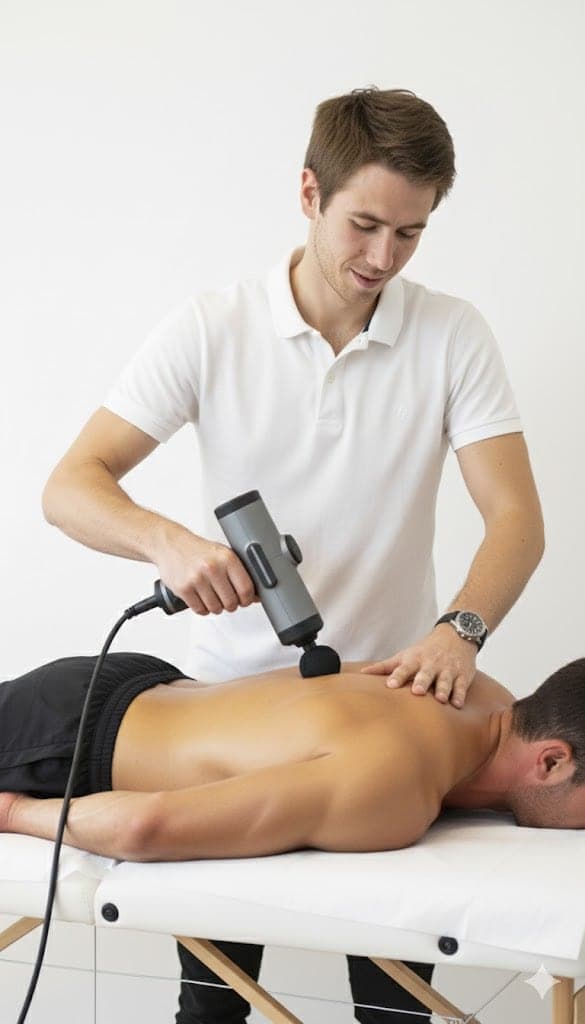
For the past several years, I’ve utilized a specialized mechanical device that has fundamentally transformed my ability to resolve IT band syndrome. This isn’t a vibration tool or percussion massager—it’s a precision instrument designed specifically for deep fascial work and myofascial release. The difference in clinical outcomes has been extraordinary.
When I treat IT band syndrome with this mechanical approach, I’m achieving three things that manual therapy simply cannot match:
Uncompromising depth: The machine allows me to work through the superficial fascial layers, the muscle bellies, and into the deep fascial planes where restrictions actually exist. I can maintain this depth consistently throughout the entire treatment session without fatigue, ensuring every adhesion is addressed and every trigger point is released.
Precise control: I adjust the intensity in real-time based on your tissue response and pain tolerance. For athletes in Emba who need aggressive treatment, I can deliver powerfully deep work that would be impossible to sustain manually. For individuals with more sensitive systems, I can work with exceptional gentleness while still achieving therapeutic depth.
Consistent treatment quality: Every session I provide is equally effective because the machine doesn’t experience fatigue, distraction, or “off days.” Your tenth treatment is as thorough and powerful as your first, ensuring continuous progress toward complete resolution.
Let me illustrate this with a case from my practice. A marathon runner in Emba came to me after three months of conventional physiotherapy that included stretching, strengthening exercises, and weekly manual therapy sessions. Her lateral knee pain had improved marginally but returned within 48 hours of any running attempt. She’d been told she might need to “give up running for a while” to let it heal—the standard advice when practitioners can’t resolve the underlying problem.
During my initial assessment, I identified severe restrictions in her TFL, vastus lateralis, and gluteus maximus. Her hip external rotation was limited, and her gluteus medius showed clear inhibition during single-leg stance. I explained that until we released the deep fascial restrictions and restored proper muscular activation patterns, her IT band would remain chronically tensioned regardless of how much she stretched or strengthened.
Within three treatment sessions using my mechanical deep-tissue approach, her range of motion had normalized, the tender points along her IT band had resolved, and she was running pain-free. The difference wasn’t my superior knowledge of anatomy—any competent physiotherapist understands IT band syndrome biomechanics. The difference was my ability to deliver sufficient mechanical force to actually change the tissue state, not just temporarily reduce symptoms.
The Evidence-Based Protocol for IT Band Syndrome in Emba
When you engage my services for physiotherapy for IT band syndrome in Emba, you’re not receiving a generic treatment protocol. I design a customized mechanical intervention strategy based on your specific biomechanical presentation, activity goals, and tissue response characteristics.
Initial Comprehensive Assessment
Before any treatment begins, I conduct a thorough evaluation that examines:
| Assessment Component | Clinical Significance |
|---|---|
| Palpation of IT band tension | Identifies specific locations of adhesion and tenderness |
| Hip range of motion testing | Reveals restrictions in flexion, extension, abduction, and rotation |
| Gluteal activation assessment | Determines if weakness or inhibition is contributing to TFL overload |
| Gait analysis | Identifies movement patterns that increase IT band friction |
| Lower kinetic chain evaluation | Examines foot, ankle, and knee mechanics that influence hip function |
This assessment takes approximately 20-30 minutes and provides me with a complete picture of why your IT band syndrome developed and, more importantly, what mechanical interventions will resolve it most efficiently.
The Treatment Sequence
My mechanical deep-tissue protocol for IT band syndrome follows a specific anatomical sequence designed to release tension systematically from proximal to distal. I don’t simply “massage the IT band”—I address the entire mechanical system.
Phase One: Gluteal and Hip Complex Release
I begin with the gluteus maximus, medius, and minimus, along with the deep external rotators. These muscles must be functioning optimally to remove excessive load from the TFL. Using the mechanical device, I work through each muscle systematically, releasing trigger points, breaking up adhesions, and restoring normal tissue compliance. The depth achieved here is significant—we’re working through some of the largest, most powerful muscles in the human body.
Phase Two: Tensor Fasciae Latae and Proximal IT Band
The TFL is almost always the primary driver of IT band syndrome. This small but powerful muscle becomes chronically shortened and hypertonic, maintaining constant tension through the IT band. I spend considerable time here, working slowly and methodically to release the muscle belly and its fascial connections. Clients often report this as the most intense part of treatment—and the most relieving.
Phase Three: Lateral Quadriceps and IT Band Itself
The vastus lateralis has extensive fascial connections to the IT band and frequently develops trigger points that refer pain to the lateral knee. I address this muscle thoroughly before working directly on the IT band itself. When treating the band, I’m not attempting to stretch it—I’m releasing adhesions between the band and underlying structures, improving its gliding mechanics.
Phase Four: Distal Structures and Integration
Finally, I address the lateral knee area where the friction syndrome occurs, releasing any inflammatory adhesions around the lateral femoral epicondyle. I also evaluate and treat the biceps femoris tendon, which can contribute to lateral knee pain and is often overlooked in conventional approaches.
Progressive Treatment Strategy
IT band syndrome resolution isn’t a single-session event. The condition developed over weeks or months of repetitive mechanical stress, and reversing it requires systematic treatment. In my experience with clients in Emba, most cases follow this timeline:
- Sessions 1-2: Initial release of superficial restrictions and trigger points. You’ll notice improved range of motion and reduced tenderness, but symptoms may return after activity.
- Sessions 3-4: Deeper fascial restrictions release. Pain during and after activity decreases significantly. This is where most clients realize conventional treatment was never reaching the actual problem.
- Sessions 5-6: Biomechanical patterns normalize. You can return to full activity without pain. We shift focus to optimization and prevention.
- Maintenance phase: Monthly sessions to maintain tissue quality and prevent recurrence, especially for athletes and highly active individuals.
What Makes This Approach Superior to Standard Physiotherapy in Emba
I want to address directly why my mechanical deep-tissue approach consistently outperforms conventional physiotherapy for IT band syndrome. This isn’t about marketing superiority—it’s about biomechanical reality.
Traditional physiotherapy relies heavily on exercises, stretching protocols, and limited manual therapy. These interventions address secondary factors—muscle imbalances, flexibility limitations, movement patterns—but they cannot resolve the primary tissue restrictions that drive the condition. It’s like trying to fix a car’s alignment problem by adjusting the mirrors. You’re addressing symptoms, not causes.
The Depth Differential
Consider this physiological fact: the tensor fasciae latae originates from the iliac crest and anterior superior iliac spine. It’s covered by skin, subcutaneous fat, and superficial fascia. To create meaningful change in this muscle’s resting tension and trigger point activity, you need to apply sustained pressure through all these layers and into the muscle belly itself.
A skilled manual therapist might achieve this depth for brief periods, but sustaining it for the 10-15 minutes required to fully release the TFL is biomechanically exhausting. The therapist’s hands fatigue, pressure decreases, and treatment efficacy drops. With my mechanical approach, I maintain optimal pressure consistently throughout the entire session. The tissue receives exactly what it needs for exactly as long as necessary.
The Precision Factor
When I’m working on your IT band syndrome, I’m not performing broad, sweeping strokes. I’m targeting specific anatomical structures—individual trigger points in the TFL, adhesions between the IT band and vastus lateralis, restrictions in the gluteus medius insertion. This requires millimeter-level precision.
The mechanical device I use provides this precision consistently. I can focus pressure on a trigger point the size of a rice grain for several minutes, gradually releasing it without my hands cramping or losing position. This level of focused work is what actually changes tissue state and resolves chronic conditions.
The Consistency Reality
Every practitioner has variations in their treatment quality based on fatigue, time of day, and previous clients. This is human nature. But when you’re investing in physiotherapy for IT band syndrome in Emba, you deserve consistent, reproducible results.
My mechanical approach eliminates treatment variability. Your sixth session is as effective as your first. If you need treatment late in the day after I’ve seen other clients, you receive the same quality care. This consistency accelerates your progress and ensures you reach complete resolution rather than plateauing at partial improvement.
The Investment Perspective: Cost Versus Value
I need to address something that distinguishes my practice from conventional physiotherapy services in Emba: I don’t position my work as an expense to be minimized. I position it as an investment in your long-term physical function and quality of life.
Many clients initially balk at my rates compared to standard massage or physiotherapy fees. I understand this reaction, but let me provide context. If you undergo conventional physiotherapy for IT band syndrome, you’ll likely attend 8-12 sessions over several months, paying moderate fees each time. You’ll do exercises at home. You’ll reduce your activity. And at the end, you’ll probably experience partial improvement with recurring flare-ups.
With my approach, most clients achieve complete resolution in 5-6 sessions. You return to full activity—running, hiking, sports—without pain or restriction. You don’t modify your life around a chronic injury. You don’t wonder if the pain will return next week. You invest more per session but require fewer sessions and achieve superior outcomes.
The True Cost of Inadequate Treatment
Consider what persistent IT band syndrome actually costs you:
- Reduced athletic performance and training consistency
- Inability to participate in activities you enjoy
- Progressive compensation patterns that create new problems in your hip, knee, or back
- Lost time at work if your profession involves physical activity
- The psychological burden of chronic pain and physical limitation
- Ongoing expenses for treatments that provide temporary relief without resolution
When I work with clients in Emba, we’re not just addressing knee pain. We’re restoring your ability to live actively and perform optimally. That’s not an expense—it’s one of the most valuable investments you can make.
The Mobile Advantage: Professional Treatment at Your Location
One unique aspect of my service is that I travel to your location in Emba. I bring a professional treatment bench, the mechanical device, and everything needed for a complete session. This isn’t a compromise in quality—it’s an enhancement of the client experience.
Traditional physiotherapy requires you to travel to a clinic, often when you’re already in pain. You sit in a waiting room. You receive treatment in a semi-private space with other people nearby. Then you travel home, potentially reaggravating the condition.
When I come to you, treatment occurs in your private, comfortable environment. There’s no commute stress before or after. If you’re an athlete, I can assess your movement in your actual training space. If you work from home, we can schedule around your professional commitments without the buffer time required for clinic visits.
This mobile approach also allows for longer, more comprehensive sessions. In a clinic setting, practitioners are pressured to maintain tight scheduling and maximize client turnover. I can spend the time necessary to fully address your condition without arbitrary time constraints.
Who Benefits Most from This Approach
While my mechanical deep-tissue method effectively treats IT band syndrome in virtually anyone, certain individuals benefit particularly dramatically from this approach:
Serious Athletes and Runners
If you’re training for marathons, competing in triathlons, or maintaining high-volume running programs, you need aggressive treatment that resolves problems quickly. You can’t afford months of reduced training while conventional physiotherapy slowly chips away at the issue. My approach gets you back to full training capacity in weeks, not months.
Previously “Failed” Cases
Many clients come to me after conventional physiotherapy, chiropractic care, or massage therapy has provided only temporary relief. These aren’t actually “failed” cases—they’re cases where the treatment modality couldn’t reach the mechanical depth required for resolution. The machine-based approach I employ consistently succeeds where manual methods plateau.
Individuals with Chronic, Severe Cases
If you’ve been dealing with IT band syndrome for years, developing extensive fascial adhesions and compensatory patterns, you need intensive treatment that can address the full scope of tissue dysfunction. Gentle, superficial approaches won’t cut it. My method can systematically work through even the most stubborn chronic cases.
Professionals Who Can’t Afford Downtime
If your career depends on physical capability—personal trainers, physical laborers, first responders—you need fast, definitive results. My treatment protocol provides the most direct path from injured to fully functional.
Frequently Asked Questions About Physiotherapy for IT Band Syndrome in Emba
Is the mechanical treatment painful?
I won’t lie to you—deep-tissue work on chronically restricted fascia is intense. You’ll feel pressure and discomfort as we release trigger points and adhesions. However, this is productive discomfort that’s resolving your problem, not pain that indicates tissue damage. I constantly adjust intensity based on your tolerance, and clients consistently report that the relief following treatment far outweighs the temporary intensity during it. Think of it this way: you can experience mild discomfort for an hour and resolve your IT band syndrome, or you can avoid that discomfort and continue dealing with chronic pain for months or years.
How many sessions will I need?
Most IT band syndrome cases resolve in 5-6 sessions when treated with my mechanical protocol. Mild, recent-onset cases sometimes require only 3-4 sessions. Severe chronic cases with extensive compensatory patterns occasionally need 8-10 sessions. This is significantly fewer than conventional physiotherapy, which often involves 12-20+ sessions with less definitive outcomes. During your initial assessment, I’ll provide a realistic timeline based on your specific presentation.
Can I continue exercising during treatment?
This depends on your activity level and severity of symptoms. I generally recommend reducing impact activities by 50-70% during the first 2-3 sessions to allow tissue healing. As we progress and your symptoms improve, you gradually return to full activity. For competitive athletes, I design modified training programs that maintain fitness while allowing tissue recovery. The key difference from conventional treatment: you’re not sidelined for months. We’re working toward rapid return to full function.
What’s different about your approach compared to foam rolling and stretching?
Foam rolling and IT band stretches are ubiquitous recommendations for this condition, and they provide minimal lasting benefit. Here’s why: foam rolling applies broad, superficial pressure that doesn’t reach the depth required to release fascial restrictions. IT band “stretching” doesn’t actually lengthen the IT band meaningfully—it’s not a muscle and has minimal elasticity. What these methods do provide is temporary pain modulation through pressure-induced analgesia and some improvement in tissue hydration. They don’t address the root mechanical dysfunction. My approach targets the actual causes—TFL hypertonicity, gluteal insufficiency, and deep fascial adhesions—with the mechanical depth necessary to create lasting change.
Do I need to do exercises or just receive treatment?
In most cases, I prescribe minimal homework initially. The mechanical treatment itself resolves the tissue restrictions, and your body naturally returns to proper movement patterns once those restrictions are released. That said, in cases with significant gluteal weakness or movement pattern issues, I may recommend specific strengthening exercises once the acute symptoms resolve. However, I’m not one of these practitioners who sends you home with 45 minutes of daily exercises. I believe in doing the actual work during our sessions and letting your body integrate the changes naturally.
Why don’t more physiotherapists use mechanical devices like yours?
Excellent question. Several reasons: First, there’s significant investment required in acquiring and mastering these specialized tools. Second, many practitioners are trained in exercise-based rehabilitation models and don’t have extensive manual therapy backgrounds that would translate to mechanical work. Third, insurance-based practice models incentivize high-volume, short-duration sessions rather than the longer, more intensive sessions my approach requires. Finally, there’s an element of professional inertia—”we’ve always done it this way” thinking that resists adopting new methodologies even when they’re demonstrably superior.
What if I’ve had IT band syndrome for years?
Chronicity doesn’t mean impossibility—it just means more extensive treatment. Long-standing IT band syndrome involves multiple layers of adaptation: chronic muscular tension, extensive fascial adhesions, altered movement patterns, and often compensatory issues in other areas of the kinetic chain. The mechanical approach I use is particularly effective for chronic cases because it can systematically work through all these layers with the depth and precision required. I’ve successfully treated clients who’ve dealt with IT band problems for 5-10 years with no other intervention providing lasting relief.
How do I know if I actually have IT band syndrome versus something else?
Classic IT band syndrome presents as lateral knee pain that worsens with repetitive knee flexion-extension, particularly during running or descending stairs. The pain is typically localized to the area just above the lateral knee joint. However, lateral knee pain can also result from lateral meniscus tears, lateral collateral ligament issues, or referred pain from lumbar spine problems. During your initial assessment, I perform specific orthopedic tests to differentiate IT band syndrome from other conditions. If I identify a condition outside my scope—such as a meniscal tear requiring orthopedic evaluation—I’ll refer you appropriately rather than treating something I can’t resolve.
The Partnership Approach: Beyond One-Off Sessions
I don’t offer single sessions or casual drop-in appointments for IT band syndrome treatment. This isn’t a relaxation massage service where you come in when you feel like it. This is systematic physiotherapy designed to resolve a specific mechanical dysfunction, and that requires a dedicated partnership.
When you engage my services, we establish a treatment plan with specific objectives and timelines. You commit to attending scheduled sessions and following any recommended activity modifications. I commit to delivering consistent, maximal-quality treatment and progressing you toward complete resolution as efficiently as possible.
This partnership structure serves both of us. You get focused attention and customized treatment rather than generic protocols. I can plan your progression strategically and track outcomes effectively. And most importantly, you actually resolve your IT band syndrome rather than managing it indefinitely.
Long-Term Performance Optimization
Once we’ve resolved your acute IT band syndrome, many clients transition to monthly maintenance sessions. This isn’t because the problem hasn’t been fixed—it’s because they’ve experienced the performance benefits of maintaining optimal tissue quality.
Athletes particularly appreciate this. When your fascia is unrestricted, your gluteals activate properly, and your movement patterns are efficient, you perform better. You run faster with less effort. You recover more quickly between training sessions. You’re less prone to developing new injuries.
For non-athletes, regular maintenance ensures that the IT band syndrome doesn’t recur and that you maintain the improved function we’ve achieved. Think of it as preventative care rather than reactive treatment.
Taking Action: Your Path Forward
If you’re reading this article because you’re dealing with IT band syndrome in Emba, you’re at a decision point. You can continue with conventional approaches—stretching, foam rolling, standard physiotherapy—and hope for gradual improvement. Or you can engage a treatment method specifically designed to address the mechanical root causes of your condition with the depth, precision, and consistency required for actual resolution.
I’ve spent a decade refining this approach, treating hundreds of cases, and achieving outcomes that conventional methods simply cannot match. I don’t claim this because of ego or marketing hyperbole. I claim it because it’s biomechanically true and clinically proven in my practice.
Your IT band syndrome developed because of specific mechanical dysfunctions in your hip and thigh musculature. Those dysfunctions created excessive tension and friction in your IT band, leading to inflammation and pain. Resolving the condition requires releasing those deep tissue restrictions and restoring proper biomechanical function. That’s exactly what my mechanical deep-tissue protocol accomplishes.
You have a choice: invest in treatment that addresses the actual problem, or continue managing symptoms indefinitely. If you’re serious about resolving your IT band syndrome and returning to optimal function, the path forward is clear.
I travel to your location in Emba with everything needed for professional treatment. We’ll conduct a comprehensive assessment, design a customized protocol, and systematically work toward complete resolution. You’ll experience what physiotherapy for IT band syndrome should be: intensive, effective, and results-driven.
The question isn’t whether this approach works—I know it does because I’ve seen it work consistently for years. The question is whether you’re ready to commit to doing what’s necessary to fix your problem rather than continuing to work around it.
Written by
Chris
Massage therapist & body mechanics specialist
Norwegian-certified with a Bachelor’s in Physical Education and Nutrition and over ten years of clinical practice, working from a portable table in clients’ homes across the Paphos district.
This article is general information from clinical practice, not a medical diagnosis. If you have severe, worsening or unexplained pain, numbness, weakness, or pain after an accident, see a doctor first.