
IT band syndrome massage in Emba: treating the hip, not the band
In short
IT band syndrome massage works best when it targets the tensor fasciae latae, glutes and lateral thigh rather than the band itself. I bring that mechanical deep-tissue work to your home in Emba, with simple loading advice to keep it.
I treat a steady stream of runners, cyclists and hill walkers in Emba with pain on the outside of the knee. Most have already rolled the IT band raw without much change. My sports massage in Paphos treats the muscles that load the band instead, at your home, using mechanical deep-tissue work.
That is the whole premise of IT band syndrome massage as I practise it: the band is the messenger, the hip is usually the sender. What follows explains what the condition is, why the usual self-treatment disappoints, and what I actually do on the table.
What IT band syndrome actually is
The iliotibial band is a thick strip of fascia running from the pelvis down the outside of the thigh to just below the knee. It is not a muscle. It is tensioned by two muscles that feed into it at the top — the tensor fasciae latae (TFL) at the front of the hip and the gluteus maximus at the back.
Pain arrives where the band passes over the lateral femoral epicondyle, the bony knob on the outside of the knee. Repeated bending and straightening under load — running downhill, long rides, the descent from the villages above Emba — compresses the tissue between band and bone until it becomes irritated.
The pattern I see most often in Emba is:
- Sharp or burning pain on the outer knee that starts a set distance into a run or ride, then eases with rest
- Worse on descents and stairs down, better on the flat
- Tenderness two or three centimetres above the joint line rather than in the joint itself
- A hip that feels stiff at the front and weak at the side when tested
- Recent increase in distance, hills or frequency in the weeks before it began
Only the first two are the knee. The rest are why the knee is hurting.
Why rolling the band itself rarely settles it
Foam rolling and stretching the IT band feels productive and hurts enough to seem serious. The band's tensile strength is closer to a tendon than a muscle, so it does not lengthen meaningfully under body-weight pressure. What is happening in most cases is that people are compressing the vastus lateralis beneath it, which is not the tissue driving the problem, while leaving the TFL and glutes untouched.
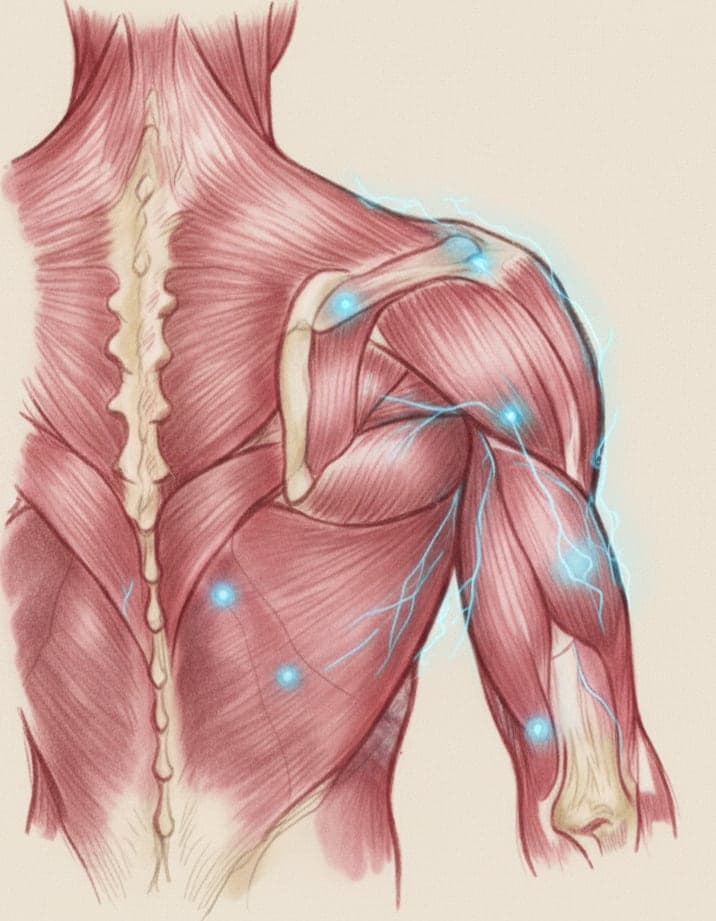
Direct pressure on the irritated spot at the knee usually makes it angrier. I leave that area mostly alone.
How I approach IT band syndrome massage
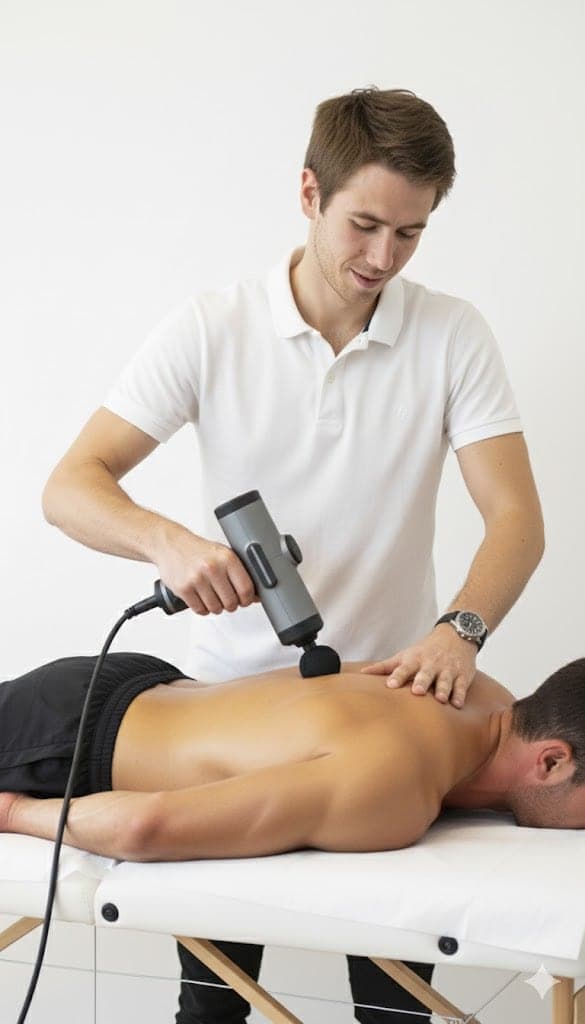
I am a mechanical deep-tissue specialist. That means I work with sustained, precisely angled pressure to change how a specific muscle behaves, rather than general kneading for comfort. With Norwegian training behind me and over ten years of doing this, the IT band presentation is one I have a fairly settled routine for — adjusted, of course, to what I find on the day.
| Region | What I am after | Typical share of the session |
|---|---|---|
| Tensor fasciae latae | Reduce resting tension, restore glide with the hip flexors | 25% |
| Gluteus medius and minimus | Release trigger points, wake the abductors | 25% |
| Gluteus maximus and deep rotators | Reduce backward drag on the band | 20% |
| Vastus lateralis under the band | Free the muscle from the fascia, not stretch the fascia | 20% |
| Calf, hamstrings, low back | Anything feeding altered gait | 10% |
The pressure is firm and specific. You will feel referred sensation into the outer knee when I find the right spot in the TFL or gluteus medius, which is useful confirmation that the hip is involved. It should feel like strong, purposeful pressure and never like being hurt; I check as I go.
What a session in Emba looks like
I am based in Chlorakas, so Emba is a few minutes away and I can usually offer an early or late slot around your training. I bring the table and everything else; you need floor space of roughly two by three metres and a plug socket nearby.
The first session runs 60 minutes and begins with about ten minutes of assessment: single-leg stance, a step-down, hip range at the front and side, and palpation of the TFL and glutes. The rest is treatment. A 90-minute session is worth it if both sides are involved or if the calf and low back are also clearly part of the story. Pricing is €90 for 60 minutes and €130 for 90 minutes; every fifth session is free. Full details are on the pricing page.
Most people leave with the outer knee tender but with a hip that moves noticeably more freely. The soreness in the glute region for a day afterwards is normal and settles on its own.
Between sessions — the part that decides the outcome
Massage changes the tissue for a window of days. What you do inside that window is what makes the change stick. I keep the homework short because short homework gets done.
- Side-lying hip abduction with the leg slightly back, slow, ten to fifteen repetitions, most days — this is the gluteus medius work
- Short-lever glute bridges with a band around the knees, two sets, before running
- Reduce the descents for two to three weeks; keep the flat and gentle uphill
- Cut weekly volume back rather than stopping entirely, then rebuild by no more than ten percent a week
- Cyclists: check saddle height and cleat position — a saddle a touch too high is a common contributor here
The typical course I plan for is two to four sessions spaced a week or so apart, then a check-in when you have returned to normal volume. Some settle faster, some take longer, and long-standing cases with a big hip weakness component take the most patience.
I also treat many of the same people for adjacent problems — the runner with an IT band on one side and a cranky calf on the other is a common combination — and it is worth mentioning that my mobile massage in Emba covers those wider running-related aches, not just this one.
What I can and can't help with
I can help with the muscular and fascial side of this: TFL and gluteal tension, altered gait, the tissue quality that keeps the band tight, and the load management that lets it calm down. What I cannot do is treat the joint itself or diagnose. See a doctor first if any of the following apply, because they are not IT band patterns and need proper assessment:
- The knee is swollen, hot, or locks or gives way
- Pain is inside the joint rather than on the outer edge
- It began with a fall, twist or direct blow
- Night pain that does not ease with rest
- Numbness, tingling or weakness in the leg
If you have already been assessed and told it is iliotibial band syndrome, or the pattern matches the description above and you have not had a trauma, this is exactly the presentation I work with.
Frequently asked questions
Is there a mobile massage therapist near me in Emba?
Yes. I work from Chlorakas, which borders Emba, so travel time is minimal and I can usually fit around training or work hours. I bring a professional table and all equipment to your home or accommodation. Booking is by WhatsApp or phone, and I will ask a few questions about your symptoms and training in advance so the first session is efficient.
How many sessions does IT band syndrome usually take?
It varies with how long it has been present and how much hip weakness sits underneath it. My working plan is two to four sessions roughly a week apart, combined with the strengthening and load changes above. If there is no change at all after two sessions I say so and suggest a review with a physiotherapist or doctor, rather than continuing to book you in.
Will you massage the painful spot on my knee?
Very little. The tissue at the lateral epicondyle is already compressed and irritated, and pressing on it tends to make it worse. I work above it — the TFL, gluteus medius, gluteus maximus and the vastus lateralis under the band — where the tension is generated. Most people are surprised that the knee feels better without much being done to the knee itself.
Should I keep running while being treated?
Usually yes, at reduced volume and with descents cut back, provided pain stays low and does not linger the next day. Complete rest often means the hip weakness that started the problem is still there when you return. If you cannot run even a few minutes on the flat without sharp pain, that is worth a medical check before we continue.
Does deep-tissue massage for the IT band hurt?
It is firm and specific and you will feel the referred sensation into the outer knee when I find the relevant trigger points, which is a good sign. It should never be pain you brace against — that defeats the purpose, because the muscle tightens rather than lets go. I adjust pressure continuously and would rather do slightly less and have you relaxed than more with you gritting your teeth.
Can cyclists get IT band syndrome too, or is it just runners?
Cyclists get it regularly, particularly after increasing distance or changing bike fit. A saddle that is a little too high or cleats that force the foot outward add repetitive load at the outer knee. The treatment is the same — the hip and lateral thigh — plus a look at your setup. It is one of the most common things I see in Emba and the surrounding villages during the cooler months.
Written by
Chris
Massage therapist & body mechanics specialist
Norwegian-certified with a Bachelor’s in Physical Education and Nutrition and over ten years of clinical practice, working from a portable table in clients’ homes across the Paphos district.
- Norwegian-certified
- BSc Physical Education & Nutrition
- 10+ years clinical practice
- Based in Chlorakas · all of Paphos district
- No call-out fee anywhere in Paphos district
Last reviewed
This article is general information from clinical practice, not a medical diagnosis. If you have severe, worsening or unexplained pain, numbness, weakness, or pain after an accident, see a doctor first.