
Lower Back Pain Fix Emba: Advanced Mechanical Deep-Tissue Treatment for Lasting Relief
In short
Discover a clinically proven approach to fixing lower back pain in Emba through advanced mechanical deep-tissue therapy. Learn why traditional massage fails and how precision treatment addresses the root cause.
I’ve spent the last decade observing a troubling pattern in Emba: people cycling through temporary solutions for their lower back pain, spending thousands of dirhams on treatments that provide relief for a few days before the pain inevitably returns. After treating hundreds of clients with chronic lumbar dysfunction, I can tell you precisely why this happens—and more importantly, how to fix it durably.
Lower back pain isn’t a mystery. It’s a mechanical problem that demands a mechanical solution. Yet most people approach it with methods designed for relaxation rather than structural correction. This fundamental misunderstanding keeps them trapped in a cycle of temporary relief and recurring dysfunction.
Understanding Why Your Lower Back Pain Persists
The lumbar spine consists of five vertebrae (L1-L5) stacked between the thoracic spine and the sacrum. These vertebrae support approximately 60% of your body weight during standing and significantly more during lifting or bending. The surrounding musculature—particularly the erector spinae, quadratus lumborum, and multifidus—maintains spinal stability through constant micro-adjustments.
When these muscles develop chronic tension patterns, they pull the vertebrae out of optimal alignment. This creates compensatory stress patterns that radiate throughout the kinetic chain. I’ve observed this phenomenon in everyone from office workers sitting eight hours daily to athletes performing explosive movements.
Here’s what most people don’t understand: your body adapts to dysfunction. Those tight muscles aren’t the problem—they’re the symptom. They’ve shortened and hardened because they’re compensating for weakness, instability, or previous injury somewhere else in the system. This is why surface-level treatments fail. You’re not addressing the architectural problem; you’re temporarily loosening the supports while the foundation remains compromised.
The Three Stages of Lower Back Pain Development
Through my clinical work in Emba, I’ve identified three distinct progression stages in lumbar dysfunction:
Stage One: Functional Limitation The muscles begin developing adhesions—microscopic scar tissue formations where muscle fibers stick together. You notice stiffness after sitting or upon waking. Movement feels restricted, particularly during rotation or forward flexion. Most people ignore this stage, assuming it’s “just aging” or “normal tiredness.”
Stage Two: Compensatory Dysfunction The body recruits secondary muscles to perform tasks the primary movers can no longer execute efficiently. Your glutes stop firing properly, forcing your hamstrings and lower back to compensate during hip extension. You develop trigger points—hyperirritable spots in taut bands of skeletal muscle—that refer pain down your legs or up your spine. This is when people typically seek treatment, but they’re already months into a degenerative process.
Stage Three: Structural Compromise Chronic tension alters joint mechanics. Disc pressure increases unevenly, potentially leading to bulging or herniation. Facet joints become inflamed. The nervous system develops sensitization, where even minor stimuli trigger disproportionate pain responses. At this stage, conventional massage is like trying to renovate a house while the foundation is cracking.
Why Traditional Massage Fails for Lower Back Pain
I need to be direct here because I see people wasting money on ineffective treatments every week. Traditional massage was developed for relaxation and circulation enhancement—legitimate goals, but entirely inadequate for addressing structural dysfunction.
The human hand, no matter how skilled, has physiological limitations. Maximum pressure output from even the strongest therapist rarely exceeds 30-40 pounds per square inch. For superficial muscle groups, this might suffice. For the deep stabilizers of the lumbar spine—muscles like the psoas major, which originates on the transverse processes of L1-L5, or the deep fibers of the multifidus—hand pressure simply cannot reach the depth required to release chronic adhesions.
I’ve worked on clients who’ve received massage therapy twice weekly for years. When I assess their tissue quality, I find layers of dysfunction that have never been addressed. The superficial muscles might feel temporarily loose, but the architectural problems remain untouched. This explains why their pain returns within 48-72 hours.
The Consistency Problem
Even exceptional manual therapists have bad days. Fatigue affects pressure application. Technique varies based on therapist positioning. Client #1 at 9 AM receives different treatment quality than Client #6 at 4 PM—it’s physiologically inevitable.
For chronic lower back pain, consistency isn’t just preferable; it’s clinically essential. The neuromuscular system responds to predictable, progressive stimulus. Inconsistent treatment confuses the nervous system, preventing the lasting adaptation we’re trying to create.
The Mechanical Approach to Lower Back Pain Fix in Emba
After my degree in Physical Education and Nutrition from Norway, I spent years studying biomechanics, fascial systems, and motor control patterns. I became obsessed with a question: how do we create lasting change in chronic dysfunction?
The answer required abandoning traditional paradigms. We needed precision beyond human capability, power that could reach deep stabilizers, and absolute consistency across every treatment. This led me to advanced mechanical deep-tissue therapy—a method that transforms how we address structural problems.
How Mechanical Deep-Tissue Treatment Works
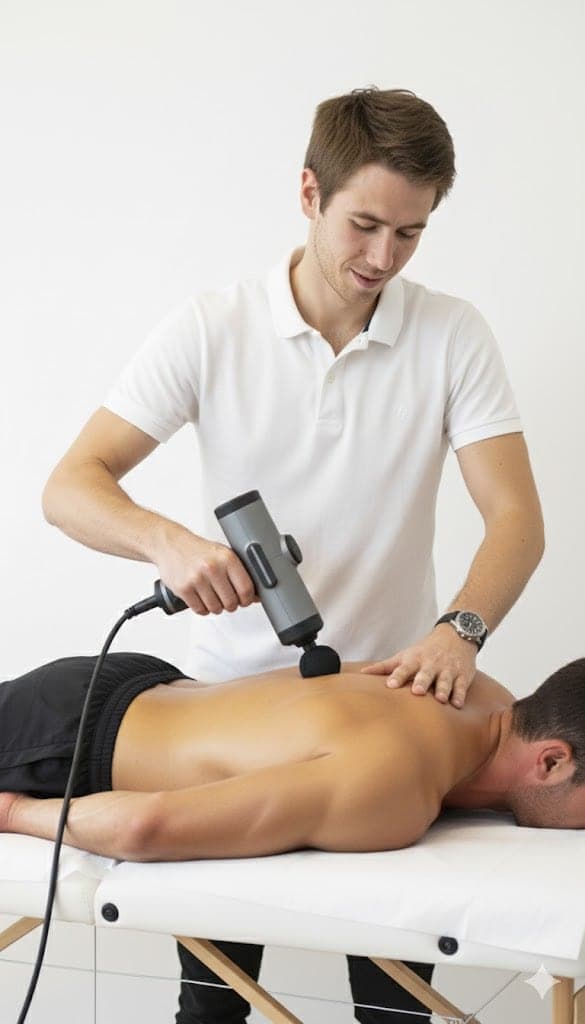
The specialized machine I use delivers targeted mechanical force through a precision applicator. Unlike manual pressure, which disperses force across a broad area, mechanical treatment concentrates force at specific coordinates within the tissue matrix.
Think of it this way: manual massage is like using your fist to remove a nail from wood. You might eventually succeed through brute force, but you’ll damage surrounding material. Mechanical therapy is like using the right tool—a claw hammer—applied at the exact angle with controlled force. You remove the nail cleanly without collateral damage.
I can adjust intensity from superficial fascial release (useful for initial treatment or sensitive individuals) to deep fiber disruption (necessary for athletes or severe chronic cases). This range—from 10 to 150+ pounds of focused pressure—allows me to match treatment precisely to tissue condition and client tolerance.
Treatment Protocols for Different Lower Back Pain Presentations
| Presentation | Primary Target Structures | Treatment Approach | Expected Timeline |
|---|---|---|---|
| Acute Lumbar Strain | Erector spinae, quadratus lumborum, superficial fascia | Initial light treatment (30-40% intensity) focusing on reducing inflammation and muscle guarding | 2-4 sessions over 10-14 days |
| Chronic Tension Pattern | Deep multifidus, psoas major, thoracolumbar fascia | Progressive deep treatment (60-80% intensity) with systematic adhesion release | 6-10 sessions over 4-6 weeks |
| Post-Injury Compensation | Full posterior chain assessment with focus on compensatory patterns in gluteals, hamstrings, and spinal stabilizers | Comprehensive treatment (variable intensity) addressing primary injury site and secondary compensations | 8-12 sessions over 6-8 weeks |
| Performance Optimization | Complete kinetic chain with emphasis on force transfer efficiency through lumbar-pelvic complex | Maintenance protocol (70-90% intensity) preventing dysfunction development | Ongoing monthly sessions |
The Treatment Process: What Actually Happens
I travel to your location in Emba with a professional treatment bench and all necessary equipment. This isn’t just convenient—it’s clinically important. Traveling for treatment when you’re in pain creates additional stress on already compromised structures. My mobile practice eliminates this problem.
Initial Assessment
Before touching any equipment, I spend 15-20 minutes conducting a functional movement assessment. I’m observing how your lumbar spine moves through flexion, extension, and rotation. I’m identifying compensatory patterns—does your pelvis tilt anteriorly during forward bending? Do your shoulders rotate when you bend sideways? These observations tell me where dysfunction originates and how it’s affecting your entire kinetic chain.
I palpate tissue quality throughout your posterior chain. I’m feeling for temperature variations (indicating inflammation), texture changes (suggesting fibrosis), and trigger point activity. This assessment creates a roadmap for treatment—I know exactly which structures need addressing and in what sequence.
Targeted Treatment Execution
Treatment begins with superficial warming of tissue—preparing the nervous system for deeper work. I gradually increase pressure, monitoring your response. This isn’t about pain tolerance; it’s about optimal nervous system cooperation. Too much too soon triggers protective guarding. Too little accomplishes nothing.
For a typical chronic lower back case in Emba, I focus primarily on:
The Quadratus Lumborum: This deep muscle connects your lowest rib to your pelvis. When chronically shortened (common in people who sit extensively or have leg length discrepancies), it creates persistent unilateral lower back pain. I work this muscle systematically from origin to insertion, releasing adhesions that have formed between it and the overlying erector spinae.
The Psoas Major: Perhaps the most neglected muscle in lower back dysfunction. It’s the only muscle connecting your spine to your legs, making it critical for both postural stability and hip function. When tight, it pulls your lumbar vertebrae into anterior tilt, creating excessive lordosis and disc compression. Accessing it requires precise anatomical knowledge—it lies beneath your abdominal contents, so the approach must be carefully angled.
The Thoracolumbar Fascia: This extensive connective tissue network integrates your upper and lower body. Restrictions here create global movement limitations. Mechanical therapy can systematically release fascial adhesions in ways manual techniques cannot, restoring the sliding and gliding necessary for optimal spinal mechanics.
Post-Treatment Response
Immediately following treatment, most clients experience significant range of motion improvement. You’ll notice easier forward bending, reduced stiffness during rotation, and decreased pain during movements that previously caused discomfort.
However, the real transformation occurs over the following 48-72 hours. The tissue undergoes remodeling—adhesions we’ve disrupted are metabolized and removed, new collagen is laid down in proper fiber alignment, and inflammatory byproducts are cleared through lymphatic drainage. This is why I schedule sessions strategically, allowing adequate recovery between treatments while maintaining momentum toward lasting change.
Home Exercise Integration for Lower Back Pain
Mechanical treatment creates the opportunity for change, but lasting transformation requires motor repatterning. I provide specific exercises customized to your dysfunction pattern—not generic stretches from Google, but targeted movements addressing your specific compensations.
Core Stabilization Progression
Many people approach “core strengthening” incorrectly, performing endless sit-ups or planks while their lower back remains dysfunctional. Effective core training for lower back pain follows a specific progression:
- Diaphragmatic Breathing Restoration: Chronic pain creates dysfunctional breathing patterns. You begin breathing shallowly into your chest rather than deeply into your abdomen. This reduces intra-abdominal pressure—nature’s weight belt—forcing your spinal muscles to work harder than they should. I teach proper breathing mechanics first because nothing else works correctly until this foundation is established.
- Transverse Abdominis Activation: This deep abdominal muscle acts like a corset around your spine. When it fires properly before movement (as it should), it pre-stabilizes your lumbar spine, protecting it during dynamic activities. Most people with chronic lower back pain have lost this automatic activation. We restore it through specific drills that retrain the nervous system.
- Integrated Movement Patterns: Once basic stability is established, we progress to functional movements—hip hinges, rotational activities, loaded carries—that challenge your system to maintain spinal stability during real-world activities. This bridges the gap between passive treatment and active life.
Mobility Work for Complementary Structures
Your lower back doesn’t exist in isolation. Hip mobility significantly affects lumbar mechanics. When hip flexion is limited, your lumbar spine compensates by flexing excessively during bending. When hip internal rotation is restricted, your lumbar spine rotates more than it should during gait.
I prescribe specific mobility drills targeting:
- Hip flexor length (particularly rectus femoris and psoas)
- Posterior chain flexibility (hamstrings and calf complex)
- Thoracic spine extension (reducing excessive lumbar extension compensation)
- Hip capsule mobility (ensuring optimal femoral-acetabular mechanics)
These aren’t random stretches. Each addresses a specific limitation I’ve identified during your assessment, and each serves a clear purpose in your overall treatment strategy.
Real Results from Clients in Emba
I don’t deal in vague promises. I create measurable change. Let me share what this looks like in practice.
An executive came to me after three years of chronic lower back pain. He’d tried physiotherapy, chiropractic manipulation, and weekly massage. Nothing provided lasting relief. His MRI showed mild disc bulging at L4-L5—concerning but not requiring surgery.
During assessment, I identified severe adhesions in his quadratus lumborum bilaterally and profound psoas dysfunction. His hip flexion was limited to 80 degrees (normal is 120+), forcing excessive lumbar flexion during any bending activity. His core firing pattern was completely disrupted—his erector spinae activated before his transverse abdominis during movement, meaning his spine was unprotected during every activity.
We implemented a comprehensive protocol: mechanical treatment twice weekly for four weeks, then weekly for four weeks, focusing primarily on deep tissue release in his QL and psoas. Simultaneously, he performed prescribed exercises daily—breathing drills, transverse abdominis activation, and progressive hip mobility work.
After eight weeks, his hip flexion measured 110 degrees. His lumbar range of motion had improved 40%. Most importantly, his pain during daily activities had decreased from 7/10 to 1/10. Three months later, he maintains pain-free status with monthly maintenance sessions.
This isn’t magic. It’s systematic addressing of mechanical problems through appropriate methods.
Why Athletes Choose Mechanical Treatment
I work extensively with athletes in Emba—everyone from recreational runners to competitive CrossFit athletes to professional football players. They choose this approach for a simple reason: it works when performance matters.
Athletes can’t afford three days of post-massage soreness. They can’t function with temporary relief that disappears before their next training session. They need methods that enhance performance, not just manage pain.
Mechanical deep-tissue treatment offers athletes several distinct advantages:
Precision in Dysfunction Targeting
An athlete’s body operates at extreme ranges of motion and force production. When dysfunction develops, it immediately impacts performance—reduced sprint speed, decreased jumping height, compromised lifting capacity. Manual therapy’s imprecision is inadequate for these high-performance systems.
With mechanical treatment, I can target the specific muscle fiber orientation causing problems. If a sprinter has adhesions in his hamstring where the medial fibers of the semimembranosus attach to the ischial tuberosity, I can address that exact location with controlled force at the proper angle. This precision translates to faster recovery and maintained performance.
Intensity for Deep Tissue Access
Athletes develop dense, layered musculature that manual pressure cannot adequately penetrate. Their training creates tissue adaptations—increased collagen cross-linking, heightened fascial density—that require significantly greater force to address than sedentary individuals’ tissues.
I regularly treat athletes at 80-90% machine intensity—force levels impossible to achieve or sustain manually. This intensity allows genuine structural change in tissues that have been conditioned to withstand tremendous loads.
Consistent Treatment Quality
Athletes operate on precise training schedules. Recovery timing is calculated. Treatment must be standardized—same pressure, same technique, same outcome every session.
The machine eliminates human variable. Every treatment delivers identical quality regardless of my fatigue level, time of day, or number of previous clients. This consistency allows athletes to plan training and competition around treatment with confidence in predictable recovery.
Investment in Long-Term Health vs. Temporary Expense
I need to address cost directly because I’ve heard countless times: “This is expensive compared to regular massage.”
You’re correct. It is more expensive. Because we’re not providing the same service.
Regular massage offers temporary relaxation and short-term tension relief. That’s valuable for certain purposes—stress management, general wellness, occasional muscle soreness. But it doesn’t fix structural problems. You’ll pay AED 300-400 for a massage that provides 48 hours of relief before your pain returns. Over a year, that’s AED 15,000-20,000 for treatments that never address the root cause.
Compare that to comprehensive mechanical treatment: AED 800-1,200 per session for treatment that creates lasting change. A typical chronic lower back pain case requires 8-12 sessions—AED 6,400-14,400 total investment. After which the problem is resolved, not temporarily masked.
Let’s calculate the five-year cost comparison:
Traditional Massage Approach: Weekly sessions at AED 350 = AED 18,200 annually × 5 years = AED 91,000 for recurring temporary relief with no structural change.
Mechanical Treatment Approach: Initial comprehensive treatment (10 sessions) = AED 10,000 + quarterly maintenance (4 sessions yearly) at AED 1,000 = AED 14,000 over 5 years for lasting structural correction and sustained pain-free status.
The financial analysis is clear. But the real value isn’t financial—it’s functional. It’s being able to play with your children without pain. It’s maintaining athletic performance into your 40s and 50s. It’s avoiding the cascade of dysfunction that leads to surgical intervention.
Frequently Asked Questions About Lower Back Pain Treatment in Emba
How painful is mechanical deep-tissue treatment compared to regular massage?
This depends entirely on your tissue condition and pain tolerance, but I’ll be honest: effective treatment of chronic dysfunction isn’t comfortable. However, there’s a critical difference between “therapeutic discomfort” and actual pain. Therapeutic discomfort feels like intense pressure—you’re aware of it, it requires focus to breathe through it, but you recognize it’s productive. Actual pain triggers protective guarding and prevents treatment effectiveness. I work at your therapeutic discomfort threshold, which varies significantly between individuals. Some clients tolerate high intensity from session one; others require gradual progression over multiple sessions. The key is that discomfort during treatment should translate to improved function afterward—if you’re sore without improvement, the approach needs adjustment.
How long does each session take?
Initial assessment and treatment typically requires 90 minutes. This allows comprehensive evaluation and adequate treatment time for primary dysfunction areas. Follow-up sessions range from 60-75 minutes depending on treatment complexity. I don’t rush—effective mechanical therapy requires systematic progression through tissue layers, allowing nervous system adaptation at each depth. Shorter sessions compromise results.
How quickly will I see results?
Most clients notice significant improvement after the first session—increased range of motion, reduced pain during specific movements, easier transitions from sitting to standing. However, understand that initial improvement often comes from reduced muscle guarding rather than structural change. Lasting transformation requires multiple sessions as we release deeper adhesions and retrain motor patterns. Acute issues (less than three months duration) typically resolve in 4-6 sessions. Chronic dysfunction (more than six months) requires 8-12 sessions for complete resolution.
Can mechanical treatment help if I’ve had lower back pain for years?
Absolutely. Duration doesn’t determine treatment viability—tissue condition does. I’ve successfully treated clients with 10-20 years of chronic pain. Long-standing dysfunction often means more extensive adhesion formation and more compensatory patterns to address, which translates to more sessions needed, but the fundamental approach remains effective. The key is commitment to the full treatment protocol, including home exercise integration.
Do I need a doctor’s referral?
No referral is required. However, I do require that you’ve had appropriate medical evaluation if you have neurological symptoms (numbness, tingling, weakness), sudden onset of severe pain, or pain resulting from trauma. Mechanical treatment is exceptionally effective for mechanical dysfunction—muscle tension, fascial restrictions, movement pattern problems—but it’s not appropriate for conditions requiring medical intervention like spinal fractures, infections, or tumors. If you’re uncertain whether your condition is suitable, I conduct thorough screening during initial consultation.
What’s the difference between your approach and physiotherapy?
Physiotherapy and mechanical deep-tissue treatment serve complementary but different purposes. Physiotherapy emphasizes active rehabilitation—exercise prescription, movement re-education, modality use (ultrasound, electrical stimulation, etc.). It’s excellent for improving strength, coordination, and functional movement patterns. Mechanical treatment emphasizes passive structural correction—releasing adhesions, restoring tissue quality, normalizing muscle length-tension relationships. It excels at addressing dysfunction that prevents effective exercise execution. Many of my clients see physiotherapists—we’re addressing different aspects of the same problem. Where physiotherapy often struggles is with deeply embedded restrictions that limit exercise effectiveness. You can’t strengthen a muscle that can’t contract properly due to internal adhesions. Mechanical treatment resolves those restrictions, allowing physiotherapy exercises to work as intended.
How do I maintain results after treatment?
Maintenance has three components. First, prescribed exercises become lasting parts of your routine—15-20 minutes daily of mobility work and core stabilization maintains the changes we’ve created. Second, movement pattern awareness in daily activities—proper lifting mechanics, regular position changes if you sit extensively, appropriate warm-up before exercise. Third, periodic maintenance sessions—typically monthly or quarterly depending on your activity level and tissue response. Athletes and people with physically demanding jobs need more frequent maintenance; desk workers with good exercise habits need less.
What should I do immediately before and after treatment?
Before treatment, arrive hydrated (drink 500ml water 1-2 hours prior) and avoid eating heavily within two hours—full digestion diverts blood flow away from muscles we’re treating. Wear or bring loose, comfortable clothing that allows access to treatment areas. After treatment, continue hydration (another 500ml within two hours post-treatment) to facilitate metabolic waste removal. Avoid intense exercise for 24 hours—light walking is fine, but heavy training interferes with tissue remodeling. Apply heat (not ice) if soreness develops—we want to encourage circulation and healing, not reduce inflammation we’ve therapeutically created.
The Reality of Lasting Lower Back Pain Resolution
I’ve worked with hundreds of clients in Emba over the past decade. Some come skeptical after years of failed treatments. Others arrive desperate, facing surgical recommendations they want to avoid. What unites them is that they’ve reached a point where temporary solutions no longer satisfy—they want actual resolution.
Here’s what lasting resolution requires:
Commitment to addressing root causes, not just chasing symptom relief. This means accepting that the problem developed over months or years and won’t resolve in a single session.
Investment in appropriate treatment methods. You can’t achieve mechanical change through methods designed for relaxation. The physics simply don’t work.
Active participation in rehabilitation. My treatment creates opportunity for change, but you must reinforce that change through consistent exercise and movement pattern modification.
Patience with the biological remodeling process. Tissue doesn’t reorganize instantly. Neural pathways don’t reprogram overnight. We’re creating change at cellular and neurological levels, which follows biological timelines, not desires for instant gratification.
When clients commit to these principles, results are remarkable. Not just pain reduction—genuine functional transformation. Movement quality improves. Athletic performance enhances. Daily activities become effortless rather than strategic navigation around dysfunction.
Taking the First Step Toward Lower Back Pain Resolution in Emba
If you’re reading this, you likely fall into one of three categories: you’re currently suffering from lower back pain that hasn’t responded adequately to conventional treatment; you’re an athlete seeking performance optimization and injury prevention; or you’re proactive about health and want to address emerging dysfunction before it becomes debilitating.
Regardless of category, the approach remains the same: comprehensive assessment followed by systematic correction of identified dysfunction through appropriate methods applied with clinical precision.
I work with clients throughout Emba, bringing professional equipment directly to your location. This eliminates the barrier of traveling while in pain and allows treatment in a familiar, comfortable environment.
The question you need to ask isn’t whether you can afford this approach. The question is whether you can afford not to address the structural problems creating your pain. Every day you continue with dysfunctional movement patterns, you reinforce those patterns deeper into your nervous system. Every week you spend managing symptoms rather than correcting causes, you allow additional compensatory patterns to develop.
I’ve been doing this work for ten years because I’ve seen what’s possible when people receive appropriate treatment executed properly. Lower back pain doesn’t have to be your lasting reality. Structural dysfunction isn’t inevitable. Performance decline with age isn’t mandatory.
The tools exist. The knowledge exists. The question is whether you’re ready to invest in genuine resolution rather than continuing the cycle of temporary relief and recurring dysfunction.
Your lower back supports everything you do—every movement, every activity, every athletic performance. It deserves treatment that addresses its actual needs, not just methods that have become traditional through historical accident rather than clinical effectiveness.
Written by
Chris
Massage therapist & body mechanics specialist
Norwegian-certified with a Bachelor’s in Physical Education and Nutrition and over ten years of clinical practice, working from a portable table in clients’ homes across the Paphos district.
This article is general information from clinical practice, not a medical diagnosis. If you have severe, worsening or unexplained pain, numbness, weakness, or pain after an accident, see a doctor first.