
IT Band Syndrome Treatment Chloraka: Advanced Deep-Tissue Solutions for Lasting Relief
In short
Discover expert IT band syndrome treatment in Chloraka with proven mechanical deep-tissue therapy. Get lasting pain relief from a specialist with 10 years of experience treating runners and athletes.
I’ve treated dozens of runners, cyclists, and active individuals in Chloraka who believed their IT band syndrome was just something they had to “manage” forever. They’d tried stretching, foam rolling, rest, ice—all the conventional approaches—only to watch the pain return the moment they resumed training. This frustration is precisely what drove me to develop a different approach to IT band syndrome treatment in Chloraka, one that addresses the mechanical root of the problem rather than temporarily masking symptoms.
After ten years of specializing in body mechanics and advanced deep-tissue therapy, I can tell you with absolute certainty: IT band syndrome is not a mystery. It’s a predictable biomechanical dysfunction with a clear solution. The challenge isn’t understanding what’s wrong—it’s accessing treatment deep enough and precise enough to actually release the fascial adhesions and muscular imbalances causing the friction. That’s where most conventional approaches fail, and where my method succeeds.
Understanding IT Band Syndrome: Beyond Surface-Level Explanations
Let me be direct about something most practitioners won’t tell you: your IT band itself isn’t the problem. The iliotibial band is a thick, fibrous fascia running from your hip to your knee. It doesn’t “get tight” in the way a muscle does because it contains virtually no elastic fibers. What actually happens is this: the muscles attaching to and surrounding the IT band—specifically the tensor fasciae latae, gluteus medius, and vastus lateralis—develop chronic tension patterns and fascial adhesions.
These adhesions create friction as the IT band slides over the lateral femoral epicondyle during knee flexion and extension. In runners, this typically manifests as sharp, burning pain on the outside of the knee. In cyclists, it often presents slightly higher, near the hip. The location tells me exactly which muscular components are dysfunctional, and therefore, where I need to direct treatment.
I’ve seen clients in Chloraka who’ve undergone months of standard physical therapy focused on stretching the IT band itself—an approach that fundamentally misunderstands the anatomy. You cannot meaningfully “stretch” a non-elastic structure. What you can do is release the muscular tension feeding into it and restore proper biomechanical tracking through the entire kinetic chain.
The Biomechanical Chain: Why IT Band Pain Isn’t Just a Knee Problem
During my university studies in Physical Education and Nutrition in Norway, I learned something that completely changed how I approach treatment: the body operates as an integrated mechanical system, not a collection of isolated parts. When I assess someone for IT band syndrome treatment in Chloraka, I’m not just looking at their knee. I’m analyzing their entire movement pattern from foot strike to hip rotation.
Here’s what I typically find: weak hip abductors allowing excessive hip drop during stance phase, internally rotated femurs creating abnormal Q-angles, tight hip flexors pulling the pelvis into anterior tilt, and compensatory patterns throughout the posterior chain. The IT band friction is merely the symptom—the weakest link in a dysfunctional system finally breaking down.
This is why foam rolling your IT band provides, at best, temporary relief. You’re applying superficial pressure to a symptom while the underlying mechanical dysfunction continues unchanged. It’s like polishing the warning light on your dashboard while ignoring the engine problem it’s alerting you to.
Available IT Band Syndrome Treatment Options in Chloraka
Let me walk you through what’s actually available for IT band syndrome treatment in Chloraka, and more importantly, why the effectiveness varies so dramatically between approaches.
Traditional Physiotherapy Clinics
Chloraka has several physiotherapy clinics offering standard treatment protocols for IT band syndrome. These typically include ultrasound therapy, electrical stimulation, basic stretching routines, and progressive strengthening exercises. The strengthening component is valuable—I’m not dismissing the importance of building hip stability and glute strength. However, these approaches almost universally fail to address the deep fascial restrictions and muscular adhesions that perpetuate the dysfunction.
I’ve worked with numerous clients who completed 12-week physiotherapy programs, dutifully performed their exercises, and still experienced pain recurrence within weeks of returning to full activity. The reason? The exercises strengthened muscles that were still mechanically restricted by fascial adhesions. It’s like trying to optimize the performance of an engine with corroded pistons—you can tune other components, but you haven’t addressed the fundamental limitation.
Sports Medicine Specialists
Some athletes in Chloraka seek treatment from sports medicine physicians, who may offer corticosteroid injections to reduce inflammation around the IT band. I need to be clear about this: injections can provide temporary symptom relief, but they do absolutely nothing to correct the biomechanical dysfunction causing the friction in the first place. Moreover, repeated corticosteroid use can weaken connective tissue structures, potentially creating long-term complications.
In my decade of experience, I’ve seen this pattern repeatedly—temporary relief followed by inevitable recurrence, often more severe than the original presentation. This is treating the symptom, not the cause. And my entire philosophy centers on lasting correction, not temporary management.
Massage Therapy and Manual Treatment
This is where we enter my area of specialization, but I need to distinguish between conventional massage therapy and the advanced mechanical deep-tissue treatment I provide. Standard massage, even deep-tissue massage performed by skilled therapists, has inherent limitations in treating IT band syndrome effectively.
Human hands, no matter how strong or experienced, simply cannot achieve the depth, precision, and consistency required to release severe fascial adhesions in the lateral thigh and hip. The muscles involved—particularly the vastus lateralis and TFL—are thick, powerful structures that develop extremely resistant scar tissue and trigger points in chronic cases. Manual therapy can scratch the surface, providing temporary relaxation, but it rarely achieves the mechanical release necessary for lasting correction.
| Treatment Approach | Mechanism | Typical Duration | Addresses Root Cause |
|---|---|---|---|
| Rest and Ice | Reduces acute inflammation | Temporary relief | No |
| Foam Rolling | Superficial fascial mobilization | Short-term (hours to days) | No |
| Standard Physiotherapy | Strengthening and basic mobility | Moderate (weeks to months) | Partial |
| Corticosteroid Injection | Anti-inflammatory | Temporary (weeks) | No |
| Manual Massage Therapy | Surface-level muscle relaxation | Short to moderate | Limited |
| Advanced Mechanical Deep-Tissue | Precise fascial release and trigger point elimination | Long-term to lasting | Yes |
My Approach: Advanced Mechanical Deep-Tissue IT Band Syndrome Treatment
What I offer in Chloraka is fundamentally different from conventional treatment options. This isn’t massage therapy in the traditional sense—it’s precision biomechanical intervention designed to durably eliminate the fascial restrictions and muscular dysfunction causing IT band friction.
The Specialized Machine: Precision, Power, and Consistency
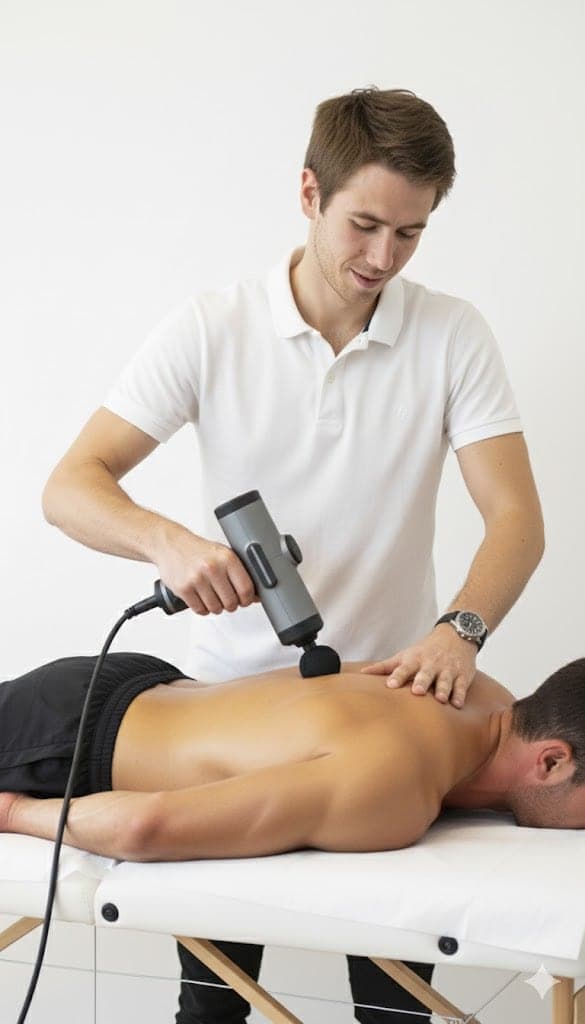
I use a specialized mechanical device that allows me to work deeper, more precisely, and more consistently than any human hands could achieve. Let me explain exactly why this matters for IT band syndrome treatment.
Depth and Penetration: The lateral thigh contains some of the body’s thickest, most resilient fascial structures. To release adhesions in the vastus lateralis or TFL effectively, you need sustained, precise pressure that penetrates through multiple tissue layers without causing bruising or excessive discomfort. The machine I use delivers this with millimeter accuracy, accessing trigger points and fascial planes that manual therapy simply cannot reach.
I remember treating a competitive cyclist in Chloraka last year who’d suffered with IT band syndrome for eighteen months. She’d tried everything—physiotherapy, massage, even considered taking six months off cycling. Within three sessions using my mechanical approach, we’d released adhesions in her TFL and hip rotators that had been causing her femur to track internally during the pedal stroke. She was back to pain-free riding within four weeks, and a year later, remains completely asymptomatic.
Complete Control: Every athlete, every runner, every active individual has different tissue density, pain tolerance, and treatment requirements. The machine allows me to adjust intensity with absolute precision—from gentle fascial mobilization for acute inflammation to powerfully deep work for chronic, resistant adhesions. This isn’t possible with manual pressure, where fatigue, leverage limitations, and variability in hand strength create inconsistent results.
Consistent Results: I don’t have “off days.” The machine doesn’t get tired, doesn’t lose focus, and delivers identical pressure characteristics every single session. This consistency is critical for progressive treatment protocols. When I tell you we’ll release your lateral hip adhesions over three sessions, you can trust that each session will build systematically on the previous one, creating cumulative improvement rather than hit-or-miss results.
Treating the Cause, Not the Symptom
Here’s how I actually treat IT band syndrome in Chloraka, step by systematic step:
Session One—Assessment and Initial Release: I begin with comprehensive movement analysis. I watch you walk, I assess your squat pattern, I evaluate hip rotation and abduction strength. This tells me precisely which structures are dysfunctional. Then we begin releasing the primary restrictions—typically the TFL, vastus lateralis, and hip rotators. I work progressively deeper, teaching your nervous system to release protective guarding while systematically breaking down fascial adhesions.
Sessions Two Through Four—Deep Structural Release: This is where real change happens. We target the deepest adhesions, the trigger points that have existed for months or years, the fascial planes that have become glued together through repetitive stress. This work is intense—I won’t lie about that—but it’s precise, controlled, and remarkably effective. Clients typically describe feeling mechanical “releases” during treatment, sensations of tissue actually letting go after being locked for extended periods.
Session Five Onward—Optimization and Prevention: Once the primary dysfunction is corrected, we shift to optimization. I teach you specific activation patterns for your gluteus medius and hip external rotators. We address any remaining restrictions in your posterior chain. We ensure your movement patterns support long-term health rather than recreating the original problem.
Why This Approach Succeeds Where Others Fail
I’ve spent ten years refining this method because I became frustrated with the limitations of conventional approaches. I watched too many athletes and active individuals trapped in cycles of temporary relief followed by inevitable recurrence. What I’ve developed isn’t just another treatment option—it’s a fundamentally different approach based on three core principles:
Mechanical specificity: I target the exact structures causing your dysfunction with precision that manual therapy cannot match.
Progressive depth: I work systematically deeper over multiple sessions, allowing tissue to adapt and release rather than forcing change that triggers protective responses.
Comprehensive correction: I don’t just release tension—I identify and correct the movement dysfunctions that created the problem, ensuring lasting results.
Exercise and Self-Care Protocols for IT Band Syndrome
While my mechanical treatment addresses the deep fascial restrictions that perpetuate IT band syndrome, I also provide clients with specific exercise protocols to support healing and prevent recurrence. Let me be clear: these exercises are complementary to proper deep-tissue treatment, not a replacement for it. But when combined with effective fascial release, they accelerate recovery and build resilience.
Hip Strengthening: The Foundation of IT Band Health
Weak hip abductors—particularly the gluteus medius—are present in virtually every IT band syndrome case I treat in Chloraka. When these muscles fail to stabilize the pelvis during stance phase, the TFL compensates, becoming chronically overloaded and pulling excessively on the IT band.
Here are the exercises I prescribe most frequently:
- Side-lying hip abduction with external rotation: Not the standard leg raise most people perform. I want the hip externally rotated and the movement controlled, focusing on posterior glute medius activation. Three sets of 15 repetitions with a 3-second hold at peak contraction.
- Single-leg balance with hip hike: Stand on one leg, drop the opposite hip, then actively lift it using hip abductor strength. This trains dynamic stabilization in a functional pattern. Two sets of 20 repetitions per side.
- Clamshells with resistance band: Again, the focus is on posterior glute medius, not TFL. Keep your feet together and control the movement without allowing pelvic rotation. Three sets of 20 repetitions.
- Single-leg Romanian deadlifts: This integrates hip stability with posterior chain strength, teaching proper hip hinge mechanics that prevent compensatory TFL overuse. Three sets of 10 repetitions per side.
Mobility Work: Strategic, Not Generic
I’m selective about mobility recommendations because not all stretching helps IT band syndrome—some actually aggravates it. Here’s what works:
- Hip flexor mobilization: Tight hip flexors pull the pelvis into anterior tilt, altering hip mechanics and increasing TFL tension. I teach a modified couch stretch with active posterior pelvic tilt. Hold for 90 seconds per side, twice daily.
- Hip internal rotation mobility: Limited internal rotation forces compensatory external rotation moments that overload the IT band. Seated or supine hip internal rotation stretches, focusing on increasing range without pain. 60 seconds per side.
- Posterior chain release: Often overlooked, but tight hamstrings and calves alter gait mechanics, creating upstream compensation at the hip. Foam rolling and specific stretching for these areas supports overall biomechanical health.
What I Don’t Recommend
Let me save you time by telling you what doesn’t work, despite being commonly prescribed:
IT band stretching: The IT band contains minimal elastic tissue. Attempting to stretch it is biomechanically futile and often irritates already inflamed structures.
Aggressive foam rolling of the IT band itself: This provides temporary neurological pain relief through gate control theory, but doesn’t address fascial adhesions and can increase inflammation if performed excessively.
Generic “runner’s stretches”: IT band syndrome requires specific intervention based on your individual biomechanical dysfunction, not a one-size-fits-all routine.
Recovery Timeline: What to Expect with Proper Treatment
Clients always ask me: “How long until I’m pain-free?” The answer depends on several factors, but I can provide realistic timelines based on a decade of treating IT band syndrome in athletes and active individuals across Chloraka.
Acute Cases (Symptoms Less Than 6 Weeks)
If you’ve caught IT band syndrome early—pain present for less than six weeks, no significant compensatory patterns developed—expect 3-5 treatment sessions over 3-4 weeks for complete resolution. You’ll typically notice significant improvement after the first session, with progressive reduction in pain during activity over subsequent weeks.
I treated a runner in Chloraka last month who’d developed IT band pain two weeks before a half-marathon she’d been training for. Three sessions over ten days, combined with modified training, and she completed her race pain-free. Six weeks later, she remains symptom-free with full training volume.
Chronic Cases (Symptoms 3-6 Months or Longer)
Chronic IT band syndrome involves significant fascial adhesions, developed compensatory patterns, and often secondary dysfunctions throughout the kinetic chain. These cases require 6-10 sessions over 6-8 weeks for substantial improvement, with continued optimization sessions recommended for another 4-6 weeks.
The timeline is longer because we’re not just releasing tissue—we’re retraining movement patterns that have been dysfunctional for months. But the investment is worth it. I’ve had clients who’ve lived with IT band pain for years achieve lasting resolution through systematic treatment and biomechanical correction.
Return to Activity Guidelines
I provide specific return-to-activity protocols because premature resumption of full training commonly causes recurrence. Here’s the framework I use:
- Pain-free daily activities: Typically achieved within 1-2 weeks of beginning treatment.
- Light exercise resumption: Swimming, cycling at low intensity, walking—activities with minimal IT band stress. Week 2-3.
- Progressive running return: Beginning with run-walk intervals, gradually increasing duration while monitoring symptoms. Week 3-5.
- Full training resumption: Return to pre-injury training volume and intensity. Week 6-8 for acute cases, 10-12 weeks for chronic cases.
The key is progressing based on tissue response, not arbitrary timelines. If pain recurs during any stage, we adjust the protocol accordingly.
Why Location Matters: IT Band Syndrome Treatment in Chloraka
Chloraka’s active community—with its runners, cyclists, and outdoor enthusiasts—creates specific demands for effective IT band syndrome treatment. The climate here supports year-round training, which means athletes don’t have natural off-seasons for recovery. This makes proper treatment even more critical.
I travel to your location in Chloraka with professional equipment, providing treatment in the comfort of your home or preferred setting. This eliminates the barrier of traveling to appointments when you’re dealing with knee pain, and it allows me to assess your actual training environment and movement patterns in context.
The convenience factor isn’t just about comfort—it’s about compliance. When treatment is accessible and fits seamlessly into your schedule, you’re far more likely to complete the full protocol necessary for lasting correction rather than stopping after initial symptom relief.
Investment in Long-Term Health, Not Short-Term Expense
I need to address the cost consideration directly because I position my service as an investment in your long-term health and performance, not an expense to minimize. Let’s examine the actual economics of IT band syndrome treatment:
The cost of ineffective treatment: How much have you already spent on physiotherapy sessions, massage appointments, foam rollers, and various devices that provided temporary relief at best? How many training cycles have been disrupted? How many races have you missed or completed at reduced capacity? For most athletes I treat, they’ve already invested hundreds or thousands of euros in approaches that didn’t solve the problem.
The cost of continued dysfunction: Beyond monetary expense, consider the cost in reduced quality of life, compromised performance, and progressive biomechanical deterioration. IT band syndrome doesn’t spontaneously resolve—it typically worsens over time, potentially leading to secondary injuries and chronic pain patterns.
The value of lasting correction: My approach delivers lasting results because it addresses the mechanical root cause of your dysfunction. The investment in comprehensive treatment—typically 6-10 sessions for chronic cases—eliminates years of recurring pain and performance limitation. When you calculate cost-per-pain-free-year, the value becomes undeniable.
I work with clients through dedicated partnerships, developing customized treatment plans based on their specific presentation, not one-size-fits-all packages. This ensures you receive exactly the intervention you need—no more, no less—for optimal results.
The Science Behind Mechanical Deep-Tissue Treatment
My approach isn’t based on anecdote or alternative theories—it’s grounded in established principles of fascial biomechanics, trigger point physiology, and motor control. Let me explain the scientific foundation supporting this method.
Fascial Adhesions and Mechanical Restriction
Fascia, the connective tissue surrounding and interpenetrating muscles, responds to repetitive stress by laying down additional collagen fibers in haphazard patterns. These create adhesions—areas where fascial layers that should glide smoothly become stuck together. In IT band syndrome, adhesions develop between the IT band and underlying vastus lateralis, and within the TFL and hip rotator complex.
These adhesions create mechanical restriction that standard stretching cannot address because stretching works through elastic deformation, while adhesions require mechanical disruption. The specialized tool I use applies precisely controlled pressure that systematically breaks down these adhesions through a combination of compression, friction, and sustained loading.
Trigger Points and Central Sensitization
Chronic muscle tension creates hyperirritable nodules called trigger points—areas of contracted muscle fibers with localized ischemia and metabolic dysfunction. In IT band syndrome, trigger points in the TFL, vastus lateralis, and gluteus medius refer pain to the knee and hip, perpetuating the pain cycle even after initial inflammation resolves.
Effective trigger point release requires sustained, precise pressure that mechanically disrupts the contracted muscle fibers and restores local circulation. The machine I use delivers this with consistent force and exact positioning, achieving releases that manual pressure often cannot.
Motor Pattern Restoration
Pain and dysfunction create altered motor control patterns—your nervous system adapts by recruiting muscles differently to avoid discomfort. These compensatory patterns often persist even after pain resolves, setting the stage for recurrence.
By combining deep-tissue release with specific motor retraining, I help clients restore optimal movement patterns. This isn’t just about feeling better—it’s about moving better, performing better, and preventing future dysfunction.
Frequently Asked Questions About IT Band Syndrome Treatment in Chloraka
How is your treatment different from regular massage or physiotherapy?
Standard massage provides superficial relaxation and cannot access the deep fascial adhesions causing IT band syndrome. Traditional physiotherapy focuses on strengthening and stretching but often fails to release the mechanical restrictions limiting movement. My specialized mechanical approach works deeper and more precisely than hands-based therapy, targeting the exact structures causing dysfunction with consistent, controlled pressure that creates lasting change rather than temporary relief.
Is the treatment painful?
The treatment is intense, particularly when addressing deep adhesions and trigger points, but it’s precisely controlled and adjusted to your tolerance. I describe it as “productive discomfort”—you’ll feel the work being done, but it’s never unmanageable. Most clients report that the sensation of tissue releasing is actually satisfying, and the immediate improvement in range of motion makes the intensity worthwhile. This isn’t relaxation massage—it’s clinical intervention designed to create mechanical change.
How many sessions will I need?
Acute cases typically require 3-5 sessions over 3-4 weeks. Chronic IT band syndrome—symptoms present for months or longer—usually needs 6-10 sessions over 6-8 weeks, with additional optimization sessions recommended. Every case is different, and I provide honest assessment after the initial session based on tissue quality, severity of restriction, and your response to treatment.
Can I continue training during treatment?
This depends on your specific presentation and training goals. I typically recommend modified training initially—reducing volume and intensity while maintaining fitness through cross-training activities that don’t stress the IT band. As treatment progresses, we systematically increase activity based on tissue response. The goal is continued athletic development while allowing proper healing, not complete rest that causes deconditioning.
Will the IT band syndrome come back after treatment?
If we properly address the biomechanical dysfunction causing the friction and you maintain appropriate strength and movement patterns, recurrence is unlikely. However, IT band syndrome develops due to specific mechanical factors—training errors, biomechanical inefficiencies, strength imbalances. If you return to the exact training patterns and movement dysfunctions that created the original problem, yes, it can recur. This is why my approach includes motor pattern correction and specific strengthening protocols, not just tissue treatment.
What makes your mechanical approach better than foam rolling?
Foam rolling applies broad, relatively superficial pressure that may provide temporary relief through neurological pain gate mechanisms, but it cannot precisely target and release deep fascial adhesions or trigger points. The specialized machine I use works with millimeter precision at depths foam rolling cannot reach, delivering controlled force that creates actual mechanical change in tissue structure rather than just temporary sensation changes.
Do you only treat athletes, or can recreational exercisers benefit too?
I treat anyone with IT band syndrome, from elite athletes to recreational walkers. The biomechanical principles are identical regardless of fitness level—the IT band dysfunction develops through the same mechanisms. What changes is the intensity of treatment required and the performance goals we’re working toward. Whether you’re training for the Olympics or just want to walk pain-free with your family, the approach is equally effective.
Why do you come to my location instead of having a clinic?
Convenience and comprehensive assessment. When you’re dealing with knee pain, traveling to appointments is a barrier to consistent treatment. More importantly, seeing you in your actual environment allows me to assess your training setup, movement patterns in context, and provide more relevant guidance. I bring professional equipment and create a clinical treatment environment wherever you are in Chloraka. This model ensures accessibility without compromising quality.
What should I expect during the first session?
The initial session includes comprehensive movement assessment—I evaluate your gait, squat pattern, hip mobility, and strength. This typically takes 20-30 minutes and gives me precise understanding of your biomechanical dysfunction. Then we begin treatment, focusing on primary restrictions while teaching your nervous system to release guarding patterns. The first session is partly diagnostic, partly therapeutic. You’ll leave with clear understanding of what’s causing your IT band syndrome and a specific treatment plan for correction.
Taking Action: Your Path to Lasting IT Band Syndrome Relief
If you’re dealing with IT band syndrome in Chloraka, you’ve likely already tried conventional approaches—rest, ice, stretching, perhaps some physiotherapy or massage. If those methods provided lasting relief, you wouldn’t be reading this article. The question now is whether you’re ready to invest in a fundamentally different approach that addresses the mechanical root of your dysfunction rather than temporarily managing symptoms.
I’ve spent ten years developing and refining this method because I became frustrated with the limitations of conventional treatment. I’ve worked with runners who were told they’d never run pain-free again, cyclists who considered giving up their sport, active individuals whose quality of life was progressively deteriorating. The consistent pattern I’ve observed is this: when you properly release the deep fascial restrictions and correct the biomechanical dysfunction causing IT band friction, the body heals remarkably well.
The mechanical approach I provide isn’t widely available because it requires specialized equipment, advanced understanding of fascial biomechanics, and systematic treatment protocols developed through years of clinical experience. It’s not easier than standard massage, it’s not cheaper than foam rolling, and it’s not as passive as receiving injections. What it is: effective, lasting, and based on sound mechanical principles that address cause rather than symptom.
Your IT band syndrome developed through specific biomechanical factors. It will resolve through specific biomechanical intervention. The choice you’re making isn’t really about which treatment to try next—it’s about whether you’re ready to invest in lasting correction rather than continuing to manage a recurring problem. After a decade of treating athletes and active individuals across Chloraka and beyond, I can tell you with certainty: proper intervention works, and the investment in your long-term health and performance is one of the most valuable decisions you can make.
Written by
Chris
Massage therapist & body mechanics specialist
Norwegian-certified with a Bachelor’s in Physical Education and Nutrition and over ten years of clinical practice, working from a portable table in clients’ homes across the Paphos district.
This article is general information from clinical practice, not a medical diagnosis. If you have severe, worsening or unexplained pain, numbness, weakness, or pain after an accident, see a doctor first.