
Professional Massage Chlorakas: Advanced Deep-Tissue Treatment for Lasting Pain Relief
In short
Discover how professional massage in Chlorakas goes beyond relaxation. With a decade of experience and specialized mechanical deep-tissue techniques, achieve lasting pain relief and optimize your body’s performance through precision treatment.
When I first arrived in Chlorakas ten years ago, I encountered a fundamental problem that continues to plague the massage industry today. A client—let’s call him Andreas—came to me after spending thousands on traditional massage therapy for chronic lower back pain. He’d seen seven different therapists. Each session felt good temporarily, but the pain always returned within days. “Maybe I just have to live with this,” he told me during our initial consultation.
I disagreed entirely.
Andreas’s story represents a critical misunderstanding about what professional massage should accomplish. Most people in Chlorakas and beyond have been conditioned to view massage as temporary relief, a pleasant escape that requires endless repetition. This perspective fundamentally misrepresents what’s possible when you apply genuine biomechanical expertise to soft tissue dysfunction.
After completing my Bachelor’s degree in Physical Education and Nutrition in Norway and working with everyone from office workers to elite athletes over the past decade, I’ve developed a specialized approach to professional massage in Chlorakas that treats causes rather than symptoms. This isn’t about relaxation music and aromatic oils—though those have their place. This is about identifying the precise mechanical failures in your musculoskeletal system and correcting them durably.
Why Traditional Massage Fails to Deliver Lasting Results
Let me be direct about something the wellness industry rarely acknowledges: most massage therapists are not trained to solve chronic pain. They’re trained to provide temporary comfort.
The distinction matters enormously.
Traditional Swedish massage, hot stone therapy, and even most “deep tissue” treatments work superficially. They address surface-level tension without accessing the deeper fascial restrictions and muscular adhesions that generate chronic pain patterns. It’s like painting over rust instead of treating the corrosion underneath—you’ve temporarily covered the problem without addressing its structural cause.
During my first three years practicing professional massage in Chlorakas, I encountered this limitation repeatedly. Clients would return every week with the same complaints: tension headaches, frozen shoulders, sciatic nerve pain, plantar fasciitis. The manual techniques I’d learned were simply inadequate for reaching the depth required to create lasting change in chronic conditions.
The Biomechanical Reality of Chronic Pain
Your body operates as an integrated mechanical system. When one component fails—whether through injury, repetitive strain, or postural dysfunction—surrounding structures compensate. Over time, these compensatory patterns become deeply embedded in your neuromuscular programming.
Consider a typical case I treated last month in Chlorakas. Maria, a 43-year-old administrator, presented with chronic neck pain and frequent migraines. Surface examination suggested simple neck tension. However, biomechanical assessment revealed the actual problem originated in her thoracic spine and shoulder girdle, where years of desk work had created profound fascial restrictions.
These restrictions were pulling her cervical vertebrae out of optimal alignment, creating muscular strain that triggered her headaches. No amount of neck massage would durably resolve this because the neck wasn’t the source—it was the victim of mechanical dysfunction occurring elsewhere.
This is precisely why professional massage in Chlorakas requires more than good intentions and soft hands. It requires systematic understanding of body mechanics, the ability to identify root causes, and tools capable of reaching the depth where actual change occurs.
The Advanced Mechanical Approach: Precision, Power, and Consistency
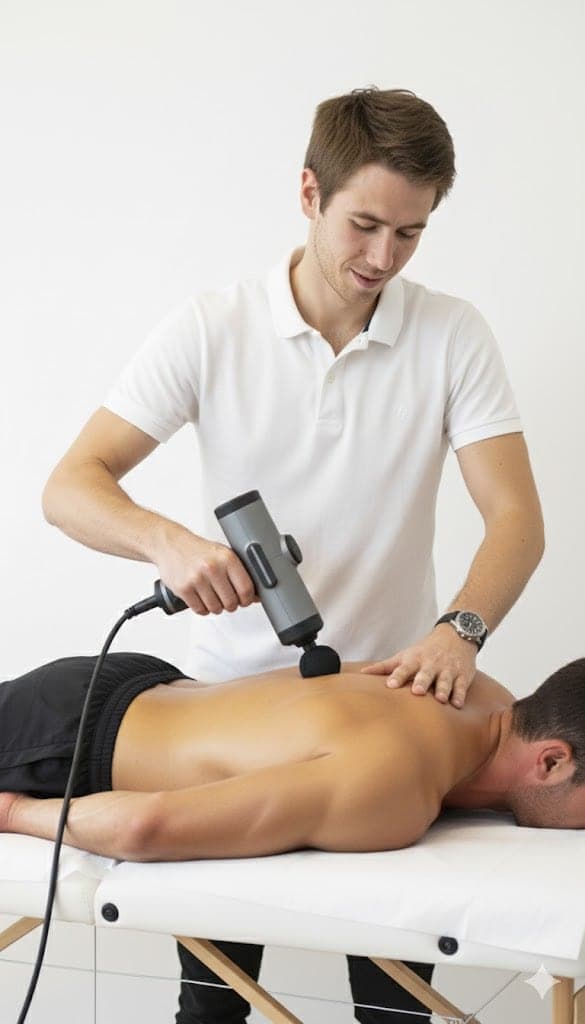
After years of recognizing the limitations of manual therapy alone, I invested significant time researching and training in advanced mechanical deep-tissue techniques. The specialized equipment I now use exclusively represents a quantum leap in what’s achievable through massage therapy.
This isn’t a trendy gadget. This is a clinically precise instrument that delivers three critical advantages human hands simply cannot match:
Depth Beyond Human Capability
The human hand, no matter how skilled, has physical limitations. Thumb and elbow techniques fatigue quickly and cannot maintain consistent pressure at the fascial depths where chronic restrictions reside. My specialized machine generates controlled, sustained pressure that penetrates 3-4 centimeters into tissue—accessing layers that manual therapy cannot reach effectively.
When I treated Andreas’s lower back pain—the case I mentioned earlier—the dysfunction wasn’t in his superficial erector spinae muscles. It was in his quadratus lumborum and psoas major, deep postural muscles that had developed severe trigger points and fascial adhesions from years of compensating for a previous ankle injury he’d dismissed as unrelated.
Manual therapy would have required such aggressive force that treatment would be intolerable. The mechanical approach delivered precise, graduated pressure that released these deep structures systematically over three sessions. Andreas has been pain-free for eighteen months.
Absolute Control and Customization
Every client who seeks professional massage in Chlorakas through my practice receives completely customized treatment intensity. The machine allows me to calibrate pressure from gentle myofascial release suitable for acute injuries to powerfully deep work appropriate for conditioned athletes.
This adjustability matters tremendously because effective treatment exists within a narrow therapeutic window. Too superficial, and you fail to access the dysfunctional tissue. Too aggressive, and you trigger protective muscle guarding that prevents release.
I worked recently with Dimitris, a semi-professional cyclist preparing for a competition. His quadriceps and hip flexors had developed profound tension from high-volume training. Manual deep-tissue work would have left him too sore to train effectively. With precise mechanical treatment calibrated to his tissue tolerance, we released the restrictions while maintaining his training schedule. He achieved a personal best in his event three weeks later.
Consistent Results Every Session
Human therapists have off days. Fatigue, distraction, and physical limitations create inconsistency. The machine I use delivers identical precision and power in the first minute of the first session and the final minute of the tenth session.
This consistency is foundational to achieving lasting results. Chronic pain patterns require systematic, progressive treatment. Each session must build upon the previous one, gradually retraining your neuromuscular system toward optimal function. Inconsistent treatment disrupts this progression and extends the timeline to resolution unnecessarily.
The Treatment Philosophy: Partnership, Not Repetition
When I provide professional massage in Chlorakas, I’m not offering an endless series of identical sessions designed to keep you dependent. I’m establishing a dedicated partnership aimed at specific, measurable outcomes.
Our initial consultation typically requires 60-90 minutes. I don’t simply ask where it hurts. I conduct a comprehensive biomechanical assessment: gait analysis, range-of-motion testing, postural evaluation, and detailed case history. This investigation reveals the mechanical story of how your pain developed and what’s maintaining it.
The Customized Treatment Plan
Based on this assessment, I develop a specific treatment protocol. For acute issues—recent injuries or isolated tension patterns—this might involve 2-4 sessions over two weeks. For chronic conditions that developed over years, we might plan 8-12 sessions over two months, with progressively longer intervals as your system stabilizes.
Each plan includes:
- Precise treatment objectives for each session
- Expected timeline to significant improvement
- Homework exercises to support mechanical changes
- Criteria for successful discharge from treatment
- Maintenance recommendations to prevent recurrence
This structured approach fundamentally differs from the open-ended “see you next week” model that characterizes most massage therapy. You deserve to know what we’re trying to achieve, how long it should take, and what success looks like.
Real Cases: What Results Look Like
I treated Elena, a 56-year-old teacher, for plantar fasciitis that had persisted for fourteen months. She’d tried orthotics, stretching protocols, and regular massage without improvement. Biomechanical assessment revealed the problem wasn’t primarily in her foot—it was in profound tightness throughout her posterior chain, particularly her calves and hamstrings, which was overloading her plantar fascia with every step.
Six sessions over five weeks, combining deep mechanical release of her lower leg and thigh with targeted foot work, eliminated her pain completely. She now walks and hikes without limitation. More importantly, she understands the mechanical relationship between her calf tightness and foot pain, allowing her to recognize and address minor flare-ups before they become problematic.
This is what professional massage in Chlorakas should accomplish: not temporary relief requiring weekly maintenance, but resolution of the underlying mechanical dysfunction creating your symptoms.
Who Benefits Most from Advanced Mechanical Deep-Tissue Treatment
My specialized approach to massage therapy serves specific populations particularly well. While nearly anyone with musculoskeletal pain can benefit, certain groups consistently achieve exceptional results.
| Client Type | Common Conditions Treated | Typical Outcomes |
|---|---|---|
| Desk Workers and Remote Professionals | Chronic neck pain, tension headaches, thoracic outlet syndrome, carpal tunnel symptoms | Resolution of pain patterns, improved postural endurance, reduced headache frequency |
| Athletes and Active Individuals | Overuse injuries, performance plateaus, chronic tightness limiting mobility | Enhanced range of motion, improved performance metrics, faster recovery |
| Chronic Pain Sufferers | Long-standing back pain, sciatica, frozen shoulder, plantar fasciitis | Significant pain reduction or elimination, restored functional capacity |
| Post-Rehabilitation Clients | Residual stiffness after physical therapy, persistent compensatory patterns | Complete recovery, return to full pre-injury function |
| Wellness-Focused Individuals | General tension, movement optimization, preventive maintenance | Enhanced body awareness, improved movement quality, injury prevention |
Why Location Shouldn’t Limit Access to Professional Treatment
One persistent challenge in Chlorakas—and throughout Cyprus—is geographic limitation. Quality specialized care often concentrates in major urban centers, requiring clients to travel significant distances and navigate clinic schedules that conflict with their work and family obligations.
I’ve eliminated this barrier entirely. I travel to your location—your home, office, or hotel—bringing a professional treatment bench and all necessary equipment. This mobile model provides several important advantages:
Convenience: Treatment fits your schedule, not mine. Early morning sessions before work, lunchtime appointments, or evening treatments after the children are settled—your priorities determine timing.
Comfort: Many clients find treatment more effective when delivered in familiar, private surroundings rather than clinical environments that may trigger anxiety or tension.
Continuity: Eliminating travel requirements significantly improves treatment compliance. Clients complete their full treatment protocols rather than discontinuing prematurely when sessions become logistically inconvenient.
Privacy: For clients dealing with sensitive conditions or simply preferring discretion, in-home treatment provides complete confidentiality.
This approach reflects my fundamental philosophy: professional massage in Chlorakas should serve your life, not complicate it.
The Science Behind Deep-Tissue Mechanical Treatment
For clients who appreciate understanding the mechanisms behind their treatment, the biomechanical principles deserve explanation.
Fascial System Dysfunction
Fascia—the connective tissue network surrounding and interpenetrating all muscles, organs, and structures in your body—plays a crucial role in movement quality and pain generation. Healthy fascia exhibits a fluid, sliding quality that allows muscles to contract and lengthen efficiently.
Chronic tension, injury, inflammation, and poor movement patterns cause fascia to develop adhesions—areas where layers that should slide freely become stuck together. These adhesions create mechanical restrictions that limit range of motion, alter movement patterns, and generate pain both locally and in distant regions through fascial continuity.
Manual massage techniques work primarily on muscle tissue and can only superficially address fascial dysfunction. The mechanical deep-tissue approach I use specifically targets these fascial restrictions, applying sustained pressure that induces piezoelectric effects—electrical charges generated by mechanical stress that stimulate fibroblast activity and collagen remodeling.
In practical terms, this means we’re not just temporarily relaxing tight muscles. We’re restructuring the fascial matrix to restore proper sliding mechanics and eliminate the architectural dysfunction generating your symptoms.
Trigger Point Deactivation
Trigger points—hyperirritable nodules within taut bands of skeletal muscle—represent another common source of chronic pain. These aren’t simply “tight spots.” They’re areas where muscle sarcomeres have become locked in sustained contraction due to metabolic crisis at the cellular level.
Trigger points generate both local pain and referred pain patterns that can be remarkably distant from the trigger point location. A trigger point in your upper trapezius, for example, commonly refers pain into your temple, creating what appears to be a tension headache.
Effective trigger point treatment requires sustained pressure of specific intensity applied for adequate duration—typically 30-90 seconds per point. Manual thumb pressure becomes intolerably painful for the therapist long before therapeutic duration is reached. The mechanical approach maintains precise pressure for as long as necessary, systematically deactivating trigger points that have been generating symptoms for months or years.
Neuromuscular Re-education
Beyond structural changes in fascia and muscle tissue, successful treatment of chronic pain requires neuromuscular re-education. Your nervous system has learned dysfunctional movement patterns and maintains them automatically. Simply releasing tight tissue doesn’t automatically restore optimal movement.
The deep mechanical work I provide creates powerful sensory input that essentially “resets” motor control patterns. Combined with specific movement education and homework exercises, this allows your nervous system to relearn efficient, pain-free movement strategies.
This is why clients often report that their bodies “feel different”—not just less painful, but fundamentally changed in how they move and hold themselves. We’ve altered the neurological programming underlying their habitual patterns.
Investment Versus Expense: The Economics of Effective Treatment
I need to address something that prospective clients frequently consider but rarely articulate directly: cost.
Professional massage in Chlorakas delivered at the level I’ve described is not inexpensive. The equipment represents significant investment. The education and experience required to use it effectively took years to develop. The customized, outcomes-focused approach requires substantially more time than conventional massage.
However, let’s examine the economic reality honestly.
The True Cost of Ineffective Treatment
If you’ve been receiving weekly massage for chronic pain over the past year, you’ve likely spent €2,400-€3,600 (assuming €50-75 per session). You still have the pain. The treatment isn’t failing because your therapist lacks care or effort—it’s failing because the approach cannot access the root mechanical dysfunction.
Now consider: if a properly designed treatment protocol resolves your condition in 8-12 sessions over two months, the total investment might be €1,200-€1,800. More importantly, the problem is actually solved. You’re not facing another year of weekly appointments.
The truly expensive option is treatment that doesn’t work.
The Broader Economic Impact of Chronic Pain
Beyond direct treatment costs, chronic pain impacts your life economically in multiple ways:
- Reduced work productivity and potential income loss
- Ongoing pharmaceutical costs for pain management
- Lifestyle limitations affecting quality of life
- Potential progression to more serious conditions requiring surgery or extensive rehabilitation
- Psychological costs including anxiety, depression, and relationship strain
When you understand that we’re not simply treating discomfort but preventing these cascading consequences, the investment in effective treatment becomes obviously rational.
I worked with Nikolas, a 38-year-old restaurant manager, whose chronic shoulder pain was affecting his sleep, his mood, and his ability to perform physical aspects of his job. He’d been taking NSAIDs daily for months and avoiding activities he loved. After treatment resolved his mechanical dysfunction, he described feeling like he’d “gotten ten years back.”
That return to full function—personally and professionally—represents value that transcends the treatment fee.
What to Expect: The Treatment Experience
If you’ve decided to pursue professional massage in Chlorakas through my specialized approach, understanding what actually happens during treatment helps set appropriate expectations.
Initial Consultation and Assessment
Your first appointment is substantially longer than subsequent sessions—typically 90 minutes. I begin with detailed case history: when your symptoms started, what makes them better or worse, previous treatments and their results, relevant injuries or medical conditions, and your specific goals for treatment.
Then I conduct physical assessment. This isn’t cursory. I evaluate:
- Postural alignment in standing and seated positions
- Gait patterns and weight distribution
- Range of motion in all relevant joints
- Tissue quality through palpation of major muscle groups
- Functional movement patterns specific to your complaints
- Specific orthopedic tests if indicated
This comprehensive evaluation typically identifies dysfunctions you weren’t aware of but which contribute significantly to your primary complaint. That hip tightness you dismissed as normal? It’s actually creating the compensatory pattern generating your back pain.
The Treatment Session Itself
I arrive at your location with my professional treatment bench—not a portable massage table, but a proper mechanical bench that allows precise positioning for optimal access to treatment areas. I also bring all necessary equipment, linens, and any additional tools required.
The mechanical deep-tissue work itself feels distinctly different from manual massage. Clients commonly describe it as “intense but satisfying” or “uncomfortable in a productive way.” You’ll feel significant pressure, but not uncontrolled pain. I continuously communicate with you to ensure we’re working within your therapeutic window.
Sessions typically progress from broader, preparatory work to specific, focused treatment of primary dysfunction areas. A shoulder treatment, for example, might begin with thoracic spine and rib mobilization, progress to scapular and rotator cuff work, and conclude with specific trigger point treatment in identified problem areas.
Standard treatment sessions after the initial consultation typically require 60 minutes, though this varies based on condition complexity and treatment phase.
Post-Treatment Response
Immediately after treatment, most clients report feeling simultaneously relaxed and energized. The specific areas we’ve worked will feel noticeably different—looser, freer, less restricted.
Within 24-48 hours, you may experience some muscle soreness similar to post-exercise soreness. This is normal and indicates we’ve created beneficial microtrauma in dysfunctional tissue, initiating the remodeling process. This soreness resolves quickly and diminishes with subsequent sessions as tissue quality improves.
The actual therapeutic benefit—meaningful pain reduction and functional improvement—typically becomes apparent 3-7 days post-treatment as inflammatory processes resolve and tissue remodeling progresses.
Frequently Asked Questions About Professional Massage in Chlorakas
How is this different from deep-tissue massage I can get at a spa?
The difference is fundamental. Spa deep-tissue massage is a relaxation-oriented service that applies somewhat firmer pressure than Swedish massage. What I provide is mechanical treatment of specific dysfunctions identified through biomechanical assessment. The specialized equipment reaches depths impossible with manual techniques and delivers consistent, calibrated pressure throughout the session. Most importantly, the approach is outcome-focused: we’re solving a problem, not providing temporary comfort.
Will the treatment hurt?
You’ll experience significant pressure and some discomfort, particularly in areas of severe dysfunction. However, productive treatment discomfort differs from pain. I continuously monitor your response and adjust intensity to maintain you within your therapeutic window—uncomfortable enough to create change, but never overwhelming. Many clients describe the sensation as “hurts so good”—intense but satisfying, with immediate relief as restrictions release.
How many sessions will I need?
This depends entirely on your specific condition. Acute issues often resolve in 2-4 sessions over 2-3 weeks. Chronic conditions that developed over years typically require 8-12 sessions over 6-10 weeks to achieve lasting resolution. During your initial assessment, I provide a specific treatment plan with estimated timeline based on your particular mechanical dysfunction. Unlike open-ended “maintenance massage,” we’re working toward discharge from treatment.
Can you treat me if I have a specific medical condition?
I work with clients managing various conditions including osteoarthritis, fibromyalgia, previous injuries, and post-surgical recovery. However, certain conditions contraindicate deep-tissue work: active cancer, acute infection, severe osteoporosis, and some cardiovascular conditions. During initial consultation, we’ll review your medical history to ensure treatment safety and appropriateness.
Do you accept insurance?
I provide detailed receipts that many clients successfully submit to their insurance providers for reimbursement under massage therapy or alternative treatment benefits. However, I don’t bill insurance directly. Payment is due at time of service, and you manage insurance submission independently.
What should I do between treatment sessions?
I provide specific homework for each client based on their condition. This typically includes targeted stretches, strengthening exercises, and postural modifications designed to support and accelerate the mechanical changes we’re creating in treatment. Compliance with these recommendations significantly impacts treatment speed and completeness. I also recommend adequate hydration and may suggest temporary activity modifications during intensive treatment phases.
What happens after my condition resolves?
Once we’ve achieved your treatment objectives and mechanical dysfunction is corrected, most clients don’t require ongoing regular treatment. I provide guidance on self-maintenance strategies and recommend periodic check-ins—perhaps quarterly or semi-annually—to address minor tensions before they develop into significant problems. The goal is independence from treatment, not dependence on it.
Why should I choose you specifically for professional massage in Chlorakas?
Because I offer something fundamentally different from conventional massage therapy. My university degree in Physical Education and Nutrition, combined with ten years of specialized practice, provides the biomechanical expertise to identify root causes rather than just treating symptoms. The advanced mechanical equipment I use exclusively delivers depth, precision, and consistency impossible with manual techniques. Most importantly, my approach is results-oriented: we establish specific objectives and work systematically toward achieving them. You’re not booking endless repetitive sessions—you’re investing in lasting resolution of mechanical dysfunction.
Taking the Next Step: How to Begin
If you’re reading this final section, you’re likely experiencing chronic pain or dysfunction that hasn’t responded adequately to conventional treatment. You’re probably somewhat skeptical—understandably so, given how many ineffective approaches you may have already tried.
I won’t tell you that every condition responds perfectly to every treatment method. What I will tell you is this: if your pain or limitation stems from mechanical dysfunction in your musculoskeletal system—and the vast majority of chronic pain does—then proper biomechanical treatment reaches the cause rather than merely managing symptoms.
The Consultation Process
Beginning treatment starts with a thorough consultation. This isn’t a sales conversation—it’s a clinical assessment to determine if my approach is appropriate for your specific condition and whether we can achieve meaningful improvement.
During this consultation, I’ll:
- Conduct comprehensive case history and biomechanical assessment
- Explain precisely what I’ve identified as the mechanical basis for your symptoms
- Provide a specific treatment plan with realistic timeline and expected outcomes
- Answer all your questions about the process, approach, and logistics
- Discuss any contraindications or limitations
You’ll leave this consultation with clear understanding of what’s generating your symptoms and whether my specialized approach to professional massage in Chlorakas can help you achieve lasting resolution.
What True Resolution Feels Like
I’ve worked with hundreds of clients over the past decade. The outcome that matters most isn’t simply pain reduction—though that’s certainly significant. What transforms people’s lives is the return of capability they’d written off as lost.
Sophia, a 62-year-old grandmother, told me after treatment that what meant most wasn’t just that her shoulder pain was gone. It was that she could pick up her grandchildren again without fear and limitation. She’d adapted to the pain by avoiding that movement entirely, and in doing so, had lost a form of connection that mattered enormously to her.
Marcus, a 29-year-old personal trainer, described finally being able to demonstrate exercises for his clients without his chronic back pain undermining his professional credibility. The pain had been manageable, but the limitation and self-consciousness it created had been affecting his career.
These stories represent what effective treatment accomplishes: not just symptom management, but restoration of full function and the life quality that depends on it.
Your Next Decision
You face a straightforward choice. You can continue managing symptoms with approaches that haven’t resolved the underlying problem, or you can address the mechanical dysfunction generating those symptoms with specialized treatment designed specifically for that purpose.
The path to resolution starts with accurate identification of root causes and systematic treatment targeting those causes directly. That’s precisely what my approach to professional massage in Chlorakas provides: specialized expertise, advanced methodology, and unwavering focus on achieving measurable, lasting outcomes.
Your body is an extraordinarily capable mechanical system. When provided with proper treatment, it possesses remarkable capacity for correction and restoration. Chronic pain and limitation aren’t inevitable consequences of aging or previous injury—they’re often simply the result of mechanical dysfunction that hasn’t been properly addressed.
I’ve dedicated my career to changing that reality for my clients. If you’re ready to stop managing symptoms and start resolving causes, I’m prepared to apply my expertise, experience, and specialized methodology to achieving that outcome for you.
The question isn’t whether lasting improvement is possible. The question is whether you’re ready to pursue it systematically with someone who has both the knowledge and tools to deliver it.
Contact me to schedule your initial consultation. Let’s determine precisely what’s generating your symptoms and develop a specific plan to resolve it durably. Your pain has a cause. Let’s address it.
Written by
Chris
Massage therapist & body mechanics specialist
Norwegian-certified with a Bachelor’s in Physical Education and Nutrition and over ten years of clinical practice, working from a portable table in clients’ homes across the Paphos district.
This article is general information from clinical practice, not a medical diagnosis. If you have severe, worsening or unexplained pain, numbness, weakness, or pain after an accident, see a doctor first.