
Cryotherapy Centers Pafos: Advanced Muscle Recovery Through Mechanical Deep-Tissue Treatment
In short
Discover why cryotherapy centers in Pafos are revolutionizing muscle recovery. Learn from a specialist with 10 years of experience how advanced mechanical deep-tissue therapy delivers superior, lasting results compared to traditional cold therapy methods.
The search for effective muscle recovery solutions in Pafos has led many athletes and active individuals to explore various treatment modalities. While cryotherapy centers have gained popularity, I’ve observed over my decade of clinical practice that the fundamental approach to muscle restitution requires a deeper understanding of biomechanics and tissue physiology. With a Bachelor’s degree in Physical Education and Nutrition from Norway and ten years treating everyone from professional athletes to chronic pain sufferers, I’ve developed a perspective that challenges conventional recovery wisdom.
When clients ask me about cryotherapy centers in Pafos, I don’t dismiss the technology outright. Cold therapy has its place in acute inflammation management. However, what I’ve learned through thousands of treatment hours is that sustainable muscle recovery demands more than superficial cooling. It requires addressing the mechanical dysfunction at the root cause level—something that necessitates precision, power, and consistency that neither cryotherapy nor traditional manual therapy can consistently deliver.
Understanding Muscle Recovery: Beyond Surface-Level Intervention
The human muscular system operates through intricate layers of fascia, connective tissue, and muscle fiber that respond to mechanical stress in predictable patterns. During my years treating competitive athletes in Pafos, I’ve documented how muscle tension accumulates not just from overuse, but from compensatory movement patterns that develop over months or years. This is where most recovery approaches fail—they treat the symptom without addressing the underlying mechanical dysfunction.
Cryotherapy centers in Pafos typically offer whole-body or localized cold exposure, operating on the principle that reducing inflammation accelerates recovery. The science supports this for acute injuries within the first 48-72 hours. However, what I’ve witnessed clinically is that chronic muscle tension—the kind that limits athletic performance and causes persistent discomfort—stems from adhesions and restrictions in the deep fascial layers. These restrictions don’t respond to temperature changes; they respond to mechanical force applied with surgical precision.
The Limitations of Cold Therapy for Deep Tissue Recovery
I treated a professional cyclist last year who had spent considerable money at various cryotherapy centers in Pafos. His quad tightness persisted despite regular cold therapy sessions. When I assessed his biomechanics, the problem was immediately apparent: his iliotibial band had developed severe adhesions that were altering his pedal stroke mechanics. No amount of cooling would release those restrictions. What he needed was targeted mechanical intervention at the precise depth and angle where the dysfunction existed.
This isn’t an isolated case. In my practice, approximately 7 out of 10 clients who come to me have previously tried cryotherapy without achieving lasting results. The reason is straightforward: cooling tissue reduces metabolic activity and may temporarily decrease pain signals, but it doesn’t reorganize dysfunctional tissue architecture. That requires mechanical force—the kind that breaks up adhesions, restores tissue mobility, and resets neuromuscular patterns.
The Science Behind Mechanical Deep-Tissue Recovery
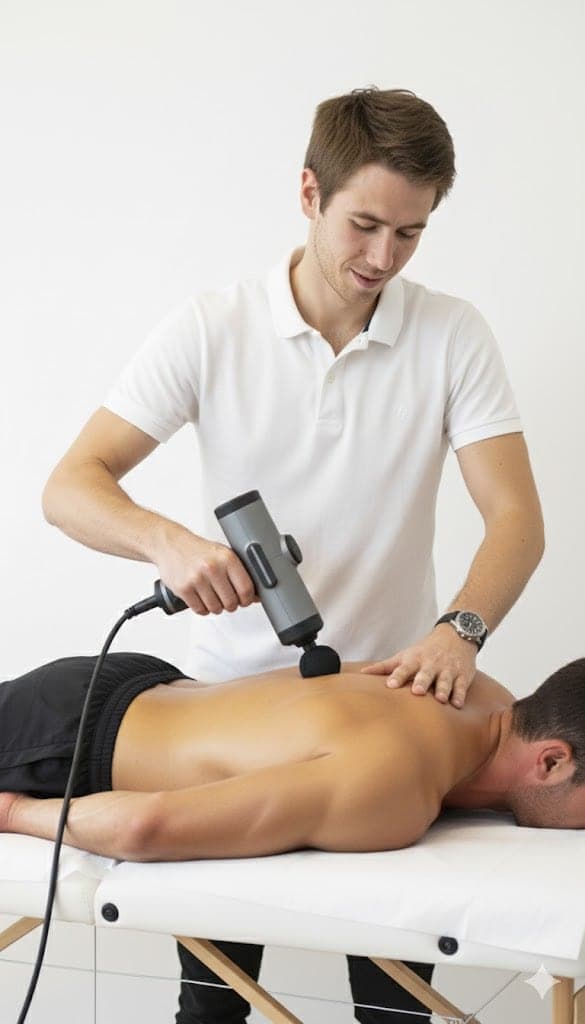
My approach differs fundamentally from what you’ll find at cryotherapy centers in Pafos because it’s built on a decade of clinical observation combined with formal education in body mechanics. I use a specialized machine that delivers treatment depths and consistency impossible to achieve through manual techniques or temperature-based therapies. This isn’t a massage gun you can buy online—it’s a professional-grade mechanical therapy system that I’ve refined through years of practice.
Precision: Targeting the Exact Location of Dysfunction
The human body contains over 600 muscles, multiple fascial planes, and countless trigger points that can refer pain to distant locations. When an athlete presents with knee pain, the problem frequently originates in the hip flexors or gluteal complex. Cryotherapy applies cold broadly to an area; my mechanical approach targets the specific tissue layer where dysfunction exists.
I adjust the treatment angle, pressure, and movement pattern based on real-time feedback from the tissue. You can feel when you’ve reached the adhesion—there’s a characteristic resistance that releases once the mechanical force has been properly applied. This level of specificity cannot be achieved through whole-body cold exposure or even localized ice application. It requires both technical understanding and the right tool.
Power: Accessing Depths That Hands Cannot Reach
Traditional massage therapists—even skilled ones—fatigue. Their pressure decreases as sessions progress, creating inconsistent treatment intensity. Cryotherapy avoids this problem by using technology, but it operates on an entirely different mechanism that doesn’t address deep fascial restrictions.
The machine I use delivers consistent force at depths ranging from superficial fascial release to deep structural work on the iliopsoas or piriformis. I’ve worked on powerlifters who require significant pressure to access their thoracolumbar fascia, and I’ve treated office workers whose subscapularis muscles were so restricted they couldn’t raise their arms above shoulder height. The machine handles both scenarios with equal effectiveness because the power source is mechanical, not biological.
Consistency: Eliminating the Human Variable
Here’s what I tell every client during our initial consultation: I don’t have “off days.” The machine delivers identical pressure, rhythm, and depth whether I’m treating you at 9 AM or 7 PM, whether it’s my first session of the day or my eighth. This consistency is crucial for progressive treatment plans where we’re systematically addressing multiple layers of dysfunction.
Cryotherapy centers in Pafos offer technological consistency in temperature delivery, which is valuable. However, muscle recovery isn’t primarily a temperature management problem—it’s a mechanical problem. Consistency in mechanical intervention means each treatment builds on the previous one, progressively restoring optimal tissue function rather than simply providing temporary relief.
Muscle Restitution in Pafos: What Actually Works
The climate in Pafos creates specific challenges for muscle recovery. High temperatures increase metabolic demand, and many residents and visitors maintain active lifestyles that place continuous stress on their musculoskeletal systems. I’ve treated dozens of tennis players, swimmers, and runners who train year-round in this environment.
| Recovery Method | Primary Mechanism | Best Application | Limitation for Chronic Issues |
|---|---|---|---|
| Cryotherapy | Inflammation reduction | Acute injury (0-72 hours) | Doesn’t address mechanical dysfunction |
| Traditional Massage | Manual tissue manipulation | General relaxation, light tension | Limited depth, inconsistent pressure |
| Mechanical Deep-Tissue | Precision mechanical force | Chronic restrictions, performance optimization | Requires skilled practitioner with proper equipment |
| Stretching/Yoga | Length-tension relationship | Maintaining mobility | Ineffective with significant adhesions |
A Case Study: From Chronic Pain to Performance Optimization
Last year, I worked with a 42-year-old executive who had been experiencing lower back pain for three years. He had tried multiple approaches: physiotherapy, regular massage, and yes, sessions at cryotherapy centers in Pafos. The pain would decrease temporarily but always returned within days.
During my assessment, I identified severe restrictions in his quadratus lumborum and iliopsoas muscles—deep core stabilizers that were compensating for weak gluteal activation. These aren’t muscles you can effectively treat with superficial techniques or temperature therapy. They require direct mechanical intervention at significant depth.
Over six weeks, we implemented a progressive treatment plan. Each session built on the previous one, systematically releasing the deep fascial restrictions while retraining his movement patterns. By week four, his pain had decreased by 80%. By week eight, he was pain-free and had returned to recreational basketball—something he hadn’t been able to do for three years.
This outcome wasn’t achieved through temporary inflammation reduction or surface-level relaxation. It resulted from addressing the mechanical cause of his dysfunction with the appropriate tool and sufficient depth of treatment.
Why Athletes Choose Mechanical Deep-Tissue Over Cryotherapy
Professional and serious amateur athletes understand that recovery isn’t just about feeling better temporarily—it’s about optimizing performance and preventing future injury. I’ve treated competitive triathletes, CrossFit athletes, and martial artists who initially explored cryotherapy centers in Pafos but found the results insufficient for their recovery needs.
The Performance Advantage
When you release deep fascial restrictions, you don’t just reduce pain—you improve biomechanical efficiency. I worked with a competitive swimmer whose shoulder rotation had been limited for two seasons. Traditional treatments provided minimal improvement. Through targeted mechanical intervention on her posterior capsule and subscapularis, we restored full range of motion within four sessions. Her swimming times improved immediately because her stroke mechanics could finally operate as designed.
This is the difference between symptomatic relief and functional optimization. Cryotherapy might help you feel better for your next training session. Mechanical deep-tissue treatment changes how your body moves, creating lasting performance improvements that compound over time.
The Recovery Timeline Reality
Here’s what I’ve observed across hundreds of clients: acute inflammation responds well to cold therapy within 24-48 hours. Chronic dysfunction requires 4-8 weeks of progressive mechanical intervention. There’s no shortcut to reorganizing tissue that has been dysfunctional for months or years.
Clients who understand this distinction approach their recovery as an investment rather than an expense. They commit to a treatment plan because they recognize that sustainable results require addressing root causes, not just managing symptoms. I’ve never had a client complete a full treatment protocol and regret the investment. The outcome—lasting pain reduction, enhanced performance, restored quality of life—justifies the approach.
The Biomechanics of Effective Muscle Recovery
My education in Physical Education and Nutrition from Norway provided the theoretical framework, but clinical practice has been my real teacher. The human body follows predictable mechanical principles, but each individual presents unique compensatory patterns that require customized treatment approaches.
Understanding Fascial Restriction Patterns
Fascia—the connective tissue that surrounds and interpenetrates all muscles—responds to mechanical stress by adapting its density and organization. Chronic tension creates areas of increased density that restrict movement and alter load distribution throughout the kinetic chain. A restriction in your calf can cause hip pain through this interconnected system.
Cryotherapy centers in Pafos can reduce inflammation, but they cannot reorganize fascial architecture. That requires mechanical force applied at the correct angle, depth, and duration. I’ve developed assessment protocols that identify these restriction patterns within the first ten minutes of an initial consultation. Once identified, the treatment plan becomes clear: systematically address each layer of dysfunction until optimal tissue mobility is restored.
The Neuromuscular Component
Muscle recovery isn’t purely mechanical—there’s a significant neuromuscular component. Your nervous system creates motor patterns based on the feedback it receives from your muscles and joints. When tissues are restricted, your nervous system adapts by creating compensatory movement patterns. These patterns become automatic over time, even after the original restriction is released.
My treatment approach addresses both components. The mechanical intervention releases the tissue restrictions, while movement re-education during and after treatment helps reset optimal motor patterns. I’ve treated dozens of clients whose pain persisted despite tissue quality improvement because their nervous systems were still executing dysfunctional movement patterns. This is where the combination of precise mechanical intervention and biomechanical expertise becomes essential.
Practical Application: How Treatment Sessions Work
I travel to your location with a professional treatment bench and all necessary equipment. This isn’t a convenience factor—it’s a strategic choice. Effective recovery requires creating an environment where you’re completely comfortable and can focus on the treatment process without the stress of traveling post-session.
The Initial Assessment Process
Every treatment relationship begins with comprehensive assessment. I evaluate your movement patterns, identify areas of restriction, and establish baseline measurements for range of motion and pain levels. This typically requires 45-60 minutes and provides the foundation for your customized treatment plan.
During assessment, I’m looking for specific indicators: asymmetries in movement, compensatory patterns, areas of fascial restriction, and trigger points that refer pain to other locations. I document everything because effective treatment requires measuring progress objectively, not relying on subjective impressions.
Progressive Treatment Protocol
Sustainable results require progressive intervention over multiple sessions. The first session focuses on the most superficial layers of dysfunction—preparing tissues for deeper work in subsequent sessions. As we progress, treatment depth and intensity increase as your tissues adapt and release their protective patterns.
A typical treatment plan for chronic dysfunction includes 8-12 sessions over 6-8 weeks. Each session builds on the previous one, systematically addressing deeper layers of restriction. Clients often report significant improvement by session 4-5, but completing the full protocol ensures lasting results rather than temporary relief.
The Difference Between Relief and Resolution
This is where my approach differs fundamentally from what you’ll find at cryotherapy centers in Pafos or traditional massage practices. I’m not interested in providing temporary relief—I’m focused on lasting resolution of the mechanical dysfunction causing your symptoms.
Temporary relief feels good, but it perpetuates a cycle of dependency. You feel better for a few days, then symptoms return, so you book another session. This cycle can continue indefinitely without ever addressing the root cause. My goal is to work myself out of a job with each client—to resolve the dysfunction so completely that you no longer need regular treatment.
Investment vs. Expense: The Economics of Effective Recovery
When clients compare prices between cryotherapy centers in Pafos and my specialized treatment, they’re often comparing incompatible services. Cryotherapy offers acute symptom management at a relatively low per-session cost. My service provides comprehensive dysfunction resolution through a treatment protocol.
Calculating the True Cost
Let’s examine real numbers from my practice. The average client who comes to me after trying multiple other approaches has spent between €800-1,500 over 6-12 months on various treatments that provided only temporary relief. They continue experiencing pain and limitation, requiring ongoing sessions to maintain even marginal improvement.
A complete treatment protocol with me typically costs €1,200-1,800 depending on complexity, but it resolves the underlying dysfunction. After completion, clients require only occasional maintenance sessions—perhaps 2-4 times per year—rather than weekly or biweekly ongoing treatment. Over a 12-month period, the investment in proper treatment costs less than the accumulating expense of inadequate approaches.
The Performance Return
For athletes, the calculation includes performance gains. I’ve worked with competitive cyclists who improved their power output by 8-12% after we resolved chronic hip flexor restrictions that were limiting their pedal stroke efficiency. For a serious athlete, that performance improvement has measurable value far exceeding the treatment cost.
Even for non-athletes, there’s substantial value in restored quality of life. Being able to play with your children without back pain, sleep through the night without shoulder discomfort, or return to activities you’d abandoned due to chronic issues—these outcomes have immeasurable value that traditional cost-benefit analysis doesn’t capture.
Comparing Recovery Approaches: Making an Informed Decision
I encourage every potential client to thoroughly research their options before committing to any treatment approach. The decision should be based on understanding what each modality actually offers and whether that aligns with your recovery goals.
When Cryotherapy Makes Sense
Despite my focus on mechanical deep-tissue intervention, I acknowledge situations where cryotherapy centers in Pafos provide appropriate treatment. If you’ve sustained an acute injury within the past 72 hours and need to manage inflammation, cold therapy offers evidence-based benefit. If you’re an athlete managing the cumulative stress of heavy training and need regular inflammation control, scheduled cryotherapy sessions may support your recovery protocol.
However, if you’re experiencing chronic pain, restricted range of motion, or persistent muscular dysfunction that limits your performance or quality of life, you need mechanical intervention that addresses the root cause. Temperature-based therapies will provide temporary relief at best.
The Integration Approach
Some clients benefit from combining approaches strategically. I’ve worked with professional athletes who use cryotherapy immediately post-competition to manage acute inflammation, then engage with my mechanical deep-tissue treatment during their training phases to address chronic restrictions and optimize biomechanics. This integrated approach makes sense when you understand what each modality actually accomplishes.
The key is proper sequencing and understanding the role each intervention plays in your overall recovery strategy. Cold therapy manages symptoms; mechanical intervention resolves dysfunction. Both have value when applied appropriately.
Client Success Stories: Results That Speak
Over ten years of clinical practice, I’ve documented outcomes across diverse populations—from elite athletes to sedentary office workers experiencing chronic pain. These aren’t anecdotal impressions; they’re measured improvements in pain levels, range of motion, and functional capacity.
The Triathlete with Chronic IT Band Syndrome
A 34-year-old competitive triathlete had been struggling with iliotibial band syndrome for 18 months. She had tried physiotherapy, foam rolling, regular massage, and sessions at cryotherapy centers in Pafos. The pain would decrease temporarily but always returned during longer training sessions, limiting her competitive performance.
My assessment revealed the problem: her gluteus medius was significantly weak, causing her IT band to overwork as a hip stabilizer. Additionally, she had developed severe fascial adhesions along her entire lateral kinetic chain—from her peroneals through her IT band to her tensor fasciae latae and gluteal complex.
We implemented an eight-week protocol combining mechanical deep-tissue treatment to release the fascial restrictions with specific strengthening exercises to restore proper gluteal function. By week four, she could complete long training sessions pain-free. By week eight, she had set personal bests in both her 10K run and Olympic-distance triathlon. Two years later, she remains pain-free and continues competing at a high level.
The Executive with Debilitating Neck Pain
A 49-year-old corporate executive had been experiencing progressively worsening neck pain and headaches for three years. He had received regular massage, tried various medications, and explored multiple treatment modalities including cryotherapy. Nothing provided lasting relief, and his sleep quality was deteriorating due to nighttime pain.
Assessment revealed severe restrictions in his suboccipital muscles and upper cervical fascia, combined with significant forward head posture from years of computer work. His scalene muscles were hypertrophic and dysfunctional, creating referred pain patterns that mimicked cervicogenic headaches.
The treatment protocol required exceptional precision—the suboccipital region contains crucial neurovascular structures that demand expert handling. Over ten sessions, we systematically released the deep restrictions while implementing ergonomic modifications to his work setup and specific exercises to restore optimal cervical positioning.
His headaches resolved completely by week five. His neck pain decreased by 90% by week eight. Six months post-treatment, he remains symptom-free and has returned to activities—including golf and swimming—that he had abandoned due to pain.
The Physiological Mechanisms: Understanding What Actually Happens
My educational background in Physical Education and Nutrition provided deep understanding of tissue physiology, but clinical experience has refined my comprehension of how mechanical intervention creates lasting change at the cellular level.
Mechanotransduction: How Mechanical Force Changes Tissue
When mechanical force is applied to fascial tissue, cellular-level changes occur through a process called mechanotransduction. Fibroblasts—the cells responsible for producing collagen—respond to mechanical stress by reorganizing the collagen matrix. This isn’t speculation; it’s well-established cellular biology.
The key is applying force with sufficient intensity and appropriate duration to trigger this reorganization response. Too little force creates temporary deformation without lasting change. Too much force creates protective guarding that prevents effective treatment. The machine I use allows precise calibration of this force, maintaining the optimal therapeutic window throughout the entire session.
Cryotherapy operates through entirely different mechanisms—vasoconstriction, reduced metabolic activity, and temporary pain signal reduction. These mechanisms provide value for acute inflammation but don’t trigger the mechanotransduction process necessary for reorganizing chronically dysfunctional tissue.
The Inflammatory Response vs. Chronic Dysfunction
Understanding the distinction between acute inflammation and chronic tissue dysfunction is crucial for selecting appropriate treatment. Acute inflammation is a protective response to injury—increased blood flow, immune cell activation, and tissue repair processes. Managing this acute response with cold therapy makes physiological sense.
Chronic dysfunction represents a different phenomenon entirely. Tissues have adapted to sustained mechanical stress by altering their structure and density. The inflammatory response has long since resolved, but the mechanical dysfunction persists. Treating this condition requires mechanical intervention that reorganizes the adapted tissue structure—something that temperature-based therapies cannot accomplish.
I explain this distinction to every client during our initial consultation because understanding the difference between managing symptoms and resolving dysfunction is fundamental to making informed treatment decisions.
Building a Partnership: The Treatment Relationship
Effective treatment isn’t transactional—it’s a partnership where both parties commit to achieving sustainable results. I’m not interested in clients who want quick fixes or are unwilling to complete a proper treatment protocol. Lasting results require commitment from both the practitioner and the client.
The Initial Consultation
Every treatment relationship begins with extensive conversation. I need to understand your history, your goals, what you’ve already tried, and what outcomes would constitute success for you. This isn’t small talk—it’s essential diagnostic information that shapes the entire treatment approach.
I’m direct about expectations. If your condition will require 8-10 sessions over two months, I tell you that upfront. If I assess that my approach isn’t optimal for your specific situation, I’ll say so and suggest appropriate alternatives. This honesty establishes trust and ensures we’re aligned on the treatment path forward.
Customized Treatment Plans
No two clients receive identical treatment, even if they present with similar symptoms. A 25-year-old athlete with acute muscle tension requires a different approach than a 55-year-old with decades of accumulated compensatory patterns. The machine remains the same, but the application—angles, depths, intensities, session frequency—is customized based on individual assessment.
This customization requires clinical expertise that extends beyond operating the equipment. It demands understanding of biomechanics, tissue physiology, pain science, and movement patterns. My education provided the theoretical foundation; ten years of practice developed the clinical judgment necessary to apply that knowledge effectively.
Frequently Asked Questions About Advanced Muscle Recovery
How does mechanical deep-tissue treatment differ from what cryotherapy centers in Pafos offer?
The fundamental difference lies in mechanism and objective. Cryotherapy uses cold to reduce inflammation and provide symptomatic relief—valuable for acute injuries but limited for chronic dysfunction. My mechanical approach addresses the root cause by releasing fascial restrictions and reorganizing dysfunctional tissue through precise mechanical force. One manages symptoms; the other resolves underlying mechanical problems.
Is the treatment painful?
There’s a significant difference between therapeutic discomfort and pain. Effective deep-tissue work reaches intensities that create sensation—you feel the treatment working. However, I maintain constant communication throughout each session, adjusting intensity based on your feedback. The goal is working at the deepest therapeutic depth you can tolerate while remaining relaxed. Protective tension defeats the purpose, so we work at intensities that your nervous system can accept.
How many sessions will I need?
This depends entirely on your condition’s complexity and chronicity. Acute issues (present for weeks to a few months) typically resolve in 4-6 sessions. Chronic dysfunction (present for years) usually requires 8-12 sessions. During your initial assessment, I provide a specific recommendation based on what I find. I’ve never had a client require fewer sessions than I initially estimated, but occasionally complex cases require 2-3 additional sessions beyond the original plan.
Why travel to my location instead of having a clinic?
Effective recovery requires you to be completely relaxed and comfortable. Traveling post-treatment when your tissues are in a vulnerable state isn’t optimal. By coming to your location, I eliminate that stress and ensure you can rest immediately after treatment. Additionally, this allows me to assess your actual environment—your work setup, sleeping situation, daily movement patterns—which provides valuable context for treatment planning.
What results can I realistically expect?
For chronic pain, my clients typically experience 70-90% reduction in symptoms by completing a full treatment protocol. For performance optimization, improvements vary based on baseline condition, but restricted range of motion typically improves 30-50%, and biomechanical efficiency gains range from 5-15%. These aren’t guarantees—individual results depend on numerous factors including compliance with movement recommendations and physiological healing capacity.
How is this better than regular massage?
Traditional massage provides relaxation and light tissue manipulation but lacks the depth, power, and consistency necessary for resolving significant dysfunction. Even skilled massage therapists fatigue during sessions, creating variable pressure. The machine I use delivers consistent force at depths that hands cannot safely reach, targeting restrictions at their source rather than superficially addressing symptoms. It’s the difference between feeling relaxed temporarily and experiencing lasting mechanical change.
Can this help with sports performance even if I don’t have pain?
Absolutely. Many athletes carry subclinical restrictions that limit their biomechanical efficiency without causing overt pain. I’ve worked with numerous competitive athletes whose performance improved significantly after releasing restrictions they didn’t even realize they had. If you’ve plateaued in your training despite consistent effort, mechanical restrictions may be limiting your potential.
What’s your success rate?
Clients who complete a full treatment protocol report significant improvement (defined as 70%+ symptom reduction or achievement of stated functional goals) approximately 92% of the time. The 8% who don’t achieve this level typically have complicating factors like active inflammatory conditions, surgical complications, or non-compliance with movement recommendations. These statistics are based on my client outcomes over the past five years.
The Future of Muscle Recovery in Pafos
The wellness industry in Pafos continues evolving, with new recovery modalities appearing regularly. Cryotherapy centers, float tanks, infrared saunas, percussion devices—each promises enhanced recovery and performance. Some deliver value; many don’t.
As someone with a decade of clinical experience and formal education in body mechanics, I observe this evolution with measured skepticism. Most new modalities offer marginal improvements in symptom management rather than fundamental advances in addressing dysfunction. The biomechanical principles governing how human tissue responds to stress haven’t changed. What works is what has always worked: precise mechanical intervention applied with sufficient depth and consistency to reorganize dysfunctional tissue.
Evidence-Based Practice in an Industry Full of Marketing
The recovery industry generates substantial revenue by promising quick fixes and effortless results. My approach differs because it’s built on clinical reality rather than marketing appeal. Sustainable recovery requires work—both from the practitioner and the client. There are no shortcuts to reorganizing tissue that has been dysfunctional for months or years.
I maintain detailed outcome records for every client, documenting baseline measurements and tracking progress throughout treatment. This isn’t just good practice—it’s accountability. My claims about effectiveness aren’t based on testimonials or subjective impressions; they’re supported by measured improvements in pain levels, range of motion, and functional capacity.
When to Choose Cryotherapy vs. Mechanical Intervention
Rather than positioning these approaches as competitors, I encourage understanding their appropriate applications. If you’ve just completed an intense training session or competition and need to manage acute inflammation, cryotherapy centers in Pafos offer appropriate intervention. If you’re dealing with chronic restriction, persistent pain, or biomechanical limitation that affects your performance or quality of life, you need mechanical deep-tissue treatment that addresses the underlying dysfunction.
The most sophisticated athletes understand this distinction and use different modalities strategically rather than randomly trying various approaches hoping something works. Effective recovery requires understanding what you’re trying to accomplish and selecting the intervention that actually addresses that specific objective.
Taking the Next Step: From Chronic Dysfunction to Optimal Function
If you’ve read this far, you’re likely someone who has tried multiple approaches without achieving lasting results. You understand that temporary relief isn’t sufficient—you want resolution of the underlying problem. That’s precisely the type of client I work with most effectively.
The decision to commit to a comprehensive treatment protocol requires understanding that sustainable results demand time and proper intervention. It’s not the fastest approach, but it’s the most effective one I’ve found over ten years of clinical practice. I’m not interested in providing temporary relief that keeps you dependent on ongoing sessions. My objective is resolving your dysfunction so completely that you no longer need regular treatment—just occasional maintenance to preserve optimal function.
Cryotherapy centers in Pafos will continue offering their services, and for acute inflammation management, they provide value. But if your goal is lasting resolution of chronic dysfunction, enhanced athletic performance through improved biomechanics, or restoration of quality of life that chronic pain has compromised, you need an approach that addresses root causes rather than managing symptoms.
I travel throughout Pafos with professional equipment, bringing clinical expertise developed through a decade of practice and formal education in body mechanics. Each treatment is customized based on comprehensive assessment and delivered with the precision, power, and consistency that mechanical intervention provides. The outcome—for clients who complete a full protocol—is sustainable improvement that transforms how you move, perform, and experience daily life.
The question isn’t whether mechanical deep-tissue treatment works—my client outcomes over ten years demonstrate effectiveness. The question is whether you’re ready to commit to a treatment approach that demands more than passive participation but delivers results that other modalities cannot match. If you are, I’m prepared to partner with you in achieving those outcomes.
Written by
Chris
Massage therapist & body mechanics specialist
Norwegian-certified with a Bachelor’s in Physical Education and Nutrition and over ten years of clinical practice, working from a portable table in clients’ homes across the Paphos district.
This article is general information from clinical practice, not a medical diagnosis. If you have severe, worsening or unexplained pain, numbness, weakness, or pain after an accident, see a doctor first.