Home massage Emba: what affordable deep-tissue work actually costs
In short
Home massage in Emba is €90 for 60 minutes or €130 for 90, with the table and equipment brought to your door. Affordable means fewer, better-targeted sessions of mechanical deep-tissue work rather than the lowest hourly rate.
I am Chris, a mobile massage therapist based in Chlorakas, a few minutes from Emba. This article is about what a home massage in Emba should cost, what you should get for the money, and how to tell cheap from affordable. I cover Emba as part of my Paphos mobile massage areas, so this is written from the driver's seat.
What affordable actually means for a home massage in Emba
The most common enquiry I get about home massage Emba starts with a price question, and I understand why. Massage prices in the district range widely and it is hard to know what you are paying for. My rates are simple: €90 for 60 minutes and €130 for 90 minutes, with every fifth session free. That is the whole list, and it is the same whether you live in central Emba or up the hill towards Tala.
What you get for that is one qualified therapist, a professional table, the mechanical equipment I use for deep-tissue work, and a treatment planned around what I find on the day. There is no travel surcharge within the Paphos district and no upsell to a package. If a session does not need 90 minutes, I will say so and book 60.
Why cost per session is the wrong number
Cheap and affordable are not the same thing. The pattern I see most often in Emba is someone who has been having lower-priced relaxation massage every week or two for months, feeling better for a day or so, and then returning to the same stiffness. Each session felt reasonable on its own. Added up over a season, they have spent a lot of money and are no further forward.
The number that matters is what it costs to get a specific problem to a manageable state and keep it there. That depends on how well the work is targeted, not on the hourly rate. General massage spreads pressure evenly across the body. Deep-tissue work spends most of the hour on the two or three structures that are actually driving the complaint, which is why it can be worth more per session and less overall.
| Approach | Typical pattern | What you tend to get |
|---|---|---|
| Frequent light massage | Weekly or fortnightly, open-ended | Short-lived ease, little structural change |
| Targeted deep-tissue block | A few sessions, then spaced out | Change you can feel in movement, then maintenance |
| One-off deep session | Single visit | Useful for acute stiffness or a reset before an event |
I am not claiming deep-tissue work suits everyone or that a fixed number of sessions fixes anything. What I can say is that when a problem is mechanical, mechanical work is the more efficient way to spend the money.
What mechanical deep-tissue work involves at your home
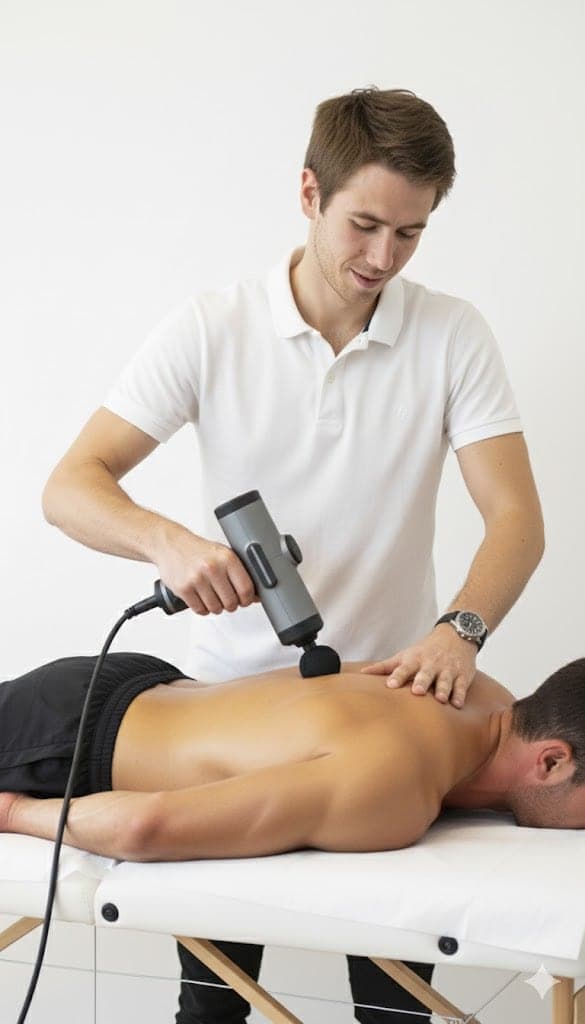
I specialise in mechanical deep-tissue massage, which means I use a handheld percussive and compressive device alongside my hands. The device does the job of delivering steady, deep pressure into thick tissue such as the glutes, hamstrings and thoracic erectors without my hands tiring or the pressure drifting over an hour. My hands do the assessment, the finer work around joints and the softer tissue, and the checking of how the tissue responds.
The order of a session at your home is fairly fixed:
- A short conversation about what hurts, when it started, and what makes it better or worse
- A look at how you stand and move, and a hands-on check of the tissue in question
- Deep work on the priority areas, mechanical and manual, at a pressure you can breathe through
- Broader work to settle the surrounding tissue so it does not simply pull the problem back
- A couple of things to do or avoid before the next session, if there is one
Setup takes me about ten minutes and I need roughly two by three metres of floor space. Most people in Emba use a spare bedroom, a living room with the coffee table moved, or a shaded veranda in the cooler months. You do not need to prepare anything beyond a clear space and, ideally, a towel or two.
The patterns I see most often in Emba
Emba is a mix of long-term residents, retirees who walk a lot, and people who commute into Paphos and sit for most of the day. That mix shows up in the bodies I work on. Rather than describe individuals, here is what tends to turn up on the table.
The presentations I see most often in Emba are a stiff, aching lower back and glutes in people who drive and sit for a living; tight calves and plantar fascia in keen walkers who cover the hills around the village; and neck and upper-back tension in anyone who spends the evening on a laptop. Less common but recurring are shoulder restrictions after gardening or pool work, and hamstring tightness in the runners who use the road out towards Tala.
None of these are exotic. They respond well to targeted deep work precisely because they are mechanical: tissue that has been held short or loaded unevenly for a long time. Getting deep enough, for long enough, is the whole task, and that is where the mechanical approach earns its place.
How to judge a mobile therapist before you book
Because Emba is a village, word of mouth is the main way people find me, and it should be. If you are comparing therapists, though, there are a few things worth asking that separate clinical work from a pleasant hour.
- Ask what training they have and where. I trained in Norway, hold a BSc in Physical Education and Nutrition, and have worked with tissue for over ten years; a serious therapist will answer this without fuss.
- Ask what they bring. A proper table, fresh linens, and whatever equipment they use should arrive with them.
- Ask how they decide what to work on. The answer should involve looking at you, not a fixed routine.
- Ask what the price includes. It should be a plain number, not a starting-from figure.
- Ask what they will not treat. A therapist with no answer to this is not thinking clinically.
If someone is much cheaper than the market, ask yourself what has been left out. If someone is much more expensive, ask what has been added. In my case the answer is the equipment, the training, and the fact that the session is planned around your body rather than the clock.
What I can and can't help with
I can help with muscular pain and stiffness, restricted movement, recovery from training, and the general heaviness that comes from sitting or standing too long. I can't diagnose, I don't treat conditions that need medical management, and I won't work through pain that has no obvious muscular cause. See a doctor first if you have unexplained weight loss, night pain that does not ease with position, numbness or weakness in a limb, pain following a fall or accident, fever, or a history of clotting problems. Once those are cleared, I am happy to work alongside whatever your GP or physio has advised, and I will tell you plainly if I think another kind of care is a better use of your money.
Frequently asked questions
Is there a mobile massage therapist near me in Emba?
Yes. I am based in Chlorakas, which borders Emba, so the drive is short and I can usually offer a time within a few days. I bring the table, linens and equipment to your home or rental and need about ten minutes to set up. Booking is by WhatsApp or phone, and there is no extra charge for travel anywhere in the Paphos district.
How much does a home massage in Emba cost?
The rate is €90 for 60 minutes and €130 for 90 minutes. Every fifth session is free, which is worth knowing if you are working through a chronic problem over a few weeks. There are no travel fees, no packages to buy up front, and no add-ons. If a shorter session is enough for what you have, I will say so rather than book the longer one.
Is deep-tissue massage painful?
It is firm and you will feel it, but it should be pressure you can breathe through, not something you brace against. Tissue that is guarded does not release, so pushing past your tolerance is counterproductive. I check in as I go and adjust. Some soreness the next day is normal after deep work and usually settles within a day or two with movement and water.
How many sessions will I need?
I don't set a number in advance, because it depends on how long the problem has been there and how your tissue responds. Most people can tell after the first session whether the approach suits them. From there we decide together whether to book a short block and then space sessions out, or simply come back when something flares. You are never committed to more than the session you have booked.
Do you cover villages near Emba as well?
Yes. Emba sits between Chlorakas, Tala, Tremithousa and the edge of Paphos town, and I cover all of them as part of the same service and price. If you are further out, in Peyia or Coral Bay for instance, the same applies. The Chlorakas page describes what I bring and how a home visit runs, and the same setup applies in Emba.
Written by
Chris
Massage therapist & body mechanics specialist
Norwegian-certified with a Bachelor’s in Physical Education and Nutrition and over ten years of clinical practice, working from a portable table in clients’ homes across the Paphos district.
- Norwegian-certified
- BSc Physical Education & Nutrition
- 10+ years clinical practice
- Based in Chlorakas · all of Paphos district
- No call-out fee anywhere in Paphos district
Last reviewed
This article is general information from clinical practice, not a medical diagnosis. If you have severe, worsening or unexplained pain, numbness, weakness, or pain after an accident, see a doctor first.