
Yoga for Shoulder Pain Relief Coral Bay: A Clinical Approach to Lasting Results
In short
Discover evidence-based yoga interventions and advanced mechanical therapy for lasting shoulder pain relief in Coral Bay. Expert guidance combining biomechanics with targeted treatment.
I’ve spent the past decade working with clients whose shoulders have become their limiting factor. Not in dramatic, injury-specific ways necessarily, but in that persistent, grinding manner that makes reaching for a coffee cup an exercise in negotiation. In Coral Bay, where the lifestyle invites swimming, surfing, and outdoor activity, shoulder pain doesn’t just limit movement—it fundamentally alters how people interact with their environment.
The conventional approach treats yoga as a gentle supplement, something to “try” alongside rest and maybe some stretching. That perspective misses the critical distinction between therapeutic intervention and recreational practice. When we discuss yoga for shoulder pain relief in Coral Bay, we’re examining a systematic approach to restoring mechanical function, not simply moving through pleasant poses.
The Biomechanical Reality of Shoulder Pain
Your shoulder joint represents one of the most mobile articulations in the human body. This mobility comes at the cost of stability. The glenohumeral joint relies on a complex arrangement of muscles, tendons, and ligaments to maintain positional integrity through extensive ranges of motion. When this system becomes compromised—through repetitive strain, postural adaptation, or compensatory patterns—pain emerges as the inevitable signal.
I’ve examined hundreds of shoulders in my practice. The pattern repeats with remarkable consistency: anterior rotation of the humeral head, shortened pectoralis minor, inhibited posterior rotator cuff musculature, and fascial restriction throughout the thoracic region. These aren’t abstract anatomical observations. They’re the specific mechanical failures that generate the sensation you describe as “shoulder pain.”
Traditional massage addresses these restrictions superficially. A therapist’s hands, regardless of skill level, cannot generate the consistent depth required to release fascial adhesions at their origin. This is where therapeutic yoga becomes valuable—when combined with advanced mechanical intervention that actually resolves the underlying tissue restriction.
Why Standard Approaches Fail in Coral Bay
The Coral Bay environment creates specific challenges. The combination of water activities, sun exposure, and an active lifestyle means shoulders work constantly. Swimming develops impressive strength in certain movement patterns while creating imbalances in others. Surfing demands explosive rotation with the arm overhead—a position that exposes any existing dysfunction immediately.
I’ve treated clients who’ve spent months attending yoga classes, following online tutorials, and working with general practitioners. They report temporary relief followed by return of symptoms. This cycle isn’t failure on their part. It reflects a fundamental misunderstanding of how chronic pain resolves.
Pain doesn’t disappear because you’ve stretched the affected area. It resolves when you’ve restored optimal mechanical function to the entire kinetic chain. For shoulders, this means addressing restrictions in the cervical spine, thoracic outlet, scapular stabilizers, and the glenohumeral joint itself. Yoga provides the framework. Mechanical deep-tissue intervention provides the depth required for lasting change.
Evidence-Based Yoga Interventions for Shoulder Pain
Let me be explicit about what works. The following approaches have demonstrated clinical efficacy both in research settings and in my direct practice with clients experiencing shoulder dysfunction.
Scapular Stabilization Sequences
The scapula must maintain precise positioning throughout shoulder movement. When scapular control deteriorates, the humeral head migrates anteriorly, creating impingement and rotator cuff strain. Yoga addresses this through sustained isometric holds that retrain neuromuscular patterns.
Downward-facing dog, when executed with proper scapular protraction and depression, creates the exact loading pattern required to activate serratus anterior and lower trapezius. These muscles are typically inhibited in chronic shoulder pain presentations. The sustained hold—45 to 90 seconds—generates the time under tension necessary for motor pattern adaptation.
I guide clients through modified variations that emphasize scapular position over depth. A client with anterior shoulder pain cannot benefit from a standard downward dog if their scapulae wing outward and their shoulders elevate toward their ears. The intervention requires precise cueing and, often, manual facilitation to establish correct positioning.
Rotator Cuff Activation Through Controlled Movement
The rotator cuff muscles—supraspinatus, infraspinatus, teres minor, and subscapularis—function primarily as dynamic stabilizers. They maintain the humeral head centered in the glenoid fossa during movement. Strengthening these muscles through isolation exercises has limited transfer to functional movement. Yoga provides integration.
Eagle pose arms create internal and external rotation demands that challenge rotator cuff control throughout range. The crossing of arms places the posterior cuff on stretch while requiring the anterior structures to maintain stability. I’ve observed measurable improvements in external rotation strength following six weeks of consistent eagle pose practice, when combined with deep-tissue release of the antagonist musculature.
Cow face pose arms generate similar benefits through a different movement pattern. The superior arm works into external rotation while the inferior arm moves into internal rotation. This asymmetrical loading exposes compensation patterns immediately. A client who cannot approximate their hands together reveals the specific restrictions requiring intervention.
The Integration Protocol I Use in Coral Bay
Here’s what actually produces lasting results: combining targeted yoga practice with advanced mechanical deep-tissue therapy that addresses the root cause of restricted movement.
| Treatment Phase | Yoga Component | Mechanical Intervention | Expected Outcome |
|---|---|---|---|
| Initial Assessment (Week 1) | Movement screening through basic poses | Identification of primary fascial restrictions | Clear treatment roadmap established |
| Foundation Building (Weeks 2-4) | Daily scapular stabilization sequences | Deep-tissue release of pectoralis minor, subscapularis | 50-70% pain reduction, improved range |
| Progressive Loading (Weeks 5-8) | Integration of weight-bearing poses | Release of thoracic outlet restrictions | Return to functional activities without compensation |
| Performance Optimization (Weeks 9-12) | Advanced arm balances and inversions | Fine-tuning of remaining restrictions | Complete resolution, enhanced performance capacity |
This protocol reflects ten years of refinement. It’s not arbitrary. Each phase builds upon the previous, creating progressive adaptation while preventing the reinjury cycle that plagues conventional approaches.
The Machine Advantage in Shoulder Treatment
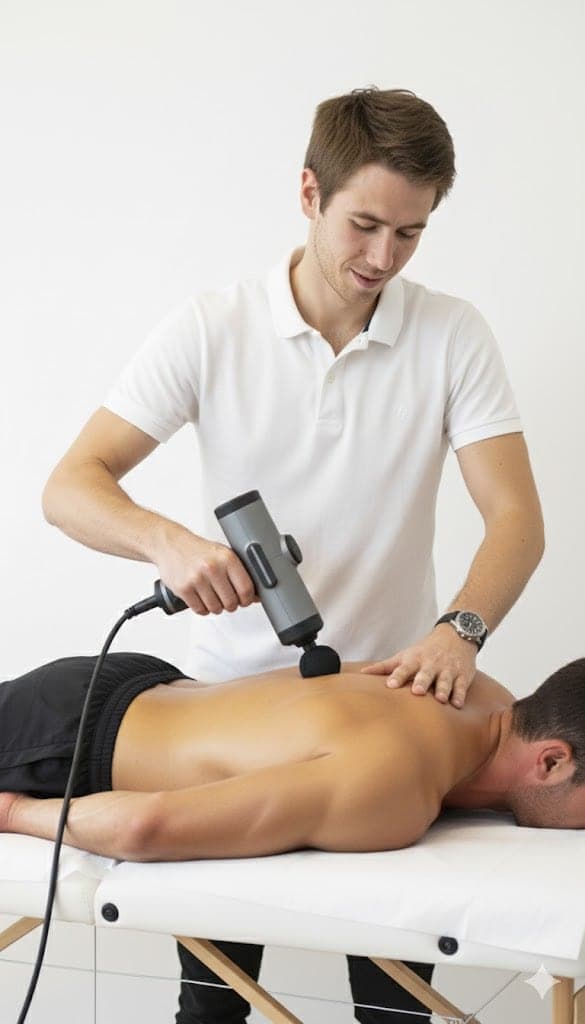
I use a specialized mechanical deep-tissue tool that operates with precision, power, and consistency beyond what human hands can deliver. This distinction matters profoundly for shoulder work.
The subscapularis muscle—the largest and strongest of the rotator cuff—lies deep to the scapula, accessible only through the axilla or by working beneath the scapular border. Releasing chronic restriction in this muscle requires sustained, precisely directed pressure at a depth that manual therapy simply cannot maintain. My machine delivers exactly this intervention.
When I work on a client’s shoulder, I’m not “massaging” in any traditional sense. I’m applying controlled mechanical force to specific tissue layers, generating a release response that restores optimal length-tension relationships. The tool allows me to maintain consistent pressure for three to five minutes on a single restriction point—something impossible with thumbs or elbows, regardless of therapist strength.
The client controls intensity throughout. We work together, communicating constantly about pressure level and tissue response. This isn’t aggressive or painful in the traditional sense. It’s precise mechanical intervention that feels like “good pain”—the sensation of restriction releasing rather than tissue being damaged.
Specific Yoga Poses for Shoulder Pain in Coral Bay
Let me break down the exact interventions that address the most common shoulder pain presentations I encounter in Coral Bay residents.
For Anterior Shoulder Pain (Surfer’s Shoulder)
Anterior shoulder pain typically results from chronic pectoralis minor shortening combined with anterior humeral head migration. The repetitive paddling motion in surfing exacerbates this pattern dramatically.
Primary Intervention: Supported Fish Pose
Place a bolster or rolled towel along your thoracic spine, allowing your shoulders to drop backward and downward. This passive position places the pectoralis minor and major on sustained stretch while encouraging posterior migration of the humeral head. Hold for three to five minutes, breathing deeply to facilitate parasympathetic activation and tissue release.
I combine this pose with mechanical release of the pectoralis minor insertion on the coracoid process. The muscle typically develops trigger points that refer pain into the anterior deltoid region. Releasing these restrictions while maintaining the stretched position creates lasting length change.
For Posterior Shoulder Pain (Overhead Activity Dysfunction)
Posterior shoulder pain often reflects infraspinatus and teres minor overload, typically secondary to scapular dyskinesis. The muscles work excessively to compensate for inadequate scapular control.
Primary Intervention: Thread the Needle Variations
From a quadruped position, reach one arm beneath your body, rotating the shoulder into internal rotation while maintaining scapular stability. This position targets the posterior rotator cuff and the posterior capsule simultaneously. Hold for 60 to 90 seconds, then progress to adding gentle cervical rotation away from the threaded arm.
The mechanical component addresses the thoracic spine restrictions that prevent proper scapular movement. I focus on the erector spinae, rhomboids, and middle trapezius, releasing the fascial restrictions that limit scapular retraction and depression.
For Superior Shoulder Pain (Impingement Syndrome)
Superior shoulder pain typically indicates subacromial impingement, where the humeral head migrates superiorly, reducing the space through which the supraspinatus tendon must pass. This creates mechanical irritation and eventual inflammation.
Primary Intervention: Puppy Pose with Scapular Depression
From quadruped, walk your hands forward while maintaining hip position over knees. Actively depress your scapulae away from your ears while allowing your chest to sink toward the floor. This creates traction through the glenohumeral joint while retraining proper scapular positioning. Hold for two to three minutes.
The mechanical intervention releases the upper trapezius and levator scapulae restrictions that maintain elevated scapular position. These muscles become chronically shortened in computer users and anyone with forward head posture. The release is often uncomfortable but produces immediate improvement in overhead range of motion.
The Critical Error Most People Make
I watch clients attempt yoga for shoulder pain relief and repeat the same fundamental mistake: they focus on the shoulder. This seems logical. The shoulder hurts, so address the shoulder. But shoulder pain is almost never a shoulder problem in isolation.
Three months ago, I worked with a client who’d been attending yoga classes specifically for shoulder pain. She’d been doing shoulder-focused poses consistently for six months with minimal improvement. During my assessment, I identified severe restriction in her latissimus dorsi—a muscle that attaches to the humerus but originates in the thoracolumbar region. The restriction was limiting her shoulder flexion and creating compensatory patterns throughout the entire shoulder complex.
We released the latissimus restriction mechanically—a fifteen-minute intervention that addressed adhesions from the thoracolumbar fascia through the lateral border of the scapula to the humeral insertion. Her overhead range improved by 30 degrees immediately. The shoulder pain she’d experienced for months resolved within three weeks of addressing the actual restriction.
This example illustrates why therapeutic intervention requires systematic assessment and treatment of the entire kinetic chain. Yoga provides excellent movement patterns. Mechanical deep-tissue therapy provides the depth required to release the restrictions preventing optimal movement.
Building a Sustainable Practice in Coral Bay
Living in Coral Bay offers extraordinary opportunities for physical activity. The ocean, the weather, the outdoor lifestyle—these are tremendous assets. They also create specific demands on your body that require intentional management.
I recommend a structured approach to yoga for shoulder pain relief that integrates into your existing lifestyle rather than adding burdensome requirements.
The Morning Sequence (10 Minutes)
- Cat-Cow Variations (2 minutes): Focus on scapular protraction and retraction rather than spinal movement. This activates the serratus anterior and rhomboids before more demanding activities.
- Downward Dog Hold (90 seconds): Emphasize scapular depression and external rotation of the upper arms. This establishes proper shoulder mechanics for the day.
- Thread the Needle (2 minutes each side): Address rotational restrictions that accumulate overnight.
- Puppy Pose (2 minutes): Create traction and space through the glenohumeral joint.
- Eagle Pose Arms (1 minute): Activate rotator cuff control before weight-bearing activities.
This sequence takes ten minutes. It addresses the primary movement patterns required for shoulder health. Most importantly, it’s sustainable—brief enough to maintain consistency, which matters more than intensity or duration.
The Integration Principle
Yoga for shoulder pain relief works through consistent practice over time. I’ve never seen a client resolve chronic shoulder dysfunction through sporadic, intense interventions. The biology doesn’t support that approach. Tissue adaptation requires regular, progressive stimulus.
However, yoga alone addresses only the movement pattern component. The underlying fascial restrictions, trigger points, and adhesions require mechanical intervention at depths that stretching and strengthening cannot reach. This is where my specialized approach becomes essential.
I travel to your location in Coral Bay with a professional treatment bench and the specialized equipment required for advanced mechanical therapy. We establish a partnership focused on your specific presentation and goals. This isn’t about scheduling occasional massage sessions. It’s about creating a systematic intervention protocol that addresses the root cause of your shoulder pain.
The Investment Perspective
I position my service as an investment rather than an expense because that’s precisely what it represents. Consider the cost of chronic shoulder pain: reduced activity capacity, decreased quality of life, potential for progression to more serious dysfunction, and the accumulating expense of treatments that provide temporary relief without addressing causation.
A client of mine in Coral Bay had spent eighteen months pursuing conventional treatment for shoulder pain. Physical therapy, chiropractic adjustments, regular massage, and cortisone injections. The total expenditure exceeded a substantial sum. The shoulder pain persisted with minor fluctuations.
We implemented my protocol: mechanical deep-tissue intervention twice weekly for eight weeks, combined with the specific yoga sequences I’ve outlined in this article. Total investment: significantly less than what he’d already spent. Outcome: complete resolution of shoulder pain, return to surfing without limitation, and the knowledge to maintain optimal function independently.
That’s the distinction between expense and investment. Expense generates temporary relief that requires continuous spending. Investment resolves the underlying problem, creating lasting value that compounds over time.
Frequently Asked Questions About Yoga for Shoulder Pain in Coral Bay
How quickly can I expect results from yoga for shoulder pain relief?
The timeline depends on chronicity and severity. Acute shoulder pain—present for less than six weeks—typically responds within two to three weeks of consistent practice combined with mechanical intervention. Chronic presentations require longer: eight to twelve weeks for significant improvement, with continued optimization over subsequent months. The critical variable is whether you’re addressing the actual restrictions or merely managing symptoms.
Can yoga make shoulder pain worse?
Yes, when executed improperly. Forcing range of motion beyond current tissue capacity creates microtrauma and inflammation. This is why I emphasize precise positioning over depth. The goal is controlled loading that stimulates adaptation, not aggressive stretching that generates protective guarding responses. With proper guidance, yoga accelerates healing rather than exacerbating dysfunction.
Do I need to attend yoga classes or can I practice independently?
For therapeutic purposes, independent practice with expert guidance produces superior results to group classes. General yoga instruction doesn’t provide the specific interventions required for shoulder dysfunction. I teach clients the exact sequences relevant to their presentation, ensuring proper execution. This focused approach eliminates the inefficiency of spending an hour in a general class that might include ten minutes of relevant content.
How does mechanical deep-tissue therapy differ from regular massage?
Regular massage addresses superficial tissue layers and provides temporary relaxation. My mechanical approach uses specialized equipment to access deep fascial restrictions, generating lasting tissue change. The tool delivers consistent pressure at depths impossible for human hands, with precision that eliminates the variability inherent in manual therapy. This isn’t relaxation therapy—it’s mechanical intervention that resolves the structural restrictions preventing optimal function.
What makes your approach different from physical therapy?
Physical therapy typically focuses on strengthening exercises and modalities like ultrasound or electrical stimulation. These approaches have value but often miss the fascial component. I address the actual tissue restrictions limiting movement, then integrate yoga to retrain optimal movement patterns. The combination of deep mechanical release and specific yoga sequencing produces results that neither approach achieves independently.
Is this treatment suitable for active individuals and athletes?
Absolutely. In fact, active individuals and athletes represent my primary clientele. The demands of surfing, swimming, and outdoor activities in Coral Bay require optimal shoulder function. My tool adjusts from light pressure for acute presentations to powerfully deep intervention for athletes seeking performance enhancement. The consistency of the mechanical approach means your treatment quality never depends on whether I’m having an “off day”—every session delivers equally effective results.
Can shoulder pain be durably resolved or will it always return?
Lasting resolution is achievable when you address causation rather than symptoms. If underlying restrictions remain, pain returns when you resume the activities that generate compensatory patterns. Once we’ve released the fascial adhesions, corrected movement patterns through specific yoga practice, and established proper biomechanics, the shoulder functions optimally under normal demands. Maintenance becomes simple: consistent movement practice and occasional intervention when new restrictions develop.
What should I expect during a treatment session?
I arrive at your location with a professional treatment bench and all required equipment. We begin with movement assessment to identify specific restrictions. The mechanical intervention involves sustained pressure on targeted tissue layers—this produces intense sensation but shouldn’t be sharply painful. We communicate constantly about pressure level and tissue response. Sessions typically last 60 to 90 minutes. After treatment, I guide you through specific yoga sequences that integrate the release work and retrain optimal movement patterns.
The Path Forward: Practical Implementation
If you’re experiencing shoulder pain in Coral Bay, you face a decision: continue managing symptoms through temporary interventions, or invest in resolving the underlying dysfunction durably.
The yoga sequences I’ve outlined in this article provide immediate value. Implement the morning sequence consistently for two weeks and you’ll notice improved range and reduced pain. However, understand that yoga addresses the movement pattern component. The structural restrictions—the fascial adhesions, trigger points, and tissue densification that prevent optimal movement—require mechanical intervention at depths that stretching cannot reach.
My decade of experience and specialized approach exists specifically to address this limitation. I don’t provide relaxation massage or general wellness services. I resolve mechanical dysfunction through advanced deep-tissue intervention combined with targeted movement retraining. This produces lasting results because it addresses causation.
The lifestyle you’ve chosen in Coral Bay demands optimal physical function. Shoulder pain doesn’t simply limit overhead activities—it fundamentally alters how you interact with your environment. Swimming becomes cautious rather than fluid. Surfing requires compensation patterns that create problems elsewhere. Simple daily activities like reaching into a cabinet become exercises in negotiation.
This is solvable. The combination of evidence-based yoga practice and advanced mechanical therapy produces reliable, lasting results. Not temporary relief, not symptom management—actual resolution of the structural and functional problems generating your pain.
I work with clients who are ready to invest in lasting solutions rather than continuing the cycle of temporary interventions. If that describes your approach, we should talk. I’ll assess your specific presentation, identify the restrictions requiring intervention, and create a customized protocol that produces the results you’re seeking.
Your shoulder pain in Coral Bay isn’t an inevitable consequence of aging or activity. It’s a mechanical problem with a mechanical solution. The question is whether you’re ready to address it properly.
Written by
Chris
Massage therapist & body mechanics specialist
Norwegian-certified with a Bachelor’s in Physical Education and Nutrition and over ten years of clinical practice, working from a portable table in clients’ homes across the Paphos district.
This article is general information from clinical practice, not a medical diagnosis. If you have severe, worsening or unexplained pain, numbness, weakness, or pain after an accident, see a doctor first.