
Coral Bay Holistic Healing: Advanced Mechanical Deep-Tissue Therapy for Lasting Pain Relief
In short
Discover how Coral Bay holistic healing combines precision mechanical therapy with trigger point expertise to deliver lasting pain relief. Not relaxation massage—clinical treatment that addresses root causes.
I’ve spent the last decade watching people invest thousands in temporary relief—chiropractic adjustments that last three days, massage sessions that feel good but change nothing, physical therapy that addresses symptoms while the underlying mechanical dysfunction remains locked in place. When I established my practice in Coral Bay, I made a decision: I would only offer treatments that create lasting change. Not because it’s easier to market, but because anything less is a disservice to people who deserve to live without chronic pain.
Coral Bay holistic healing, when properly executed, isn’t about candles and soft music. It’s about understanding biomechanics at a level that allows you to identify the precise mechanical restriction causing pain, applying the exact pressure required to release it, and doing so with consistency that human hands simply cannot match. This is clinical work. This is what a decade of experience and a Bachelor’s degree in Physical Education and Nutrition has taught me: the body responds to precision, not intention.
Why Traditional Massage Fails in Coral Bay—And What Actually Works
I travel to clients throughout Coral Bay, and the stories I hear are remarkably consistent. Someone’s been getting monthly massages for two years. They feel wonderful for 48 hours, then the shoulder tension returns. The lower back tightens again. The neck stiffness comes back with a vengeance. They’re told this is normal—that “maintenance” is required indefinitely.
This is not normal. This is failure.
The fundamental problem with traditional massage in the context of holistic healing is that it treats tissue as if pressure alone creates change. But chronic pain isn’t caused by tissues that need pressing—it’s caused by specific mechanical restrictions, fascial adhesions, and trigger points that have created compensatory patterns throughout the kinetic chain. A relaxation therapist applies general pressure to general areas. I identify the exact source of dysfunction and apply precise, controlled force to eliminate it.
The difference isn’t philosophical. It’s mechanical. When I assess a client who’s been dealing with chronic hip pain, I’m not looking at their hip. I’m analyzing their gait pattern, identifying which muscle groups are overcompensating, tracing the fascial lines that have shortened due to those compensations, and locating the specific trigger points that are maintaining the dysfunction. Then I treat those points with a level of depth and precision that resolves them durably.
The Science Behind Advanced Mechanical Therapy in Coral Bay Holistic Healing
Let me explain what happens when you treat tissue properly. A trigger point—a hyperirritable nodule within a taut band of skeletal muscle—exists because the sarcomeres in that location are locked in contraction. This isn’t tension you can “breathe away” or stretch out. This is a metabolic crisis at the cellular level, where calcium ions remain in the muscle cell and ATP production cannot clear them.
To resolve this, you need sufficient mechanical force to disrupt the dysfunctional motor endplate, break the pain-spasm-pain cycle, and restore normal sarcomere length. Human hands, no matter how skilled, face three insurmountable limitations:
- They cannot maintain consistent pressure for the duration required to create lasting change in deep tissue
- They cannot penetrate through superficial muscle layers without causing collateral tissue damage
- They fatigue, leading to variable treatment quality depending on the therapist’s physical state
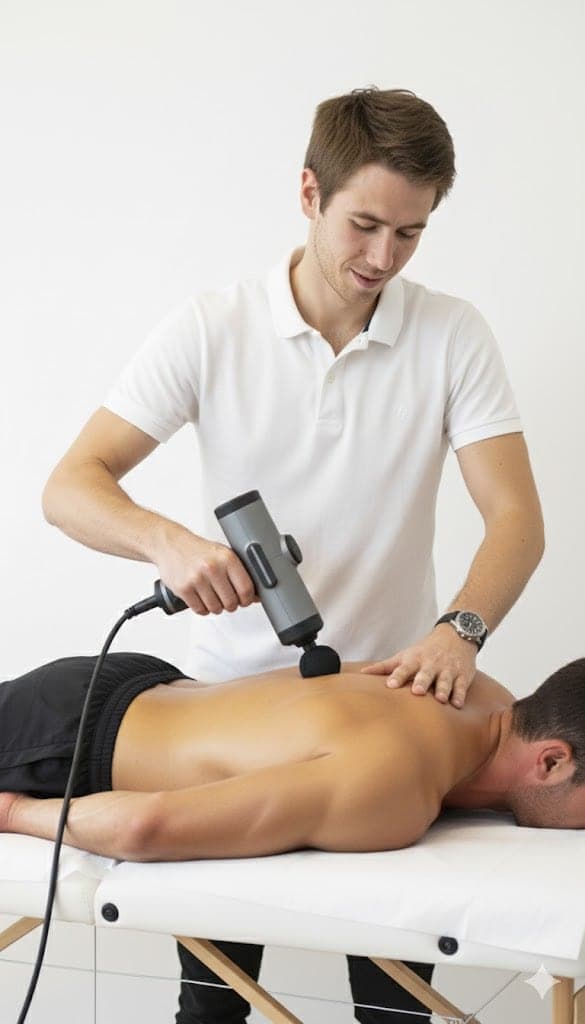
This is why I use specialized mechanical equipment for every treatment. The machine I’ve integrated into my practice delivers three critical advantages that define effective Coral Bay holistic healing:
Precision That Eliminates Guesswork
When I locate a restriction in the psoas major—a muscle buried beneath the abdominal contents and impossible to access effectively by hand—I can position the therapeutic head at the exact angle required and maintain that position with millimeter accuracy. This isn’t approximate. This is geometric precision applied to anatomical structure.
I’ve treated competitive athletes whose performance was limited by restrictions that previous therapists couldn’t even locate, let alone resolve. A runner with chronic IT band syndrome doesn’t need their IT band stretched—the iliotibial tract is a tendon, not a muscle. They need the tensor fasciae latae and gluteus medius trigger points released, the hip rotator mechanics restored, and the gait pattern corrected. This requires precision.
Power That Reaches Root Causes
Superficial tissue responds to light pressure. Deep tissue—the multifidus, the piriformis, the scalenes—requires significant force applied at the correct vector. The machine I use can deliver that force sustainably, allowing me to work through multiple tissue layers without compromise.
I recently treated a client who’d been dealing with “unexplained” shoulder pain for eighteen months. Three different massage therapists had worked on her upper trapezius. Two physical therapists had given her rotator cuff exercises. The problem wasn’t in any of those locations. The problem was a severely restricted subscapularis—the deepest rotator cuff muscle—creating mechanical dysfunction throughout the shoulder girdle. Accessing that muscle requires working through the pectoralis major, the anterior deltoid, and the coracobrachialis. Human hands cannot maintain therapeutic pressure through those layers. Mechanical therapy can.
Her shoulder pain resolved completely in four sessions. Not managed. Resolved.
Consistency That Guarantees Results
I don’t have off days. The machine doesn’t get tired. When a client returns for their second session, the treatment quality is identical to their first. When they return for their tenth session, the precision remains unchanged. This consistency is what allows me to create progressive treatment plans that build on each session’s results rather than simply repeating the same ineffective protocol.
In traditional massage, you’re betting on the therapist’s current physical condition, stress level, and whether they’ve already treated six clients that day. In mechanical therapy, you’re receiving the same clinical precision every single time. This is what transforms holistic healing from hopeful to reliable.
Trigger Point Therapy: The Foundation of Effective Coral Bay Holistic Healing
Most people have heard of trigger points. Few understand what they actually are or why they matter. A trigger point isn’t just a “knot” or a “tight spot.” It’s a specific pathological condition with identifiable characteristics: a palpable nodule in a taut muscle band that produces pain in a predictable referral pattern when compressed.
The reason this matters in Coral Bay holistic healing is that trigger points are almost never located where the pain is felt. A client complaining of headaches might have the cause in their upper trapezius or sternocleidomastoid. Someone with chronic lower back pain might have the primary dysfunction in their quadratus lumborum or gluteus medius. Treating the pain location is futile. Identifying and eliminating the trigger point is curative.
I’ve mapped hundreds of trigger point patterns over the past decade. I can predict with remarkable accuracy where the dysfunction exists based on where the client feels pain. This isn’t guessing—this is applied anatomy combined with clinical experience.
How I Assess and Treat Trigger Points Differently
When you arrive for treatment, I don’t ask you to “tell me where it hurts” and then press on that area. I conduct a systematic assessment:
- Movement Analysis: I watch how you stand, walk, and move through basic ranges of motion. This reveals compensatory patterns that indicate which muscle groups are dysfunctional.
- Palpation Protocol: I systematically assess muscle groups based on the movement patterns I’ve observed, identifying taut bands and nodules that match clinical trigger point criteria.
- Referral Pattern Confirmation: I apply pressure to suspected trigger points and confirm that the referral pattern matches established anatomical maps. If pressing on your upper trapezius reproduces your temple headache, I’ve identified the source.
- Treatment Hierarchy: I don’t treat everything I find. I prioritize based on which restrictions are primary (causing the problem) versus secondary (compensating for the problem). Treating compensations before addressing primary dysfunction is counterproductive.
This systematic approach is what differentiates clinical trigger point therapy from someone pressing on areas that feel tight. One produces lasting results. The other produces temporary relief followed by inevitable return of symptoms.
The Mobile Advantage: Professional Coral Bay Holistic Healing in Your Space
I travel to your location throughout Coral Bay with a professional treatment bench and all necessary equipment. This isn’t a compromise in quality—it’s an enhancement of the therapeutic environment.
When you’re treated in your own space, several clinical advantages emerge. First, you’re not adding the physical stress of travel to an already compromised system. If you’re dealing with chronic lower back pain, the act of driving to an appointment, sitting in a waiting room, and driving home afterwards exacerbates the exact condition we’re trying to resolve.
Second, the post-treatment recovery period is optimized. After a deep-tissue session where we’ve released significant restrictions, your nervous system needs time to integrate the changes. Being able to rest immediately in your own environment, rather than navigating traffic, allows for better therapeutic outcomes.
Third, it allows for environment-specific assessments. If your pain is worse when you work at your home office, I can observe your workspace setup and identify ergonomic factors that are contributing to the dysfunction. If your sleep position is creating mechanical stress, I can assess your bed and pillow arrangement. Treatment isn’t separate from life—it’s integrated into the context where dysfunction occurs.
What Makes This Approach Holistic—And Why That Word Matters
The term “holistic healing” has been diluted by marketers who use it to mean “natural” or “alternative.” That’s not what holistic means in a clinical context. Holistic means addressing the whole system, not isolated parts. It means understanding that your shoulder pain might be caused by your hip dysfunction. That your headaches might be caused by your breathing pattern. That your chronic fatigue might be caused by pain-induced sleep disruption.
When I work with clients in Coral Bay, I’m not providing a massage service. I’m analyzing and optimizing a complex biomechanical system. This requires understanding how:
Fascial continuity creates tension patterns that cross multiple joints Neurological facilitation causes muscles to remain contracted even when the original stressor is removed Compensatory patterns redistribute load in ways that create secondary dysfunctions Metabolic factors like hydration, inflammation, and tissue quality affect recovery capacity
My Bachelor’s degree in Physical Education and Nutrition isn’t decorative. It’s the foundation that allows me to consider factors that relaxation therapists don’t even know exist. When I assess tissue quality, I’m considering your hydration status, inflammatory markers, and whether nutritional deficiencies might be impairing collagen synthesis. When I design a treatment plan, I’m considering recovery capacity, training load if you’re an athlete, and whether your sleep quality is adequate for tissue repair.
This is holistic. This is comprehensive. This is what produces results that last.
Investment vs. Expense: Understanding the Economics of Lasting Relief
I’m going to address something that most therapists avoid: cost. My services are not inexpensive. They’re also not expensive when you understand what you’re receiving.
If you’ve been getting monthly massages for the session price (see current pricing) and you’ve been doing this for two years, you’ve spent a substantial sum on temporary relief. Your condition hasn’t improved. You’re dependent on continuing those sessions indefinitely. That’s an expense—a recurring cost that provides no lasting value.
If you invest in a properly structured treatment plan with me—typically four to eight sessions depending on complexity—you’re paying for lasting resolution. After we’ve eliminated the mechanical restrictions causing your pain, you don’t need monthly maintenance. You don’t need to come back unless new dysfunction develops or you want performance optimization. That’s an investment—a one-time cost that provides lasting value.
I’ve had clients calculate their annual spending on various therapies—massage, chiropractic, acupuncture, physical therapy copays—and realize they’ve been spending a wide range of costs per year on temporary management of conditions that could be durably resolved. The mathematics are clear. The only question is whether you want relief that requires ongoing expense or resolution that provides lasting freedom.
Coral Bay Holistic Healing for Athletic Performance Optimization
I work with recreational athletes, competitive athletes, and professionals throughout Coral Bay who understand that pain isn’t the only indicator of dysfunction. Restricted range of motion, asymmetrical movement patterns, and compensatory mechanics all limit performance even when they’re not painful.
An example: I recently worked with a cyclist who wasn’t experiencing significant pain but felt his power output had plateaued. His coach had optimized his training plan. His bike fit had been professionally adjusted. But something was limiting his ability to generate force through the pedal stroke.
The issue was bilateral hip internal rotation restriction caused by trigger points in the piriformis and superior gemellus. These restrictions weren’t painful—they’d developed gradually over years of training. But they were limiting his ability to fully engage his gluteal muscles during the power phase of the pedal stroke. He was compensating by overusing his quadriceps, which is less efficient for sustained power production.
We released the restrictions, restored normal hip mechanics, and his functional threshold power increased by 12 watts within two weeks. That’s not placebo. That’s mechanical optimization producing measurable performance improvement.
Athletes who understand their bodies as systems rather than collections of parts appreciate what Coral Bay holistic healing can provide. It’s not about feeling better. It’s about functioning optimally.
The Treatment Process: What to Expect During Sessions
Because I provide a fundamentally different service than traditional massage, the session structure differs significantly.
Initial Assessment Session (90-120 Minutes)
The first session is comprehensive. I need to understand your complete mechanical situation, not just the complaint that brought you in. This includes:
Assessment ComponentPurposeDuration
Movement AnalysisIdentify compensatory patterns and mechanical restrictions15-20 minutes Pain History and PatternUnderstand chronicity, triggers, and previous treatment responses10-15 minutes Systematic PalpationLocate primary trigger points and fascial restrictions20-30 minutes Initial TreatmentBegin addressing primary dysfunctions40-50 minutes
I don’t treat everything in the first session. The goal is to identify the treatment hierarchy, address the most significant restrictions, and allow your system to begin adapting. Trying to fix everything at once overwhelms the nervous system’s capacity to integrate change.
Progressive Treatment Sessions (60-90 Minutes)
Subsequent sessions build systematically on previous work. I reassess movement patterns to confirm that previous restrictions have resolved, identify any compensatory patterns that may have emerged, and continue working through the treatment hierarchy.
This isn’t repetitive. Each session is different because your mechanical state is changing. As primary restrictions resolve, secondary compensations become apparent. As those are addressed, we can progress to performance optimization work.
Maintenance and Optimization (As Needed)
After the primary treatment plan is complete—typically four to eight sessions—most clients don’t need regular appointments. Some choose quarterly sessions for performance optimization. Athletes might schedule sessions during peak training phases. But you’re not locked into indefinite monthly treatments because the underlying dysfunction has been resolved, not just managed.
Common Conditions Resolved Through Coral Bay Holistic Healing
While I don’t diagnose medical conditions—that’s outside my scope—I can tell you which mechanical dysfunctions I address most frequently in Coral Bay:
Chronic Lower Back Pain
Usually caused by quadratus lumborum or gluteus medius trigger points, hip flexor restrictions, or multifidus dysfunction. Rarely caused by the area where pain is felt. I trace the compensatory pattern, identify the primary restriction, and resolve it. Most cases resolve in three to six sessions.
Shoulder Dysfunction and Rotator Cuff Issues
Almost always involves subscapularis or infraspinatus trigger points, with secondary restrictions in the levator scapulae and upper trapezius. The key is treating the deepest restrictions first, then allowing the superficial compensations to normalize. Surgery is rarely necessary when proper mechanical therapy is applied early.
Headaches and Migraines
Frequently originate from trigger points in the sternocleidomastoid, temporalis, or suboccipital muscles. I’ve worked with clients who’ve had weekly migraines for years, tried multiple medications, and been told to “manage stress better.” In many cases, the cause is purely mechanical. Eliminate the trigger points, and the headaches disappear.
IT Band Syndrome and Lateral Knee Pain
The IT band is not a muscle and cannot be stretched. Foam rolling it is futile. The pain comes from trigger points in the tensor fasciae latae and gluteus medius causing excessive tension on the iliotibial tract. Treat those muscles properly, and the knee pain resolves without ever touching the knee.
Plantar Fasciitis
Usually involves dysfunction in the gastrocnemius, soleus, or tibialis posterior creating mechanical stress on the plantar fascia. Treating the foot itself is addressing the symptom. Treating the posterior chain mechanics is addressing the cause.
Why Location Matters: Coral Bay’s Unique Therapeutic Environment
I chose to base my practice in Coral Bay because the community values results over appearances, substance over marketing, and long-term solutions over quick fixes. The clients I work with here understand that meaningful change requires commitment to a process, not a single appointment.
The climate and lifestyle in Coral Bay also create specific mechanical patterns I’ve learned to recognize. The combination of beach activities, water sports, and outdoor recreation means I frequently work with clients who’ve developed chronic dysfunctions from repetitive movement patterns in unstable environments. Surfing creates specific shoulder and thoracic restrictions. Diving creates distinct breathing pattern dysfunctions that manifest as neck and upper back pain. Trail running on uneven terrain creates ankle and hip compensations that eventually produce knee and lower back problems.
Understanding these activity-specific patterns allows me to provide more targeted treatment. When a client tells me they surf four days a week, I know exactly which muscle groups to assess and which compensatory patterns to expect. This local knowledge, combined with advanced mechanical therapy, is what makes Coral Bay holistic healing particularly effective in this community.
Frequently Asked Questions About Advanced Mechanical Therapy in Coral Bay
Is mechanical therapy painful?
Discomfort during treatment is common and indicates we’re working on tissue that’s been dysfunctional. However, there’s a critical difference between therapeutic discomfort and harmful pain. I adjust pressure constantly based on your feedback and tissue response. The goal is to work at the deepest level your system can integrate, not to cause suffering. Most clients describe the sensation as “intense but relieving”—they can feel restrictions releasing in real time.
How is this different from deep tissue massage?
Deep tissue massage is a technique. What I provide is systematic mechanical therapy based on assessment of specific dysfunctions. Most deep tissue massage applies general pressure to general areas. I identify exact restrictions, apply precise force at correct vectors, and work through a clinical treatment hierarchy. The difference is planning versus pressure.
Do I need to do anything between sessions?
Yes. I provide specific guidance on movement patterns to reinforce, positions to avoid, and sometimes corrective exercises to support the mechanical changes we’re creating. This isn’t homework for the sake of compliance—it’s necessary to prevent compensatory patterns from reforming while your system adapts to improved mechanics.
How long do results last?
When restrictions are properly resolved and movement patterns are corrected, results are lasting unless new dysfunction is introduced. I have clients I treated three years ago who remain pain-free because we addressed the cause, not just symptoms. However, if you return to the activities or positions that created the original dysfunction without modification, problems can redevelop.
Can you help with conditions other therapists haven’t been able to resolve?
Frequently, yes. Not because I’m superior to other therapists, but because the methodology is different. If previous treatment focused on symptoms rather than mechanical causes, or used techniques that couldn’t access deep restrictions, then a different approach often produces different results. I’ve worked with clients who’ve been through extensive physical therapy, multiple massage therapists, and various alternative treatments without improvement. In most cases, the issue wasn’t that they were untreatable—it was that they hadn’t received treatment targeting the actual dysfunction.
Do you work with medical professionals?
I collaborate with physical therapists, chiropractors, and physicians who understand that mechanical therapy addresses aspects of dysfunction that fall outside their primary scope. I’m not a replacement for medical care—I’m a specialist in mechanical tissue dysfunction. When medical professionals identify that a patient’s pain is mechanical rather than pathological, they sometimes refer to me for treatment that complements their care.
What should I do to prepare for a session?
Arrive hydrated and avoid heavy meals immediately before treatment. Wear comfortable clothing that allows access to the areas being treated. Be prepared to provide detailed information about your pain patterns, what makes them better or worse, and what treatments you’ve already tried. The more information I have, the more precisely I can target the actual dysfunction.
How do you determine how many sessions I’ll need?
After the initial assessment, I can provide a realistic estimate based on the complexity of your mechanical dysfunction, how long it’s been present, and your tissue’s response to the first treatment. Acute conditions that haven’t created extensive compensatory patterns might resolve in two to three sessions. Chronic, complex conditions with multiple layers of compensation might require six to eight sessions. I update this estimate as treatment progresses based on actual results.
The Philosophy Behind Lasting Results
I’ve built my practice on a principle that seems obvious but is rarely applied: treat the cause, not the symptom. This requires patience, precision, and a willingness to work systematically through layers of dysfunction rather than chasing immediate relief.
When someone comes to me with chronic pain, they usually want that pain gone immediately. I understand that desire. But if I only address the pain location without identifying why that tissue is dysfunctional, I’ve provided temporary relief and guaranteed they’ll be back in my schedule within weeks.
Instead, I work backward from the symptom to the source. I identify which mechanical restriction is creating the pain, what caused that restriction to develop, and what compensatory patterns have formed around it. Then I dismantle that entire chain of dysfunction systematically, starting with the primary cause.
This takes longer initially. It requires more complex assessment. It demands that clients understand they’re participating in a process, not receiving a quick fix. But it produces results that don’t require ongoing maintenance because we’ve eliminated the underlying problem.
That’s the difference between therapy and temporary relief. That’s what defines Coral Bay holistic healing as I practice it: comprehensive, systematic, lasting resolution of mechanical dysfunction.
Making the Decision to Invest in Your Mechanical Health
If you’ve read this far, you’re probably dealing with chronic pain that hasn’t responded to conventional treatment, or you’re an athlete looking for genuine performance optimization rather than temporary recovery services. You’re evaluating whether what I offer is worth the investment.
Here’s what I can tell you with certainty after a decade of clinical work: mechanical dysfunction doesn’t improve on its own. Compensatory patterns become more entrenched over time. Pain that’s manageable now becomes debilitating later. Performance limitations that seem minor now become career-limiting eventually.
The question isn’t whether to address these issues—it’s when, and with what methodology. You can continue managing symptoms with therapies that provide temporary relief. You can hope the problem resolves spontaneously, which mechanical restrictions never do. Or you can invest in systematic treatment that addresses root causes and produces lasting results.
I travel throughout Coral Bay providing advanced mechanical therapy to clients who’ve decided they want resolution rather than management. I bring professional equipment, clinical expertise developed over ten years and backed by university education, and a methodology that treats the cause of pain rather than its symptoms.
This is Coral Bay holistic healing done properly: comprehensive assessment, precise treatment, systematic progression, and lasting results. Not because the approach is trendy or marketable, but because it’s the only methodology I’ve found that actually works.
If you’re ready to stop managing pain and start eliminating it, the next step is straightforward. We schedule an initial assessment where I evaluate your complete mechanical situation, identify the primary dysfunctions, and create a treatment plan designed to produce lasting resolution. You decide whether the approach makes sense for your situation. If it does, we begin the systematic process of restoring optimal function to your system.
The investment is yours to make. The results, when you work with someone who understands mechanical dysfunction at this level, speak for themselves.
Written by
Chris
Massage therapist & body mechanics specialist
Norwegian-certified with a Bachelor’s in Physical Education and Nutrition and over ten years of clinical practice, working from a portable table in clients’ homes across the Paphos district.
This article is general information from clinical practice, not a medical diagnosis. If you have severe, worsening or unexplained pain, numbness, weakness, or pain after an accident, see a doctor first.