Yoga for Posture Improvement Pafos: The Mechanical Reality Behind Alignment
In short
Discover why traditional yoga falls short for postural correction in Pafos and how advanced mechanical deep-tissue treatment addresses the root biomechanical causes of misalignment for lasting results.
After a decade of working with clients throughout Pafos who’ve spent years—sometimes decades—practicing yoga for posture improvement, I’ve observed a pattern that needs addressing. These individuals arrive at my practice with the same forward head carriage, the same rounded shoulders, and the same chronic tension patterns they had when they first stepped onto a yoga mat five or ten years ago. They’re flexible, certainly. They can execute impressive asanas. But their fundamental postural architecture remains compromised.
The issue isn’t that yoga lacks value. The issue is that yoga for posture improvement in Pafos—or anywhere else—addresses only half the equation. You’re stretching tissue that’s already overstretched while ignoring the mechanical restrictions that created the postural deviation in the first place.
With my background in Physical Education and Nutrition from Norway and ten years of specialized practice in body mechanics, I’ve developed an approach that treats postural dysfunction at its biomechanical source. This isn’t about relaxation or stress relief. This is about systematically dismantling the fascial adhesions, muscular compensations, and structural restrictions that prevent your body from achieving and maintaining proper alignment—restrictions that no amount of downward dogs or warrior poses can address.
The Fundamental Flaw in Yoga for Posture Improvement
Let me paint you a picture from my practice. Last month, a software developer came to me after three years of dedicated yoga practice specifically focused on improving his forward head posture. He attended classes four times weekly. He’d invested in private sessions. He practiced at home. Yet his cervical spine remained in the same 30-degree anterior translation it had when he started.
During assessment, I identified severe adhesions in his anterior scalenes, subclavius, and pectoralis minor—tissue so bound and restricted that it was physically preventing his head from moving posteriorly, regardless of how much he stretched the posterior chain. His yoga practice had actually worsened the imbalance by further lengthening already overstretched posterior cervical muscles while the anterior restrictions remained untouched.
This is the core mechanical reality: postural deviations exist because certain tissues have become shortened, adhered, and neurologically dominant while their antagonists have become inhibited and overstretched. Yoga addresses the overstretched side. It doesn’t—and cannot—address the adhered, shortened tissue creating the dysfunction.
Why Stretching Fails at Postural Correction
The human body operates through tensegrity—a balance of tension and compression throughout the myofascial system. When you develop forward head posture, for instance, the posterior cervical muscles aren’t tight because they’re short. They’re tight because they’re constantly working to prevent your head from falling further forward, fighting against shortened anterior chain restrictions.
Stretching these already-overstretched posterior muscles provides temporary relief but worsens the underlying imbalance. You need to release the anterior restrictions—the scalenes, the sternocleidomastoid insertions, the deep cervical fascia—that are pulling your structure out of alignment. This requires mechanical intervention at a depth and precision that manual stretching simply cannot achieve.
The Biomechanical Requirements for Postural Change
Genuine postural improvement requires three specific interventions that yoga fundamentally cannot provide:
Deep Fascial Release at Restriction Points
Fascial adhesions that create postural deviations exist in layers—superficial fascia, deep fascia, and the fascial planes between muscle groups. These adhesions require sustained, precise pressure at specific depths to achieve plastic deformation of the collagen matrix. We’re talking about mechanical forces of 40-60 pounds per square inch, applied with millimeter precision, sustained for 90-120 seconds per restriction point.
Human hands cannot deliver this combination of depth, precision, and consistency. They fatigue. They lack the mechanical advantage. They cannot maintain exact pressure over the required duration. This is why I exclusively use a specialized mechanical deep-tissue tool that provides precisely calibrated force delivery.
Targeted Release of Neurologically Dominant Tissue
Every postural deviation involves certain muscles becoming neurologically dominant—constantly firing, constantly shortened, constantly pulling your structure out of alignment. In upper crossed syndrome, which affects virtually everyone who works at a computer, the upper trapezius, levator scapulae, and pectoralis major become dominant while the deep cervical flexors, serratus anterior, and lower trapezius become inhibited.
Correcting this requires releasing the dominant tissue until it returns to normal resting length and neural drive. This isn’t accomplished through stretching—the tissue immediately returns to its shortened state because the nervous system has been programmed for this pattern. It requires sustained mechanical intervention that forces neurological adaptation.
Systematic Treatment of the Entire Kinetic Chain
Your forward head posture isn’t just about your neck. It’s connected to thoracic spine position, which is connected to lumbar lordosis, which is influenced by hip flexor length, which is affected by foot mechanics. Effective postural correction requires systematic treatment of the entire kinetic chain, identifying and releasing restrictions at each level.
Most yoga practices in Pafos focus on isolated areas or general flexibility. They don’t assess and treat the complete biomechanical chain that creates and maintains postural deviations.
Advanced Mechanical Deep-Tissue Treatment: The Solution Yoga Cannot Provide
Over the past decade, I’ve developed a systematic protocol specifically for postural correction that addresses the mechanical realities yoga overlooks. Using a specialized tool that delivers controlled, sustained pressure at precise depths, I work through the fascial layers systematically, releasing restrictions that have existed for years or decades.
Precision at Depths Human Hands Cannot Reach
The machine I use isn’t a massage gun or percussion device. It’s a specialized tool designed for sustained, controlled pressure that can be adjusted from superficial work to depths exceeding what any therapist’s hands can achieve. More importantly, it can maintain exact pressure for the duration required to achieve plastic deformation of restricted tissue.
When treating someone for postural improvement, I typically work 4-6 centimeters deep in areas like the thoracic paraspinals or hip flexor complex. At these depths, I’m accessing the fascial planes and muscle bellies that are actually creating the structural restrictions. Surface work—what you receive in yoga stretching or traditional massage—cannot reach these layers.
Complete Control and Customization
Every client presents differently. An office worker in Pafos with forward head posture from computer work has different tissue quality and pain tolerance than an athlete with postural deviation from sport-specific training. The mechanical system I use allows precise calibration for each individual, each tissue type, and each session.
On your first session, I might work at 30-40% intensity, introducing your nervous system to deep fascial work while beginning to address superficial restrictions. By session three or four, we’re working at 70-80% intensity, accessing the deep fascial planes where the primary restrictions exist. This progression is impossible with manual therapy, where therapist fatigue and inconsistency prevent systematic advancement.
Consistent Results Without “Off Days”
One of my clients—a yoga instructor, ironically—came to me after recognizing that her own postural issues weren’t improving despite daily practice. She’d received regular massage therapy for years, but results were unpredictable. Some sessions provided significant relief. Others barely made a difference.
The mechanical approach eliminates this variability. The machine delivers identical force and precision every session. Your progress becomes predictable and measurable. We establish baseline measurements—forward head translation, shoulder protraction distance, thoracic kyphosis angle—and track objective improvement over the treatment series.
Real Cases: Postural Transformation in Pafos
Let me share specific examples of postural corrections I’ve achieved with clients in Pafos, contrasting their experience with previous yoga-based attempts.
The Entrepreneur with Thoracic Outlet Syndrome
A 42-year-old business owner came to me with severe thoracic outlet syndrome—numbness in his hands, chronic neck pain, and visible shoulder elevation. He’d practiced yoga for posture improvement for two years, focusing on chest opening poses and shoulder stretches. His symptoms had actually worsened.
Assessment revealed severe adhesions in his anterior scalenes, subclavius, and pectoralis minor, creating mechanical compression of the neurovascular bundle. His yoga practice had strengthened his already-dominant upper trapezius while failing to address the anterior restrictions causing the compression.
Treatment protocol:
- Sessions 1-2: Release of superficial pectoral fascia and subclavius, introduction to anterior scalene work
- Sessions 3-5: Deep scalene release, first rib mobilization, subclavian groove treatment
- Sessions 6-8: Complete anterior chain integration, neural mobilization, postural re-education
After eight sessions over six weeks, his symptoms were 95% resolved. Nerve conduction studies showed restored function. Most significantly, his posture had fundamentally changed—his shoulders sat in proper position without conscious effort, and his cervical spine had returned to normal alignment.
This wasn’t achieved by stretching what was already overstretched. It was achieved by mechanically releasing the tissue that was physically preventing proper alignment.
The Athlete with Hip Imbalance
A competitive runner approached me with chronic IT band syndrome and visible pelvic tilt. Her yoga practice included extensive hip opening work, but her running gait remained compromised and her symptoms persisted.
Examination identified the actual cause: severe adhesions in her psoas major and iliacus, creating anterior pelvic tilt and compensatory IT band tension. Her hip opening yoga poses were mobilizing her already-hypermobile lateral hip structures while leaving the primary restriction—deep hip flexor fascia—completely untouched.
Deep mechanical treatment of the psoas and iliacus, combined with release of the thoracolumbar fascia and quadratus lumborum, resolved her pelvic tilt within five sessions. Her IT band symptoms disappeared once the primary biomechanical cause was addressed. She returned to competitive running with improved mechanics and no pain.
Understanding the Investment: Lasting Results vs. Temporary Relief
When clients initially contact me about yoga for posture improvement in Pafos, they’re often surprised by my fee structure. I don’t offer single sessions or drop-in appointments. I provide comprehensive treatment series because that’s what genuine postural correction requires.
Consider the economics clearly: You can spend 50-100 euros monthly on yoga classes indefinitely, experiencing marginal and temporary improvements in how you feel while your underlying postural dysfunction remains unchanged. Or you can invest 800-1200 euros in a complete treatment series that systematically addresses and resolves the biomechanical causes of your postural deviation.
The True Cost of Inadequate Treatment
Poor posture isn’t merely an aesthetic concern. It’s a progressive mechanical dysfunction with serious long-term consequences:
| Postural Deviation | Biomechanical Consequence | Long-Term Impact |
|---|---|---|
| Forward Head Posture | 10 lbs additional load per inch of anterior translation | Accelerated cervical degeneration, chronic headaches, TMJ dysfunction |
| Rounded Shoulders | Altered scapulohumeral rhythm | Rotator cuff impingement, frozen shoulder, thoracic outlet syndrome |
| Anterior Pelvic Tilt | Increased lumbar compression, hamstring lengthening | Disc herniation, chronic low back pain, hip osteoarthritis |
| Thoracic Kyphosis | Reduced rib cage mobility, altered breathing mechanics | Decreased respiratory efficiency, increased cardiac workload |
These aren’t theoretical risks. They’re the predictable outcomes of sustained postural deviation. Every year you maintain dysfunctional posture accelerates these degenerative processes. The question isn’t whether you can afford treatment. The question is whether you can afford not to address the underlying cause.
Why Traditional Massage Fails Where Mechanical Treatment Succeeds
Many clients in Pafos have tried massage therapy before approaching me, expecting that relaxation-focused massage would improve their posture. They’re confused when it doesn’t. Let me explain the fundamental difference:
Traditional massage therapy is designed for relaxation and temporary muscle tension relief. It works superficially, focuses on general areas rather than specific restrictions, and provides symptomatic relief without addressing mechanical causes. A massage therapist working manually cannot generate the sustained pressure required to release deep fascial adhesions. Their hands fatigue. Their pressure varies. They cannot maintain the mechanical specificity required for structural change.
Advanced mechanical deep-tissue treatment is an entirely different intervention. It’s precisely targeted, works at depths where restrictions actually exist, delivers consistent force throughout the session, and is designed specifically to create lasting biomechanical change. This isn’t a relaxing experience. It’s a systematic dismantling of the mechanical restrictions preventing proper posture.
The Precision Advantage
When I treat forward head posture, I’m not working generally on “the neck.” I’m specifically targeting the insertion points of the anterior scalenes on the first rib. I’m releasing the fascial plane between sternocleidomastoid and the deep cervical fascia. I’m addressing the precise anatomical structures creating the mechanical restriction.
This level of precision requires both advanced anatomical knowledge and mechanical tools capable of delivering force to exact locations. Manual therapy cannot achieve this specificity consistently.
The Complete Protocol: How Postural Correction Actually Works
My approach to postural correction follows a systematic protocol developed over ten years of specialized practice. This isn’t improvised. It’s a structured progression based on biomechanical principles and clinical outcomes.
Initial Comprehensive Assessment
Every client begins with detailed postural analysis including:
- Photographic documentation with grid analysis for objective measurement
- Goniometric assessment of joint angles and structural deviations
- Palpatory examination identifying specific fascial restrictions
- Movement analysis revealing compensatory patterns
- Pain mapping and symptom correlation
This assessment typically requires 45-60 minutes and provides the baseline data against which we measure progress. Unlike yoga classes that work generally on “posture,” I identify your specific structural deviations and the exact tissue restrictions causing them.
Systematic Treatment Progression
The treatment series typically spans 8-12 sessions over 6-10 weeks, following this progression:
Phase One: Foundation (Sessions 1-3)
Initial sessions introduce your nervous system to deep fascial work while addressing superficial restrictions. We work at moderate intensity, establishing tolerance and beginning to release surface-layer adhesions. This phase also involves client education—teaching you the biomechanics of your specific postural deviation so you understand what we’re correcting and why.
Phase Two: Deep Release (Sessions 4-7)
With tolerance established, we access the deep fascial planes where primary restrictions exist. This is where significant structural change occurs. We’re working at maximum sustainable intensity, holding pressure on specific restrictions for 90-120 seconds to achieve plastic deformation of collagen fibers. This phase is demanding but produces measurable postural improvement.
Phase Three: Integration (Sessions 8-10)
Final sessions focus on integrating changes throughout the kinetic chain, addressing any remaining restrictions, and establishing new movement patterns that support improved alignment. We reassess all baseline measurements and document objective improvement.
Customized Between-Session Protocols
Unlike yoga classes where everyone does the same poses regardless of individual needs, I provide customized protocols for each client between sessions. These aren’t general stretches. They’re specific interventions targeting your particular restrictions and reinforcing the mechanical changes we’re creating.
For someone with forward head posture from computer work, the protocol might include specific chin tuck exercises with measured progression, thoracic extension mobilization at exact vertebral levels, and targeted strengthening of deep cervical flexors. For an athlete with pelvic imbalance, protocols focus on hip flexor mobilization techniques and core stability exercises that support neutral pelvic position.
The Convenience Factor: Professional Treatment at Your Location
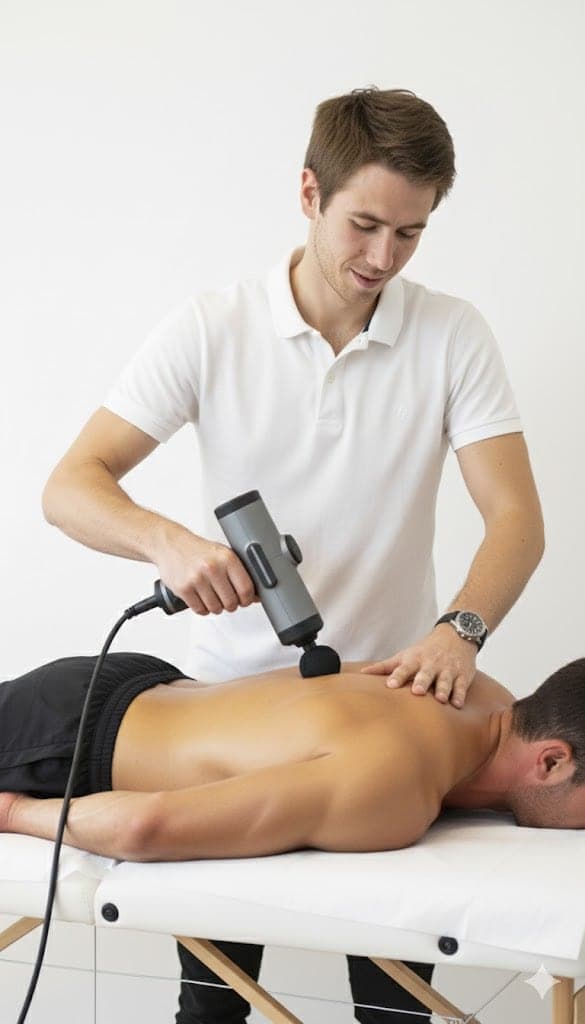
I travel to your location throughout Pafos with a professional treatment bench and all necessary equipment. This isn’t merely convenient—it’s clinically advantageous. You receive treatment in your own environment, eliminating the stress of travel and allowing immediate rest afterward when your tissue is in a temporary state of increased mobility.
This mobile approach also allows me to assess your actual working environment or training setup, identifying external factors contributing to postural dysfunction. I’ve modified countless computer workstations, adjusted training equipment, and redesigned daily activity patterns based on what I observe in clients’ actual environments—interventions impossible from a clinic setting.
Common Questions About Mechanical Postural Correction
How is this different from yoga for posture improvement that I’ve been doing?
Yoga stretches tissue that’s already overstretched while leaving the shortened, adhered tissue untouched. Mechanical deep-tissue treatment specifically targets and releases the restrictions causing your postural deviation. Yoga is flexibility training. This is structural correction of mechanical dysfunction.
Why can’t massage therapy accomplish the same results?
Manual massage cannot generate the sustained pressure, consistent force, and mechanical precision required to release deep fascial adhesions. Therapist hands fatigue, pressure varies, and the depths necessary for structural change cannot be reached manually. The machine I use delivers calibrated force consistently throughout the session, accessing tissue layers hands cannot reach.
How quickly will I see postural improvement?
Most clients notice subjective changes—reduced pain, easier movement, decreased tension—within 2-3 sessions. Objective postural measurements show significant improvement by sessions 5-6. Complete correction of long-standing postural deviations typically requires 8-12 sessions, depending on severity and duration of the dysfunction.
Is the treatment painful?
Deep fascial release involves controlled discomfort at therapeutic intensity. We’re accessing restricted tissue that’s been bound for years—this process isn’t painless, but it’s precisely calibrated to your tolerance. Pain levels are consistently 6-7 out of 10 during active treatment, immediately dropping to 2-3 afterward. Most clients describe the sensation as “intense but productive,” distinctly different from injury pain.
Will my posture return to its previous state after treatment?
No. Once fascial adhesions are mechanically released and your structure returns to proper alignment, the change is lasting provided you don’t recreate the same mechanical stress patterns. I provide specific guidance on maintaining results, but the structural corrections themselves are lasting. This isn’t temporary symptomatic relief—it’s resolution of the mechanical cause.
Why don’t you offer single sessions?
Because genuine postural correction cannot be achieved in a single session. Fascial restrictions develop over years. They require systematic treatment through multiple sessions to fully release. Offering single sessions would be dishonest—taking your money while knowing I cannot produce meaningful results. I only provide services that deliver the outcomes I promise.
How does this help athletic performance?
Optimal posture is fundamental to efficient movement mechanics. Forward head posture reduces rotational power. Rounded shoulders compromise overhead mechanics. Pelvic tilt affects running gait efficiency. By correcting these structural deviations, we optimize your kinetic chain for maximum performance with minimum energy expenditure. Athletes typically see immediate improvements in previously restricted movements once proper alignment is restored.
Can this prevent future injuries?
Absolutely. Most musculoskeletal injuries result from compensatory movement patterns caused by underlying postural dysfunction. When your structure is properly aligned, force distribution becomes balanced, movement becomes efficient, and injury risk decreases substantially. This is preventive medicine at its most effective—addressing mechanical dysfunction before it progresses to injury.
The Clinical Reality: Why This Approach Works When Yoga Doesn’t
After ten years and hundreds of postural correction cases, I can state with complete confidence: yoga for posture improvement in Pafos or anywhere else provides minimal lasting benefit for actual structural postural dysfunction. It’s valuable for flexibility, stress management, and general wellness, but it fundamentally cannot address the mechanical restrictions that create and maintain postural deviations.
The human body is a mechanical system governed by physical laws. When tissue becomes adhered and shortened, creating structural imbalance, that tissue must be mechanically released. Stretching, breathing exercises, and mindful movement have their place, but they cannot create the mechanical force required to dismantle fascial adhesions and restore proper tissue length.
This isn’t opinion. It’s biomechanical reality confirmed by measurable outcomes in client after client. The difference between my approach and traditional yoga or massage isn’t subtle—it’s the difference between treating symptoms and resolving causes, between temporary relief and lasting correction, between feeling slightly better and functioning optimally.
Your Next Step: From Understanding to Action
If you’ve been practicing yoga for posture improvement without achieving the structural changes you need, you now understand why. The question is what you do with this understanding.
You can continue investing time and money in approaches that haven’t worked, hoping for different results. Or you can commit to a systematic protocol specifically designed to address the biomechanical causes of your postural dysfunction—a protocol with a decade of proven outcomes behind it.
I work with clients throughout Pafos who’ve reached the same conclusion you’re approaching: that genuine postural correction requires advanced mechanical intervention beyond what traditional approaches provide. These are individuals who value their long-term structural health enough to invest in proper treatment rather than continuing with inadequate solutions.
The treatment series requires commitment—of time, of financial investment, and of tolerating controlled discomfort during deep fascial work. But the alternative is continued postural deterioration with its inevitable consequences: accelerated degeneration, chronic pain, restricted movement, and decreased quality of life.
My schedule fills several weeks in advance because clients who experience genuine structural correction refer others seeking the same results. If you’re serious about correcting your posture—not just temporarily feeling better but actually resolving the mechanical dysfunction—contact me to discuss your specific situation and whether this approach is appropriate for your needs.
This is specialized work requiring advanced knowledge and precise mechanical intervention. It’s not for everyone. But for those who recognize that their posture requires more than stretching and strengthening exercises, it’s the only approach that addresses the actual problem.
Your structure determines your function. Your posture determines your long-term musculoskeletal health. The choice between adequate treatment and continued dysfunction is yours to make.
Written by
Chris
Massage therapist & body mechanics specialist
Norwegian-certified with a Bachelor’s in Physical Education and Nutrition and over ten years of clinical practice, working from a portable table in clients’ homes across the Paphos district.
This article is general information from clinical practice, not a medical diagnosis. If you have severe, worsening or unexplained pain, numbness, weakness, or pain after an accident, see a doctor first.