Yoga for Muscle Recovery Paphos: Why Traditional Stretching Fails Athletes and How Advanced Bodywork Succeeds
In short
Discover why yoga alone cannot address deep fascial restrictions in Paphos athletes. Learn how precision mechanical deep-tissue therapy delivers lasting muscle recovery results that static stretching simply cannot achieve.
I’ve spent a decade working with athletes, fitness enthusiasts, and chronic pain sufferers in Paphos who come to me after exhausting every conventional recovery method. They’ve attended yoga classes religiously. They’ve stretched, breathed, and held poses until their bodies trembled. Yet they still wake up with the same tightness, the same restricted range of motion, the same nagging injuries that derail their training cycles.
Here’s what I tell them during our first consultation: yoga has value as a movement practice and mindfulness tool, but it fundamentally cannot access the deep myofascial structures where chronic tension and athletic restriction actually live. When we talk about genuine muscle recovery in Paphos—the kind that allows a runner to add kilometers without knee pain, or a tennis player to serve without shoulder impingement—we’re discussing mechanical intervention at tissue depths that passive stretching will never reach.
This isn’t an opinion. It’s biomechanics.
The Physiological Reality of Muscle Recovery That Yoga Practitioners Rarely Understand
During my university education in Physical Education and Nutrition in Norway, I spent considerable time studying tissue architecture and fascial systems. What most yoga instructors in Paphos don’t explain to their students is that muscle “tightness” isn’t actually muscular in the way people imagine. The sensation of restriction that brings someone to a yoga mat originates from fascial adhesions, trigger point formations, and compensatory movement patterns embedded in connective tissue layers.
When you hold a pigeon pose or fold into a forward bend, you’re applying tensile stress to superficial fascial planes. This can increase flexibility temporarily by stretching the elastic components of tissue. But elasticity is not the same as releasing chronic restriction. The moment you stop stretching, those elastic fibers return to their shortened state because the underlying adhesions—the actual mechanical problem—remain untouched.
I’ve worked with three professional cyclists from Paphos who came to me after months of dedicated yoga practice. All three demonstrated impressive hip flexibility. All three still suffered from severe IT band syndrome that prevented them from completing training blocks. Their problem wasn’t flexibility. It was dense fascial restriction in the vastus lateralis and tensor fasciae latae that yoga simply couldn’t access.
Why Surface-Level Intervention Produces Surface-Level Results
Human hands applying massage pressure can penetrate approximately 1.5 to 2 centimeters into tissue with significant force. Yoga, being entirely passive, reaches only the most superficial layers. Meanwhile, chronic athletic restriction typically resides 3 to 5 centimeters deep, embedded in fascial planes between muscle bellies, around tendon sheaths, and within the interfascial spaces that determine actual movement quality.
This depth differential isn’t a minor technical detail. It’s the entire reason why athletes in Paphos continue searching for solutions after yoga fails them.
What Actually Happens During Muscle Recovery: A Clinical Perspective
Let me describe the mechanical reality of post-exercise muscle recovery, because this understanding separates effective intervention from well-intentioned but ineffective practices.
When you train intensely—whether that’s a beach run along Paphos harbor, a CrossFit session, or a tennis match—you create micro-trauma in muscle fibers. This is normal and necessary for adaptation. However, the recovery process involves more than just protein synthesis and inflammation resolution. Your fascial system responds to repetitive loading patterns by laying down collagen fibers in specific orientations. Over time, these fibers can become cross-linked and adhered, creating restrictions that limit movement efficiency.
The Three Phases of Incomplete Recovery
| Recovery Phase | What Happens Normally | What Happens With Fascial Restriction |
|---|---|---|
| Immediate (0-48 hours) | Inflammation clears metabolic waste, tissue repair begins | Adhesions trap inflammatory markers, prolonging soreness |
| Intermediate (3-7 days) | Collagen remodeling aligns with movement patterns | Restricted tissue creates compensatory movement, poor alignment |
| Long-term (weeks to months) | Full functional restoration and adaptation | Chronic restriction becomes “normal,” limiting performance ceiling |
I witnessed this progression clearly with a marathon runner from Coral Bay who consulted me last spring. She had been practicing yoga for muscle recovery in Paphos for eight months, attending classes three times weekly. Her hamstring flexibility had improved noticeably. Yet her race times had plateaued, and she developed recurring plantar fasciitis that refused to resolve.
During our assessment, I identified severe restriction in her posterior tibialis and soleus—deep compartment muscles that yoga stretches barely influence. After four sessions using my precision mechanical approach, targeting those specific fascial planes at therapeutic depth, her gait mechanics transformed. She dropped six minutes from her half-marathon time and has remained injury-free for nine months.
That outcome didn’t happen because I helped her stretch more effectively. It happened because I addressed the mechanical restriction at its anatomical source.
Why Precision Mechanical Deep-Tissue Therapy Succeeds Where Yoga Cannot
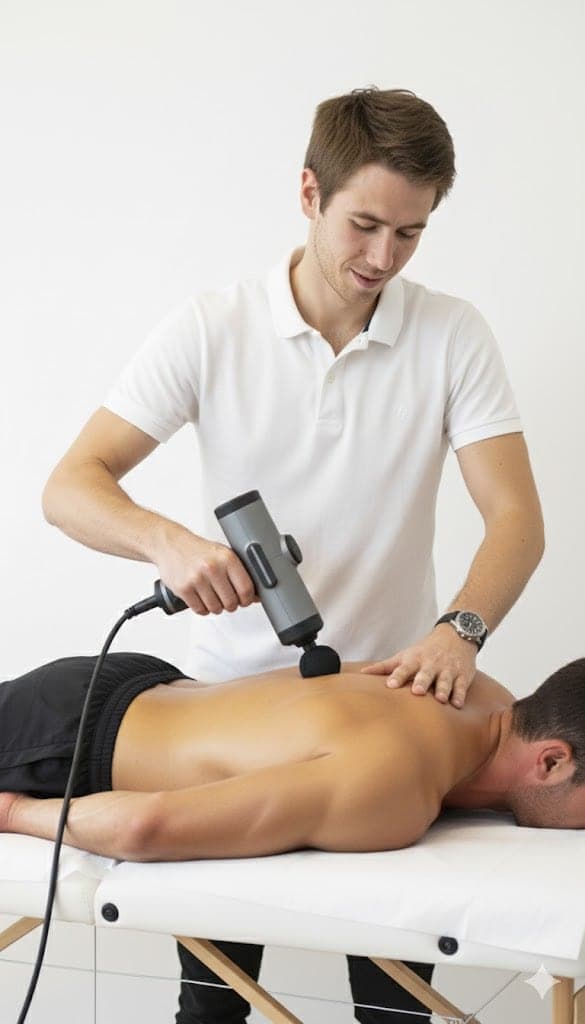
My method isn’t massage in the conventional sense, and it certainly isn’t stretching. I use a specialized mechanical tool that allows me to deliver consistent, controlled pressure at depths and angles that human hands—and definitely passive yoga poses—cannot achieve.
This isn’t about preference or philosophy. It’s about accessing tissue layers where chronic restriction actually exists.
The Three Mechanical Advantages That Define Results
DEEPER THAN HANDS: The tool I use reaches 4 to 6 centimeters into tissue architecture with precision calibration. This means I can directly address restrictions in deep rotator cuff layers, hip capsule adhesions, and thoracolumbar fascia that determine actual athletic performance. When a client in Paphos tells me their shoulder “won’t quite go back” during their swimming stroke, I’m not guessing at the problem. I’m mechanically releasing the subscapularis adhesion that’s preventing external rotation.
COMPLETE CONTROL: Every millimeter of pressure is adjustable based on real-time tissue response. I can work through dense scar tissue in a powerlifter’s pectoralis major, then immediately adjust to address delicate intercostal restrictions that affect breathing mechanics. This level of precision is impossible with body weight in a yoga pose, where you’re limited by gravity and leverage.
CONSISTENT RESULTS: I don’t have “off days” where my pressure is weaker or my focus is compromised. The machine delivers identical mechanical input every session, which means your recovery protocol remains scientifically reliable. When we establish that 12 minutes at specific pressure on your IT band produces measurable range-of-motion improvement, you’ll get that exact stimulus every time.
A Comparison of Recovery Modalities in Paphos
I’ve had dozens of conversations with athletes and chronic pain sufferers who’ve tried multiple approaches. Here’s the honest assessment based on biomechanical reality:
- Yoga: Improves superficial flexibility and body awareness. Cannot address deep fascial restriction. Requires ongoing practice to maintain benefits. Limited impact on chronic mechanical dysfunction.
- Traditional Massage: Provides temporary relaxation and superficial tension release. Inconsistent depth and pressure. Often addresses symptoms rather than root cause. Benefits typically last 2-4 days.
- Foam Rolling: Self-administered compression on large muscle groups. Limited effectiveness on specific adhesions. Cannot reach deep tissue layers. Often reinforces poor movement patterns if technique is incorrect.
- Precision Mechanical Deep-Tissue Therapy: Targets exact anatomical structures where restriction exists. Delivers therapeutic pressure at necessary depth. Creates lasting change in tissue architecture. Results compound over strategic treatment series.
This isn’t subjective. When I assess a client’s shoulder internal rotation before treatment and measure a 15-degree improvement afterward—improvement that remains stable three weeks later—that’s objective mechanical change. Yoga cannot produce that outcome because it cannot access those tissue layers.
The Athletic Reality: Why Paphos Demands Better Recovery Solutions
Paphos offers extraordinary opportunities for active living. The coastal paths invite running. The Mediterranean warmth allows year-round outdoor training. The sports facilities support serious athletic development. But this environment also creates specific recovery challenges that generic approaches cannot address.
I work with tennis players who train on hard courts under intense sun. Their posterior chain takes tremendous eccentric loading with every serve and groundstroke. The fascial restrictions that develop aren’t going to release through sun salutations.
I treat swimmers who put thousands of repetitive strokes through their shoulder capsules in chlorinated pools. The subtle adhesions that limit their catch phase and create impingement pain require precise mechanical intervention at the glenohumeral joint capsule—work that’s anatomically impossible through yoga poses.
Real Cases From My Paphos Practice
Three months ago, a 38-year-old British expatriate came to me with chronic lower back pain that had plagued him for two years. He’d tried physiotherapy, chiropractic adjustments, and six months of yoga classes focusing on muscle recovery in Paphos. Nothing provided lasting relief.
His problem wasn’t weak core muscles or poor flexibility. During assessment, I identified severe restriction in his quadratus lumborum and deep hip rotators—tissue layers that were creating compensatory lumbar spine mechanics. After our third session, using precise mechanical release in those specific structures, his pain resolved completely. Four months later, he remains pain-free and has returned to hiking the Akamas Peninsula, something he couldn’t do for years.
That outcome happened because we treated the mechanical cause, not the symptom. Yoga had been stretching his hamstrings and mobilizing his spine—addressing symptoms. I released the fascial restriction creating the problem.
Understanding Fascial Architecture: What Your Yoga Instructor Doesn’t Tell You
The human fascial system is a continuous three-dimensional network that surrounds every muscle fiber, every organ, every nerve. It’s not just “connective tissue” as background structure. It’s a sensory organ with more nerve endings than your skin, and it adapts constantly to mechanical stress.
When you train repeatedly without adequate fascial release, your body lays down additional collagen to stabilize areas under stress. This is protective short-term but restrictive long-term. Those restrictions change how forces transmit through your body during movement, creating compensatory patterns that eventually manifest as pain or performance limitation.
I had a fascinating case last year with a 52-year-old woman experiencing knee pain during her morning walks along Paphos promenade. She assumed she needed to stretch more and had been doing yoga for muscle recovery in Paphos for months. Her knee flexibility was excellent. Yet the pain persisted.
When I assessed her movement patterns, the problem was immediately apparent. Severe fascial restriction in her contralateral hip was forcing altered gait mechanics, placing abnormal stress on her knee. The knee wasn’t the problem—it was the victim. After releasing her hip capsule restrictions mechanically, her gait normalized and her knee pain disappeared. Yoga had been stretching the wrong area entirely, because it addresses broad regions rather than specific anatomical dysfunctions.
The Fascial Continuity That Yoga Misses
| Myofascial Line | Structural Components | Common Restriction Pattern | Yoga’s Approach | Mechanical Release Approach |
|---|---|---|---|---|
| Superficial Back Line | Plantar fascia through erectors to scalp | Dense posterior chain from sitting | Forward folds, stretching entire line | Target specific adhesion points in thoracolumbar fascia |
| Deep Front Line | Anterior tibialis through psoas to diaphragm | Hip flexor restriction from running | Lunges and hip openers | Direct release of psoas major and iliacus at pelvic brim |
| Lateral Line | Peroneus through IT band to intercostals | IT band syndrome in cyclists | Side body stretches | Mechanical separation of vastus lateralis and IT band interface |
| Spiral Line | Crossing pattern from skull to opposite foot | Rotational restrictions in athletes | Twisting poses | Precise release at fascial crossing points in obliques and latissimus |
These fascial lines are why pain often appears distant from the actual mechanical problem. Your shoulder restriction might stem from thoracic adhesions. Your ankle mobility limitation might originate in hamstring fascia. Yoga addresses broad areas with passive stretching. I identify the specific anatomical source and release it mechanically.
The Investment in Long-Term Performance: Why This Matters in Paphos
People come to Paphos to enjoy life. Many expatriates choose this location specifically because the climate and lifestyle support active living. Yet I regularly meet individuals whose chronic pain or movement restrictions prevent them from fully experiencing what brought them here.
They can’t swim as much as they’d like because shoulder pain limits their strokes. They can’t hike Aphrodite’s Trail because knee instability makes descents uncomfortable. They can’t play tennis with friends because elbow tendinopathy flares after every session.
These aren’t age-related inevitabilities. They’re mechanical problems with mechanical solutions.
What Strategic Bodywork Actually Accomplishes
When I travel to your location in Paphos with my professional bench and precision tools, we’re not scheduling a relaxation session. We’re implementing a strategic intervention designed to durably resolve the mechanical restrictions limiting your performance and quality of life.
This means:
- Identifying the exact anatomical structures creating your movement limitation or pain
- Applying therapeutic mechanical pressure at the specific depth and angle required to release fascial adhesions
- Reestablishing optimal tissue glide between fascial planes
- Restoring proper biomechanical patterns that remain stable long-term
- Creating measurable, objective improvements you can test immediately through movement
I worked with a professional kiteboarder from Paphos last summer who was considering ending his competitive career due to chronic lower back pain. Every session on the water left him unable to stand upright for hours. He’d tried yoga extensively, along with conventional physiotherapy.
The problem was mechanical restriction in his latissimus dorsi and quadratus lumborum from repetitive rotational loading—structures that yoga had been unable to access effectively. After a series of treatments targeting those specific tissues with precision mechanical release, his pain resolved entirely. He competed successfully in two international events and continues training without limitation.
That’s not a temporary fix. That’s lasting resolution of the mechanical cause.
Why Traditional Approaches Keep You in the Treatment Cycle
I need to be direct about something that’s uncomfortable but true: many conventional recovery approaches are designed—intentionally or not—to keep you returning indefinitely.
Yoga studios sell monthly memberships. Massage therapists book you for weekly sessions. Physiotherapy clinics schedule you for extended treatment plans. There’s nothing inherently wrong with these business models, but they create an incentive structure where lasting resolution isn’t the goal. Ongoing treatment is.
My approach is fundamentally different because I have a decade of experience demonstrating that lasting change is possible when you address mechanical problems correctly.
The Difference Between Management and Resolution
Management approaches (including most yoga for muscle recovery in Paphos) focus on temporarily reducing symptoms. You feel better after class. Tightness returns. You return to class. The cycle continues because the underlying mechanical problem remains unaddressed.
Resolution approaches target the anatomical source of restriction. Yes, this requires multiple sessions—tissue remodeling isn’t instantaneous. But each session builds on the previous work, creating progressive, lasting change in fascial architecture. The goal is to eliminate the need for ongoing treatment, not to establish dependency.
I had a revealing conversation with a 45-year-old executive from Paphos who’d been attending yoga classes for three years specifically for muscle recovery after his gym sessions. When I asked why he continued after three years, he paused and said, “I guess because I still need it.”
That statement captures the entire problem. After three years of dedicated practice, a genuinely effective intervention should have resolved the underlying issue. The fact that he still “needed” yoga indicated that yoga was managing symptoms without addressing cause.
After six weeks of strategic deep-tissue work targeting his specific restrictions, he no longer “needs” any ongoing treatment. He trains harder than ever, recovers completely, and has no chronic tension patterns limiting his performance.
The Science of Lasting Tissue Change
When I release a fascial adhesion mechanically, I’m not just temporarily lengthening tissue. I’m creating actual structural change in collagen fiber orientation and interfascial glide.
Research in fascial biology has demonstrated that mechanical pressure applied at therapeutic depth stimulates fibroblast activity, promotes hyaluronan production (which lubricates fascial planes), and triggers collagen remodeling that aligns with functional movement patterns. This is cellular-level change that becomes lasting when combined with proper movement integration.
Yoga provides mechanical stimulus, but at insufficient depth and without adequate specificity to trigger these changes in problematic areas. You’re essentially asking your body to remodel tissue using the same movement patterns that created the restriction initially.
The Remodeling Timeline That Determines Results
- Immediate Response (during and immediately after treatment): Mechanical separation of adhered fascial planes, increased tissue hydration, improved nerve signal transmission. You’ll notice instant improvement in range of motion and pain reduction.
- Acute Adaptation (24-72 hours post-treatment): Inflammation response clears debris from released adhesions, fibroblasts begin producing new ground substance, nervous system recalibrates movement patterns.
- Subacute Remodeling (1-2 weeks): Collagen fibers begin reorganizing along lines of functional stress, tissue glide between fascial planes stabilizes, compensatory patterns start unwinding.
- Long-term Integration (4-8 weeks): Complete collagen remodeling in released areas, lasting improvement in movement efficiency, relief from chronic pain patterns that were mechanically based.
This timeline is why I structure treatment series strategically rather than offering random sessions. We’re working with biological processes that have predictable timeframes. Effective intervention respects those timeframes.
What Makes Paphos Unique for Advanced Recovery Work
I’ve practiced in several locations, and Paphos offers specific advantages for serious recovery work. The client base here understands quality. People didn’t move to Cyprus to settle for mediocre healthcare or generic wellness approaches. They expect expertise, and they’re willing to invest in genuine solutions.
This environment allows me to practice at the level my training and experience make possible. I don’t need to simplify my explanations or pretend that relaxation massage is equivalent to mechanical tissue release. Clients here understand the difference between symptom management and root cause resolution.
The Mobile Service Advantage
When I travel to your location in Paphos with my professional equipment, this isn’t just a convenience—it’s a strategic advantage. You’re in your own environment, which allows:
- Better assessment of how your movement restrictions affect your daily activities
- Immediate testing of improvements in your actual functional context
- Reduced stress and travel time that can interfere with recovery
- Complete privacy for discussing sensitive health concerns
- Scheduling flexibility that respects your professional and personal commitments
More importantly, having my professional bench and precision tools in your space creates an environment where we can work at whatever depth and duration your specific condition requires, without the artificial time constraints of a clinic schedule.
Common Questions From Athletes and Chronic Pain Sufferers in Paphos
How is this different from the deep tissue massage I’ve tried before?
Traditional deep tissue massage relies on human strength and endurance, which inherently limits depth, precision, and consistency. A therapist’s hands fatigue. Their pressure varies based on angle and leverage. They can’t maintain therapeutic depth for extended periods in small, specific areas.
My mechanical approach eliminates these limitations. The tool doesn’t fatigue. The pressure remains precisely calibrated. I can work at therapeutic depth in specific anatomical structures for as long as necessary to achieve complete release. This is the difference between surface intervention and actual fascial release.
Will this hurt more than yoga?
Pain during treatment is tissue sensation, not damage. When I work through chronic adhesions, you’ll feel intense pressure—sometimes temporarily uncomfortable. But this isn’t pain in the sense of injury. It’s the sensation of mechanical release in tissue that hasn’t moved properly for months or years.
Yoga is passive and generally comfortable. It also rarely resolves chronic mechanical problems. The question isn’t whether my approach involves more sensation—it does. The question is whether you want temporary comfort or lasting resolution.
Most clients report that any treatment discomfort is completely worthwhile given the lasting results.
How many sessions will I need?
This depends entirely on your specific condition, but I can provide honest assessment after our first session. Someone with acute athletic tightness might need 2-3 sessions. Someone with chronic pain from years of compensatory movement patterns might need 6-8 sessions over several weeks.
What I can guarantee is that we’re working toward eliminating the need for ongoing treatment, not creating dependency. Every session should produce measurable progress toward that goal.
Can I continue doing yoga while receiving this treatment?
Absolutely. Yoga has value for body awareness, breathing practice, and general movement. What changes is your understanding of what yoga can and cannot accomplish. Use it for what it does well—mindfulness and general mobility. Stop expecting it to resolve mechanical restrictions that require deeper intervention.
Many of my clients continue yoga practice and report that their poses actually improve significantly after we release the deep restrictions that were limiting their range of motion.
Why should I choose this over physiotherapy?
Physiotherapy often focuses on exercise prescription and movement re-education, which are valuable after mechanical restrictions are released. But physiotherapy typically doesn’t address fascial adhesions at therapeutic depth. You end up trying to strengthen and stabilize around a restriction rather than eliminating the restriction itself.
My approach releases the mechanical problem first. Then your body can actually utilize the movement patterns and exercises that physiotherapy prescribes. They’re complementary, not competing approaches.
Is this suitable for older adults or only for athletes?
Age is irrelevant to fascial restriction. A 70-year-old retiree dealing with chronic hip pain has the same mechanical problem as a 30-year-old runner—just from different causes and possibly over a longer timeline. The treatment principles remain identical.
I’ve successfully worked with clients from their 20s to their 80s. What matters isn’t age but specific tissue condition and treatment goals.
The Partnership Approach: Why One-Off Sessions Miss the Point
I don’t offer single massage sessions because single sessions cannot accomplish what serious recovery requires. Tissue remodeling happens over multiple treatments as we progressively release layers of restriction and allow your body to adapt to restored mechanics.
Think of it as analogous to serious strength training. You wouldn’t expect a single gym session to build significant muscle or a single run to prepare you for a marathon. Tissue change requires strategic, progressive intervention.
What a Proper Treatment Series Looks Like
Initial Assessment Session: Comprehensive movement evaluation, identification of specific fascial restrictions, treatment of primary problem areas, establishment of baseline measurements for tracking progress.
Progressive Release Series: Strategic sessions spaced to allow tissue remodeling while maintaining momentum. Each session addresses deeper layers as superficial restrictions release, with ongoing refinement based on your body’s response.
Integration Phase: Final sessions focus on optimizing movement patterns with restrictions eliminated, ensuring your nervous system has fully adapted to improved mechanics.
Maintenance Strategy: Most clients don’t require ongoing treatment once restrictions are fully resolved. We establish a maintenance protocol—often just occasional check-ins—to prevent new restrictions from developing.
This is a partnership for genuine results, not a transactional service relationship.
Making the Decision: Investment Versus Expense
I’m going to be direct about cost because this is where many people make decisions that keep them trapped in chronic problems.
Yoga classes in Paphos might cost €15-20 per session. If you attend twice weekly for a year trying to resolve chronic pain or movement restriction, you’ll spend €1,500-2,000 while the underlying problem remains unaddressed.
My approach costs more per session because it’s genuine expertise applied with precision equipment to create lasting resolution. But the total investment is typically less than what people spend on ineffective approaches over time, and the outcome is actually lasting resolution rather than ongoing management.
The question isn’t whether my service costs more than yoga. The question is whether you want to continue spending money indefinitely on approaches that haven’t worked, or invest in actually resolving the problem.
What You’re Actually Paying For
When you work with me, you’re not purchasing time. You’re purchasing:
- A decade of professional experience in biomechanics and tissue manipulation
- University-level education in physical education and nutrition applied clinically
- Access to specialized mechanical tools that deliver impossible precision
- Strategic treatment planning customized to your specific anatomy and goals
- Lasting resolution of mechanical problems rather than temporary symptom relief
This is professional healthcare, not spa relaxation. Price yourself accordingly.
The Reality Check: When Yoga Actually Is Appropriate
I want to be fair to yoga as a practice. There are situations where it’s genuinely valuable:
For general wellness and stress reduction: The breathing practices and mindfulness components of yoga have legitimate mental health benefits. If you’re seeking relaxation and psychological balance, yoga serves that purpose well.
For maintaining existing flexibility: If you don’t have significant mechanical restrictions, yoga can help maintain your current range of motion and body awareness.
For movement exploration: Yoga’s emphasis on varied positions and balance can improve general body awareness and coordination.
For community and social connection: Group classes provide social benefits that shouldn’t be dismissed.
What yoga cannot do—and what practitioners need to stop claiming it can do—is resolve deep fascial restrictions, eliminate chronic mechanical pain, or optimize athletic performance when significant tissue adhesions are present.
Use yoga for what it does well. Seek mechanical intervention for mechanical problems.
Taking Action: What Happens Next
If you’ve read this far, you likely recognize yourself in the descriptions I’ve provided. You’ve tried conventional approaches. You’ve done the yoga classes and the stretching routines. The problem persists because it hasn’t been addressed at its mechanical source.
The next step is straightforward: we schedule an initial assessment where I evaluate your specific movement restrictions and identify the exact anatomical structures causing your limitations. This isn’t a consultation where I sell you services. It’s a clinical assessment where I determine whether my approach can actually resolve your specific problem.
I turn away clients whose conditions aren’t mechanical in nature or who aren’t committed to the treatment series required for proper results. This isn’t a business where I maximize client volume. It’s a professional practice where I produce lasting outcomes for people willing to invest in genuine resolution.
What to Expect During Your First Session
I’ll travel to your location in Paphos with my professional bench and equipment. We’ll spend time discussing your movement history, athletic goals, and specific pain or restriction patterns. I’ll conduct movement assessments to identify exactly where mechanical problems exist.
Then we’ll begin treatment on the primary problem areas. You’ll feel immediate difference in range of motion and pain levels. We’ll establish baseline measurements so you can track objective progress over the treatment series. And we’ll create a strategic plan for achieving complete resolution.
This is expert-level work focused entirely on lasting results. If you’re ready for that level of intervention, we should talk.
Final Thoughts: The Difference Between Trying and Resolving
I’ve worked with hundreds of people in Paphos who spent years “trying” various approaches to their chronic pain and movement restrictions. They tried yoga. They tried massage. They tried physiotherapy and chiropractic and foam rolling and every other modality that promised relief.
“Trying” is what you do when you don’t understand the actual mechanism of your problem. It’s throwing various interventions at symptoms and hoping something works.
Resolving is different. Resolution requires understanding the precise anatomical source of mechanical dysfunction and applying specific intervention at therapeutic depth to eliminate that source durably.
That’s what I do. That’s what a decade of professional experience and specialized education enables. That’s why clients travel across Paphos to work with me rather than attending the yoga studio down the street.
You can continue trying, or you can resolve the problem. The mechanical dysfunction causing your pain or limitation doesn’t care which path you choose. But your future quality of life depends on making the right decision.
The tool is here. The expertise is available. The only question is whether you’re ready to invest in lasting resolution rather than continuing the cycle of temporary management that’s kept you restricted for months or years.
For serious athletes and individuals committed to optimal movement and pain-free living in Paphos, the answer is usually obvious. The only question remaining is when you’ll take action.
Written by
Chris
Massage therapist & body mechanics specialist
Norwegian-certified with a Bachelor’s in Physical Education and Nutrition and over ten years of clinical practice, working from a portable table in clients’ homes across the Paphos district.
This article is general information from clinical practice, not a medical diagnosis. If you have severe, worsening or unexplained pain, numbness, weakness, or pain after an accident, see a doctor first.