Yoga for Back Pain Geroskipou: Advanced Treatment That Actually Works
In short
Discover why mechanical deep-tissue therapy surpasses traditional yoga for chronic back pain relief in Geroskipou. Learn the science-backed approach from a specialist with 10 years of experience.
I’ve spent the last decade working with clients in Geroskipou who come to me after months—sometimes years—of trying yoga for their back pain. They tell me similar stories: “I’ve been going to yoga classes three times a week, but my lower back still locks up every morning.” Or: “My instructor keeps saying I need to strengthen my core, but the pain just migrates to different areas.”
Here’s what I tell them, and what I’m going to share with you today: yoga can be an excellent supplementary practice for maintaining mobility and building body awareness. But when you’re dealing with chronic mechanical back pain—the kind that disrupts your sleep, limits your work capacity, and forces you to decline social activities—you need a fundamentally different approach. You need treatment that addresses the root biomechanical dysfunction, not exercises that work around it.
After treating hundreds of cases in Geroskipou, I can state with complete confidence: the fastest path to lasting back pain relief combines targeted mechanical intervention with strategic movement rehabilitation. This article will explain exactly why this works, what traditional yoga misses, and how you can finally achieve the lasting results you’ve been searching for.
The Biomechanical Reality of Back Pain That Yoga Cannot Address
Let me be direct about something the wellness industry rarely discusses: most chronic back pain originates from deep fascial adhesions, trigger point formations, and compensatory muscle patterns that have developed over years of repetitive stress or acute injury. These aren’t conditions you can “stretch away” or “strengthen around.”
I earned my Bachelor’s degree in Physical Education and Nutrition in Norway, where we studied extensively the mechanics of human movement and tissue adaptation. What I learned—and what ten years of clinical practice has confirmed—is that chronic pain represents a failure in the body’s mechanical system. Specific tissues have become dysfunctional, creating protective patterns that perpetuate the problem.
Why Traditional Yoga Falls Short for Mechanical Dysfunction
When you attend a yoga class in Geroskipou, you’re typically performing generalized movements designed for general wellness. The instructor cannot possibly assess and address your specific fascial restrictions, trigger point locations, or compensatory patterns. Even in private sessions, manual techniques lack the precision and consistency needed to resolve deep-seated mechanical problems.
I’ve observed this pattern repeatedly: clients come to me after six months of dedicated yoga practice. They’ve improved their flexibility, yes. They’ve learned breathing techniques. But their fundamental pain pattern remains because the underlying mechanical dysfunction was never directly treated.
The Three Components Yoga Cannot Provide
Targeted Depth: The deepest layers of your posterior chain—where chronic back pain originates—require mechanical intervention that exceeds what manual pressure or bodyweight stretching can achieve. I’m talking about the multifidus, quadratus lumborum, and deep erector spinae fibers that have been locked in protective spasm for months or years.
Precise Localization: Your pain isn’t generalized—it originates from specific anatomical structures. A yoga sequence cannot isolate and treat the exact trigger point in your right QL that’s referring pain down your hip, or the fascial adhesion between your T12 and L1 that’s limiting your spinal mobility.
Progressive Intensity: Effective treatment requires precisely calibrated force that increases systematically as tissues release. This level of control is impossible with bodyweight movements or instructor-applied pressure.
The Science-Based Alternative: Mechanical Deep-Tissue Intervention
After recognizing these limitations early in my career, I dedicated myself to developing a treatment protocol that actually resolves chronic back pain durably. This method combines advanced anatomical knowledge with specialized mechanical equipment that delivers results traditional approaches cannot match.
How Precision Mechanical Therapy Works
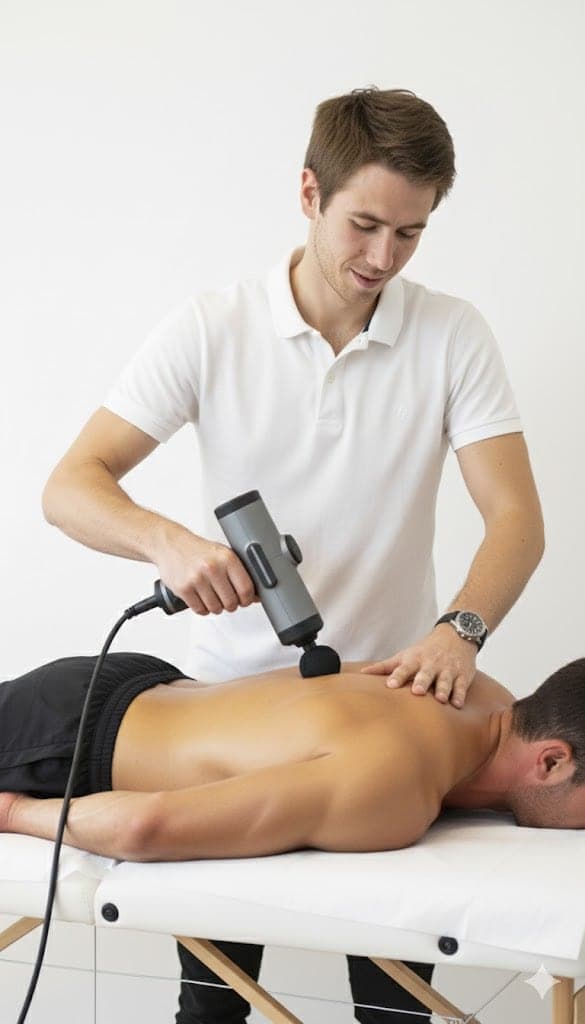
I use a specialized therapeutic instrument that allows me to apply controlled, sustained pressure to specific dysfunctional tissues. This isn’t massage in the traditional sense—it’s mechanical intervention designed to:
- Break down fascial adhesions that restrict normal tissue gliding
- Deactivate trigger points that create referred pain patterns
- Release chronic muscle splinting that limits range of motion
- Restore optimal length-tension relationships in postural muscles
- Reestablish normal proprioceptive feedback from treated areas
The equipment I work with provides three critical advantages over any manual technique:
DEEPER THAN HANDS: The tool allows me to work through superficial layers without fatigue, reaching the deep spinal stabilizers and hip flexors where most chronic back pain originates. I can maintain therapeutic pressure for 8-10 minutes on a single trigger point cluster—something impossible with thumb or elbow pressure.
COMPLETE CONTROL: I adjust intensity in real-time based on tissue response and your feedback. For acute presentations, I work with lighter pressure to avoid protective guarding. For chronic, densely fibrotic tissue in athletic clients, I can deliver substantially deeper intervention. This precision is categorically impossible in a group yoga class.
CONSISTENT RESULTS: My equipment never has an “off day.” Every session delivers the same quality of treatment, eliminating the variability inherent in manual therapy. You receive optimal intervention every single time, which accelerates the cumulative effect necessary for lasting resolution.
The Clinical Approach to Back Pain Resolution in Geroskipou
When a new client contacts me about their back pain, I begin with a thorough biomechanical assessment. This isn’t a casual conversation—it’s a systematic evaluation of:
| Assessment Component | What I’m Evaluating | Why It Matters |
|---|---|---|
| Pain History | Onset mechanism, progression pattern, aggravating factors | Identifies primary mechanical driver |
| Movement Analysis | Gait pattern, spinal segmentation, hip mobility | Reveals compensatory strategies |
| Palpation Assessment | Tissue quality, trigger point locations, fascial mobility | Maps treatment target zones |
| Functional Testing | Loaded movement patterns under various conditions | Establishes baseline performance metrics |
This assessment typically reveals what I call the “mechanical cascade”—a sequence of adaptations that started with an initial dysfunction and progressively involved compensatory structures. For example, I frequently see this pattern in Geroskipou clients who work desk jobs:
The Typical Mechanical Cascade in Chronic Back Pain
- Initial Dysfunction: Prolonged sitting creates adaptive shortening in hip flexors (psoas and iliacus)
- Primary Compensation: Shortened hip flexors increase anterior pelvic tilt, forcing lumbar extensors into chronic overwork
- Secondary Compensation: Overworked lumbar extensors develop trigger points and protective spasm
- Tertiary Compensation: Restricted lumbar extension forces thoracic spine into compensatory hypermobility
- Symptom Presentation: Client experiences “lower back pain” but the root cause is hip flexor dysfunction
This is why general yoga sequences fail. They address symptoms (tight back muscles) without resolving the mechanical cause (hip flexor restriction creating downstream dysfunction). My intervention targets the entire cascade systematically, working from root cause to secondary compensations.
What Actual Treatment Looks Like: A Case Study
Let me share a recent case that illustrates the difference between symptomatic treatment and mechanical resolution. A 42-year-old client contacted me after two years of intermittent back pain that had recently become constant. She had tried:
- Six months of weekly yoga classes focused on “back strengthening”
- Three months of general massage therapy
- Various pain medications and anti-inflammatories
- Core strengthening exercises from YouTube videos
None of these interventions produced lasting change. Some provided temporary relief, but her baseline pain level remained unchanged.
My Assessment and Treatment Plan
During her initial evaluation, I identified:
Primary Dysfunction: Severe bilateral psoas restriction with active trigger points referring pain to her lower back and anterior hip. The tissue had become densely fibrotic from years of compensatory overwork.
Secondary Dysfunction: Reactive splinting in her quadratus lumborum and multifidus, creating the sensation of constant muscle tension.
Tertiary Dysfunction: Reduced thoracic extension mobility, forcing excessive movement demand on her lumbar spine.
I designed a treatment protocol targeting these dysfunctions in sequence:
Phase One (Weeks 1-3): Deep intervention to the psoas complex, working progressively deeper as tissue began releasing. Each session involved 40-50 minutes of targeted work to these structures. I could feel the tissue quality changing session by session—from rigid and resistant to progressively more pliable.
Phase Two (Weeks 4-6): Continued psoas work combined with release of secondary compensatory patterns in the QL and lumbar paraspinals. As the primary dysfunction resolved, the protective splinting in these structures began releasing spontaneously.
Phase Three (Weeks 7-9): Thoracic mobilization and integration work, ensuring her movement patterns incorporated the restored hip and lumbar mobility.
The Results
After nine weeks of bi-weekly treatment, her pain had completely resolved. More importantly, when I reassessed her movement patterns six months later, the improvements remained stable. She had returned to activities she’d avoided for years—hiking, playing with her children, even training for a half-marathon.
This is what I mean by lasting resolution. We didn’t teach her to “manage” her pain or “work around” her limitations. We systematically restored normal mechanical function, eliminating the condition that was generating pain signals.
Yoga’s Role in the Recovery Process: When and How
I want to be clear about something: I’m not categorically opposed to yoga. What I oppose is positioning yoga as a primary treatment for mechanical back pain when it fundamentally cannot address the underlying dysfunction.
Once I’ve resolved a client’s mechanical restrictions—once their tissues are functioning normally again—yoga can serve as an excellent maintenance practice. At that point, you’re working with a properly functioning mechanical system, and yoga’s benefits become accessible:
When Yoga Becomes Valuable
- After mechanical restoration: Once your hip flexors, spinal stabilizers, and fascial system are functioning normally, yoga maintains this mobility
- For body awareness: Yoga teaches you to recognize subtle movement patterns and maintain quality of motion
- For stress management: The breathing and mindfulness components provide genuine psychological benefits
- For community: Group classes offer social connection and accountability for maintaining practice
But these benefits only become relevant after you’ve addressed the mechanical dysfunction generating your pain. Attempting to strengthen or stretch around active trigger points and fascial restrictions is not only ineffective—it can reinforce compensatory patterns and delay actual recovery.
The Investment in Lasting Resolution
I’ve treated clients who spent thousands of euros on yoga memberships, massage packages, and various wellness services before finally seeking specialized treatment. They tell me they wish they’d made this decision years earlier.
Here’s my perspective after a decade in this field: your back pain isn’t going to resolve itself. The mechanical dysfunctions creating your symptoms have taken months or years to develop, and they require targeted intervention to reverse. Every week you delay represents another week of:
- Compensatory patterns becoming more deeply ingrained
- Secondary structures developing their own dysfunctions
- Lost productivity and reduced quality of life
- Potential progression to more serious mechanical problems
What My Service Actually Costs (And What It’s Worth)
I don’t offer single “relaxation sessions” or package deals for generic massage. What I provide is a dedicated therapeutic partnership focused on one goal: lasting resolution of your mechanical dysfunction.
My treatment protocol typically requires:
| Phase | Duration | Session Frequency | Focus |
|---|---|---|---|
| Assessment & Initial Intervention | 1-2 weeks | 2 sessions | Identify root cause and begin primary release |
| Active Treatment | 6-8 weeks | Weekly or bi-weekly | Systematic resolution of mechanical cascade |
| Integration & Stabilization | 3-4 weeks | Bi-weekly | Ensure changes remain stable |
| Maintenance (Optional) | Ongoing | Monthly or as needed | Prevent recurrence and optimize performance |
This represents an investment in lasting change, not an expense for temporary relief. Compare this to:
- Years of ongoing yoga memberships providing no mechanical resolution
- Repeated massage sessions that feel good but change nothing fundamentally
- Lost work productivity and missed experiences due to chronic pain
- The psychological burden of believing you’ll “just have to live with it”
Why I Travel to Your Location
I provide mobile service throughout Geroskipou because I’ve learned that convenience dramatically affects treatment compliance and results. When you’re dealing with significant back pain, the prospect of driving across town for an appointment can become another barrier to getting the help you need.
I arrive at your location with professional treatment equipment—a specialized therapy bench and all necessary tools. Your environment is comfortable, familiar, and private. We can work in extended sessions without the time pressure of a clinic schedule. This isn’t just convenient—it’s clinically superior because:
Relaxation Response: You’re more likely to achieve the parasympathetic state necessary for deep tissue release in your own environment.
Immediate Integration: After treatment, you can immediately test your restored mobility in your actual living and working spaces, giving us real-world feedback for the next session.
Scheduling Flexibility: We can arrange sessions at times that fit your schedule, increasing consistency and accelerating results.
Yoga Classes in Geroskipou: A Supplementary Resource
For those specifically searching for yoga instruction in Geroskipou, several studios and independent instructors offer classes. However, I encourage you to approach this decision with clarity about your actual needs.
Questions to Ask Before Committing to Yoga for Back Pain
About Your Condition:
- Have I had a thorough biomechanical assessment identifying the specific structures causing my pain?
- Do I have active trigger points, fascial restrictions, or chronic muscle splinting?
- Has my pain been constant or progressively worsening despite previous treatments?
- Does my pain interfere with daily activities, work, or sleep?
About the Yoga Instruction:
- Does the instructor have training in therapeutic intervention for mechanical dysfunction?
- Will the instruction be individualized based on my specific mechanical limitations?
- Can the instructor identify and address my particular compensatory patterns?
- What is the plan if my pain increases during practice?
If you answered “yes” to multiple questions in the first category and “no” to questions in the second category, yoga is unlikely to resolve your condition. You need targeted mechanical intervention first.
The Treatment Philosophy Behind Lasting Results
Throughout my career, I’ve refined a treatment philosophy that differs fundamentally from conventional approaches in the wellness industry. Most practitioners treat symptoms; I treat mechanical causes. Most provide temporary relief; I aim for lasting resolution.
This philosophy rests on several core principles:
Principle One: The Body Is a Mechanical System
Your musculoskeletal system operates according to biomechanical principles. When tissues become dysfunctional, they create predictable patterns of compensation and pain referral. These patterns can be mapped, assessed, and systematically corrected through targeted intervention.
Pain is a signal—an output from your nervous system indicating mechanical dysfunction. Treating pain directly (through medication or relaxation) is like disconnecting your car’s “check engine” light without addressing the engine problem. The light turns off, but the underlying issue remains and worsens.
Principle Two: Dysfunction Develops in Layers
Your current pain pattern didn’t appear overnight. It represents the end stage of a mechanical cascade that may have started months or years ago. Effective treatment must work backward through this cascade, addressing each layer systematically.
This is why single-session treatments rarely produce lasting change. Lasting resolution requires multiple sessions working progressively deeper as superficial layers release and compensatory patterns unwind.
Principle Three: Tissue Quality Determines Function
The quality of your fascial system, muscle tissue, and connective structures directly determines your mechanical function. When these tissues become restricted, fibrotic, or adhesed, normal movement becomes impossible regardless of how much you “strengthen” or “stretch.”
My mechanical intervention directly improves tissue quality, restoring the sliding, gliding, and elastic properties necessary for pain-free movement. Once tissue quality normalizes, function returns naturally.
Principle Four: The Client Is an Active Partner
Treatment isn’t something I do “to” you—it’s a collaborative process. Your feedback during sessions guides pressure adjustments and treatment focus. Your observations between sessions inform our strategy. Your commitment to the protocol determines how quickly we achieve results.
I provide the specialized knowledge and technical intervention you cannot access on your own. You provide the essential information about your experience and the consistency necessary for cumulative effect.
Common Questions About Advanced Mechanical Treatment
Is this approach more painful than regular massage?
The intervention can be intense—we’re working on dysfunctional tissue that has been problematic for extended periods. However, I maintain constant communication and adjust pressure to remain within your tolerance. Most clients describe the sensation as “uncomfortable but productive,” distinctly different from the sharp, protective pain that signals tissue damage.
As treatment progresses and tissue quality improves, the same depth of work becomes progressively more comfortable. By your fourth or fifth session, what felt intense initially feels merely firm.
How is this different from deep tissue massage I can get at any spa?
Standard deep tissue massage typically involves general techniques applied broadly across muscle groups. While therapists may work deeply, they lack the specialized equipment and biomechanical assessment necessary to target specific dysfunctional structures.
My approach combines clinical assessment, targeted intervention to precise anatomical structures, and equipment that provides depth and consistency impossible with manual techniques. We’re not providing relaxation—we’re systematically correcting mechanical dysfunction.
Why haven’t other practitioners identified these problems?
Most massage therapists receive training focused on relaxation and general wellness, not clinical intervention for mechanical dysfunction. Physical therapists typically focus on exercise prescription rather than direct tissue work. Chiropractors primarily address joint mobility, not soft tissue quality.
My specific combination of education (Bachelor’s in Physical Education and Nutrition), extensive training in advanced bodywork techniques, and decade of focused practice creates a specialized skill set uncommon in the wellness industry.
How do I know if I’m a good candidate for this treatment?
You’re an ideal candidate if:
- You’ve been dealing with back pain for more than three months
- Previous treatments provided only temporary relief
- Your pain follows predictable patterns (worse with certain activities or times of day)
- You can identify specific areas of tightness or restriction
- You’re committed to a systematic treatment protocol, not seeking a quick fix
What happens after my pain resolves?
Once we’ve achieved complete pain resolution and restored normal mechanical function, most clients transition to occasional maintenance sessions—perhaps monthly or quarterly. These sessions address any new restrictions before they develop into pain patterns, and they provide an opportunity to optimize performance for specific activities or demands.
Some clients choose to discontinue treatment entirely, knowing they can return if new issues develop. Others value the ongoing optimization and performance enhancement that regular mechanical work provides, particularly athletes and professionals with high physical demands.
Making the Decision: Yoga or Specialized Treatment?
If you’ve read this far, you’re likely someone who has been searching for real answers about your back pain. You’ve probably tried multiple approaches, invested significant time and money, and experienced the frustration of temporary improvements followed by recurring symptoms.
I want to give you absolute clarity: yoga and mechanical deep-tissue intervention serve different purposes. Yoga is a movement practice that can enhance flexibility, build body awareness, and provide stress management benefits—but only if your mechanical system is functioning properly to begin with.
If you have chronic back pain with identifiable mechanical dysfunction, attempting to yoga your way to resolution is like trying to fix a broken engine by learning to drive more smoothly. The skills may be valuable eventually, but they cannot repair the fundamental mechanical problem.
The Path to Lasting Resolution
Here’s what I recommend: begin with a thorough assessment and targeted treatment protocol to resolve your mechanical dysfunction. Once your tissues are functioning normally—once you can move without pain and restriction—incorporate yoga or other movement practices that align with your interests and goals.
This sequence provides:
- Rapid symptom relief: Most clients experience significant pain reduction within 2-4 sessions
- Progressive functional improvement: Range of motion and movement quality improve systematically
- Lasting mechanical correction: We’re not managing symptoms; we’re eliminating their cause
- Optimal platform for maintenance: Once mechanics are correct, movement practices maintain them effectively
Taking the First Step in Geroskipou
I’ve been providing advanced mechanical therapy throughout Geroskipou for years now, working with clients from all backgrounds and activity levels. What they share in common is a commitment to real resolution, not temporary management.
My service model is straightforward: I travel to your location with professional equipment. We conduct a thorough initial assessment. I explain exactly what mechanical dysfunctions are creating your symptoms. We develop a targeted treatment plan. Then we execute that plan systematically until you achieve complete, lasting resolution.
This isn’t passive treatment where you lie on a table hoping for improvement. It’s an active partnership where we work together toward a specific goal: restoring your mechanical function to a state where pain-free movement is natural and effortless.
What to Expect from Your First Session
Your initial appointment typically runs 90 minutes and includes:
- Detailed pain history and functional assessment (20-30 minutes)
- Movement analysis and palpation examination (15-20 minutes)
- Initial mechanical intervention targeting primary dysfunctions (40-50 minutes)
- Treatment plan discussion and scheduling strategy (10 minutes)
Most clients notice immediate changes in mobility and discomfort levels, though complete resolution requires the systematic protocol we discussed earlier. The goal of the first session isn’t to “fix everything”—it’s to demonstrate that your condition is treatable, to show you what proper intervention feels like, and to begin the release process.
Final Thoughts: Investment Versus Expense
I’ll close with the same perspective I share with every new client: your back pain represents a significant drain on your quality of life. Every day you continue with mechanical dysfunction is a day of reduced capacity, limited enjoyment, and wasted potential.
The yoga classes available throughout Geroskipou may serve your needs perfectly—if you’re looking for general wellness, community, and movement practice. But if you’re searching for “yoga for back pain Geroskipou” because you’re hoping to resolve chronic mechanical dysfunction, you’re looking in the wrong direction.
What you need is someone who understands biomechanics at a deep level, who possesses the technical skills and specialized equipment to intervene effectively, and who can guide you through a systematic resolution process. That’s precisely what I provide.
The question isn’t whether you can afford specialized treatment. The question is whether you can afford to continue living with dysfunction that affects your work, relationships, and daily experience. When you frame the decision that way, the answer becomes obvious.
I’ve helped hundreds of clients in Geroskipou transition from chronic pain to effortless function. The process is systematic, the results are predictable, and the outcome is lasting resolution. That’s not a marketing promise—it’s what happens when you address mechanical dysfunction with the appropriate intervention.
Your back pain has a specific mechanical cause. That cause can be identified, targeted, and corrected. And once it’s corrected, it stays corrected, giving you back the quality of life you’ve been missing.
The choice is yours: continue exploring symptomatic approaches that provide temporary relief, or invest in specialized intervention that produces lasting results. I know which path leads to resolution, because I’ve walked it with every client I’ve successfully treated.
Written by
Chris
Massage therapist & body mechanics specialist
Norwegian-certified with a Bachelor’s in Physical Education and Nutrition and over ten years of clinical practice, working from a portable table in clients’ homes across the Paphos district.
This article is general information from clinical practice, not a medical diagnosis. If you have severe, worsening or unexplained pain, numbness, weakness, or pain after an accident, see a doctor first.