
Acupuncture for Back Pain Geroskipou: Why Traditional Needles Fall Short of Mechanical Precision
In short
Discover why acupuncture for back pain in Geroskipou often addresses symptoms rather than causes, and how advanced mechanical deep-tissue therapy delivers the lasting relief your spine actually needs.
I’ve spent a decade treating chronic back pain in clients across Cyprus, and I can’t count the number of times someone has walked through my door after spending months—sometimes years—trying acupuncture. They arrive frustrated, wallet lighter, and still wincing when they bend to tie their shoes. The conversation always starts the same way: “I thought acupuncture would fix it. Everyone said it worked for them.”
Here’s what I tell them, and what I’m going to tell you: acupuncture for back pain in Geroskipou might offer temporary relief, but it fundamentally misunderstands what’s actually happening in your lower back. Let me explain why, and more importantly, what actually works when you’re serious about eliminating pain durably.
The Fundamental Problem With Acupuncture for Chronic Back Pain
Acupuncture operates on a 2,000-year-old framework of energy meridians and qi flow. I respect the tradition, but here’s the clinical reality: your back pain isn’t caused by blocked energy channels. It’s caused by adhesions in your fascia, chronically contracted muscle fibers, compromised biomechanics, and compensatory movement patterns that have developed over months or years of improper loading.
When someone inserts needles into specific points hoping to “release” your lower back, they’re addressing a theoretical construct rather than the physical, measurable dysfunction in your soft tissue. I’ve examined the backs of dozens of clients post-acupuncture, and what I find is always the same: the underlying mechanical restrictions remain completely untouched.
Think about it this way. If your car’s suspension is misaligned and your tires are wearing unevenly, would you expect adjusting the radio frequency to fix the problem? That’s essentially what’s happening when you treat mechanical dysfunction with energetic interventions.
What’s Actually Happening in Your Lower Back
After ten years of hands-on assessment and treatment, combined with my background in physical education and biomechanics, I can tell you exactly what causes most chronic back pain in Geroskipou residents:
- Fascial adhesions between muscle layers that restrict normal gliding motion
- Trigger points in the quadratus lumborum, erector spinae, and multifidus muscles
- Compensatory tension patterns from old injuries or repetitive poor posture
- Reduced mobility in the thoracolumbar fascia creating mechanical stress points
- Weakness in stabilizing muscles combined with overactivity in prime movers
None of these respond to needles placed in meridian points. They respond to precise, sustained mechanical pressure applied at the exact location and depth of the restriction.
Why Geroskipou Residents Keep Seeking Acupuncture Despite Limited Results
I understand the appeal. Acupuncture feels less invasive than deep tissue work. It’s quiet, meditative, and you can lie there peacefully for thirty minutes. There’s also a placebo effect that shouldn’t be dismissed—believing something will help can trigger endorphin release and provide short-term pain modulation.
But here’s what I’ve observed in my practice: clients who come to me after acupuncture typically report the same pattern. They feel better for 24 to 48 hours post-treatment, then the pain returns to baseline or sometimes worsens. Why? Because the structural cause hasn’t been addressed.
The Difference Between Pain Modulation and Pain Resolution
This distinction is critical, and it’s where most people get stuck in cycles of temporary relief followed by recurring pain.
Pain modulation means you’re changing how your nervous system perceives pain signals. Acupuncture may do this through counter-stimulation or endorphin release. You feel better, but nothing has changed structurally.
Pain resolution means you’ve identified and eliminated the mechanical cause of the pain signal. The tissue is no longer compressed, restricted, or dysfunctional. The pain doesn’t return because there’s nothing generating it.
After a decade of clinical work, I can confidently say: only mechanical intervention achieves mechanical resolution.
How Advanced Mechanical Deep-Tissue Treatment Actually Addresses Back Pain
When I work on someone’s lower back, I’m not guessing about meridians or following ancient maps. I’m palpating for specific, identifiable dysfunction: areas where tissue doesn’t move properly, points that refer pain in predictable patterns, restrictions that limit range of motion.
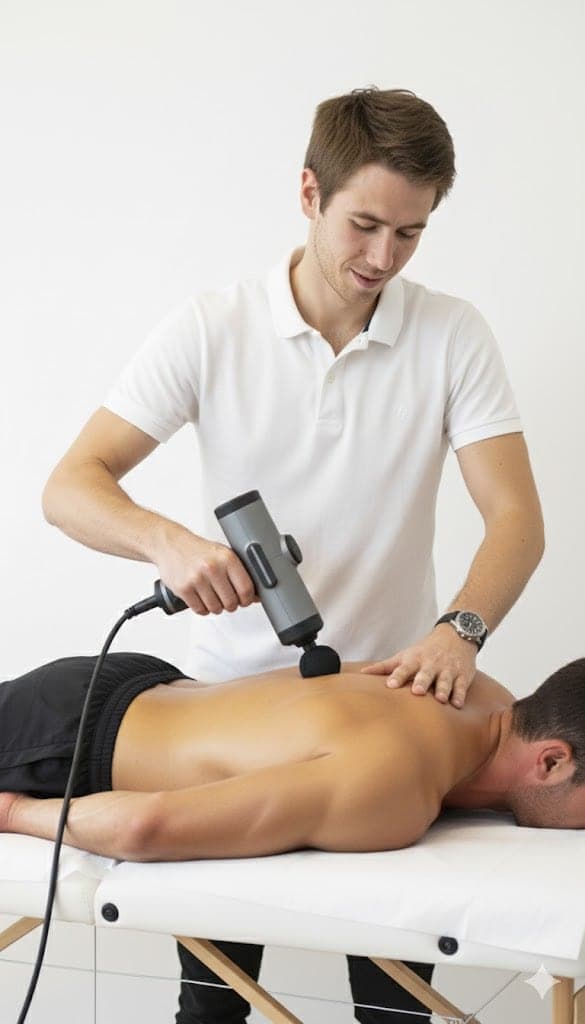
My approach uses a specialized mechanical tool that delivers what human hands and acupuncture needles simply cannot: sustained, precise pressure at the exact depth required to release chronic fascial adhesions and trigger points.
The Three Critical Advantages of Mechanical Precision
1. Depth and Penetration
Your deepest spinal stabilizers—the multifidus, rotatores, and intertransversarii muscles—lie beneath multiple layers of larger muscles. Acupuncture needles can reach these depths anatomically, but they can’t generate the mechanical force needed to release chronic tension. My specialized tool delivers consistent pressure through tissue layers, reaching dysfunction at its source.
I worked with a client last month—a 47-year-old accountant from Geroskipou who’d spent three months doing weekly acupuncture. When I assessed her, I found severe restrictions in her left quadratus lumborum and adhesions between her thoracolumbar fascia and underlying erector spinae. These structures were creating compensatory loading that radiated pain into her hip and down her lateral thigh.
Two sessions with targeted mechanical treatment released those restrictions completely. She’s now pain-free and has returned to hiking the Aphrodite Trail, something she couldn’t do for over a year.
2. Controlled Intensity
One of acupuncture’s limitations is that needle insertion is essentially binary—it’s either in or out. With mechanical treatment, I can adjust pressure with millimeter precision, gradually working deeper as tissue releases, matching exactly what your body can handle in that moment.
This is particularly crucial for chronic back pain, where protective muscle guarding is common. Push too hard too fast, and you trigger a defensive response that makes treatment counterproductive. I control intensity in real-time based on tissue response, something impossible with static needle placement.
3. Consistency Across Sessions
I’ll be blunt about something most acupuncturists won’t tell you: treatment quality varies significantly based on practitioner skill, energy level, and even their mood that day. I’ve eliminated this variable completely.
My mechanical tool delivers identical pressure, penetration, and precision every single session. You’re never getting an “off day” version of treatment. This consistency is essential for progressive tissue remodeling—you need reliable stimulus to achieve reliable adaptation.
The Clinical Protocol: How I Treat Back Pain in Geroskipou
When someone contacts me about their back pain, we don’t start with a standard massage routine. We start with a thorough biomechanical assessment.
Assessment Phase
I evaluate:
- Range of motion in flexion, extension, lateral flexion, and rotation
- Pain reproduction with specific loading patterns
- Palpable restrictions in soft tissue and fascial planes
- Compensatory patterns in adjacent regions (thoracic spine, hips, pelvis)
- Movement quality during functional tasks
This assessment tells me exactly where to focus treatment and what intensity progression to use. It’s objective, measurable, and specific to your unique dysfunction pattern.
Treatment Execution
Unlike acupuncture sessions where you lie passively while needles do their work, my treatments involve active participation and real-time feedback. I need you to tell me when I’ve reached the precise point of restriction, when release begins, and when we’ve achieved full resolution.
The mechanical tool allows me to:
- Apply sustained pressure to trigger points until they fully release
- Work along fascial planes to restore gliding motion between tissue layers
- Address compensatory tension in surrounding musculature
- Progressively increase depth as protective guarding decreases
Treatment isn’t comfortable—I won’t pretend it is. But it’s purposeful discomfort that produces measurable change, not pain for pain’s sake.
Progressive Tissue Remodeling
Here’s something critical that separates my approach from both acupuncture and standard massage: I’m not just releasing tension. I’m creating conditions for tissue remodeling and improved motor control.
After mechanical release, I guide clients through specific movement patterns that reinforce proper biomechanics. This neuromuscular re-education ensures you don’t immediately recreate the dysfunction that caused your pain in the first place.
Real Outcomes: What Lasting Relief Actually Looks Like
I measure success in objective terms. Can you bend forward without pain? Can you sit for your work day without stiffness? Can you return to sports or activities you’d stopped doing?
Last year, I worked with a competitive cyclist from Geroskipou who’d been battling lower back pain for eighteen months. He’d tried acupuncture, traditional massage, and various pain medications. Nothing provided lasting relief.
During assessment, I identified severe restrictions in his iliopsoas and rectus femoris—hip flexors that were pulling his pelvis into anterior tilt and creating excessive lumbar lordosis. This mechanical stress was generating constant compression in his lower lumbar segments.
We addressed the restrictions with four targeted sessions. I also modified his bike fit and taught him specific stretching protocols to maintain the changes. Six months later, he completed a 150-kilometer ride completely pain-free—something unthinkable before treatment.
The Economic Reality of Choosing Effective Treatment
Let’s talk honestly about investment versus expense. If you’re paying for acupuncture sessions every week or two, getting temporary relief but no lasting resolution, you’re spending money on symptom management, not problem-solving.
I’ve had clients who spent hundreds of euros over months of acupuncture before finally addressing the actual mechanical cause. That’s expensive, both financially and in terms of continued pain and reduced quality of life.
My treatment model is different. We work intensively to resolve the root dysfunction, then establish maintenance protocols you can manage independently. You’re investing in lasting resolution, not subscribing to indefinite symptom management.
Common Questions About Mechanical Treatment vs. Acupuncture
Is mechanical deep-tissue treatment painful?
It’s intense, particularly when working on chronic restrictions. But there’s a fundamental difference between therapeutic discomfort and harmful pain. I work within your tolerance while achieving the depth necessary for release. Most clients describe it as “hurts so good”—uncomfortable in the moment but immediately followed by improved mobility and reduced pain.
How many sessions does it typically take to resolve chronic back pain?
This depends entirely on how long you’ve had the problem and what caused it. Acute back pain from a recent injury might resolve in one to three sessions. Chronic pain from years of accumulated dysfunction typically requires four to eight sessions for complete resolution, with progressive improvement after each treatment.
Why don’t more therapists use mechanical tools instead of hands?
Honestly? Because it requires completely different training and challenges traditional massage paradigms. It’s also harder work—there’s no autopilot mode when you’re doing precise mechanical intervention. Most therapists train in relaxation-focused modalities because that’s what the market expects. I chose to specialize in results-focused biomechanical treatment because I saw the gap between what people needed and what was available.
Can I combine acupuncture with your treatment approach?
You can, but I haven’t found it necessary or beneficial. Adding acupuncture doesn’t enhance mechanical tissue release—it’s addressing a different theoretical framework. If someone wants to continue acupuncture for stress reduction or general wellness, that’s their choice, but for back pain resolution, the mechanical work stands alone.
Do you work with acute injuries or only chronic pain?
Both, but the approach differs. Acute injuries require careful assessment to rule out serious pathology, then gentle progressive loading to promote proper healing. Chronic pain often needs more aggressive intervention to break up long-standing adhesions and dysfunctional patterns.
What happens if the pain returns after treatment?
If we’ve truly resolved the mechanical cause, pain shouldn’t return unless you recreate the causative pattern—poor posture, overuse without adequate recovery, new injury, etc. Part of my protocol includes teaching you how to maintain the results through proper movement patterns and self-care. If pain does recur, it’s typically because we missed a contributing factor during assessment, which we then address in follow-up.
The Science Behind Mechanical Intervention for Back Pain
Let me ground this in evidence-based practice. While I won’t claim mechanical treatment has the extensive research base that acupuncture has accumulated (though much of that research shows equivocal results), the biomechanical principles I use are well-established in sports medicine and rehabilitation science.
| Mechanism | How It Works | Clinical Outcome |
|---|---|---|
| Fascial adhesion release | Sustained mechanical pressure breaks cross-links between collagen fibers | Restored tissue gliding and range of motion |
| Trigger point deactivation | Ischemic pressure disrupts sustained sarcomere contraction | Elimination of referred pain patterns |
| Mechanoreceptor stimulation | Deep pressure activates Golgi tendon organs and Ruffini endings | Reduced muscle tone and pain perception |
| Improved tissue perfusion | Release of compression allows restored blood flow | Enhanced healing and waste removal |
My background in physical education and nutrition from Norway emphasized understanding body mechanics at a fundamental level. I don’t just manipulate tissue—I understand the anatomical relationships, biomechanical forces, and physiological responses that determine treatment outcomes.
Why Precision Matters More Than Pressure Alone
There’s a common misconception that deep-tissue work is just “pushing harder.” That’s not only wrong, it’s potentially harmful. Effective mechanical intervention requires:
Accurate anatomical targeting: Knowing exactly which structure needs release and how to access it through overlying tissue layers.
Appropriate force vectors: Applying pressure in the direction that lengthens restricted fibers rather than compressing them laterally.
Progressive loading: Starting at tolerable intensity and increasing as tissue releases, rather than forcing through protective guarding.
Integration with movement: Combining mechanical release with active motion to reinforce new tissue length and motor patterns.
This level of precision is why I use a specialized mechanical tool rather than relying solely on hands. Human hands fatigue, shake, and can’t maintain consistent pressure for the duration required to fully release chronic restrictions. The machine provides unwavering precision for as long as needed.
What Makes Geroskipou Unique for Back Pain Treatment
Living and working in Geroskipou, I’ve observed patterns specific to this region. The combination of office work, tourist industry demands, and Cyprus’s car-dependent culture creates particular risk factors for lower back dysfunction.
Many residents spend hours daily in forward-flexed postures—hunched over computers, leaning into service work, or collapsed in car seats during commutes. This chronic flexion shortens hip flexors, weakens glutes and core stabilizers, and creates excessive load on the lumbar spine.
Add Cyprus’s heat, which can lead to dehydration affecting fascial tissue quality, and you have a perfect storm for developing chronic back pain.
Mobile Service: Professional Treatment at Your Location
I travel to your location with everything needed for professional treatment. This isn’t a compromise on quality—I bring the same specialized equipment and create the same clinical environment I would in a dedicated space.
Why this model? Because I’ve found that convenience isn’t just about comfort—it’s about compliance. When treatment is accessible and fits your schedule, you’re far more likely to complete the full protocol and achieve lasting results rather than dropping out after one or two sessions.
Making the Decision: Acupuncture or Mechanical Treatment?
I’m not here to demonize acupuncture. For some conditions and some people, it provides value. But for mechanical dysfunction causing chronic back pain, you need mechanical solutions.
If you’ve been cycling through temporary relief followed by recurring pain, it’s time to address the actual cause. My specialized approach isn’t for everyone—it requires commitment to the process, tolerance for intense treatment, and willingness to participate actively in your recovery.
But if you’re serious about lasting resolution rather than ongoing symptom management, if you want to understand exactly what’s wrong and how we’re fixing it, if you’re ready to invest in long-term health rather than indefinite maintenance—then this is the approach that will finally deliver results.
The Partnership Approach to Pain Resolution
I don’t offer single sessions or generic packages. We work together through a customized protocol based on your specific dysfunction, treatment response, and functional goals. This might mean four sessions for acute issues or eight sessions for complex chronic patterns, but every treatment builds on the previous one toward complete resolution.
You’ll learn exactly what caused your pain, how we’re correcting it, and how to maintain the results independently. That’s the definition of sustainable healthcare—empowering you with understanding and capability, not creating dependency on ongoing treatment.
Your Next Step Toward Lasting Back Pain Relief
After ten years of clinical practice and countless clients who finally found relief after years of searching, I can state this with absolute confidence: mechanical dysfunction requires mechanical treatment. Acupuncture for back pain in Geroskipou will continue to disappoint as long as the underlying biomechanical problems remain unaddressed.
The specialized tool I use delivers deeper penetration than hands, more consistent pressure than any manual technique, and adjustable intensity matched precisely to your tissue’s needs. Combined with my decade of experience and education in body mechanics, this approach resolves what others merely manage.
If you’re ready to stop managing symptoms and start resolving causes, if you’re ready to understand your body’s mechanics rather than just hoping needles will somehow fix it, then let’s talk about what’s actually going on in your back and how we’re going to fix it durably.
Your spine deserves precise, effective intervention based on biomechanical reality, not theoretical energy pathways. The question is whether you’re ready to invest in the approach that actually works.
Written by
Chris
Massage therapist & body mechanics specialist
Norwegian-certified with a Bachelor’s in Physical Education and Nutrition and over ten years of clinical practice, working from a portable table in clients’ homes across the Paphos district.
This article is general information from clinical practice, not a medical diagnosis. If you have severe, worsening or unexplained pain, numbness, weakness, or pain after an accident, see a doctor first.