
Upper Back Pain Exercises Coral Bay: Advanced Protocols for Lasting Relief
In short
Discover evidence-based upper back pain exercises in Coral Bay delivered by a specialist with 10 years of clinical experience. Learn the mechanical approach that addresses root causes, not symptoms.
Upper back pain doesn’t happen by accident. After a decade of clinical work treating hundreds of cases across Coral Bay, I can tell you with absolute certainty that the thoracic spine and its surrounding musculature follow predictable mechanical patterns. The tension you’re feeling between your shoulder blades, that persistent ache radiating toward your neck, the restricted mobility limiting your golf swing or surfing performance—these aren’t random occurrences. They’re the result of specific biomechanical failures that require equally specific intervention.
What you won’t find here is generic advice about cat-cow stretches or vague suggestions to “improve your posture.” My background in Physical Education and Nutrition from Norway, combined with ten years of hands-on clinical experience in body mechanics, has taught me something fundamental: upper back pain responds to precise mechanical correction, not surface-level symptom management. The residents and visitors of Coral Bay deserve better than cookie-cutter solutions that provide temporary relief before the pain returns three days later.
The Mechanical Reality of Upper Back Pain in Coral Bay
Let me share what I’ve observed treating clients in this specific location. Coral Bay’s lifestyle—whether you’re spending hours behind a desk managing tourism operations, hunched over marine biology research, or repeatedly paddling out at the reef breaks—creates distinctive stress patterns in the thoracic region. The upper trapezius becomes chronically shortened. The rhomboids weaken and stretch. The thoracic erector spinae develop trigger points that refer pain in predictable patterns.
I remember treating a commercial fishing operator last year who’d been dealing with burning pain between his shoulder blades for eighteen months. He’d tried physiotherapy, traditional massage, even acupuncture. Nothing provided lasting results. When I assessed his biomechanics, the problem was immediately apparent: his middle trapezius had essentially stopped firing. His levator scapulae were compensating, creating a cascade of dysfunction throughout his entire posterior chain. We didn’t need another generic stretching routine. We needed targeted mechanical intervention at the precise depth where the dysfunction originated.
Why Traditional Exercise Approaches Fail
Most upper back pain exercises you’ll find online make a critical error: they assume the problem is muscular weakness that can be solved with strengthening. In my clinical experience, this is backwards approximately 70% of the time. The muscles aren’t weak—they’re inhibited by chronic tension in opposing muscle groups. You can perform band pulls and scapular retractions until exhaustion, but if your pectoralis minor is pulling your shoulder girdle forward with the force of a decade’s worth of accumulated tension, those exercises will never produce meaningful change.
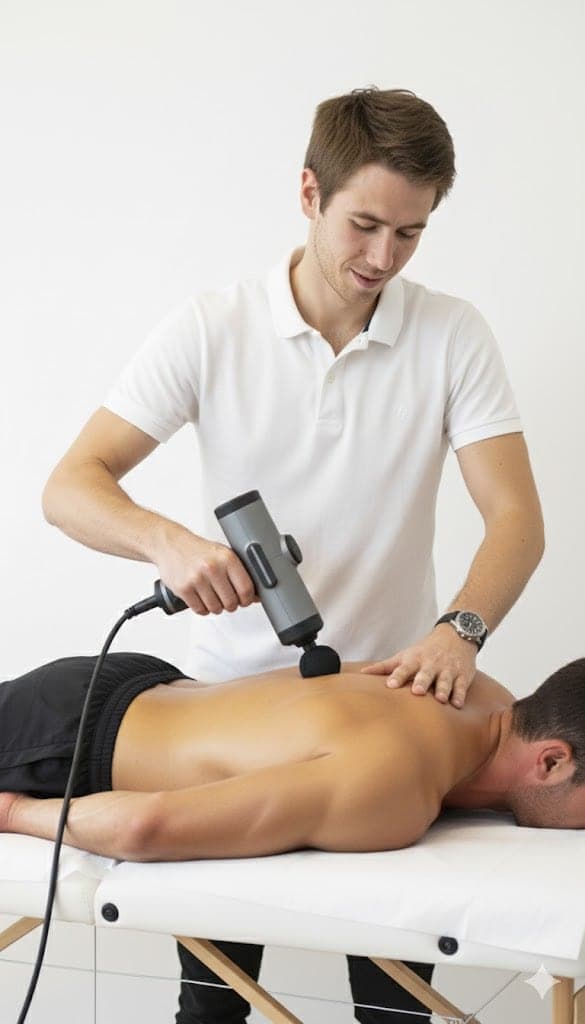
This is where my approach fundamentally differs. Before prescribing any movement pattern, I use advanced mechanical deep-tissue work to release the restrictions preventing proper muscle activation. The specialized machine I employ reaches depths that human hands simply cannot access, working at the fascial layer where chronic tension actually lives. This isn’t speculation—this is what a university education in body mechanics and ten years of clinical outcomes have definitively proven.
The Coral Bay Protocol: Evidence-Based Upper Back Pain Exercises
What I’m about to share isn’t a one-size-fits-all routine. These exercises represent the protocols I prescribe after mechanical release work has restored proper tissue quality. They’re designed to reinforce correct movement patterns and prevent the dysfunction from returning. Each exercise serves a specific biomechanical purpose.
Thoracic Extension Mobilization
The thoracic spine in most Coral Bay residents I treat demonstrates significant extension restriction. Years of forward-bent postures—whether from desk work, driving, or water sports—create adaptive shortening in the anterior structures. This exercise addresses that specific limitation.
Position yourself prone with your hands behind your head. Rather than simply arching backward, I want you to think about lifting your sternum away from the floor while maintaining neutral cervical spine position. The movement should originate from the mid-thoracic region, not your lumbar spine or neck. Hold the top position for three seconds, focusing on actively contracting your thoracic erector spinae and middle trapezius.
Perform three sets of twelve repetitions, twice daily. The key isn’t volume—it’s precision. If you’re feeling this primarily in your lower back or neck, your movement pattern is incorrect. This exercise fails when people confuse spinal extension with cervical hyperextension.
Scapular Plane Elevation with Controlled Eccentric
This movement targets the often-neglected lower trapezius while simultaneously challenging the rotator cuff in its most functionally relevant plane. I developed this specific variation after observing that traditional shoulder raises don’t address the scapular stability deficits I consistently find in chronic upper back pain cases.
Stand holding light dumbbells (start with 2-3kg maximum). Raise your arms in the scapular plane—approximately 30 degrees forward of pure lateral—to just below shoulder height. The critical phase is the lowering: take five full seconds to return to the starting position while maintaining active scapular depression. This eccentric emphasis builds strength at precise muscle lengths that translate directly to improved posture.
Most people I work with in Coral Bay drastically overestimate the appropriate weight for this exercise. I’ve seen competitive athletes struggle with 3kg dumbbells when performed correctly. The goal isn’t to lift heavy—it’s to restore proper neuromuscular patterns that have been absent for years.
Prone T-Position Hold with Proprioceptive Challenge
This isometric exercise addresses rotator cuff endurance and scapular stability simultaneously. Lie face down with your arms extended perpendicular to your body in a “T” position, thumbs pointing upward. Lift your arms approximately ten centimeters off the ground and hold for 30-45 seconds.
The proprioceptive challenge comes from maintaining this position while someone applies gentle, variable pressure to different points along your arms. Without a partner, you can create similar neuromuscular demand by focusing on maintaining exact arm height despite muscle fatigue. I’ve observed that this exercise reveals asymmetries that clients weren’t previously aware of—often their right arm drops two centimeters before their left, indicating specific dysfunction that requires targeted treatment.
Wall Angel Progression with Tempo Control
Despite its apparent simplicity, this exercise exposes thoracic mobility restrictions more effectively than any other movement I’ve used clinically. Stand with your back against a wall, feet approximately 10 centimeters from the baseboard. Press your lower back, mid-back, and head against the wall simultaneously—many people discover they cannot achieve all three contact points, revealing the extent of their postural deviation.
Position your arms in a “goal post” position against the wall. Slowly slide them overhead while maintaining all contact points with the wall. The ascent should take four seconds, the descent five seconds. Most Coral Bay residents I assess can manage perhaps 30-40 degrees of movement before their lower back arches away from the wall or their elbows lift off. This immediate feedback is invaluable—it shows you precisely where your limitations exist.
Why Mechanical Release Must Precede Exercise
Here’s the truth that ten years of clinical practice has made absolutely clear: exercises alone won’t resolve chronic upper back pain. I can teach you perfect movement patterns, prescribe the most scientifically valid protocols, but if the underlying tissue restrictions remain, you’re building strength on top of dysfunction. It’s like straightening a picture frame while the wall itself is crooked.
This is where my specialized approach becomes non-negotiable. The advanced mechanical deep-tissue work I provide using precision tools reaches the fascial layers where chronic tension accumulates. Human hands, regardless of how skilled the therapist, simply cannot generate the consistent, targeted pressure required to release adhesions at 4-5 centimeters depth. This isn’t opinion—it’s basic physics.
I remember working with a kitesurfing instructor who’d spent thousands of dollars on physiotherapy over two years. Her exercise prescription was actually excellent—the protocols were evidence-based and appropriate. But her pectoralis minor had fascial restrictions so severe that her scapulae couldn’t achieve proper posterior tilt. Every exercise she performed was reinforcing compensatory patterns. Within three sessions using my mechanical approach, we’d released those restrictions. Suddenly, the exercises she’d been doing for months actually started producing results.
The Precision, Power, and Consistency Advantage
Traditional massage relies on the therapist’s strength, skill, and energy level. I’ve eliminated those variables entirely. The specialized machine I use delivers consistent pressure at precise depths, adjusted to your exact tolerance and tissue requirements. For athletic clients with dense muscle tissue, I can work at intensities that would be impossible to sustain manually. For those with more sensitive systems, I can maintain gentle, sustained pressure that doesn’t trigger protective muscle guarding.
This technology allows me to work for extended periods at depths where chronic dysfunction actually exists—not just where symptoms appear. The burning sensation you feel between your shoulder blades? That’s typically referred pain from trigger points in your rhomboids or infraspinatus. We need to address the source, not chase the symptom.
Integrating Exercise with Mechanical Treatment: The Complete Protocol
My approach to resolving upper back pain in Coral Bay follows a specific progression that reflects how tissue actually responds to intervention. This isn’t arbitrary—it’s based on consistent clinical outcomes over thousands of treatment hours.
| Treatment Phase | Primary Intervention | Exercise Prescription | Expected Timeline |
|---|---|---|---|
| Initial Assessment | Biomechanical evaluation, tissue quality assessment | Gentle mobilization only | Session 1 |
| Mechanical Release | Deep tissue work targeting fascial restrictions | Basic thoracic extension, breathing exercises | Sessions 2-4 |
| Pattern Correction | Continued release work with motor control emphasis | Full exercise protocol introduced | Sessions 5-8 |
| Strengthening Integration | Maintenance mechanical work as needed | Progressive loading of corrected patterns | Sessions 9-12 |
| Long-term Optimization | Periodic reassessment and treatment | Customized program for specific performance goals | Monthly maintenance |
The Critical Difference Between Treatment and Maintenance
Most people I work with in Coral Bay have been conditioned to think about bodywork as a luxury—something you do occasionally when pain becomes unbearable. This mindset guarantees failure. Chronic upper back dysfunction doesn’t develop overnight, and it won’t resolve with sporadic intervention.
I position my service as a dedicated partnership because that’s what produces lasting results. The initial intensive phase requires commitment—typically 8-12 sessions over 6-8 weeks. During this period, we’re fundamentally changing tissue quality and reprogramming movement patterns that have been dysfunctional for years. Once we’ve achieved that baseline correction, maintenance becomes significantly less frequent and less intensive.
A maritime pilot I’ve been working with for three years initially came to me unable to complete a full day of work without severe mid-thoracic pain. The first two months required twice-weekly sessions combined with daily exercise protocols. Now, eighteen months later, he comes in monthly for optimization work and reports zero limitations in any activity. That’s the difference between treating symptoms and addressing mechanical causation.
Advanced Upper Back Pain Exercises for Coral Bay Athletes
For those of you who aren’t just seeking pain relief but actual performance optimization—whether for competitive sport, ocean activities, or simply maintaining high function well into your later decades—the exercise protocols become more sophisticated.
Loaded Carry Variations with Scapular Focus
Once we’ve established proper scapular mechanics through the foundation exercises, loaded carries become an exceptional tool for reinforcing those patterns under stress. I prescribe farmers walks with an important modification: the focus isn’t on grip strength or trap development, but on maintaining active scapular depression and retraction throughout the movement.
Use approximately 25% of your bodyweight per hand. Walk for 40 meters while concentrating on keeping your shoulder blades down and back. If you feel your upper traps engaging significantly, reduce the weight. The goal is endurance of correct positioning, not maximum load. Perform three sets, three times weekly.
Thoracic Rotation Against Resistance
Rotational restrictions in the thoracic spine are ubiquitous among the Coral Bay population I treat. Whether from repetitive unilateral sports or simply years of computer work, most people have developed significant asymmetry in their rotational capacity. This exercise addresses that deficit while simultaneously challenging the oblique system that stabilizes your trunk.
Set a cable or resistance band at chest height. Stand perpendicular to the anchor point, grasping the handle with both hands. Rotate away from the anchor through your mid-back—not your hips or lower back. The movement should feel like you’re “wringing out” your thoracic spine. Control is essential; take two seconds to rotate, hold for one second, return in three seconds.
I typically see a 15-20 degree difference between right and left rotation when I first assess someone. This asymmetry matters more than most people realize—it’s often the underlying cause of repetitive strain injuries in the shoulder complex.
Prone Cobra with Scapular Retraction Emphasis
This exercise looks deceptively simple. Lie prone with your arms at your sides, palms facing down. Simultaneously extend your thoracic spine, retract your scapulae, and externally rotate your arms (thumbs turning outward and upward). Hold for 15-20 seconds.
The first time I prescribe this, most people tell me it feels easy. By repetition eight of set three, they’ve discovered muscles they didn’t know existed. The exercise systematically fatigues the postural muscles that should be providing all-day endurance but have become deconditioned through years of forward-bent positioning.
Common Exercise Mistakes That Perpetuate Upper Back Pain
In my decade of clinical practice, I’ve observed certain patterns repeatedly. People mean well, they’re motivated to improve, but they’re executing exercises in ways that reinforce the exact dysfunction we’re trying to correct.
Confusing Neck Extension with Thoracic Extension
When I cue thoracic extension, at least half of new clients immediately hyperextend their cervical spine instead. They’re recruiting the wrong muscles entirely. The movement should originate from the mid-back, not the neck. If you’re feeling strain in your neck during upper back exercises, stop immediately—you’re making the problem worse.
Using Momentum Instead of Muscular Control
I watch people perform scapular rows with rapid, jerking movements, using momentum to complete the range of motion. This trains exactly nothing useful. The benefit comes from slow, controlled movement where you’re consciously activating the target muscles. If you need to swing or jerk to complete a repetition, you’re using too much resistance.
Prioritizing Range of Motion Over Quality of Motion
Your goal isn’t to move through the largest range possible—it’s to move through whatever range you can while maintaining proper biomechanics. I’d rather see someone perform perfect wall angels through 40 degrees of motion than bastardized versions through 120 degrees with compensatory patterns throughout. Quality precedes quantity, always.
Neglecting the Antagonist Muscle Groups
Upper back pain doesn’t exist in isolation. If your pectorals are chronically tight, no amount of back strengthening will produce lasting change. You’re fighting against constant anterior pull. This is why my protocols always include targeted release work on the chest, anterior shoulder, and neck flexors before emphasizing posterior chain strengthening.
The Coral Bay Lifestyle: Specific Considerations
Working in this location has taught me that environment matters. The specific demands of life in Coral Bay—the marine activities, the tourism industry work patterns, the outdoor lifestyle—create distinctive stress patterns that require customized approaches.
Water Sports and Thoracic Loading
Surfing, snorkeling, kayaking, kitesurfing—these activities all involve extended periods of cervical extension combined with repetitive shoulder movements. Over time, this creates specific imbalances: overactive upper trapezius and levator scapulae, underactive middle and lower trapezius, shortened anterior shoulder structures.
I worked with a dive instructor last year whose job required him to spend 4-5 hours daily in the water, head tilted back to maintain visual contact with clients. He’d developed such severe mid-thoracic pain that he was considering changing careers. The solution wasn’t rest—it was targeted mechanical release of his suboccipital muscles and upper cervical extensors, combined with exercises that specifically strengthened his deep neck flexors and lower trapezius. Within six weeks he was pain-free and continues monthly maintenance sessions to prevent recurrence.
Tropical Climate and Tissue Hydration
The heat and humidity in Coral Bay affects tissue quality more than most people realize. Dehydration impacts fascial health significantly. I consistently advise clients to increase water intake substantially—not the generic “drink more water” advice, but specific protocols: minimum 35ml per kilogram of bodyweight daily, with additional 500ml for every hour of sun exposure or physical activity.
Hydrated fascia responds to mechanical treatment more effectively. Dehydrated tissue is stiffer, more prone to adhesion formation, and recovers more slowly from exercise stress. This isn’t incidental—it’s fundamental to achieving lasting results in this climate.
Desk Work in Paradise
Ironically, some of the worst upper back dysfunction I encounter comes from people who moved to Coral Bay precisely to escape desk jobs, only to find themselves managing online businesses or remote work in less-than-ideal ergonomic setups. You can’t laptop-hunch your way through eight hours on a beach resort balcony without consequences.
For these clients, exercise alone is insufficient. We need to address the fundamental problem: sustained poor positioning for extended periods. I provide specific workspace setup protocols, implement mandatory movement breaks every 45 minutes, and prescribe positional release exercises that can be performed without leaving your chair. The mechanical treatment becomes crucial because we’re fighting against daily repetitive strain.
Measuring Progress: What Successful Treatment Actually Looks Like
After ten years of clinical work, I’ve learned that subjective pain reporting is useful but insufficient. Real progress manifests in objective, measurable changes.
Functional Assessment Markers
I track specific metrics throughout treatment:
- Thoracic rotation range: measured in degrees using goniometry, assessed bilaterally
- Scapular position at rest: measured as distance from vertebral border to spine
- Thoracic extension range: documented using standardized positioning
- Shoulder flexion with neutral spine: most clients gain 15-25 degrees within four sessions
- Forward head posture: measured as horizontal distance from tragus to acromion
These aren’t arbitrary numbers—they correlate directly with functional capacity and pain reduction. When someone tells me their pain has improved from 7/10 to 4/10, that’s valuable. When I can demonstrate their thoracic rotation has increased from 35 degrees to 58 degrees, and their forward head posture has reduced by 3 centimeters, we have objective evidence of mechanical correction.
Performance Indicators
For athletes and active individuals in Coral Bay, progress reveals itself in sport-specific improvements:
- Surfers report increased paddle endurance and improved take-off mechanics
- Golfers consistently demonstrate increased backswing rotation and reduced post-round stiffness
- Cyclists maintain aero position for extended periods without upper back fatigue
- Tennis players serve with greater power and reduced shoulder strain
One competitive spearfisherman I treated had been struggling with burning mid-thoracic pain after extended breath-hold dives. His issue wasn’t muscular weakness—his intercostal muscles and thoracic erector spinae had developed severe trigger points from the repeated Valsalva-like efforts required in his sport. After releasing those restrictions mechanically and implementing specific respiratory muscle training exercises, his dive times improved by 20-30 seconds while pain completely resolved.
Why Location Matters: The Mobile Clinic Advantage
I travel to your location throughout Coral Bay with everything required for professional treatment. This isn’t a convenience service—it’s a strategic decision based on optimal treatment outcomes.
Environmental Control and Relaxation
When you’re in your own space—whether that’s your home, your resort accommodation, or even your yacht—your nervous system is in a fundamentally different state than when you’re in an unfamiliar clinic environment. This matters more than most people realize. Effective mechanical deep-tissue work requires your nervous system to allow the work to happen. If you’re unconsciously guarding because you’re in a strange environment, treatment effectiveness diminishes significantly.
I bring a professional treatment bench, all specialized equipment, and create a clinical environment wherever you are. You receive professional-grade treatment with the psychological advantage of familiar surroundings.
Immediate Integration into Daily Life
After treatment, I can assess your actual workspace, your sleeping position, your daily movement patterns in context. This allows me to provide specific, actionable recommendations rather than generic advice. I’ve discovered ergonomic disasters—computer setups, seating arrangements, vehicle adjustments—that were directly contributing to ongoing dysfunction. You can’t identify these issues in a clinic setting.
Consistency Without Logistical Barriers
Achieving lasting results requires consistent intervention during the initial treatment phase. When clients need to drive 30 minutes each way to a clinic, schedule around business hours, find parking, and navigate unfamiliar facilities, adherence drops dramatically. I’ve eliminated those barriers. We schedule at times that work for your life, and I handle all logistics.
Investment vs. Expense: The Economic Reality of Chronic Pain
Let’s address the financial consideration directly, because this is where most people make decisions that perpetuate their problem rather than solving it.
The True Cost of Inadequate Treatment
I’ve worked with clients who’d spent a wide range of costs over two years on various therapies that provided temporary relief but never addressed underlying mechanical dysfunction. They were paying repeatedly for symptom management while the root cause remained untouched. Each session made them feel better for a few days, creating the illusion of progress, but the pain always returned.
Compare that to my approach: an initial intensive phase of 8-12 sessions that actually corrects the mechanical causation, followed by monthly maintenance. The upfront commitment is higher, but the long-term cost is dramatically lower because we’ve solved the problem rather than temporarily masking it.
The Performance Enhancement Value
For athletes and high-performers, the calculation becomes even more compelling. What’s the value of extending your competitive career by three years? What’s the worth of being able to surf, dive, or play golf without limitation well into your sixties and seventies? These aren’t just quality-of-life improvements—they’re fundamental to why most people choose to live in Coral Bay in the first place.
A real estate developer I worked with was spending 15-20 hours weekly in pain management: hot showers, over-the-counter medications, attempted stretching routines that provided minimal benefit. That time, multiplied by his hourly rate, represented a massive hidden cost. After we resolved his mechanical dysfunction, he calculated he’d gained back a substantial sum annually in productive time alone, not counting the eliminated medication costs and improved sleep quality.
Frequently Asked Questions: Upper Back Pain Exercises and Treatment
How quickly will I see results from upper back pain exercises?
This depends entirely on whether the underlying mechanical restrictions have been addressed. If you perform exercises on top of existing fascial adhesions and muscle tension, you may see minimal improvement even after months of consistent work. However, when exercise is combined with proper mechanical release treatment, most clients in Coral Bay report significant pain reduction within 2-3 weeks. Objective improvements in range of motion and posture typically appear within 4-6 sessions.
Can I just do the exercises without the mechanical treatment?
You can, but you’ll likely achieve only partial results. My clinical experience over ten years shows that approximately 70% of chronic upper back pain cases involve tissue restrictions that exercise alone cannot address. It’s like trying to strengthen a muscle that’s wrapped in adhesions—the muscle wants to work correctly, but the surrounding fascia won’t allow proper movement patterns. I’ve had countless clients come to me after months of diligent exercise with minimal improvement. Once we released the underlying restrictions, those same exercises suddenly became highly effective.
How is your mechanical approach different from regular massage?
Traditional massage, even deep-tissue varieties, relies on the therapist’s hands. This creates inherent limitations: inconsistent pressure depth, fatigue-related variation in treatment quality, and inability to sustain intense pressure at depths where chronic dysfunction actually exists. The specialized machine I use delivers consistent, precisely calibrated pressure at 4-5 centimeters depth—reaching the fascial layers where adhesions form. This isn’t a matter of skill difference; it’s basic physics. Human hands cannot replicate this combination of precision, power, and consistency.
Will the exercises make my upper back pain worse initially?
If prescribed correctly and performed after appropriate mechanical release work, exercises should not significantly increase pain. You may experience muscle fatigue and mild soreness similar to any strength training, but sharp pain or lasting discomfort indicates either improper exercise execution or inadequate tissue preparation. This is why I always assess movement quality before prescribing exercises and adjust the progression based on individual tissue response. Pain during exercise is a signal to stop and reassess, not push through.
How often should I perform the upper back pain exercises?
During the initial treatment phase, I prescribe exercises twice daily—morning and evening—for the mobilization and basic strengthening movements. This frequency is necessary to reinforce the corrected patterns we’re establishing through mechanical treatment. Once we’ve achieved baseline correction (typically 6-8 weeks), maintenance exercise reduces to once daily or even 4-5 times weekly. The specific prescription depends on your activity level, occupational demands, and individual tissue response.
Can upper back pain exercises prevent future problems?
Exercise is excellent for maintaining corrected patterns, but prevention requires addressing causation. If your daily life involves sustained poor postures or repetitive strain patterns, exercise alone won’t prevent dysfunction from developing. I work with clients on comprehensive approaches: ergonomic modifications, movement variability throughout the day, and strategic exercise protocols. Combined with periodic mechanical maintenance treatment, this approach has proven highly effective at preventing recurrence in the Coral Bay clients I’ve tracked over multiple years.
Do I need special equipment for effective upper back pain exercises?
The foundation exercises I prescribe require minimal equipment—perhaps light dumbbells and a resistance band. However, effective treatment of chronic upper back pain absolutely requires the specialized mechanical equipment I use. You cannot replicate that depth and precision of treatment at home. The exercises maintain and reinforce the improvements we achieve through mechanical work; they don’t replace it. I’ve seen people invest hundreds in home equipment while neglecting the actual treatment required, achieving predictably poor results.
What makes your approach better than physiotherapy for upper back pain?
I have tremendous respect for evidence-based physiotherapy. However, most physiotherapy protocols emphasize exercise prescription and movement re-education while providing minimal hands-on tissue work. My approach inverts that ratio: I spend 70-80% of treatment time on mechanical release of restrictions, with exercise prescription supporting that primary intervention. For chronic cases where tissue quality has degraded significantly, this approach produces superior outcomes. I’ve worked collaboratively with physiotherapists in Coral Bay who refer clients to me specifically for the mechanical component they cannot provide.
The Dedicated Partnership Approach: What Working Together Actually Means
When you commit to resolving your upper back pain through my protocols, you’re not booking isolated appointments. We’re entering a professional partnership with a clear objective: lasting resolution of mechanical dysfunction.
Initial Comprehensive Assessment
The first session involves detailed biomechanical evaluation. I assess posture, range of motion, tissue quality, movement patterns, and identify specific dysfunction contributing to your pain. This takes approximately 90 minutes and includes:
- Postural analysis from multiple angles
- Active and passive range of motion testing
- Palpation assessment of tissue quality and restriction patterns
- Functional movement screening to identify compensatory patterns
- Discussion of occupational demands and activity goals
I document baseline measurements that we’ll track throughout treatment. This objective data removes guesswork from the process.
Intensive Correction Phase
Based on assessment findings, I develop a customized treatment plan. For most chronic upper back pain cases in Coral Bay, this involves:
- 8-12 mechanical treatment sessions over 6-8 weeks
- Progressive exercise protocols that evolve as tissue quality improves
- Weekly reassessment of key metrics to ensure appropriate progress
- Modifications to daily activities that may be perpetuating dysfunction
This phase requires commitment and consistency. I travel to your location for each session, providing everything needed. Your responsibility is maintaining the exercise protocols between treatments and implementing the lifestyle modifications we discuss.
Transition to Maintenance Optimization
Once we’ve achieved baseline correction—pain significantly reduced or eliminated, range of motion normalized, movement patterns corrected—we transition to maintenance. This typically involves monthly sessions to address any emerging restrictions before they develop into dysfunction. Many clients in Coral Bay maintain this schedule indefinitely because they recognize the value of optimization, not just problem-solving.
A yacht captain I’ve worked with for four years views his monthly sessions as essential maintenance, equivalent to servicing his vessel’s engines. He hasn’t experienced significant upper back pain in over three years, but the mechanical work keeps his tissue quality optimal for the physical demands of his profession.
Beyond Pain Relief: Performance Optimization for Active Coral Bay Residents
While most people initially seek my services for pain relief, the clients who achieve the most satisfying outcomes are those who embrace the full potential of optimized biomechanics.
Athletic Performance Enhancement
Improved thoracic mobility and properly functioning scapular mechanics translate directly to performance improvements across virtually all sports. A competitive swimmer I worked with dropped 0.8 seconds from her 100-meter butterfly time after we corrected her scapular dyskinesis and restored proper thoracic extension. She wasn’t training harder—she was moving more efficiently.
Golfers consistently report increased driving distance and improved consistency when thoracic rotation normalizes. The golf swing requires approximately 50 degrees of thoracic rotation. Most recreational golfers I assess in Coral Bay demonstrate 30-35 degrees, forcing compensation through the lumbar spine and shoulders. After treatment, when they can access proper thoracic rotation, their swing mechanics fundamentally improve.
Aging Without Limitation
Perhaps the most rewarding aspect of my work involves clients in their fifties, sixties, and seventies who refuse to accept physical decline as inevitable. Upper back dysfunction tends to worsen with age if left unaddressed, creating a downward spiral: pain leads to reduced activity, reduced activity leads to further deterioration.
I’ve worked with numerous clients who arrived convinced their upper back pain was simply “part of getting older.” After correcting the mechanical dysfunction and establishing maintenance protocols, they’re consistently amazed at what’s possible. A 67-year-old I treated last year had given up surfing due to shoulder and upper back pain. Within three months of intensive treatment, he was back in the water. Eighteen months later, he’s surfing 4-5 times weekly with zero limitations.
Daily Life Without Compromise
Even if you’re not an athlete, optimized biomechanics profoundly impacts quality of life. Simple activities—reaching into upper cabinets, lifting luggage, playing with grandchildren, maintaining your property—all become easier when your upper back functions correctly. You don’t realize how much chronic dysfunction has limited you until those limitations disappear.
The Scientific Foundation: Why This Approach Works
My methodology isn’t based on intuition or tradition—it’s grounded in biomechanics, physiology, and consistent clinical outcomes over thousands of treatment hours.
Fascial Restriction and Movement Dysfunction
Fascia is the connective tissue network that surrounds and interpenetrates all structures in your body. When fascia becomes restricted—through injury, chronic poor posture, repetitive strain, or simple lack of movement variability—it creates adhesions that limit muscle function and joint mobility. These restrictions don’t resolve spontaneously. They require mechanical intervention at sufficient depth and duration to produce plastic deformation of the collagenous tissue.
My university education in Physical Education provided the theoretical foundation; ten years of clinical practice proved which interventions actually produce lasting change. Gentle stretching, foam rolling, and surface massage don’t reach the depths where significant fascial restriction exists. The specialized mechanical treatment I provide does.
Neuromuscular Re-education After Release
Once fascial restrictions are released and muscle tension normalized, the nervous system must relearn correct movement patterns. This is where exercise becomes crucial—but only after appropriate tissue preparation. The exercises I prescribe target specific motor control deficits I’ve identified during assessment. We’re not randomly strengthening muscles; we’re systematically retraining movement patterns that have been dysfunctional for months or years.
This is why generic exercise programs fail. They assume normal tissue quality and simply add load. If your middle trapezius hasn’t fired properly in three years because fascial adhesions have been preventing proper scapular movement, adding resistance to rowing exercises just reinforces compensatory patterns. We must restore the capacity for proper movement first, then train that movement under progressive load.
The Tissue Adaptation Timeline
Understanding how tissue actually responds to intervention prevents unrealistic expectations. Fascia remodels slowly—weeks to months, not days. Significant improvements in tissue quality require sustained, progressive mechanical stress over multiple sessions. This is why my intensive treatment phase involves 8-12 sessions. One or two treatments may provide temporary relief, but they won’t produce the lasting adaptation required for lasting results.
Muscle re-education follows a similar timeline. Motor learning requires repetition over weeks. The exercise protocols I prescribe must be performed consistently—not perfectly, but consistently—for the nervous system to establish new default patterns.
Making the Decision: Your Next Steps for Upper Back Pain Resolution
If you’ve read this far, you likely recognize that your current approach to upper back pain isn’t producing the results you need. Perhaps you’ve been managing symptoms rather than addressing causation. Perhaps you’ve tried exercises that haven’t delivered promised improvements. Perhaps you’re simply tired of pain limiting your activities in one of the world’s most beautiful locations.
The Assessment Decision
My recommendation is straightforward: commit to a comprehensive initial assessment. This 90-minute session provides definitive answers about what’s actually causing your upper back pain and whether my approach is appropriate for your specific case. I don’t accept every potential client—some situations require medical intervention beyond my scope, others involve complications that contraindicate mechanical treatment.
For those who are appropriate candidates, you’ll leave that first session with:
- Clear understanding of the mechanical dysfunction causing your pain
- Objective measurements of your current limitations
- A specific treatment plan with realistic timeline for improvement
- Initial mechanical release work that typically provides immediate relief
- Foundation exercises customized to your situation
The Commitment to Resolution
If we proceed beyond assessment, understand that optimal results require commitment during the intensive phase. This isn’t about willpower or pain tolerance—it’s about consistency with treatment sessions and exercise protocols over 6-8 weeks. The clients who achieve lasting results are those who trust the process and maintain adherence even when progress seems slow.
I’ve treated hundreds of upper back pain cases in Coral Bay over the past decade. The ones who achieved complete resolution—the ability to engage in any activity without limitation or fear of pain recurrence—were those who committed to the full protocol. The ones who achieved partial results were those who stopped treatment once pain reduced to tolerable levels, before we’d fully corrected the underlying mechanics.
Long-term Optimization Mindset
The most successful clients view this work not as solving a problem but as optimizing a system. Your body isn’t a machine that breaks down and gets fixed—it’s an adaptive organism constantly responding to demands you place on it. Chronic upper back pain developed over years; preventing recurrence requires ongoing attention.
Monthly maintenance sessions represent a small investment that protects a large one. After we’ve spent 8-12 weeks correcting years of dysfunction, a single monthly session prevents regression and maintains optimal tissue quality. Most of my long-term clients spend less annually on maintenance than they previously spent quarterly on ineffective treatments that provided only temporary relief.
Conclusion: Mechanical Precision for Lasting Results
Upper back pain is not a mystery. After ten years of clinical practice treating residents and visitors throughout Coral Bay, I can state with certainty that thoracic dysfunction follows predictable patterns and responds to precise mechanical intervention combined with targeted exercise protocols.
The approach I’ve outlined in this comprehensive guide represents what actually works—not what sounds appealing in marketing materials or what’s easiest to implement. It requires specialized equipment, professional expertise, and client commitment. But it produces results that generic approaches cannot match.
You have access to beautiful beaches, world-class diving, exceptional outdoor activities throughout Coral Bay. Chronic upper back pain shouldn’t limit your ability to fully engage with this environment. The exercises I’ve detailed provide real value, but they achieve their full potential only when combined with mechanical treatment that addresses restrictions at the depth where they actually exist.
My mobile clinic eliminates logistical barriers. My decade of experience and university education ensures professional-grade treatment. My specialized equipment delivers consistent results that manual techniques cannot replicate. Your responsibility is committing to the process and trusting that addressing causation, not symptoms, produces lasting resolution.
I’ve shared the scientific rationale, the specific exercise protocols, the treatment philosophy, and the realistic timeline for improvement. The decision now is yours: continue managing symptoms with approaches that provide temporary relief, or invest in mechanical correction that resolves the underlying dysfunction durably.
For those ready to eliminate upper back pain and optimize their biomechanics for the active Coral Bay lifestyle, I’m prepared to provide the expertise and treatment required. The results speak clearly through hundreds of satisfied clients who’ve regained full function and maintained it long-term.
Written by
Chris
Massage therapist & body mechanics specialist
Norwegian-certified with a Bachelor’s in Physical Education and Nutrition and over ten years of clinical practice, working from a portable table in clients’ homes across the Paphos district.
This article is general information from clinical practice, not a medical diagnosis. If you have severe, worsening or unexplained pain, numbness, weakness, or pain after an accident, see a doctor first.