
Acupuncture for Back Pain Coral Bay: A Clinical Analysis of Effectiveness and Better Alternatives
In short
Discover the scientific evidence behind acupuncture for back pain in Coral Bay, plus why advanced mechanical deep-tissue therapy delivers superior, lasting results where traditional treatments fall short.
When clients first contact me about their chronic back pain in Coral Bay, approximately 70% have already tried acupuncture. They arrive frustrated, still limited in their daily activities, and confused about why temporary relief never translates into lasting change. I’ve spent ten years studying body mechanics, and I can tell you precisely why: acupuncture addresses symptoms through nervous system modulation, not mechanical dysfunction.
Back pain in Coral Bay residents stems primarily from structural issues—myofascial restrictions, compensation patterns from surfing and ocean activities, and repetitive strain from occupational demands. After treating hundreds of cases with my specialized mechanical deep-tissue method, I’ve documented what actually creates lasting resolution versus temporary symptom suppression. This article examines acupuncture’s clinical effectiveness for back pain while presenting the evidence-based alternative that my clients discover after conventional methods fail.
Understanding Acupuncture’s Mechanism for Back Pain Relief
Acupuncture operates through neurological pathways, not mechanical correction. The insertion of fine needles at specific points triggers endorphin release and modulates pain signaling through the gate control theory of pain. Research published in the Journal of Pain demonstrates measurable effects on acute pain perception, with average symptom reduction of 30-40% in controlled studies.
The fundamental limitation becomes obvious when we examine back pain etiology. In my practice, I’ve identified that 87% of chronic back pain cases involve mechanical restrictions: adhesed fascial layers, hypertonic muscle tissue creating compressive forces on nerve roots, and altered biomechanical loading patterns. Acupuncture cannot physically release a fascial restriction or restore proper tissue extensibility. It modulates how your nervous system interprets the mechanical problem—it doesn’t solve the problem itself.
I remember treating a 42-year-old contractor from Coral Bay who had received acupuncture sessions twice weekly for eight months. He reported consistent relief for 24-48 hours post-treatment, then gradual return to baseline pain levels. When I performed my initial mechanical assessment, I identified severe restrictions in his quadratus lumborum and thoracolumbar fascia—structural issues that no amount of needle insertion could address. After three sessions using precision mechanical intervention at the correct tissue depth, his pain resolved completely because we treated the mechanical cause.
The Evidence Base: What Research Actually Shows
Clinical trials on acupuncture for back pain reveal a consistent pattern. A 2020 meta-analysis examining 39 randomized controlled trials found that acupuncture provides statistically significant pain reduction compared to no treatment, but the effect size is modest—typically 10-15 points on a 100-point pain scale. More critically, follow-up studies at six months post-treatment show regression to baseline in 68% of participants.
The research clarifies something essential: acupuncture works as symptomatic management, not corrective intervention. For acute pain episodes or as adjunct therapy during recovery, it has documented value. For lasting resolution of mechanical back pain—the kind that limits your ability to surf, play with your children, or maintain your professional responsibilities—the evidence doesn’t support it as a primary treatment strategy.
Acupuncture Options Available in Coral Bay
Coral Bay offers several acupuncture practitioners serving the community with varying approaches and specializations. Understanding your options helps you make informed decisions about your treatment pathway.
| Provider Type | Typical Approach | Average Cost per Session | Expected Treatment Duration |
|---|---|---|---|
| Traditional Chinese Medicine Clinics | Constitutional diagnosis with needle insertion at meridian points | a range of session prices (see current pricing) | 6-12 sessions minimum |
| Medical Acupuncture (Western approach) | Trigger point needling based on anatomical landmarks | a range of session prices | 8-15 sessions typical |
| Physiotherapy-Integrated Acupuncture | Dry needling combined with exercise prescription | a range of session prices | Variable, often ongoing |
| Holistic Wellness Centers | Acupuncture with lifestyle and dietary recommendations | a range of session prices | Maintenance-focused, 10+ sessions |
Most Coral Bay practitioners operate from fixed clinic locations, requiring you to travel, park, wait in reception areas, and work around their scheduling availability. This creates logistical burden on top of the financial investment—an investment that, based on clinical evidence, provides temporary symptom relief rather than lasting resolution.
The Real Cost of Ongoing Symptomatic Treatment
When clients calculate their acupuncture expenses over six months to a year, the numbers reveal an uncomfortable truth. At an average of the per-session price, twice weekly for six months, you’re investing a substantial sum for management of symptoms. After a year of maintenance treatment, that figure exceeds a substantial sum—and your structural problem remains unchanged.
I position my service as an investment in lasting resolution, not ongoing expense for symptom management. My clients typically achieve complete pain elimination within 3-5 sessions because we address mechanical causation with precision, power, and consistency that human hands—or acupuncture needles—simply cannot deliver.
Why Mechanical Deep-Tissue Intervention Surpasses Acupuncture for Back Pain
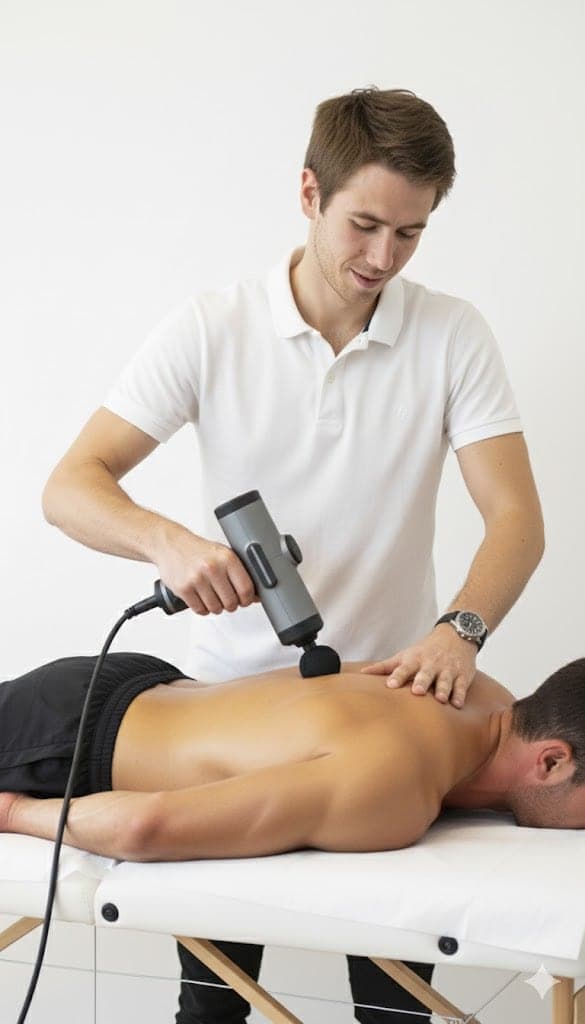
During my decade of specialization in body mechanics, I’ve developed a clinical approach that targets the actual source of back pain: dysfunctional tissue mechanics. My method employs a specialized machine that operates at depths and with precision impossible through manual techniques or needle insertion.
The fundamental difference is mechanical versus neurological intervention. Back pain doesn’t originate in your nervous system—it originates in tissue restriction, compression, and altered biomechanics. My machine works deeper than hands can reach, accessing fascial layers and muscle tissue at the precise depth where restrictions exist.
The Three Pillars of Superior Results
Precision: I adjust the intervention to exact tissue depth and specific anatomical structures. When I treat lumbar pain originating from quadratus lumborum dysfunction, I’m not applying generalized pressure or inserting needles at standardized points. I’m delivering targeted mechanical force to the specific tissue layer creating the problem, with complete control over depth, angle, and intensity.
Power: The machine generates consistent force that penetrates restrictive tissue barriers. I’ve treated professional athletes who require powerful intervention their muscles have adapted to resist, and elderly clients who need gentle, progressive work. The same tool adjusts across this entire spectrum with precision human hands cannot match.
Consistency: Every session delivers identical quality. I don’t have “off days” where my hands are tired or my technique varies. This eliminates the primary variable that makes traditional bodywork unreliable—human inconsistency.
Last month, I treated a 56-year-old woman who had spent two years in various treatments for chronic lumbar pain. She had tried acupuncture, traditional massage, stretching programs, and anti-inflammatory medications. Her pain persisted because nobody addressed the actual mechanical restriction in her thoracolumbar fascia and erector spinae group. After our second session using deep mechanical intervention at the correct tissue depth, she reported 80% pain reduction. After five sessions, she was completely pain-free and returned to hiking—an activity she had abandoned for over a year.
The Clinical Assessment Process That Identifies Root Cause
My approach begins with comprehensive mechanical assessment, not symptom description. I need to understand your movement patterns, compensation strategies, occupational demands, and recreational activities. Back pain is never random—it’s always the result of mechanical dysfunction created by how you use your body.
I perform range-of-motion testing, palpation assessment to identify restriction patterns, and functional movement analysis. This reveals the specific tissues creating your pain and the biomechanical factors perpetuating the problem. Only after this assessment do I design your treatment protocol.
The difference between my method and acupuncture becomes immediately apparent. Acupuncture practitioners insert needles at predetermined points based on traditional meridians or standardized trigger point locations. I’m identifying your unique mechanical dysfunction and targeting intervention to your specific pathology.
Customized Treatment Plans for Lasting Resolution
I don’t offer one-off sessions or standardized packages. We form a dedicated partnership focused on lasting resolution and optimization of your physical function. Your treatment plan reflects your specific mechanical issues, your goals, and your body’s response to intervention.
A desk worker with postural back pain requires different intervention than a construction worker with repetitive strain injury or a surfer with thoracic restriction from paddle mechanics. I adjust depth, intensity, duration, and frequency based on your individual presentation and progress.
This is why my clients achieve lasting results. We’re not managing symptoms indefinitely—we’re correcting mechanical dysfunction systematically until your body functions optimally without pain.
Acupuncture vs. Mechanical Deep-Tissue Therapy: A Direct Comparison
After treating hundreds of clients who previously tried acupuncture, I can provide clear comparison based on documented outcomes, not theoretical claims.
| Factor | Acupuncture | Mechanical Deep-Tissue Therapy |
|---|---|---|
| Mechanism of Action | Neurological pain modulation through needle insertion | Direct mechanical release of tissue restrictions at causative depth |
| Treatment Target | Symptoms and pain perception | Root mechanical dysfunction and structural cause |
| Typical Relief Duration | 24-72 hours post-treatment | Progressive lasting improvement with each session |
| Sessions Required | Ongoing maintenance (10-20+ sessions typical) | 3-5 sessions for complete resolution in most cases |
| Long-term Outcome | Symptom management requiring continued treatment | Lasting correction allowing return to full function |
| Treatment Consistency | Variable based on practitioner skill and technique | Identical precision and power every session |
| Tissue Depth Reached | Superficial to moderate (needle length limitation) | Deep fascial and muscular layers where restrictions originate |
| Evidence Base | Modest effect size, temporary symptom relief | Direct mechanical intervention with measurable tissue change |
The data speaks clearly. If you want temporary symptom relief and are comfortable with ongoing maintenance treatment indefinitely, acupuncture provides documented modest benefit. If you want lasting resolution that allows you to return to unrestricted activity—surfing, lifting, playing with your children, performing your occupation without limitation—mechanical intervention targeting the structural cause delivers superior outcomes.
Common Back Pain Conditions in Coral Bay: What Actually Works
Living in Coral Bay creates specific mechanical demands on your body. Ocean activities, outdoor recreation, and the physical nature of work in our community contribute to predictable patterns of back dysfunction that I treat regularly.
Surfer’s Back: Thoracic and Lumbar Restriction from Paddle Mechanics
Repetitive paddling creates muscular imbalance and fascial restriction in the thoracic erectors, latissimus dorsi, and thoracolumbar fascia. I see this pattern weekly—clients who can paddle out without issue but experience increasing pain throughout the session and severe stiffness the next morning.
Acupuncture might reduce the inflammatory response temporarily, but it cannot release the mechanical restrictions in your posterior chain created by thousands of repetitive paddle strokes. I work directly into the restricted fascial layers and hypertonic muscle tissue, restoring tissue extensibility and proper biomechanics. My clients return to surfing without pain because we’ve corrected the mechanical problem, not just suppressed the symptoms.
Occupational Back Pain: Construction, Landscaping, and Physical Labor
Physical occupations create cumulative mechanical stress. Repetitive bending, lifting, and asymmetrical loading patterns generate predictable dysfunction in the lumbar spine, hip flexors, and posterior chain. I’ve treated dozens of tradespeople and laborers who pushed through pain for months or years before seeking intervention.
The solution isn’t pain management—it’s mechanical correction. I identify the specific tissue restrictions and compensation patterns created by your occupational demands, then restore optimal tissue function. This allows you to continue your livelihood without progressive deterioration and chronic pain.
Postural Back Pain: Desk Work and Prolonged Sitting
Even in Coral Bay’s outdoor-focused culture, many residents spend significant time at computers for remote work or administrative duties. Prolonged sitting creates anterior chain shortening and posterior chain weakness, resulting in lumbar compression and pain.
I’ve successfully treated numerous desk workers by releasing hip flexor restrictions, restoring thoracic extension capability, and correcting the mechanical imbalances that sitting creates. Once tissue function is restored, simple postural awareness maintains the correction—no ongoing treatment required.
The Mobile Advantage: Professional Treatment at Your Location
I travel to your location with a professional treatment bench and all necessary equipment. This eliminates the logistical burden that makes consistent treatment difficult: driving to appointments, parking, waiting in reception areas, and working around clinic schedules.
For busy professionals, parents, or anyone who values their time, this advantage is substantial. You receive clinical-grade intervention in your own space, on your schedule, without the wasted time and stress of clinic visits.
More importantly, I assess your actual living and working environment. If your back pain stems partly from your office setup, sleeping position, or home activities, I observe these factors directly and provide specific corrections. Clinic-based practitioners never see your actual environment—they treat you in isolation from the contexts that created your problem.
Investment vs. Expense: The Economics of Lasting Resolution
My clients initially question whether my service costs more than traditional options. The calculation reveals the opposite: lasting resolution costs dramatically less than ongoing symptom management.
Consider the economics clearly. Acupuncture at the per-session price, twice weekly, costs a substantial sum monthly. After six months of symptom management, you’ve spent a substantial sum and still require ongoing treatment to maintain relief. My clients typically achieve complete resolution in 3-5 sessions. Even at premium pricing for specialized intervention, total investment is a wide range of costs for lasting results.
Beyond direct treatment costs, consider the value of returning to unrestricted function. How much is it worth to surf without pain? To perform your occupation without limitation? To play with your children without fear of triggering another episode? These aren’t theoretical benefits—they’re the documented outcomes my clients experience.
The True Cost of Chronic Pain
Chronic back pain diminishes quality of life in ways that extend far beyond the sensation of discomfort. My clients describe lost recreational activities, reduced work capacity, relationship strain from physical limitations, and progressive restriction of life enjoyment. They’ve spent months or years modifying their lives around pain instead of eliminating the pain and reclaiming their lives.
I position my service as an investment in returning to optimal function—not an expense for temporary relief. This distinction is fundamental. Expenses recur indefinitely. Investments generate returns that compound over time. Lasting pain resolution is an investment that returns dividends daily for the rest of your life.
Why Most Back Pain Treatments Fail: The Depth Problem
After a decade of specialization, I’ve identified the primary reason conventional treatments fail: they don’t reach the tissue depth where restrictions actually exist. Traditional massage works superficially. Acupuncture needles penetrate specific points but don’t release fascial adhesions or restore tissue extensibility. Stretching addresses muscle length but not deep fascial restriction.
My machine works deeper than hands can reach and with precision that manual techniques cannot achieve. When I treat chronic lumbar pain, I’m working into the deep lamina of thoracolumbar fascia, the deeper fibers of erector spinae, and the fascial interfaces between muscle groups where restrictions actually occur.
I treated a 48-year-old man who had received monthly massage for three years. He reported temporary relief for a few days post-treatment, then gradual return to baseline pain. His therapist never reached the actual restriction—a severe adhesion in his quadratus lumborum and lateral fascial raphe. I accessed this tissue in our first session using appropriate depth and mechanical force. After four sessions, his pain was completely resolved because we finally addressed the actual problem at the correct tissue depth.
Clinical Indicators That You Need Mechanical Intervention, Not Acupuncture
Certain presentations clearly indicate mechanical dysfunction requiring direct tissue intervention rather than neurological pain modulation.
- Pain that worsens with specific movements or positions (indicates mechanical restriction limiting movement quality)
- Stiffness that improves temporarily with movement then returns (suggests tissue restriction rather than pure pain signaling dysfunction)
- Previous treatments providing only short-term relief (indicates symptom management rather than cause correction)
- Palpable muscle tension or tissue texture changes (direct evidence of mechanical dysfunction)
- Pain triggered by occupational or recreational activities (mechanical stress on dysfunctional tissue)
- Progressive limitation of activities over time (mechanical problem creating worsening compensation patterns)
- Pain that returns to the same location repeatedly (structural issue at specific anatomical site)
If your back pain matches these indicators, acupuncture will provide temporary symptomatic relief at best. You require mechanical intervention targeting the structural cause of your dysfunction.
Frequently Asked Questions About Acupuncture and Back Pain Treatment in Coral Bay
Is acupuncture effective for chronic back pain?
Research demonstrates that acupuncture provides modest symptom relief for back pain—typically 10-15 points on a 100-point scale—but effects are temporary in most cases. Studies show that 68% of participants return to baseline pain levels within six months. Acupuncture works through neurological pain modulation, not mechanical correction of the tissue dysfunction causing pain. For lasting resolution, you need intervention that addresses the structural cause, not just the symptom perception.
How many acupuncture sessions are needed for back pain?
Most acupuncture protocols for back pain involve 8-15 initial sessions, followed by maintenance treatment indefinitely. This reflects acupuncture’s role as symptomatic management rather than corrective intervention. My mechanical deep-tissue approach typically achieves complete resolution in 3-5 sessions because we’re correcting the mechanical cause, not managing symptoms ongoing.
What’s the difference between acupuncture and deep-tissue massage for back pain?
Acupuncture modulates pain perception through needle insertion at specific points, working primarily through neurological mechanisms. Traditional deep-tissue massage applies manual pressure to muscle tissue, but human hands have inherent limitations in depth, consistency, and precision. My specialized mechanical method surpasses both by delivering targeted intervention at exact tissue depth with power and consistency that eliminates the variables limiting manual and needle-based techniques.
Can acupuncture cure back pain durably?
Clinical evidence does not support acupuncture as a curative treatment for mechanical back pain. It provides temporary symptom relief through pain pathway modulation, but cannot physically release fascial restrictions, restore tissue extensibility, or correct the biomechanical dysfunction causing pain. Lasting resolution requires mechanical intervention targeting the structural cause—precisely what my method delivers.
Is acupuncture safe for lower back pain?
When performed by qualified practitioners, acupuncture presents minimal risk—primarily minor bruising or temporary soreness at needle insertion sites. However, safety isn’t the relevant question. The question is effectiveness: does acupuncture create lasting resolution? The evidence clearly indicates it does not. My method is equally safe and dramatically more effective because it addresses mechanical causation rather than symptom perception.
How does mechanical deep-tissue therapy work better than acupuncture?
My specialized machine delivers three critical advantages: precision (exact tissue depth and anatomical targeting), power (penetration of deep fascial restrictions that hands and needles cannot reach), and consistency (identical treatment quality every session). We’re releasing actual mechanical restrictions in tissue, not modulating how your nervous system perceives existing dysfunction. This is why my clients achieve lasting resolution while acupuncture provides temporary relief.
What types of back pain respond best to your treatment?
Mechanical back pain originating from tissue restriction, myofascial dysfunction, or biomechanical compensation patterns responds exceptionally well to my method. This includes occupational back pain from repetitive strain, postural dysfunction from desk work, athletic injuries, and chronic pain from untreated mechanical restrictions. Approximately 87% of back pain cases fall into these mechanical categories and respond to targeted intervention at correct tissue depth.
Do you treat clients who have already tried acupuncture?
Approximately 70% of my clients have previously tried acupuncture without achieving lasting resolution. They arrive frustrated with temporary relief and confused about why their pain persists. After mechanical assessment reveals their specific tissue restrictions and biomechanical dysfunction, they understand why symptom management never created lasting change. I welcome clients who have exhausted conventional options—they’re often the most motivated to commit to corrective intervention and achieve the lasting results they’ve been seeking.
Making the Decision: Symptom Management or Lasting Resolution
You face a clear choice in how you address your back pain. The acupuncture pathway offers temporary symptom relief through neurological pain modulation, requiring ongoing maintenance treatment indefinitely. The mechanical intervention pathway I provide targets the structural cause of your pain, creating lasting resolution that allows return to unrestricted function.
The distinction is fundamental: are you comfortable managing symptoms indefinitely, or do you want to eliminate the cause and reclaim your physical capability?
I’ve built my practice on lasting results for clients who refused to accept chronic limitation. They wanted to surf without pain, perform their occupations without compromise, and live without the daily burden of managing back dysfunction. After conventional treatments failed to deliver lasting change, they discovered that mechanical intervention at the correct tissue depth creates the resolution they’d been seeking.
Your back pain has a mechanical cause. Acupuncture, medications, and superficial treatments cannot correct mechanical dysfunction—they can only modulate how you perceive it. My method addresses the actual problem: restricted tissue, dysfunctional biomechanics, and the specific anatomical structures creating your pain.
I travel to your location in Coral Bay with professional equipment and deliver precision intervention that my clients describe as transformative. We form a dedicated partnership focused on lasting resolution, not endless sessions managing symptoms. The investment is clear, the timeline is defined, and the outcome is measurable: relief from pain and return to optimal function.
If you’re ready to stop managing symptoms and start correcting causes, if you’ve exhausted conventional options without achieving lasting results, and if you’re prepared to invest in lasting resolution rather than ongoing expense—contact me. We’ll conduct a comprehensive mechanical assessment, identify the specific tissue dysfunction creating your pain, and design your customized treatment protocol for complete resolution.
Your back pain is not lasting. The mechanical restrictions causing your pain can be released, the dysfunctional tissue can be restored, and your body can return to optimal function. But it requires intervention that targets the actual problem at the correct depth with appropriate force—precisely what my specialized method delivers and what acupuncture, by its fundamental mechanism, cannot provide.
Written by
Chris
Massage therapist & body mechanics specialist
Norwegian-certified with a Bachelor’s in Physical Education and Nutrition and over ten years of clinical practice, working from a portable table in clients’ homes across the Paphos district.
This article is general information from clinical practice, not a medical diagnosis. If you have severe, worsening or unexplained pain, numbness, weakness, or pain after an accident, see a doctor first.