
Trigger Point Therapy for Athletes: The Science Behind Lasting Performance Enhancement
In short
Discover how advanced trigger point therapy for athletes targets the cause of muscular restrictions at their source, enhances range of motion, and delivers measurable performance gains through precision mechanical treatment.
I’ve worked with competitive athletes for over a decade, and I can tell you with absolute certainty: the difference between good performance and exceptional performance often comes down to what’s happening in your muscle tissue at the microscopic level. Trigger point therapy for athletes isn’t about temporary relief or post-workout relaxation—it’s about systematically eliminating the biomechanical restrictions that prevent you from accessing your full athletic potential.
After ten years of clinical practice and a university education in physical education and nutrition, I’ve treated everyone from weekend warriors to professional competitors. What I’ve learned is this: most athletes are operating at 70-80% of their actual capacity, and they don’t even realize it. The culprit? Myofascial trigger points that have been accumulating for years, creating compensation patterns that rob you of power, speed, and resilience.
Understanding Trigger Points: The Hidden Performance Barrier
Let me explain what’s actually happening in your muscle tissue. A trigger point is a hyperirritable nodule within a taut band of skeletal muscle fibers. These aren’t just “knots” or “tension”—they’re localized areas of hypoxia where blood flow has been compromised, metabolic waste has accumulated, and the sarcomeres (your muscle’s contractile units) have become locked in a shortened position.
When you’re an athlete, these trigger points create three critical problems:
Restricted Range of Motion: Shortened muscle fibers physically cannot lengthen to their full extent. A sprinter with trigger points in their hip flexors will never achieve optimal stride length. A tennis player with trigger points in their rotator cuff will never access complete shoulder rotation. The mathematics are simple: restricted tissue equals restricted performance.
Altered Movement Patterns: Your nervous system is remarkably adaptive—sometimes to your detriment. When trigger points prevent normal movement, your brain creates compensatory patterns. You start recruiting secondary muscles to perform primary movements. This isn’t just inefficient; it’s a recipe for injury. I’ve seen countless athletes develop chronic issues not from their sport itself, but from the compensation patterns their bodies adopted around untreated trigger points.
Diminished Power Output: Trigger points create what we call “taut bands”—areas where muscle fibers remain in partial contraction even at rest. This means you’re starting every movement from a position of pre-tension. Your muscles are fighting against themselves before they even engage with external resistance. It’s like trying to accelerate with the parking brake partially engaged.
Why Traditional Approaches Fall Short for Serious Athletes
I need to be direct about something that many practitioners won’t tell you: standard massage therapy wasn’t designed to address trigger points at the depth and precision required for athletic performance optimization. Here’s why:
The human hand, no matter how skilled, has biomechanical limitations. To effectively release a mature trigger point—one that’s been present for months or years—you need sustained pressure at a depth that exceeds what manual therapy can consistently deliver. I’ve seen therapists exhaust themselves trying to achieve the mechanical advantage necessary to create lasting change in dense athletic tissue.
Furthermore, consistency is a critical variable in therapeutic outcomes. Even the most experienced practitioner has variations in pressure, angle, and endurance across different sessions and different days. When you’re an athlete preparing for competition, this variability is unacceptable. You need predictable, reproducible results.
The Mechanical Advantage: Precision Engineering for Athletic Tissue
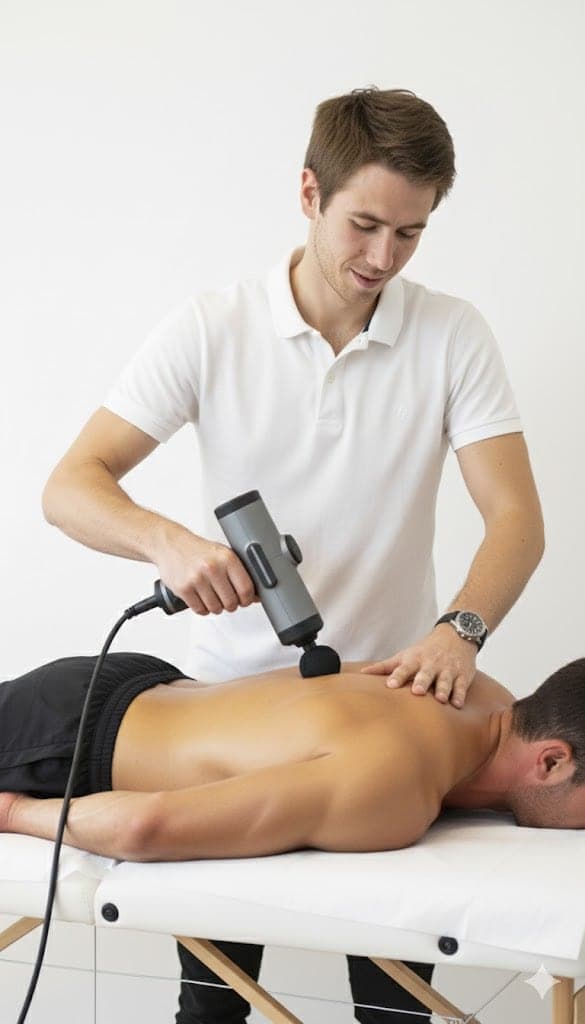
This is where my method fundamentally differs from conventional approaches. I use specialized mechanical equipment that delivers what I call the three essential elements: Precision, Power, and Consistency.
Depth and Mechanical Advantage
The specialized tool I employ can reach depths of 5-7 centimeters into muscle tissue—far beyond what manual techniques can achieve. This isn’t about applying more force; it’s about biomechanical efficiency. The tool’s design creates a concentrated focal point that allows therapeutic pressure to penetrate through superficial layers without causing surface trauma.
I’ll give you a concrete example. Last year, I worked with a competitive cyclist who had been experiencing chronic tightness in his quadriceps. Multiple sports therapists had addressed the surface tension, but the deep trigger points in his vastus intermedius—the deepest of the quadricep muscles—remained untouched. Within three sessions using my mechanical approach, we released trigger points that had been present for over two years. His power output measurements on the bike increased by 12% over the following month.
Controlled Intensity for Athletic Tissue
Athletic muscle tissue has different density, different fiber composition, and different tolerance thresholds than sedentary tissue. The machine I use allows me to calibrate intensity with precision—from superficial fascial work to deep structural release. This isn’t a one-size-fits-all approach. A marathon runner needs different treatment parameters than a powerlifter, and my equipment allows me to deliver exactly what each athlete’s tissue requires.
I adjust the depth, frequency, and duration of treatment based on real-time tissue response. When I encounter a trigger point, I can maintain the exact pressure needed to induce ischemic compression—the therapeutic mechanism that forces blood out of the area, then allows a rush of fresh, oxygenated blood when pressure is released. This flush effect is what initiates the healing cascade that durably resolves trigger points.
Reproducible Results Session After Session
Here’s what I’ve learned from treating hundreds of athletes: your body doesn’t care about effort or intention. It responds to mechanical input. The machine I use delivers identical pressure, identical depth, and identical duration every single session. There are no “off days.” There’s no variability based on my physical condition or fatigue level.
For athletes, this consistency translates directly into predictable progress. You can schedule your treatments around your training cycles with confidence, knowing that each session will deliver exactly what your tissue needs for optimal recovery and adaptation.
Trigger Point Therapy and Range of Motion: The Biomechanical Reality
Let’s talk specifically about how trigger point therapy for athletes enhances range of motion, because this is where the science becomes immediately applicable to your performance.
The Neuromuscular Component
Trigger points don’t just create mechanical restrictions—they alter your neuromuscular signaling. Each trigger point sends aberrant signals to your spinal cord, creating what’s called “facilitation.” This means your nervous system maintains a higher baseline level of muscle tension than necessary.
When I release a trigger point, the immediate effect is often a dramatic increase in passive range of motion. I’m not stretching the muscle; I’m eliminating the neurological noise that was preventing relaxation. I’ve measured increases of 15-20 degrees in hip flexion immediately following treatment of iliopsoas trigger points. That’s not subtle—that’s the difference between a good squat and a biomechanically optimal squat.
The Fascial Network
Your fascia is a continuous web of connective tissue that surrounds and interpenetrates every structure in your body. Trigger points create areas of fascial restriction that affect tissues far beyond the immediate location. When I release a trigger point in your thoracolumbar fascia, you might experience improved shoulder mobility because the fascial connections have been restored to their normal tension relationships.
I worked with a CrossFit competitor who couldn’t achieve proper overhead position in the snatch. The limitation wasn’t in her shoulders—it was in trigger points along her latissimus dorsi and serratus anterior that were creating fascial tension down into her lumbar region. We addressed the trigger points systematically, and her overhead mobility improved by 30 degrees over four weeks. Her snatch PR increased by 10 kilos.
The Clinical Protocol: How I Approach Athletic Trigger Point Therapy
My treatment protocol is based on a decade of clinical experience and continuous refinement. This isn’t improvised work—it’s systematic, progressive, and entirely focused on measurable outcomes.
Phase One: Assessment and Mapping
Before any treatment begins, I conduct a comprehensive biomechanical assessment. I’m looking for:
- Active and passive range of motion limitations
- Compensation patterns in functional movement
- Palpable trigger points and their referral patterns
- Postural deviations that suggest chronic muscular imbalances
- Sport-specific movement restrictions
I map out the trigger points systematically. Many athletes are surprised to learn that their perceived pain location is often not where the actual problem resides. A runner with knee pain might have the causative trigger points in their hip rotators or ankle dorsiflexors. This is why generic stretching and foam rolling often fail—you’re addressing the symptom location, not the source.
Phase Two: Systematic Release
I work through the trigger points in a specific sequence based on biomechanical priorities. Deep stabilizers before superficial movers. Proximal structures before distal. Primary movers before synergists.
Each trigger point receives sustained ischemic compression until I feel the tissue release—typically 30-90 seconds of precisely calibrated pressure. The machine allows me to maintain this pressure without fatigue, ensuring complete therapeutic effect. I’m not guessing about release; I can feel the nodule soften and the taut band relax under the treatment head.
Phase Three: Movement Integration
Releasing trigger points is only half the equation. Your nervous system needs to relearn optimal movement patterns. After treatment, I guide you through specific movement patterns that reinforce the new tissue length and neuromuscular signaling.
This isn’t traditional “stretching”—it’s neuromuscular re-education. I’m teaching your brain that the old compensation patterns are no longer necessary. This integration work is what transforms temporary relief into lasting change.
Sport-Specific Applications: Trigger Point Therapy Across Disciplines
Different sports create different trigger point patterns. Here’s what I’ve observed across various athletic populations:
Endurance Athletes (Runners, Cyclists, Triathletes)
Endurance athletes develop trigger points through repetitive stress in limited ranges of motion. The most common patterns I treat:
| Muscle Group | Common Trigger Point Location | Performance Impact |
|---|---|---|
| Hip Flexors | Iliopsoas, rectus femoris | Reduced stride length, lower back compensation |
| Hip Rotators | Piriformis, gemelli | IT band syndrome, knee tracking issues |
| Calf Complex | Gastrocnemius, soleus | Reduced ankle mobility, Achilles stress |
| Thoracic Extensors | Erector spinae | Breathing restriction, postural fatigue |
I treated a marathon runner last year who had hit a plateau at the 3:15 mark despite consistent training. His limiting factor wasn’t cardiovascular—it was trigger points in his hip flexors that were preventing optimal hip extension. After six weeks of systematic treatment, he ran a 3:06 marathon. Same training volume, same genetics—different tissue quality.
Strength and Power Athletes
Powerlifters, Olympic weightlifters, and CrossFit athletes create trigger points through high-force contractions, often at extreme ranges of motion. I frequently address:
- Pectoralis major and minor: Restricting shoulder external rotation and overhead position
- Upper trapezius and levator scapulae: Creating shoulder elevation patterns that limit pressing mechanics
- Quadratus lumborum and multifidi: Affecting spinal stability and force transfer
- Adductor complex: Limiting hip mobility in squatting patterns
Rotational Athletes (Golf, Tennis, Baseball)
Rotational sports create asymmetric trigger point patterns. I see consistent issues in:
The oblique sling systems—opposite-side latissimus and gluteus maximus connections that generate rotational power. Trigger points here don’t just reduce power; they increase injury risk in the kinetic chain.
The rotator cuff complex, particularly subscapularis and infraspinatus, where trigger points create subtle timing deficits that compound into significant velocity losses over the course of a swing or throw.
The Investment Mindset: Why Elite Athletes Choose Advanced Trigger Point Therapy
I need to address something directly: my service is not inexpensive. And it shouldn’t be. What I provide isn’t a luxury or an indulgence—it’s a strategic investment in your athletic infrastructure.
Consider the economics. How much have you invested in coaching, equipment, programming, and nutrition? Thousands of dollars, probably tens of thousands over your athletic career. Yet all of that investment is filtered through the quality of your physical tissue. If your muscles can’t achieve full range of motion, if trigger points are creating compensation patterns, if chronic tension is limiting force production—you’re not accessing the return on those other investments.
I worked with a professional golfer who had spent over a substantial sum on swing coaching over three years. He had the technical knowledge, the strength, the equipment—but couldn’t consistently execute because trigger points in his thoracic spine and hip rotators were preventing the rotation his swing required. After eight weeks of systematic trigger point therapy, his swing speed increased by 7 mph. That translated directly into competitive results and prize money that dwarfed the cost of treatment.
What to Expect: The Realistic Timeline for Athletic Transformation
I don’t believe in false promises or unrealistic expectations. Here’s what you can genuinely expect from a professional trigger point therapy protocol:
Immediate Effects (Session 1)
- Noticeable increase in passive range of motion
- Reduced sensation of “tightness” in treated areas
- Often some temporary soreness as tissue responds to deep work
- Immediate feedback on movement quality differences
Short-Term Adaptations (Weeks 1-4)
- Progressive improvement in active range of motion
- Reduced need for excessive warm-up time
- Decreased occurrence of “problem areas” during training
- Beginning of neuromuscular pattern changes
Structural Changes (Weeks 4-12)
- Lasting resolution of chronic trigger points
- Measurable improvements in sport-specific performance metrics
- Reduction or elimination of compensation patterns
- Enhanced recovery between high-intensity sessions
Long-Term Optimization (3+ months)
- Sustained tissue quality requiring minimal maintenance
- New baseline of movement capacity and performance
- Reduced injury occurrence due to improved biomechanics
- Ability to train at higher volumes and intensities
The Partnership Model: Why One-Off Sessions Don’t Work
Here’s an uncomfortable truth: if you’re looking for a one-time “fix,” you’re not ready for what I provide. Trigger point therapy for athletes is not a transactional service—it’s a partnership in performance optimization.
Trigger points didn’t develop overnight. They’re the accumulated result of months or years of training stress, compensation patterns, and suboptimal biomechanics. Addressing them requires a systematic, progressive approach with consistent follow-through.
I work with athletes on dedicated programs, typically 8-12 weeks initially, then transitioning to maintenance protocols based on individual needs and competitive schedules. This isn’t about creating dependency—it’s about ensuring complete resolution and preventing recurrence.
I travel to your location with professional equipment and everything needed for clinical-quality treatment. This eliminates the friction of scheduling and travel on your end, ensuring consistency of treatment even during heavy training blocks.
Trigger Point Therapy vs. Other Modalities: Understanding the Differences
Athletes often ask me how trigger point therapy compares to other interventions they’ve tried. Let me clarify the distinctions:
Trigger Point Therapy vs. Standard Massage
Standard massage is often focused on relaxation, circulation, and general tension reduction. It works primarily with superficial tissue layers and uses broad, sweeping techniques. Trigger point therapy is surgical in its precision—we’re addressing specific pathological nodules with sustained pressure protocols designed to create lasting structural change.
Trigger Point Therapy vs. Foam Rolling
Foam rolling provides general myofascial release and can be useful for maintenance. However, it lacks the depth, precision, and mechanical advantage to address mature trigger points in athletic tissue. It’s the difference between surface cleaning and deep structural work.
Trigger Point Therapy vs. Physical Therapy
Physical therapy excels at rehabilitation protocols, exercise prescription, and functional training. Trigger point therapy addresses the tissue restrictions that often underlie the movement dysfunctions that physical therapy treats. They’re complementary, not competitive. I frequently work alongside physical therapists, each providing our specialized expertise.
Trigger Point Therapy vs. Active Release Technique (ART)
ART combines manual pressure with active movement. It’s effective but limited by the practitioner’s hand strength and endurance. My mechanical approach delivers deeper, more sustained pressure with zero variation in quality across the entire session.
The Science of Tissue Remodeling: What Happens After Treatment
Understanding the biological processes following trigger point release helps you optimize your training around treatment sessions.
When a trigger point is released through sustained ischemic compression, several physiological cascades begin:
Immediate vascular flush: Blood flow increases to the area, delivering oxygen and nutrients while removing accumulated metabolic waste products. This is why treated areas often feel warm and may appear slightly reddened.
Inflammatory signaling: The mechanical stress of treatment triggers controlled inflammation—not pathological inflammation, but the healing cascade that initiates tissue remodeling. This is why some post-treatment soreness is normal and actually indicates effective treatment.
Collagen remodeling: Over 48-72 hours, the fascial tissue around the former trigger point begins reorganizing along lines of tension. This is why movement integration work is crucial during this window.
Neuromuscular recalibration: Your nervous system adjusts baseline muscle tone and movement patterns based on the new tissue length and tension relationships. This process continues for 1-2 weeks following treatment.
Common Misconceptions About Trigger Point Therapy for Athletes
Let me address some persistent myths I encounter:
“More pressure equals better results”
False. Effective trigger point therapy requires appropriate pressure—enough to compress the trigger point and create ischemia, but not so much that it triggers protective muscle guarding. The precision of my equipment allows me to find this therapeutic window consistently.
“Pain during treatment means it’s working”
Partially true. You should feel significant pressure and possibly referral pain patterns, but not sharp or unbearable pain. When I encounter a trigger point, you’ll recognize it—there’s a unique quality of discomfort that’s different from simple pressure. I adjust intensity based on your tissue response, not based on your pain tolerance.
“I can achieve the same results with stretching”
Stretching a muscle that contains active trigger points often makes the problem worse. You’re forcing already shortened fibers to lengthen while the trigger point remains. The result is increased tension in the surrounding tissue and potential micro-trauma. Address the trigger point first, then restore normal length.
“Results should be lasting after one session”
Acute trigger points—those present for days or weeks—often respond dramatically to single sessions. Chronic trigger points—those present for months or years—require systematic treatment to achieve lasting resolution. This is basic tissue remodeling biology, not a limitation of the technique.
Frequently Asked Questions About Athletic Trigger Point Therapy
How often should athletes receive trigger point therapy?
During the initial resolution phase, I recommend 1-2 sessions per week for 4-6 weeks. This frequency allows adequate tissue remodeling time between sessions while maintaining therapeutic momentum. After initial resolution, most athletes transition to maintenance protocols of 1-2 sessions per month, adjusted based on training volume and competitive schedule.
Can I train normally after a trigger point therapy session?
Light to moderate training is appropriate the same day as treatment. I recommend avoiding maximum intensity work for 24-48 hours to allow the inflammatory cascade to progress without interference. Think of it like strength training—you’re creating controlled tissue stress that requires recovery time to yield adaptation.
Will trigger point therapy improve my athletic performance?
If biomechanical restrictions are currently limiting your performance—and in my experience, they are for 95% of athletes—then yes, systematically addressing trigger points will improve measurable performance outcomes. Range of motion, force production, movement efficiency, and recovery capacity all improve when tissue quality improves.
How is your mechanical approach different from percussion devices like Theragun?
Percussion devices provide rapid, shallow stimulation that affects superficial tissue and creates a neurological analgesic effect. They’re useful for warm-up and general tension reduction. My equipment delivers sustained, deep compression that mechanically releases trigger points at their source. Completely different mechanisms and outcomes.
Do you work with injured athletes?
I work with athletes managing chronic issues and movement restrictions. For acute injuries, I coordinate with medical professionals and physical therapists. My role is optimizing tissue quality and movement capacity, not treating acute pathology.
What makes your approach superior to traditional hands-on trigger point therapy?
Three factors: depth of penetration that hands cannot achieve, consistency of pressure across the entire session, and precision of application. I’ve trained in manual techniques extensively—I use mechanical methods because they deliver superior outcomes.
Is trigger point therapy suitable for all athletic levels?
Absolutely. Whether you’re a competitive professional or a dedicated amateur, if you train consistently, you develop trigger points. The principles of tissue quality and biomechanical efficiency apply equally across all levels of athletic participation.
How do I know if trigger points are affecting my performance?
Common indicators include: persistent “tightness” that doesn’t respond to stretching, asymmetries in range of motion or strength, chronic areas that require excessive warm-up, plateaus in performance despite consistent training, and recurring injuries in specific areas.
The Long-Term Vision: Athletic Longevity and Tissue Quality
I want to conclude with the perspective that shapes everything I do: athletic performance isn’t just about your next competition or your current season. It’s about sustaining high-level function for years and decades.
The athletes I work with who see the most dramatic improvements are those who shift their mindset from reactive symptom management to proactive tissue optimization. They don’t wait until pain forces them to seek treatment—they systematically address restrictions before they become limitations.
I’ve worked with athletes in their 40s and 50s who move better and perform stronger than they did in their 20s and 30s, not because they’re training more, but because their tissue quality is superior. They’ve eliminated the accumulated restrictions that most athletes simply accept as “normal aging.”
Trigger point therapy for athletes, when performed with precision and integrated into a comprehensive approach to physical preparation, doesn’t just improve your current performance—it extends your athletic lifespan. You’re not just adding years to your sport; you’re adding quality to those years.
This is why I describe my service as an investment rather than an expense. The return isn’t measured in single sessions or immediate relief—it’s measured in sustained performance, reduced injury occurrence, and the capacity to continue pursuing your athletic goals at the highest level possible for your biology and dedication.
I bring this decade of experience, this clinical precision, and this results-focused approach directly to your location. Professional equipment, systematic protocols, and an unwavering commitment to lasting improvement in your athletic infrastructure.
The question isn’t whether trigger point therapy can enhance your performance and extend your athletic career. The evidence is unequivocal. The question is whether you’re ready to make the investment in the tissue quality that underlies everything you do as an athlete.
Written by
Chris
Massage therapist & body mechanics specialist
Norwegian-certified with a Bachelor’s in Physical Education and Nutrition and over ten years of clinical practice, working from a portable table in clients’ homes across the Paphos district.
This article is general information from clinical practice, not a medical diagnosis. If you have severe, worsening or unexplained pain, numbness, weakness, or pain after an accident, see a doctor first.