
Therapeutic Massage Kissonerga: Advanced Deep-Tissue Treatment for Chronic Pain Relief
In short
Discover how specialized therapeutic massage in Kissonerga addresses chronic pain at its root cause through precision mechanical deep-tissue work, delivering lasting results beyond traditional relaxation massage.
I’ve spent a decade working with clients who arrive carrying years of accumulated tension, chronic pain that has resisted conventional treatment, and the frustration of temporary relief that never addresses the underlying problem. In Kissonerga, I provide therapeutic massage that fundamentally differs from the spa experiences most people associate with the term “massage.” My approach is clinical, mechanical, and designed for one outcome: lasting pain relief through addressing the root cause of musculoskeletal dysfunction.
Traditional massage therapists work within certain limitations—the strength of their hands, the fatigue that sets in during intensive sessions, and the inability to maintain consistent pressure at the precise depth required to release deep-seated fascial restrictions. My specialized mechanical deep-tissue method eliminates these constraints entirely. With a Bachelor’s degree in Physical Education and Nutrition from Norway and ten years of focused practice, I’ve developed a treatment protocol that treats the body as the biomechanical system it is, not simply as tissue requiring relaxation.
Understanding the Mechanics of Chronic Pain: Why Traditional Approaches Fail
Most chronic pain stems from compensatory patterns that develop over months or years. A client I worked with last month in Kissonerga had spent eighteen months trying various treatments for persistent lower back pain. She’d visited chiropractors, tried physiotherapy exercises, and received dozens of traditional massages. Each provided temporary relief, but the pain always returned within days.
The reason is straightforward: her treatment focused on symptoms rather than cause. The lower back pain originated from a restricted iliopsoas muscle and fascial adhesions in her hip flexors—compensation patterns that developed after a minor car accident years earlier. Her body had adapted around this restriction, creating a cascade of mechanical inefficiencies that eventually manifested as back pain.
When we address chronic pain effectively, we must understand the kinetic chain. The site of pain is rarely the source of the problem. Therapeutic massage in Kissonerga, as I practice it, requires identifying these compensatory patterns through careful assessment and then systematically releasing the restrictions that perpetuate them.
The Biomechanical Assessment Process
Before any hands-on work begins, I conduct a comprehensive movement assessment. This isn’t a cursory intake form—it’s a systematic evaluation of how your body moves through space, where restrictions limit range of motion, and which compensatory patterns have developed over time.
I examine gait patterns, postural alignment, and specific joint mobility. For athletes, I assess sport-specific movement patterns. For desk workers, I identify the characteristic restrictions that develop from prolonged sitting. Each body tells a story through its movement limitations, and reading that story accurately determines treatment success.
Mechanical Deep-Tissue Massage: Precision, Power, and Consistency
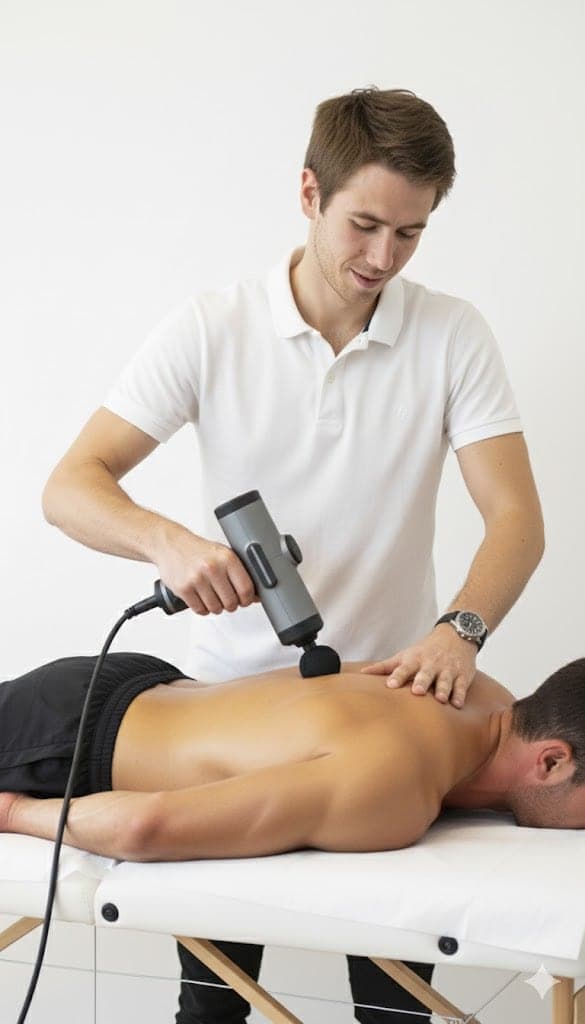
My therapeutic massage approach in Kissonerga utilizes a specialized mechanical tool that represents the evolution of deep-tissue work. This isn’t about replacing human intuition with machinery—it’s about combining clinical knowledge with technological capability to achieve results impossible through manual techniques alone.
Depth and Precision Beyond Manual Limitation
The human hand, regardless of the therapist’s strength, cannot maintain consistent pressure at depths of 4-6 centimeters for extended periods. Yet this is precisely the depth required to address fascial restrictions in major muscle groups like the quadratus lumborum, psoas major, or deep gluteal muscles.
My mechanical method delivers controlled pressure at these depths without compromising precision. The tool’s design allows me to target specific fascial planes with millimeter accuracy, releasing adhesions that manual techniques simply cannot reach effectively. For clients with chronic pain, this depth is not optional—it’s essential for addressing the structural restrictions maintaining their symptoms.
Controlled Intensity Tailored to Individual Tolerance
One misconception about therapeutic deep-tissue work is that “deeper is always better.” This is categorically false. Effective treatment requires working at the precise intensity that allows tissue release without triggering protective muscle guarding.
The mechanical tool I use provides infinitely adjustable intensity levels. For someone new to deep-tissue work, we begin conservatively, allowing their nervous system to adapt to the depth of treatment. For conditioned athletes who require aggressive fascial release, we can deliver significantly greater force with complete control. This adjustability is impossible to replicate consistently with manual pressure.
Consistency That Eliminates Treatment Variables
I’ve worked days when I’m operating at peak energy and days when I’m managing fatigue like any human. The difference with mechanical therapeutic massage is that my tool doesn’t have “off days.” Every stroke delivers identical pressure, depth, and rhythm. For clients investing in a treatment series, this consistency means predictable results.
A competitive cyclist I treat in Kissonerga requires monthly maintenance sessions to manage training-induced muscular tension. He schedules these sessions knowing he’ll receive identical treatment quality regardless of external variables. That reliability is crucial for athletes who cannot afford inconsistent recovery support.
Treating Causes, Not Symptoms: A Paradigm Shift in Pain Management
The fundamental difference between my therapeutic massage service in Kissonerga and conventional approaches is philosophical. I do not treat pain—I treat the mechanical dysfunctions that generate pain. This distinction is not semantic; it represents an entirely different treatment methodology.
The Cascade Effect of Fascial Restriction
Consider a typical case: chronic shoulder pain in someone who works at a computer. The pain presents in the deltoid and upper trapezius, so conventional treatment focuses there. Temporary relief occurs, but the pain returns.
The actual problem is anterior shoulder capsule restriction combined with shortened pectoralis minor muscles—direct results of prolonged forward shoulder positioning. These restrictions force the posterior shoulder muscles to work excessively just to maintain arm position, eventually creating pain through chronic overload.
Treating the deltoid and trapezius provides temporary relief because we’ve addressed tissue that’s inflamed from overwork. But we haven’t released the anterior restrictions forcing that overwork to continue. Within days, the pain returns because the mechanical cause persists.
My approach systematically releases the anterior restrictions first, restores normal shoulder mechanics, and then addresses any secondary tissue damage in the posterior shoulder. This sequence produces lasting results because we’ve corrected the underlying biomechanical dysfunction.
Progressive Treatment Protocols for Layered Restrictions
Chronic pain doesn’t develop overnight, and it doesn’t resolve in a single session. Bodies develop compensatory patterns in layers, with each restriction creating downstream effects that eventually establish their own restrictions.
Effective therapeutic massage requires a progressive protocol that addresses these layers systematically. In the initial assessment, I identify the primary restrictions—the original mechanical dysfunctions driving the compensatory cascade. These receive priority in early sessions.
As primary restrictions release, secondary compensations become accessible. A client might arrive with knee pain, and we discover that hip restrictions have altered their gait pattern, overloading specific knee structures. We address the hip restrictions first, allow movement patterns to normalize, and then address any remaining knee tissue damage.
This layered approach requires patience and understanding that sustainable results demand time. I’m explicit with clients: we’re not masking pain, we’re rebuilding functional movement patterns. That process cannot be rushed without compromising outcomes.
The Investment Framework: Understanding Value Beyond Session Cost
When I discuss pricing with potential clients in Kissonerga, I frame the conversation around investment rather than expense. This distinction matters because it reflects how we should evaluate therapeutic intervention.
An expense is money spent on temporary relief—a cost that recurs because the underlying problem persists. Conventional massage often falls into this category: you feel better for a few days, the pain returns, and you book another session. The cycle continues indefinitely.
An investment is money spent to resolve a problem durably or to optimize function in ways that compound over time. When therapeutic massage successfully addresses the mechanical causes of chronic pain, you’re investing in years of improved function, eliminated pain, and enhanced quality of life.
Calculating the True Cost of Chronic Pain
Before dismissing therapeutic treatment as expensive, consider what chronic pain actually costs. Calculate the accumulated expense of temporary relief measures: over-the-counter medications, regular conventional massage sessions, chiropractic adjustments that provide brief relief, and potentially lost work productivity.
A client I worked with in Kissonerga had spent approximately €200 monthly for eighteen months on various pain management approaches—a total of €3,600 without resolving her underlying problem. She invested €800 in a comprehensive treatment series with me, achieved lasting relief, and now requires only occasional maintenance sessions. The financial logic is straightforward when you examine cumulative costs versus resolution investment.
Beyond direct financial costs, consider the quality-of-life impact. Chronic pain restricts activities, limits athletic performance, disrupts sleep, and creates psychological stress. What is the value of eliminating these limitations? For most people, it substantially exceeds any treatment cost.
Conditions Addressed Through Advanced Therapeutic Massage
My therapeutic massage practice in Kissonerga specializes in musculoskeletal conditions that respond to mechanical intervention. These are not relaxation sessions—they are clinical treatments for specific functional problems.
| Condition Category | Common Presentations | Treatment Focus |
|---|---|---|
| Chronic Back Pain | Lower back pain, thoracic restrictions, postural dysfunction | Psoas release, QL work, fascial plane separation, movement pattern correction |
| Shoulder Dysfunction | Impingement syndrome, frozen shoulder, rotator cuff issues | Capsular release, pectoralis work, scapular stabilizer balancing |
| Lower Extremity Issues | IT band syndrome, plantar fasciitis, knee pain, hip restrictions | Fascial release through kinetic chain, gait pattern assessment, targeted deep tissue |
| Athletic Performance | Reduced flexibility, movement restrictions, recovery optimization | Sport-specific fascial release, maintenance protocols, performance enhancement |
| Postural Syndromes | Forward head posture, rounded shoulders, desk-worker patterns | Anterior chain release, posterior chain strengthening support, ergonomic guidance |
Case Study: Resolving Chronic IT Band Syndrome
A runner in Kissonerga contacted me after two years of persistent IT band pain that had forced him to abandon running entirely. He’d tried rest, stretching protocols, foam rolling, and conventional sports massage without lasting improvement.
My assessment revealed the problem wasn’t primarily in the IT band itself—it was in his hip mechanics. Years of sitting at a desk job had created severe hip flexor restrictions and gluteal inhibition. When he ran, his body compensated for weak, inhibited glutes by overusing the tensor fasciae latae, creating excessive tension through the IT band.
We didn’t focus primarily on the IT band. Instead, I systematically released his hip flexor restrictions, worked extensively on fascial adhesions in his glutes, and provided specific activation exercises to restore proper firing patterns. After four sessions over six weeks, he was running pain-free. Three months later, he completed a half-marathon.
This outcome was possible because we addressed cause rather than symptom. Had we focused exclusively on the IT band—the site of pain—we would have provided temporary relief at best, because the mechanical dysfunction driving the problem would have persisted.
The Mobile Service Advantage: Professional Treatment in Your Space
I travel to client locations throughout Kissonerga with a professional treatment bench and all equipment necessary for clinical-grade therapeutic massage. This mobile approach provides several advantages beyond simple convenience.
Treatment in a Familiar Environment
The nervous system’s response to therapy is influenced by environmental factors. Many clients find treatment in their own space allows deeper relaxation, which facilitates more effective fascial release. When you’re not managing the stress of travel to an appointment, parking, and unfamiliar surroundings, your body is more receptive to therapeutic intervention.
For clients with mobility issues or chronic pain that makes travel difficult, mobile service eliminates a significant barrier to accessing treatment. I’ve worked with clients who had avoided seeking treatment specifically because the prospect of driving while in pain was overwhelming.
Privacy and Dedicated Attention
Unlike clinic environments where therapists work with multiple clients in sequence, my mobile service means I’m focused exclusively on you during our session. There’s no waiting room, no adjacent treatment tables with other clients, and no rushed atmosphere. We take the time necessary to address your specific needs comprehensively.
This dedicated partnership approach is central to my practice philosophy. Effective therapeutic work requires understanding your specific goals, limitations, and response to treatment. That understanding develops through focused attention over multiple sessions, not through rushed appointments in busy clinic settings.
Customized Treatment Plans: The Partnership Approach
I don’t offer one-off massage sessions. My therapeutic massage service in Kissonerga is structured around treatment plans designed to achieve specific outcomes. This approach might seem inflexible, but it reflects reality: meaningful resolution of chronic musculoskeletal issues requires systematic, progressive intervention.
Initial Assessment and Goal Setting
Every client relationship begins with a comprehensive assessment session. We discuss your pain history in detail—when it started, what treatments you’ve tried, what activities exacerbate symptoms, and what your functional goals are.
I then conduct movement assessment to identify mechanical restrictions and compensatory patterns. This assessment informs the treatment strategy: which structures require priority attention, what sequence of interventions will be most effective, and what realistic timeline exists for achieving your goals.
Goal setting is collaborative but realistic. If you’ve had chronic shoulder pain for five years, we’re not resolving it in two sessions. I provide an honest assessment of what’s achievable in what timeframe, because managing expectations appropriately is essential for treatment success.
Progressive Treatment Phases
Treatment plans typically follow a three-phase structure:
Phase One: Acute Intervention (Weeks 1-4) Focused sessions addressing primary restrictions. Frequency is typically twice weekly initially, as we’re creating significant tissue change and want to prevent old patterns from re-establishing between sessions. Clients usually experience measurable pain reduction during this phase, though complete resolution is rare.
Phase Two: Consolidation (Weeks 5-10) Session frequency reduces to weekly as we address secondary restrictions and reinforce new movement patterns. Home exercise protocols become important during this phase—we’re not just releasing restrictions, we’re teaching your body to maintain improved mechanics.
Phase Three: Maintenance (Ongoing) After achieving primary treatment goals, most clients benefit from periodic maintenance sessions. Frequency varies based on activity level and individual factors, but monthly or bi-monthly sessions prevent restriction recurrence and maintain optimal function.
Monitoring Progress and Adjusting Protocol
Each session includes reassessment of key metrics: range of motion measurements, pain scales, and functional movement quality. This data guides treatment adjustments—if progress plateaus, we modify the approach rather than simply continuing ineffective intervention.
I maintain detailed session notes documenting exactly which structures received work, at what depth, and how tissue responded. This precision allows us to identify patterns: which interventions produced optimal results, which areas require additional attention, and how your body specifically responds to treatment variables.
This systematic approach is what separates professional therapeutic work from conventional massage. We’re not simply applying techniques—we’re implementing a strategic protocol designed to achieve specific biomechanical outcomes.
Athletic Performance Enhancement: Beyond Pain Management
While much of my practice focuses on pain resolution, I also work with athletes in Kissonerga seeking performance optimization. The mechanical principles are identical—we’re addressing fascial restrictions and movement limitations—but the goals differ.
Movement Efficiency and Power Generation
Athletic performance depends substantially on movement efficiency. Fascial restrictions create mechanical inefficiencies that reduce force generation, increase energy expenditure, and limit speed or precision in sport-specific movements.
A competitive tennis player I work with experienced persistent difficulty generating power on her serve despite excellent technique and adequate strength. Assessment revealed significant thoracic spine restrictions and latissimus dorsi fascial adhesions—restrictions that prevented full shoulder rotation and limited her kinetic chain’s ability to transfer force efficiently.
After releasing these restrictions systematically, her serve velocity increased measurably without any technique changes. The improvement came purely from removing mechanical limitations that had prevented her body from expressing existing strength and skill optimally.
Recovery Optimization and Training Adaptation
Intense training creates controlled tissue damage—this is how adaptation occurs. However, accumulated fascial restriction from repetitive training stress can impair recovery and eventually limit performance gains.
Regular therapeutic deep-tissue work facilitates faster recovery by improving tissue perfusion, reducing adhesion formation, and maintaining optimal movement mechanics despite training load. Athletes can train harder and more frequently when recovery systems are functioning optimally.
I work with several cyclists in Kissonerga who schedule maintenance sessions every three to four weeks during heavy training periods. This protocol keeps them mechanically efficient, reduces injury risk, and ensures their bodies can adapt positively to training stress rather than accumulating dysfunction.
Frequently Asked Questions About Therapeutic Massage Kissonerga
How does mechanical therapeutic massage differ from traditional hands-on massage?
Mechanical therapeutic massage provides several advantages: deeper tissue penetration, absolutely consistent pressure throughout treatment, and the ability to maintain precise intensity for extended periods without therapist fatigue. The tool I use reaches depths of 4-6 centimeters with controlled pressure, accessing fascial layers that manual techniques cannot address effectively. This isn’t about replacing human assessment—I’m constantly evaluating tissue response and adjusting treatment—but about using technology to deliver mechanical intervention beyond manual limitations.
Will therapeutic deep-tissue massage be painful?
Effective deep-tissue work involves some discomfort, but pain and discomfort are distinct experiences. During treatment, you should feel intense pressure and sensation as we release restrictions, but this should remain within tolerable limits. I adjust intensity continuously based on your feedback and tissue response. If treatment triggers protective muscle guarding, we’re working too aggressively, which actually reduces effectiveness. The goal is working at the edge of your tolerance—creating tissue change without overwhelming your nervous system.
How many sessions will I need to resolve chronic pain?
This depends entirely on your specific condition, how long you’ve had symptoms, and what compensatory patterns have developed. Generally, conditions present for less than six months may respond substantially within 4-6 sessions. Chronic issues present for years typically require 8-12 sessions for significant resolution. I provide a realistic timeline after initial assessment, but understand that bodies vary in response rate. Some clients progress rapidly, others require more time—we adjust protocol based on measured progress, not arbitrary timelines.
Can therapeutic massage replace physiotherapy or medical treatment?
I work within my scope of practice, which is mechanical soft tissue intervention. For many musculoskeletal conditions, advanced therapeutic massage is highly effective, sometimes more so than conventional physiotherapy for specific restrictions. However, I’m not diagnosing medical conditions or replacing appropriate medical care. If your pain involves nerve compression, fracture, infection, or other medical issues, medical evaluation is essential. I work collaboratively with medical providers when appropriate—many physicians refer patients to me specifically for soft tissue work that complements their medical management.
What should I expect during my first therapeutic massage session?
The initial session begins with a detailed intake discussion and movement assessment, taking approximately 30 minutes. We’ll discuss your pain history, functional goals, and any relevant medical information. I’ll assess how you move, identify restrictions, and explain what I’ve found in clear terms. Hands-on treatment follows, typically 60-90 minutes depending on what we’re addressing. After treatment, I’ll provide specific guidance on what to expect over the next 48 hours and outline a recommended treatment plan. Plan for 2-2.5 hours total for the initial assessment session.
Why don’t you offer single, one-off massage sessions?
Because they’re ineffective for the conditions I treat. If you want relaxation massage, many excellent therapists in Kissonerga provide that service. My practice focuses specifically on resolving chronic musculoskeletal dysfunction, which requires systematic, progressive intervention. Attempting to address complex compensatory patterns in a single session is professional malpractice—it sets false expectations and wastes your money. I only accept clients willing to commit to a treatment protocol because that’s what produces actual results. This policy protects both your investment and my professional reputation.
What results can I realistically expect from therapeutic massage treatment?
For conditions appropriate to soft tissue intervention, my clients typically experience substantial pain reduction or complete resolution, improved range of motion, better movement quality, and enhanced functional capacity. Athletes often see measurable performance improvements as mechanical restrictions resolve. However, results require two things: appropriate technique application and client compliance with any recommended home protocols. I can release fascial restrictions with high reliability—that’s technical work. Maintaining those improvements requires you following through with movement practices or activity modifications I recommend. It’s a partnership, and outcomes reflect both parties’ contributions.
Do you provide documentation for insurance purposes?
I provide detailed treatment receipts documenting each session, including date, duration, areas addressed, and techniques used. Whether your insurance covers therapeutic massage depends entirely on your specific policy—some cover it under alternative therapy provisions, others don’t. I recommend checking with your provider before beginning treatment. My fees are structured as private pay, and while some clients successfully obtain partial reimbursement, I cannot guarantee insurance coverage. The investment framework I discussed earlier applies regardless of insurance status—we’re evaluating value based on outcomes, not simply recouping session costs.
Why Experience and Methodology Matter in Therapeutic Massage
Ten years of professional practice has taught me that technique without understanding is merely procedural application. Effective therapeutic massage requires deep knowledge of functional anatomy, biomechanics, movement science, and pain physiology. My degree in Physical Education and Nutrition provides that foundation—I understand how bodies move, how systems interact, and how interventions create change at multiple physiological levels.
This knowledge base allows me to think critically about each client’s presentation rather than simply applying standard protocols. When a client describes their symptoms, I’m not just listening to pain location—I’m mentally modeling their kinetic chain, identifying likely restriction patterns, and formulating hypotheses about causation that I’ll test during assessment.
This analytical approach is what produces consistent results. I’m not guessing or working intuitively—I’m applying systematic reasoning to complex biomechanical problems. When clients achieve lasting pain relief through my therapeutic massage work in Kissonerga, it’s because we’ve correctly identified causation and addressed it methodically, not because we got lucky with technique application.
Taking the Next Step: Beginning Your Treatment Journey
If you’re living with chronic pain in Kissonerga and conventional approaches have provided only temporary relief, understand that this pattern will continue until you address mechanical causation. Pain medications mask symptoms. Conventional massage provides temporary relaxation. Neither resolves the structural restrictions perpetuating your condition.
My therapeutic massage approach offers an alternative: systematic identification and release of the mechanical dysfunctions generating your pain. This requires time, focused work, and partnership between us, but it produces outcomes that fundamentally differ from symptom management—actual resolution.
I’m selective about accepting clients because effective treatment requires mutual commitment. You must be willing to engage with a progressive protocol, follow through with any home recommendations, and understand that sustainable results require adequate time. If you’re looking for quick fixes or one-time relief, my service isn’t appropriate for your needs.
However, if you’re frustrated with the recurrent nature of your pain, tired of temporary solutions, and ready to invest in actually resolving your condition, let’s have a conversation. Initial consultations allow us to discuss your specific situation, determine if therapeutic massage is appropriate for your condition, and outline what a treatment plan would involve.
The choice is straightforward: continue managing symptoms indefinitely, or invest in addressing causes and achieving lasting resolution. For clients willing to engage with the process properly, therapeutic massage in Kissonerga represents a legitimate pathway to the pain-free function they’ve been seeking.
Written by
Chris
Massage therapist & body mechanics specialist
Norwegian-certified with a Bachelor’s in Physical Education and Nutrition and over ten years of clinical practice, working from a portable table in clients’ homes across the Paphos district.
This article is general information from clinical practice, not a medical diagnosis. If you have severe, worsening or unexplained pain, numbness, weakness, or pain after an accident, see a doctor first.