Standing Desk Benefits: How Elevation Transforms Your Posture and Body Mechanics
In short
Discover the profound standing desk benefits for posture correction through mechanical adaptation. Expert insights on optimizing spinal alignment, muscular engagement, and long-term postural health.
After treating hundreds of clients with chronic postural dysfunction over the past decade, I’ve observed a consistent pattern: the majority of lower back pain, neck tension, and shoulder dysfunction originates from one fundamental source—prolonged static positioning in seated work environments. The standing desk benefits extend far beyond the superficial advantages most people discuss. We’re not simply talking about burning a few extra calories or feeling more alert. We’re addressing a biomechanical imperative that determines whether your body degenerates or optimizes over the course of your working life.
My background in Physical Education and Nutrition, combined with ten years of clinical experience treating the mechanical consequences of poor posture, has taught me something critical: your body adapts to the positions you force it to maintain. When you sit for eight hours daily, your hip flexors shorten, your thoracic spine rounds forward, and your deep cervical flexors weaken. This isn’t about comfort—it’s about structural integrity. The standing desk represents one of the most practical interventions for interrupting this degenerative cascade, but only when implemented with proper understanding of biomechanical principles.
The Biomechanical Reality of Sitting: Understanding What You’re Fighting Against
Before we explore standing desk benefits, you need to understand the enemy. Sitting creates a specific pattern of muscular inhibition and facilitation that systematically destroys postural integrity. The psoas major and iliacus muscles—your primary hip flexors—remain in a shortened position throughout your workday. Over weeks and months, this adaptive shortening becomes your new baseline. When you finally stand, these tight hip flexors anteriorly rotate your pelvis, creating compensatory lumbar hyperextension.
Simultaneously, your gluteal muscles—particularly gluteus maximus and medius—experience reciprocal inhibition. They essentially forget how to fire properly because your seated position eliminates their functional demand. This phenomenon, known as gluteal amnesia in clinical settings, compromises your entire posterior chain stability. I’ve treated competitive athletes who couldn’t activate their glutes properly despite years of training, simply because their desk jobs had neurologically disconnected these critical stabilizers.
The thoracic spine tells an equally concerning story. Seated posture inherently promotes flexion—your shoulders round forward, your scapulae protract, and your mid-back curves into kyphosis. The deep cervical flexors weaken while the upper trapezius and levator scapulae become chronically overactive, creating the classic forward head posture that plagues desk workers. This isn’t just aesthetic. For every inch your head moves forward from its optimal position over your shoulders, you add approximately 10 pounds of mechanical stress to your cervical spine structures.
Standing Desk Benefits: The Mechanical Advantages of Elevation
When properly implemented, standing work positions create immediate biomechanical advantages that counteract seated dysfunction. The standing desk benefits operate on multiple physiological systems simultaneously, but the postural improvements remain the most clinically significant.
Spinal Alignment and Load Distribution
Standing positions your spine in its natural S-curve configuration, distributing compressive forces across vertebral bodies, intervertebral discs, and facet joints according to their evolutionary design. The lumbar lordosis maintains appropriate depth without the excessive anterior pelvic tilt that sitting encourages. Your thoracic spine naturally extends slightly, positioning your scapulae in proper relation to your ribcage. Most importantly, your cervical spine stacks vertically above your thoracic spine, eliminating the forward head position that generates exponential loading on posterior neck structures.
I’ve measured significant improvements in my clients’ postural alignment after implementing standing work protocols. One software developer I worked with reduced his forward head posture from 3.5 inches anterior to only 0.5 inches within eight weeks of consistent standing desk use, combined with targeted mechanical treatment to release his chronically tight sternocleidomastoid and scalene muscles. The standing position didn’t fix the problem alone—but it prevented him from recreating the mechanical stress patterns that had caused the dysfunction initially.
Muscular Activation and Anti-Gravity Engagement
Standing desk benefits include continuous low-level activation of your postural stabilization system. Your deep spinal muscles—multifidus, rotatores, and intertransversarii—engage to maintain upright positioning. Your gluteal muscles activate to control hip extension and prevent anterior pelvic drift. Your core stabilizers, including transversus abdominis and internal obliques, create intra-abdominal pressure that unloads spinal structures.
This constant neurological input reinforces proper motor patterns. Your central nervous system receives feedback about correct positioning rather than dysfunctional positioning. Over time, these patterns become your default. I’ve observed this transformation repeatedly: clients who initially struggled to maintain standing positions for 20 minutes eventually stand comfortably for hours because their neuromuscular system has re-educated itself to prefer mechanically optimal positioning.
Hip Flexor Length and Posterior Chain Integration
Perhaps the most underappreciated standing desk benefits involve hip flexor mechanics. When you stand, your psoas and iliacus muscles extend to their full resting length. This prevents the adaptive shortening that sitting guarantees. Maintaining proper hip flexor length is absolutely critical for postural health because these muscles attach directly to your lumbar vertebrae. Tight hip flexors literally pull your lower back into extension, creating compression, inflammation, and pain.
Simultaneously, standing positions demand gluteal engagement. Your body must stabilize against gravity, and your posterior chain—gluteals, hamstrings, and erector spinae—provides that stability. This regular activation prevents the inhibition patterns that sitting creates. I’ve treated athletes with significant performance limitations solely from gluteal amnesia developed during their office work hours. Reintegrating standing positions into their daily routine, combined with mechanical treatment to release fascial restrictions, restored their athletic capacity remarkably quickly.
Common Misconceptions: Why Standing Alone Isn’t Sufficient
Many people implement standing desks and experience disappointment because they misunderstand the fundamental principle: standing desk benefits require proper execution and complementary interventions. Simply standing doesn’t automatically correct years of postural adaptation. I’ve treated numerous clients who developed new pain patterns after transitioning to standing work because they failed to address the underlying mechanical restrictions that sitting had created.
The Tissue Restriction Problem
If you’ve spent years sitting, your fascia—the connective tissue surrounding and interconnecting your muscles—has adapted to that position. Your hip flexors aren’t just weak; they’re mechanically shortened with densified fascial adhesions. Your posterior shoulder capsule has tightened. Your thoracic spine has lost extension mobility at the segmental level. Standing in this restricted state simply transfers dysfunctional loading patterns from one position to another.
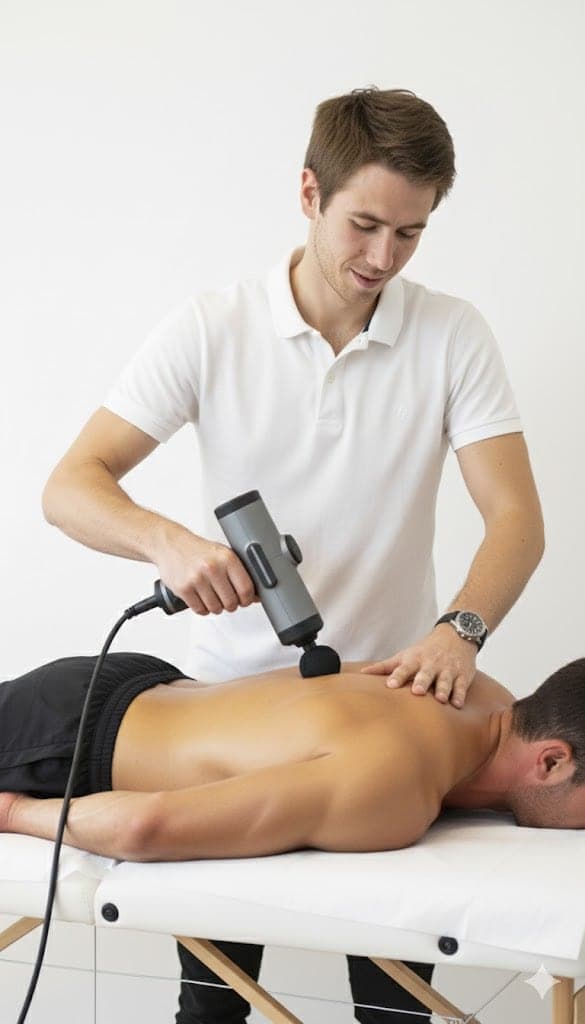
This is where mechanical intervention becomes essential. My specialized approach using precision mechanical tools releases these restrictions at depths human hands cannot reach. I’m not providing relaxation massage. I’m systematically addressing fascial densifications, trigger points, and movement restrictions that prevent your body from assuming optimal positions. The machine I use delivers consistent pressure that penetrates through superficial layers to access the deepest tissue structures where chronic restrictions develop.
One client—a legal professional with severe chronic low back pain—attempted standing desk implementation three times over five years without success. Each time, standing created increased pain within days, so she returned to sitting. When she came to me, I discovered massive restrictions through her entire iliopsoas complex, quadratus lumborum, and deep lumbar stabilizers. After six weeks of intensive mechanical treatment combined with standing desk transition protocols, she successfully transitioned to 60% standing work time with zero pain. The standing desk wasn’t the problem. Her underlying mechanical restrictions were preventing her body from tolerating the position change.
The Movement Variation Requirement
Another critical misconception: standing desk benefits depend on movement variation, not static standing. Holding any position statically—even an optimal position—creates cumulative stress. Your body requires regular position changes to maintain tissue health and circulatory function. Standing statically for eight hours is arguably worse than sitting statically for eight hours because standing positions generate higher compressive loads on lower extremity joints and vascular structures.
Optimal implementation involves strategic variation between sitting and standing throughout your workday. Research suggests 30-60 minute intervals work well for most individuals, though this varies based on your current tissue condition and movement capacity. I recommend starting with shorter standing intervals—perhaps 15-20 minutes—and gradually increasing duration as your postural endurance develops. This progressive adaptation allows your neuromuscular system to strengthen gradually without creating overload injuries.
Implementing Standing Desk Benefits: A Clinical Protocol
Based on my decade of experience treating postural dysfunction, I’ve developed specific implementation protocols that maximize standing desk benefits while minimizing adaptation challenges. This isn’t generic advice—this protocol reflects clinical reality from hundreds of successful transitions.
Phase 1: Assessment and Mechanical Release (Weeks 1-4)
Before implementing significant standing work time, you need baseline mechanical assessment. Where are your primary restrictions? Most people have developed fascial densifications through hip flexors, thoracic paraspinals, and posterior shoulder structures. These restrictions must be released before standing positions become sustainable.
During this phase, I recommend mechanical treatment sessions every 7-10 days, targeting the specific tissue restrictions that sitting has created. My specialized machine accesses depths that manual therapy cannot reach, releasing restrictions at their origin rather than superficially treating symptoms. Between sessions, standing time should remain minimal—perhaps 10-15 minutes twice daily—to begin neurological adaptation without creating overload.
Phase 2: Progressive Standing Integration (Weeks 5-8)
As mechanical restrictions release and tissue quality improves, standing tolerance increases substantially. During this phase, I typically recommend increasing standing intervals to 20-30 minutes, occurring 4-5 times throughout the workday. This provides approximately 90-120 minutes of total standing time, which research suggests offers significant metabolic and postural benefits without creating excessive fatigue.
Continue mechanical treatment every 10-14 days during this phase to address any new restrictions that develop as your body adapts to position changes. Pay particular attention to lower leg structures—calves and peroneals—which often develop tension as they adapt to increased standing loads. The precision control of mechanical treatment allows exact pressure modulation to address these structures without creating tissue damage that manual techniques sometimes produce.
Phase 3: Optimization and Maintenance (Week 9 Onward)
By week 9-12, most clients achieve their optimal standing-sitting ratio, typically 50-60% standing time distributed throughout the day. At this point, standing desk benefits become fully apparent: improved postural alignment, reduced pain, enhanced energy levels, and better movement quality. Mechanical treatment transitions to maintenance protocols—typically every 3-4 weeks—to prevent restriction redevelopment and optimize tissue quality long-term.
This isn’t a temporary intervention. This is lasting optimization of your biomechanical function. I’ve maintained clients on this protocol for years, and their postural integrity continues improving. They’re not managing pain—they’ve eliminated the mechanical causes of their pain through proper positioning and consistent tissue maintenance.
The Ergonomic Details That Determine Success or Failure
Standing desk benefits depend absolutely on proper ergonomic setup. I’ve treated too many people who damaged themselves with poorly configured standing stations. The details matter enormously.
Desk Height and Monitor Positioning
Your standing desk surface should position at elbow height when your shoulders are relaxed and your elbows flexed to 90 degrees. This typically places the desk 38-46 inches from floor level for most adults, but individual anthropometry varies. Your monitor should position with the top of the screen at or slightly below eye level, approximately 20-28 inches from your eyes. This prevents the forward head positioning that undermines the postural benefits you’re trying to achieve.
Many people position monitors too low, creating the same cervical flexion that sitting creates. Your eyes should look slightly downward—approximately 10-20 degrees below horizontal—but your head should remain in neutral position over your shoulders. If you’re looking down significantly, your monitor is too low. This single setup error negates much of the standing desk benefits you’re working to achieve.
Footwear and Surface Considerations
Standing on hard surfaces in unsupportive footwear creates excessive loading on foot structures, ankle joints, and lower leg musculature. I recommend either cushioned anti-fatigue mats or supportive footwear—preferably both. The mat should provide some compliance without being so soft that it compromises stability. Your body requires stable ground contact for proper postural control, so excessively soft surfaces can actually worsen alignment rather than improving it.
Footwear matters more than most people realize. Elevated heels—even small heels—create anterior weight shift that increases lumbar extension and quadriceps loading. Zero-drop shoes with adequate arch support provide optimal mechanical positioning for standing work. I’ve observed significant improvement in clients’ standing tolerance simply from footwear modifications.
Weight Distribution and Position Variation
Even during standing intervals, position variation remains essential. Shift weight between legs regularly. Elevate one foot on a small footrest periodically to flex your hip and unload your lumbar spine. These micro-variations prevent static loading patterns that create cumulative stress. Your body tolerates movement beautifully but responds poorly to sustained static positioning, regardless of whether that position is sitting or standing.
| Implementation Phase | Duration | Standing Time Per Day | Mechanical Treatment Frequency | Primary Focus |
|---|---|---|---|---|
| Phase 1: Assessment | Weeks 1-4 | 20-30 minutes | Every 7-10 days | Release primary restrictions |
| Phase 2: Integration | Weeks 5-8 | 90-120 minutes | Every 10-14 days | Build standing tolerance |
| Phase 3: Optimization | Week 9+ | 4-6 hours | Every 3-4 weeks | Maintain tissue quality |
Beyond Posture: The Systemic Standing Desk Benefits
While postural improvement represents the primary standing desk benefit for most clients I work with, the systemic effects extend considerably further. Your body functions as an integrated system, and position changes influence multiple physiological processes simultaneously.
Metabolic and Cardiovascular Effects
Standing work increases energy expenditure by approximately 15-20% compared to seated work. Over an eight-hour workday, this represents 100-200 additional calories burned. While modest in isolation, this metabolic advantage compounds significantly over weeks and months. More importantly, standing positions activate larger muscle groups—particularly lower extremity muscles—which increases glucose uptake and improves insulin sensitivity. This matters for everyone, but particularly for individuals with metabolic concerns or type 2 diabetes risk factors.
Cardiovascular function improves substantially with standing positions. Seated positioning compresses major blood vessels, reducing venous return and creating peripheral pooling. Standing eliminates this compression and facilitates more efficient circulation. I’ve worked with clients who experienced significant reduction in lower extremity edema simply from implementing standing work protocols. The circulatory benefits extend beyond superficial comfort—they influence tissue oxygenation, waste removal, and overall cellular function.
Cognitive and Productivity Improvements
The neurological standing desk benefits surprise many people. Increased blood flow during standing positions enhances cerebral perfusion, potentially improving cognitive function and alertness. Multiple clients have reported enhanced focus and mental clarity during standing work intervals. While the mechanisms remain incompletely understood, the subjective experience is consistent: standing work often feels more engaging and productive than seated work.
This isn’t universal—some complex cognitive tasks may benefit from the reduced physical demands of sitting—but for many work activities, the enhanced alertness from standing provides measurable advantages. One financial analyst I worked with discovered she processed data more quickly and made fewer errors during standing work sessions. She now strategically times her most demanding analytical work for standing intervals.
Case Studies: Real Results From Proper Implementation
Theory matters, but results matter more. Let me share specific examples from my practice that demonstrate the standing desk benefits when properly implemented alongside mechanical treatment.
Case Study 1: The Architect With Chronic Thoracic Pain
A 42-year-old architect came to me with constant mid-back pain that had progressively worsened over six years. She had tried conventional physiotherapy, chiropractic care, and ergonomic modifications without lasting improvement. Upon assessment, I discovered massive fascial restrictions through her rhomboids, mid-trapezius, and thoracic erector spinae. Years of hunched drawing posture had created densified tissue that pulled her constantly into flexed positioning.
I implemented intensive mechanical treatment targeting these specific restrictions while simultaneously introducing a standing desk to her workspace. The machine’s precision allowed me to release restrictions at the fascial layer where they had developed, not just superficially treating muscular tension. Within four weeks, her pain had reduced by approximately 60%. By week 12, she was essentially pain-free and maintaining 4-5 hours of standing work daily. Three years later, she remains pain-free with quarterly maintenance treatments. The standing desk didn’t cure her pain—releasing her mechanical restrictions did—but the standing position prevents those restrictions from redeveloping.
Case Study 2: The Software Developer With Lumbar Disc Issues
A 38-year-old software developer had developed L4-L5 disc pathology diagnosed through MRI. His orthopedic surgeon recommended surgery, but he wanted to explore conservative options first. His primary complaint was severe pain after 2-3 hours of sitting, making his work nearly impossible. Assessment revealed catastrophically tight hip flexors pulling his lumbar spine into excessive extension, combined with essentially non-functional gluteal muscles.
I began aggressive mechanical treatment to release his iliopsoas complex, quadratus lumborum, and thoracolumbar fascia restrictions. The depth required exceeded what manual therapy could provide—we needed the consistent, powerful penetration that only mechanical treatment delivers. Simultaneously, we implemented a standing desk with initial standing intervals of only 10 minutes to avoid overloading his compromised disc structures.
Progress occurred gradually over 16 weeks. As his hip flexors released and lengthened, his pelvic positioning normalized. As his gluteals reactivated, his posterior chain began providing proper stability. As his standing tolerance increased, his sitting pain decreased. By week 20, he worked 6 hours daily standing with zero pain. A follow-up MRI six months later showed his disc pathology had partially remodeled. Surgery was no longer discussed. The standing position reduced compressive loading on his damaged disc while mechanical treatment eliminated the fascial restrictions that had created the loading pattern initially.
Case Study 3: The Executive Assistant With Cervical Radiculopathy
A 51-year-old executive assistant developed cervical radiculopathy with radiating pain down her right arm. Neurological testing confirmed C6 nerve root irritation. Her neurologist prescribed medication and rest, but symptoms persisted for months. When she came to me, I measured 4 inches of forward head positioning—extraordinarily severe. Her anterior neck muscles had essentially failed, allowing her head to drift progressively forward, creating massive compression on her cervical nerve roots.
The treatment protocol focused on releasing her chronically shortened anterior structures—sternocleidomastoid, scalenes, and pectoralis minor—while simultaneously strengthening her deep cervical flexors. We implemented an aggressive standing desk protocol because her seated position had contributed substantially to her forward head development. The mechanical treatment accessed tissue depths that no manual technique reaches, releasing restrictions that had developed over decades.
Within 8 weeks, her radicular symptoms had resolved completely. By week 12, her forward head positioning had reduced to less than 1 inch. She maintains 5-6 hours of daily standing work now, two years later, with zero cervical symptoms and monthly maintenance treatments. The standing position keeps her head positioned properly over her shoulders rather than drifting forward. The mechanical treatment removed the restrictions that had prevented her from maintaining that position. Together, these interventions solved a problem that conventional medical care had only managed symptomatically.
The Investment Mindset: Why Standing Desk Benefits Require Professional Support
Many people purchase standing desks expecting immediate transformation. When results disappoint, they abandon the intervention, concluding that standing desks don’t work. This represents a fundamental misunderstanding of biomechanical adaptation. Standing desk benefits require professional implementation protocols and complementary mechanical treatment for most people with established postural dysfunction.
Consider the reality: if you’ve sat 8 hours daily for 10 years, your body has adapted structurally to that position. Your fascia has remodeled. Your muscles have changed length. Your nervous system has established motor patterns based on dysfunctional positioning. Standing won’t reverse these adaptations automatically. You need targeted intervention to release restrictions, restore tissue quality, and re-educate movement patterns. Only then can standing positions deliver their full benefits.
This is why I describe my service as an investment rather than an expense. I’m not providing temporary relief that fades after a few days. I’m systematically correcting the mechanical dysfunction that creates your pain. My specialized machine delivers treatment that human hands cannot replicate—deeper penetration, more consistent pressure, and precise control that allows exact tissue targeting. I work with clients over months, not single sessions, because genuine structural change requires time and progressive intervention.
I travel to your location with professional equipment, eliminating the inconvenience that prevents many people from receiving adequate treatment. This isn’t luxury service—it’s practical acknowledgment that people with demanding careers need treatment that fits their schedule, not vice versa. The customized protocols I develop reflect your specific restrictions, work demands, and goals. We’re not following generic programs. We’re addressing your unique biomechanical situation with precision intervention.
Practical Implementation Guidelines: Your Action Protocol
If you’re considering implementing standing desk benefits, follow this systematic approach to maximize success and minimize adaptation challenges:
Step 1: Obtain Professional Assessment
Before purchasing equipment or changing work habits, get proper biomechanical assessment. Where are your restrictions? What postural deviations have developed? What tissue quality limitations exist? This information determines your implementation strategy and treatment needs. Generic advice fails because everyone’s mechanical situation differs based on their work history, injury history, and genetic factors.
Step 2: Address Mechanical Restrictions First
Don’t attempt significant standing work time if you have substantial mechanical restrictions. Release those restrictions through proper mechanical treatment before demanding that your body tolerate new positions. This prevents the development of compensatory pain patterns and makes your standing desk transition dramatically more comfortable.
Step 3: Implement Progressive Standing Protocols
Start with short standing intervals—10-15 minutes—and increase gradually over weeks. Your body needs progressive adaptation time. Rushing this process creates overload injuries that force you to abandon standing work entirely. Patient, systematic progression consistently produces superior long-term results compared to aggressive immediate implementation.
Step 4: Optimize Your Setup Precisely
Invest time getting your ergonomic details correct. Desk height, monitor position, footwear, and surface selection all influence whether standing desk benefits materialize or problems develop. Small setup errors create cumulative stress that eventually produces pain, undermining the entire intervention.
Step 5: Maintain Tissue Quality Long-Term
Even after successful standing desk implementation, continue regular mechanical maintenance. Your tissues will redevelop restrictions over time if not properly maintained. Quarterly or monthly maintenance treatments prevent restriction redevelopment and keep you functioning optimally rather than just adequately.
Frequently Asked Questions About Standing Desk Benefits
How long should I stand at my standing desk?
Optimal standing duration varies individually based on your current tissue condition and adaptation level. Generally, I recommend starting with 10-15 minute intervals 2-3 times daily, gradually increasing to 30-60 minute intervals 4-6 times daily over 8-12 weeks. Total standing time of 4-6 hours daily provides substantial benefits for most people without creating excessive fatigue. The key is variation—never stand statically for your entire workday.
Will a standing desk fix my back pain?
Standing desk benefits include reduced mechanical stress on spinal structures, but standing alone rarely resolves established pain conditions. Most chronic pain involves fascial restrictions, trigger points, and movement dysfunctions that require direct treatment. A standing desk prevents you from recreating the mechanical stress that caused your pain initially, but doesn’t eliminate existing restrictions. Combining proper standing work protocols with mechanical treatment produces dramatically better outcomes than either intervention alone.
What’s the best standing desk height?
Your standing desk should position at elbow height when your shoulders are relaxed and your elbows bent 90 degrees. This typically places the desk surface 38-46 inches from the floor for most adults, but anthropometric variation is substantial. If you’re reaching upward or hunching downward, your desk height is incorrect. Adjustable desks allow precise height optimization and accommodate different activities that may require different working heights.
Should I wear shoes while using a standing desk?
Supportive footwear significantly improves standing tolerance and reduces lower extremity fatigue. Zero-drop shoes with adequate arch support provide optimal mechanical positioning. Avoid elevated heels, which shift your weight forward and increase lumbar extension stress. If you prefer standing barefoot, use a quality anti-fatigue mat to reduce impact forces and provide some cushioning. The combination of supportive shoes and an anti-fatigue mat typically provides the best results.
Can standing desks cause new problems?
Improperly implemented standing work can create new issues, particularly if you have existing mechanical restrictions or stand statically without position variation. Common problems include lower leg fatigue, plantar fasciitis, and increased lumbar extension stress. These typically result from excessive standing duration before adequate adaptation has occurred, poor ergonomic setup, or attempting to stand with significant mechanical restrictions that haven’t been addressed. Proper progressive implementation protocols prevent these complications.
How quickly will I notice standing desk benefits?
Timeline varies substantially based on your current condition and how well you implement the protocol. Most people notice increased alertness and reduced lower back stiffness within 1-2 weeks of proper standing desk use. Significant postural improvements typically require 8-12 weeks of consistent implementation combined with mechanical treatment to release restrictions. Long-term structural optimization continues developing over 6-12 months. Expecting immediate dramatic changes leads to disappointment—this is a systematic intervention that produces progressive improvements.
Do I need to stand all day to get benefits?
No. Standing all day would actually create problems rather than solving them. Research suggests 4-6 hours of standing time distributed throughout the day provides optimal benefits without excessive fatigue. The relationship between standing time and benefits isn’t linear—more isn’t necessarily better. Strategic variation between sitting and standing positions produces superior results to static standing, regardless of duration.
What about treadmill desks or standing desk mats?
Anti-fatigue mats improve standing comfort and reduce lower extremity fatigue. They’re a worthwhile investment if you’re implementing significant standing work time. Treadmill desks represent a more complex consideration. Slow walking (1-2 mph) during work activities can enhance the benefits of standing positions, but requires substantial adaptation and works better for some task types than others. I generally recommend establishing comfortable standing tolerance before introducing walking complications.
The Long-Term Perspective: Sustainable Postural Health
Standing desk benefits represent one component of comprehensive postural optimization, not a complete solution in isolation. Your postural health depends on multiple factors: your work positioning, your movement patterns outside work, your tissue quality, and your biomechanical awareness. Successful long-term outcomes require addressing all these elements systematically.
I’ve worked with hundreds of clients over the past decade, and the pattern is consistent: people who view their body as a mechanical system requiring maintenance and optimization achieve lasting results. People who seek quick fixes without understanding underlying principles cycle through temporary improvements and recurring problems. Standing desks work when integrated into a comprehensive approach to biomechanical health. They fail when treated as isolated interventions expected to overcome years of dysfunction without additional support.
My role is providing the mechanical treatment that releases restrictions, restores tissue quality, and enables your body to function optimally. My specialized approach using precision mechanical tools delivers results that manual techniques cannot achieve because we access tissue depths and apply consistent pressure that human hands cannot replicate. I don’t provide relaxation—I provide systematic correction of mechanical dysfunction. When combined with proper positioning strategies like standing desk implementation, this approach produces lasting resolution of pain conditions that conventional treatment only manages.
The investment in your postural health pays dividends across every aspect of your life. Reduced pain improves sleep quality, enhances mood, increases productivity, and enables physical activities you may have abandoned. Improved posture enhances athletic performance, reduces injury risk, and slows degenerative processes. These aren’t minor quality of life improvements—they fundamentally determine whether you maintain functional independence and physical capability as you age or progressively decline into limitation and disability.
I encourage you to approach standing desk implementation with realistic expectations and commitment to doing it properly. This isn’t about purchasing equipment and hoping for magic. It’s about understanding your biomechanical reality, addressing your specific restrictions through proper treatment, implementing position changes strategically, and maintaining your tissue quality long-term. When you approach it this way, standing desk benefits become substantial and lasting. When you approach it casually without professional support, you’ll likely join the many people who abandon their standing desks after a few uncomfortable weeks.
Your body is the only one you get. The mechanical stress patterns you establish now determine your functional capacity for decades to come. Standing desk implementation represents practical acknowledgment that your work positioning matters profoundly for your long-term health. Combined with proper mechanical treatment and comprehensive postural optimization, it provides a foundation for lasting pain resolution and enhanced quality of life. That’s not marketing language—that’s clinical reality from ten years of treating postural dysfunction and witnessing the transformations that proper intervention produces.
Written by
Chris
Massage therapist & body mechanics specialist
Norwegian-certified with a Bachelor’s in Physical Education and Nutrition and over ten years of clinical practice, working from a portable table in clients’ homes across the Paphos district.
This article is general information from clinical practice, not a medical diagnosis. If you have severe, worsening or unexplained pain, numbness, weakness, or pain after an accident, see a doctor first.