
Sports massage vs deep tissue: which one do you actually need
In short
Sports massage vs deep tissue is mostly a question of purpose, not pressure. Sports massage prepares and recovers a training body; deep tissue works slowly into chronic restriction. Many people in Paphos need a blend of both.
I get asked this most weeks, usually by someone who has tried both and is not sure what they were paying for. As a mobile therapist offering sports massage in Paphos, I treat both approaches on the same table, so here is how I separate them and how I decide which one you need.
Sports massage vs deep tissue is not a hard-versus-harder debate. The two overlap heavily in technique, and a good session often borrows from both. The real difference is in purpose: what the work is trying to change, and how quickly. Once you see that, the choice becomes much easier and much less about labels.
What the two terms actually mean
Both names get used loosely, so it helps to define them the way I use them on the table.
Sports massage is treatment organised around training and performance. It looks at how a body is being loaded, which tissues are doing the most work, and what needs to be prepared, flushed or maintained so that the next session goes well. It is not only for athletes; anyone whose week involves repetitive physical demand fits the same logic.
Deep tissue massage is treatment organised around chronic restriction. It works slowly through the outer layers into the deeper muscle and fascia, looking for the bands, adhesions and holding patterns that have been there for months or years. Depth is a means, not the goal.
Sports massage vs deep tissue in practice
Here is how the two compare across the things clients actually notice: pace, pressure, timing and what you feel afterwards.
| Sports massage | Deep tissue massage | |
|---|---|---|
| Main aim | Preparation, recovery, maintenance | Releasing chronic restriction |
| Pace | Brisker, more rhythmic | Slow, sustained |
| Pressure | Moderate to firm, varies with timing | Builds gradually, often very specific |
| Typical focus | Working muscle groups, kinetic chain | Fascial layers, long-held tension |
| Timing | Around training or events | Independent of training |
| Aftercare feel | Looser, lighter, sometimes energised | Some tenderness for a day or two |
The pressure row is the one that surprises people. Sports massage is often assumed to be gentle and deep tissue brutal. In reality, a maintenance sports session on a cyclist's quads can be as firm as anything I do, and deep tissue on a guarded neck starts light and earns its depth over twenty minutes.
When sports massage is the right call
If your body is being asked to perform on a schedule, sports massage is usually the better frame. That covers the obvious cases and a few less obvious ones.
- You train regularly and want to keep training without niggles turning into stoppages.
- You have an event coming up: a race, a tournament, a long hike, a heavy season at work.
- You are recovering from a hard week and feel heavy, stiff and slow rather than injured.
- You have a recurring tight spot that flares with load and settles with rest.
- You want the therapist to look at how you move, not only where it hurts.
The presentation I see most often in this group in Paphos is the runner or cyclist whose calves and hamstrings tighten as the mileage climbs. Recurring calf tightness is rarely about the calf alone; it usually sits in a posterior chain that is being loaded unevenly, so I work the whole line rather than the loudest part of it. Around events I keep the work moderate. Heavy pressure the day before a race leaves tissue sore and reactive, which is the opposite of what you want on the start line.
When deep tissue is the right call
Deep tissue is the better frame when the problem has stopped being about load and started being about time. The tension is there whether or not you train, it has been there for a while, and it responds to firm work in a way that lighter treatment does not reach.
The presentation I see most often here is the desk-based client whose neck and shoulders have been tight for years, often with a forward-rotated posture that keeps the upper back and chest wall under constant strain. Working the sore neck alone rarely changes much. The tissue that needs the deep, patient work is usually the chest, the upper traps and the muscles between the shoulder blades, and that is where I spend the time.
Deep tissue is not a synonym for maximum force. Pushing hard into a guarded muscle produces more guarding. The depth comes from time and angle, and from a client who can breathe through the work rather than brace against it.
Why I rarely treat them as separate bookings
In practice I do not run two rigid menus. Most of the people who message me need some of each, and I would rather build the session around the body in front of me than around a label.
- A triathlete with a chronic hip flexor restriction gets deep, slow work on the hip and brisker maintenance work on everything else.
- A desk worker who has taken up trail running gets deep tissue for the long-standing neck and sports-style work for the newly loaded legs.
- Someone recovering from a heavy month at work often needs a mostly sports-style flush with one or two deep, patient stops.
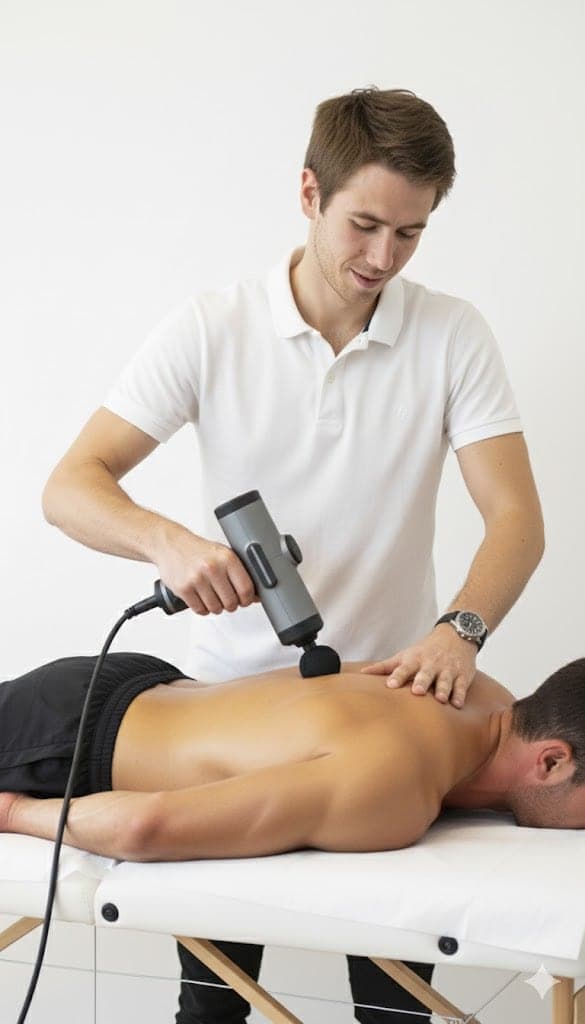
This is also why I work with a mechanical deep-tissue device alongside my hands. On the areas that need real depth held for real time, it lets me keep the pressure steady and specific without my thumbs fatiguing halfway through, so the fifth client of the day gets the same quality as the first. On the areas that need pace and rhythm, hands are still better, and I use them.
Both approaches take the same table, the same set-up and the same time slot. Whether you book a deep tissue massage or a sports massage, the price is the same: €90 for 60 minutes and €130 for 90 minutes, and every fifth session is free. What changes is where the minutes go.
How I decide on the day
I do not need you to arrive knowing which one you want. A short conversation and a few minutes of hands-on assessment usually settle it.
- What has changed recently: training load, a new job, an event, a long drive, an injury.
- How long the tension has been there and whether rest changes it.
- How the tissue feels under the hand: reactive and tired, or dense and quiet.
- What you need to be able to do next week, so I know how much soreness you can afford.
- Which parts of the session should be firm and slow, and which should move.
I can help with tension, tightness, restriction and recovery; see a doctor first if you have sharp pain after a fall or impact, numbness or weakness in a limb, swelling that is hot or red, or pain that wakes you at night and is not related to position. Those are not massage problems until someone has ruled the other things out.
If it is your first session, 90 minutes gives me enough time to do both the assessment and the work properly. After that, 60 minutes is usually enough for maintenance. Details of both are on the pricing page.
Frequently asked questions
Which is better for chronic back pain, sports massage or deep tissue?
Neither is better by name. If the pain flares with load and settles with rest, a sports-style approach that looks at how you are moving tends to help most. If it is a dense, constant ache that has been there for months, slow deep tissue work into the lower back, glutes and hips usually reaches it better. Often the honest answer is a mix, and I will tell you which on the day.
Does deep tissue massage have to hurt?
No. Deep tissue should feel intense and specific, and there is often a satisfying edge to it, but pain that makes you tense up or hold your breath is counter-productive. Guarded muscle does not release; it defends. I work to the point where the tissue starts to give and stay there, and I adjust if you tell me it is too much.
Can I have sports massage if I am not an athlete?
Yes. The sports frame is about load, not sport. Someone who gardens heavily, lifts children, drives long hours or stands all day is loading their body in repetitive ways, and the same preparation, recovery and maintenance logic applies. Many of my sports-style sessions in Paphos are with people who have not raced anything in years.
How sore will I be after deep tissue?
Some tenderness for a day or two is normal, similar to the feeling after a hard workout. Drinking water, gentle movement and a warm shower help. If soreness is sharp, lasts more than a few days or gets worse rather than better, let me know, because that tells me the pressure needs to come down next time.
How often should I book?
For maintenance around regular training, every two to four weeks keeps most people ahead of the niggles. For chronic restriction, a shorter run of sessions closer together at the start, then spacing them out as the tissue changes, tends to work best. I will suggest a rhythm after the first session rather than sell you a fixed block.
Do you bring everything for a home visit?
Yes. I bring the table, linens, oils and the mechanical device, and I set up in whatever room has the space, whether that is a living room, a spare bedroom or a shaded terrace. You need to provide nothing except a bit of floor space and, ideally, a quiet half hour before I arrive so you are not rushing straight from the car to the table.
Written by
Chris
Massage therapist & body mechanics specialist
Norwegian-certified with a Bachelor’s in Physical Education and Nutrition and over ten years of clinical practice, working from a portable table in clients’ homes across the Paphos district.
- Norwegian-certified
- BSc Physical Education & Nutrition
- 10+ years clinical practice
- Based in Chlorakas · all of Paphos district
- No call-out fee anywhere in Paphos district
Last reviewed
This article is general information from clinical practice, not a medical diagnosis. If you have severe, worsening or unexplained pain, numbness, weakness, or pain after an accident, see a doctor first.