
Relaxing Massage for Couples: How Mechanical Precision Creates Lasting Results
In short
Discover why traditional relaxation massage fails couples seeking genuine relief. Learn the science behind mechanical deep-tissue therapy that delivers lasting results, not temporary comfort.
When couples search for relaxing massage experiences together, they typically imagine candlelit rooms, aromatic oils, and gentle Swedish strokes. I’ve spent a decade watching couples leave these sessions feeling momentarily peaceful, only to return weeks later with the same tension patterns, the same postural compensations, and the same unresolved mechanical dysfunction. After treating hundreds of couples in Oslo and throughout Norway, I can state definitively: what most people call “relaxing” is merely distraction from the underlying problem.
The question isn’t whether massage should feel relaxing. The question is whether that relaxation produces measurable, lasting change in your body’s mechanical function. With my background in Physical Education and Nutrition from a Norwegian university and ten years specializing in advanced mechanical deep-tissue therapy, I’ve developed an approach to relaxing massage for couples that achieves both immediate comfort and lasting structural improvement. This article challenges conventional thinking about what couples massage should accomplish.
Why Traditional Couples Massage Fails at Creating Lasting Relaxation
Most couples book massage sessions seeking relief from chronic tension. One partner carries stress in their shoulders from desk work. The other struggles with lower back pain from standing all day. They visit a spa together, experience 60 minutes of pleasant sensation, and leave believing they’ve addressed their problems. Three weeks later, they’re booking another session for the same issues.
This cycle reveals a fundamental misunderstanding about tissue mechanics. Relaxation isn’t simply the absence of tension—it’s the restoration of optimal tissue length, proper fascial glide, and balanced muscular recruitment patterns. When I examine couples who’ve received years of “relaxing” massage, I consistently find:
- Chronic adhesions in the thoracolumbar fascia that manual therapy never penetrated
- Compensation patterns where secondary muscles have taken over for inhibited primary movers
- Trigger points buried 4-5 centimeters deep that superficial techniques cannot reach
- Scar tissue formation from repetitive strain that requires mechanical disruption, not gentle kneading
The human hand, regardless of the therapist’s skill level, has physical limitations. Maximum sustainable pressure output ranges from 15-30 pounds per square inch. Deep postural muscles—the multifidi, the psoas, the rotator cuff stabilizers—require 40-60 PSI of precisely targeted pressure to release chronic holding patterns. This is simple biomechanics, not opinion.
The Mechanical Advantage: Why Precision Tools Outperform Manual Techniques
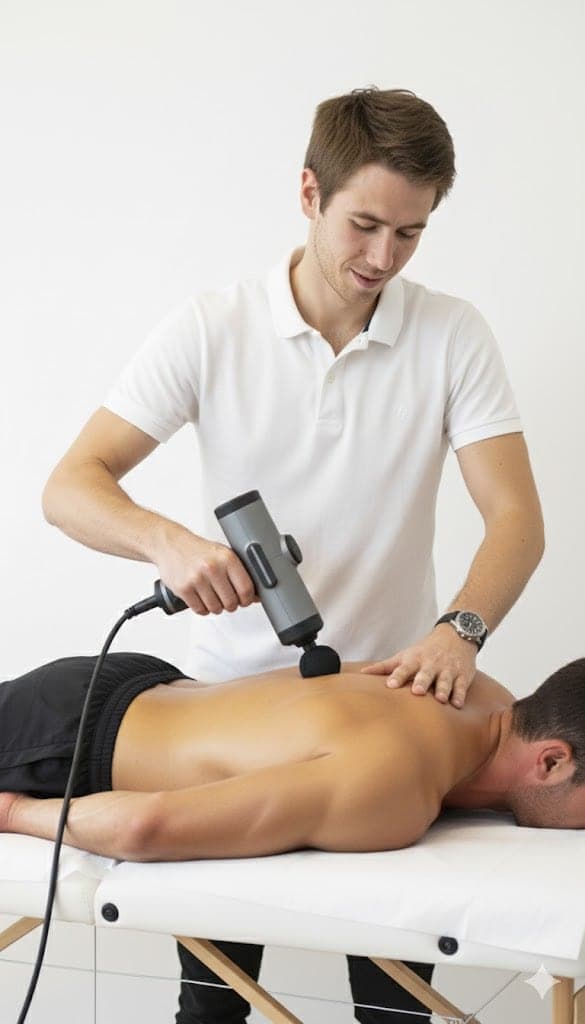
I transitioned to specialized mechanical deep-tissue therapy after years of manual work left my own hands compromised and my clients’ results inconsistent. The machine I use delivers three capabilities that human hands cannot match: precision, power, and consistency.
Precision That Targets Root Causes
When treating couples, I frequently observe mirrored dysfunction. Both partners develop right-sided neck tension, not from individual pathology, but from shared environmental factors—sitting on the same side of the sofa, driving the same vehicle, sleeping on the same mattress. Traditional massage addresses each person’s symptoms separately. My approach identifies the mechanical pattern causing both presentations.
The precision attachment on my device allows me to work within specific fascial planes, following the exact trajectory of muscle fiber orientation. When releasing the levator scapulae in one partner, I’m working at a 45-degree angle from C1-C4 toward the superior angle of the scapula, matching the anatomical fiber direction. This isn’t guesswork or intuition—it’s applied anatomy delivering results you can measure through increased range of motion immediately after treatment.
Power That Reaches Causative Tissue Layers
Last month, I treated a couple in their early forties. Both were recreational cyclists. Both complained of lower back stiffness they described as “just tension.” Manual palpation revealed significant restrictions in their quadratus lumborum and iliopsoas complexes—structures located beneath multiple tissue layers that require substantial mechanical force to access.
Using graduated pressure calibrated to each partner’s tolerance, I worked progressively deeper over three sessions. The specialized tool delivered 45 PSI of sustained pressure to the QL attachment points at the 12th rib and iliac crest. This level of mechanical input simply cannot be achieved with thumbs or elbows without causing tissue trauma or therapist injury.
The result? Both partners reported complete resolution of their “back tension” within two weeks. More significantly, neither has experienced recurrence in six months because we addressed the actual structural restriction, not just the symptomatic muscle guarding.
Consistency That Eliminates Treatment Variables
Human performance fluctuates. A therapist working their sixth client of the day cannot deliver the same pressure, precision, or sustained focus as they did with their first client. This variability means couples receiving manual massage together rarely get equivalent treatment quality.
The mechanical system I use eliminates this variable entirely. Every stroke delivers exactly the programmed pressure. Every treatment follows the same biomechanical protocol. When I work with couples, both partners receive identical technical excellence, adjusted only for their individual tissue density and treatment goals.
What Couples Actually Need: A Systematic Approach to Structural Balance
After a decade treating couples, I’ve identified patterns that consistently emerge. Partners develop complementary dysfunction because they share movement habits, stress environments, and often, compensatory behaviors that mirror each other.
| Common Couple Pattern | Underlying Mechanical Issue | Required Intervention Depth |
|---|---|---|
| Simultaneous neck tension | Forward head posture from shared screen time | Deep cervical fascia, 3-4 cm depth |
| Mirrored shoulder elevation | Chronic upper trapezius dominance, inhibited lower trap | Scapular stabilizers, 4-5 cm depth |
| Bilateral hip restriction | Shortened hip flexors from sitting, anterior pelvic tilt | Iliopsoas complex, 5-7 cm depth |
| Low back stiffness | Erector spinae hypertonicity compensating for core weakness | Multifidi and rotatores, 3-4 cm depth |
Addressing these patterns requires more than parallel appointments. It demands systematic assessment of how each partner’s dysfunction affects the other’s compensatory strategies. When one partner has restricted ankle dorsiflexion, they often develop altered gait patterns that the other partner unconsciously mimics during shared activities like hiking or walking. True relaxation for couples means restoring optimal movement patterns in both individuals simultaneously.
The Treatment Experience: What to Expect from Advanced Mechanical Therapy
Couples often ask whether mechanical deep-tissue work can feel relaxing. The answer depends entirely on how we define relaxation. If you mean passive, superficial stroking that produces temporary sedation, then no—my method serves a different purpose. If you mean the profound release that occurs when chronic tissue restriction finally yields, when proper length-tension relationships are restored, when compensatory holding patterns dissolve, then yes—this is the most authentic relaxation possible.
Initial Assessment and Baseline Measurement
I begin every couples treatment with comprehensive postural and movement analysis. This isn’t casual observation. I assess:
- Standing alignment from anterior, posterior, and lateral views
- Active and passive range of motion in major joint complexes
- Functional movement patterns including squat mechanics, overhead reach, and rotational capacity
- Palpable tissue quality—density, temperature, adherence—in target regions
This baseline establishes measurable outcomes. When I tell couples we’ll achieve specific improvements, I’m referring to quantifiable changes in shoulder flexion degrees, hip internal rotation capacity, or thoracic extension range. These aren’t subjective feelings—they’re objective mechanical improvements we’ll verify post-treatment.
The Treatment Protocol: Progressive Mechanical Release
I travel to your location with professional equipment, including a specialized treatment bench and the precision mechanical device. The environment we create focuses entirely on results, not ambiance. No candles, no music, no theatrical elements that distract from the serious work at hand.
Treatment progresses systematically through targeted tissue layers. I begin with moderate pressure to assess real-time tissue response, then advance progressively deeper as restrictions release. The specialized tool allows me to maintain consistent pressure through 3-5 minute sustained holds on specific adhesions—something impossible with manual techniques.
Most couples notice immediate changes during the session. As chronic tension releases in one partner’s upper trapezius, they experience genuine shoulder descent—not forced repositioning, but natural return to optimal resting position. This is the hallmark of effective treatment: the body adopts improved alignment voluntarily because we’ve eliminated the mechanical restrictions preventing it.
Post-Treatment Integration and Maintenance
The 72 hours following treatment are critical. As tissues remodel and new movement patterns establish, couples must actively engage in the integration process. I provide specific movement protocols—not generic stretches, but precisely targeted exercises that reinforce the structural changes we’ve achieved.
This might include controlled hip flexor lengthening sequences for partners with anterior pelvic tilt, or scapular depression drills for those with chronically elevated shoulder girdles. These aren’t optional recommendations. They’re essential components of converting temporary tissue change into lasting structural improvement.
Why Couples Choose Mechanical Deep-Tissue Over Traditional Massage
Every week, I work with couples who’ve spent years in traditional massage therapy with minimal lasting benefit. They finally seek my services when they recognize that feeling temporarily relaxed differs fundamentally from being structurally sound.
Investment Versus Expense: The Economic Reality
Traditional couples massage typically costs a wide range of costs per session and requires monthly repetition to maintain any perceived benefit. Over a year, couples invest a wide range of costs for temporary relief without addressing underlying causes. Over five years, that’s a wide range of costs spent on symptom management.
My approach requires fewer total sessions because we’re correcting mechanical dysfunction, not just temporarily reducing muscle tone. Most couples achieve their primary goals within 4-8 treatments over 8-12 weeks. Maintenance sessions occur quarterly or semi-annually because the structural changes persist. The total investment is substantially lower, and the outcome—lasting improvement—is incomparably superior.
This isn’t about choosing expensive treatment over affordable options. It’s about choosing effective intervention over repeated temporary relief.
The Partnership Model: Committed to Your Long-Term Results
I don’t offer single-session couples massage. This isn’t a spa service or a special occasion indulgence. I work exclusively with couples committed to resolving their mechanical dysfunction durably. This requires a partnership approach where we establish clear goals, implement systematic treatment protocols, and measure objective progress.
During our initial consultation, I’m assessing whether couples understand what genuine structural improvement requires. If you’re seeking pleasant relaxation without commitment to the integration work, we’re not a good match. If you’re ready to relieves chronic pain patterns and optimize your mechanical function long-term, this is precisely the partnership you need.
Common Misconceptions About Relaxing Massage for Couples
After thousands of treatment sessions, I’ve encountered consistent misconceptions that prevent couples from achieving their actual goals. Let me address the most pervasive:
Misconception: Deeper Pressure Causes More Tissue Damage
This belief stems from confusing therapeutic mechanical force with traumatic injury. When applied with precision to specific tissue restrictions, deep pressure produces controlled microtrauma that stimulates remodeling and improved tissue quality. This is how strength training builds muscle and how therapeutic intervention resolves adhesions.
The mechanical device I use delivers calibrated pressure that never exceeds tissue tolerance. We’re not causing damage—we’re providing the mechanical stimulus necessary for tissue adaptation and improved function. The soreness some clients experience post-treatment is delayed onset muscle soreness from restored muscle fiber recruitment, not injury.
Misconception: Relaxation Requires Gentle Touch
The most profound relaxation I observe in couples occurs when chronic holding patterns finally release. A client who’s maintained elevated shoulders for fifteen years experiences genuine relaxation when we restore proper length to their upper trapezius and levator scapulae. This isn’t achieved through gentle stroking—it requires precise mechanical intervention at sufficient depth to disrupt the adhesions maintaining that dysfunction.
Gentle touch produces temporary nervous system sedation. Deep mechanical release produces structural change that allows authentic relaxation to persist.
Misconception: All Massage Therapists Deliver Equivalent Results
Professional credentials and years of experience don’t equate to mechanical effectiveness. A therapist with excellent manual skills still faces the physical limitations of human tissue capacity. Their hands will fatigue, their pressure output will vary, and they cannot reach tissue depths that require mechanical advantage.
My university degree in Physical Education and Nutrition provides the theoretical foundation to understand biomechanics, tissue physiology, and movement science. My decade of specialized practice provides clinical expertise in applying that knowledge. The mechanical device provides the physical capability to deliver what theory and experience demand. All three components are necessary.
Case Studies: Couples Who Achieved Lasting Results
Let me share specific examples illustrating what’s possible when couples commit to addressing mechanical dysfunction systematically.
Case One: Marathon Runners with Chronic IT Band Syndrome
Both partners were experienced marathoners experiencing lateral knee pain that limited their training volume. They’d received regular sports massage for two years with temporary improvement but consistent recurrence. When I assessed their movement patterns, I identified significant restrictions in their tensor fasciae latae, gluteus medius, and vastus lateralis—the primary contributors to iliotibial band tension.
Over six sessions spanning ten weeks, I systematically released these restrictions using progressive mechanical pressure that reached the deep fascial planes where adhesions had formed. Both partners increased their weekly running volume from 30 to 50 miles without knee pain recurrence. One year later, both completed their goal marathon pain-free—something they hadn’t achieved in five previous attempts.
This outcome wasn’t luck or placebo effect. We addressed the causative tissue restrictions with sufficient mechanical force to produce lasting structural change.
Case Two: Office Workers with Forward Head Posture
A couple in their mid-thirties, both working tech industry jobs, presented with identical postural dysfunction: 3-4 inches of forward head translation, rounded shoulders, and chronic neck pain they’d managed with weekly massage for three years. Their accumulated massage expense exceeded a substantial sum with zero lasting improvement.
I identified their primary restrictions: shortened pectoralis minor pulling their scapulae into protraction, hypertonic upper trapezius and levator scapulae maintaining elevated shoulder position, and deep cervical flexor weakness allowing forward head drift. These patterns required mechanical intervention at 4-5 centimeter depths—impossible to reach effectively with manual techniques.
After eight sessions over twelve weeks, combined with specific corrective exercises I prescribed, both partners demonstrated complete resolution of forward head posture. Their heads now rest directly over their shoulders in neutral standing position. Neither has experienced neck pain in eighteen months. The structural change is lasting because we corrected the mechanical cause.
Frequently Asked Questions About Mechanical Deep-Tissue for Couples
Does mechanical massage hurt more than manual massage?
Pain is subjective and varies by individual pain tolerance, tissue density, and restriction severity. What I can state objectively is that mechanical deep-tissue work produces stronger sensations than superficial massage because we’re working at depths where significant dysfunction exists. Clients describe the sensation as “intense” or “challenging” rather than painful. Most importantly, we’re working within your tolerance while achieving depths that manual therapy cannot reach regardless of discomfort level.
How many sessions do couples typically need?
This depends entirely on the severity and chronicity of your dysfunction. Couples with recent onset tension from acute stress might achieve their goals in 3-4 sessions. Those with decade-long postural dysfunction and multiple compensatory patterns typically require 6-10 sessions to resolve primary issues. I assess this during our initial consultation and provide honest estimates based on what I observe in your movement patterns and tissue quality.
Can we book occasional sessions like regular couples massage?
No. I work exclusively with couples committed to resolving their mechanical dysfunction through systematic treatment protocols. Single sessions or occasional appointments don’t produce lasting results because we need consistent progression through tissue layers and regular reinforcement during the remodeling phase. If you’re seeking occasional relaxation, traditional spa services better suit your goals. If you’re serious about lasting structural improvement, we’ll design a committed treatment plan.
Is this treatment safe for everyone?
Deep mechanical therapy is contraindicated for certain conditions including acute inflammation, uncontrolled hypertension, recent surgery in treatment areas, and pregnancy. During our initial consultation, I conduct a thorough health history to identify any contraindications. For appropriate candidates—which includes most people seeking relief from chronic musculoskeletal dysfunction—this approach is both safe and more effective than traditional alternatives.
What happens if one partner has higher pain tolerance than the other?
I calibrate treatment intensity individually based on each person’s tissue response and tolerance, not arbitrary pressure standards. The mechanical device allows precise adjustment from light therapeutic pressure to powerfully deep athletic treatment. Both partners receive treatment appropriate to their needs—the tool’s consistency ensures both receive equally effective intervention despite different intensity levels.
How do we maintain results after completing our treatment plan?
Maintenance requires two components: movement integration and periodic reinforcement. I provide specific exercise protocols that reinforce the structural changes we’ve achieved. These aren’t time-consuming—typically 10-15 minutes daily of targeted movement patterns. Additionally, most couples benefit from quarterly maintenance sessions where we address any emerging compensation patterns before they become established dysfunction. This approach maintains your results indefinitely.
Why do you travel to clients instead of maintaining a fixed location?
Traveling to your location eliminates the stress and time investment of commuting to appointments. When couples finish demanding workdays, the last thing they need is additional travel. I arrive at your home with all necessary equipment, conduct professional treatment in your comfortable environment, and you’re already home for post-treatment rest. This model serves my clients’ needs more effectively than requiring them to come to me.
What makes your approach different from chiropractors or physical therapists?
Chiropractors primarily address joint alignment through manipulation. Physical therapists focus on exercise-based rehabilitation and functional movement training. My specialization is soft tissue mechanical dysfunction—releasing the fascial restrictions, adhesions, and chronic holding patterns that prevent optimal joint function and movement quality. These approaches are complementary, not competing. Many of my clients work simultaneously with chiropractors or physical therapists, and we’re addressing different components of their mechanical system.
The Science Behind Lasting Mechanical Change
Understanding why mechanical deep-tissue produces lasting results requires basic knowledge of tissue physiology. When you maintain static postures or repetitive movement patterns for extended periods, your fascial system adapts. Collagen fibers align along stress vectors. Cross-links form between fascial planes. Trigger points develop where sustained contraction creates localized hypoxia and metabolic waste accumulation.
These adaptations aren’t pathological initially—they’re your body’s intelligent response to consistent mechanical demands. Problems arise when these adapted patterns no longer serve your functional needs but have become structurally reinforced through tissue remodeling.
Reversing these adaptations requires mechanical force sufficient to disrupt established collagen cross-links, restore proper fascial plane glide, and reset muscle spindle tone. Research demonstrates that sustained pressure of 40-60 seconds at depths reaching target tissue triggers mechanotransduction—the process by which mechanical forces initiate cellular responses leading to tissue remodeling.
Manual therapy, even skilled manual therapy, rarely achieves the necessary pressure-depth-duration combination consistently. The specialized mechanical device I use delivers precisely this combination, producing measurable changes in tissue density, length, and function.
Why Traditional Relaxing Massage Remains Popular Despite Limited Efficacy
If traditional couples massage produces only temporary results, why does it remain the standard choice? Several factors explain this phenomenon:
First, most people have never experienced genuine structural change and therefore don’t know what’s possible. They’ve been conditioned to believe that chronic tension is inevitable and that temporary relief is the best available outcome. This is simply false, but it’s a pervasive belief that benefits the spa industry while disserving clients.
Second, effective treatment requires commitment and sometimes involves intense sensation during tissue release. Many people prefer passive relaxation over active participation in their own structural improvement. I respect this choice, but it’s critical to understand that preference and effectiveness are different considerations.
Third, the massage industry has successfully marketed the idea that all bodywork is essentially equivalent, differentiated only by pressure preference and environmental ambiance. This marketing obscures the fundamental difference between techniques that produce temporary nervous system sedation and those that create lasting structural change.
Making the Decision: Is Mechanical Deep-Tissue Right for Your Relationship?
Couples seeking my services should ask themselves several questions:
Are you experiencing chronic musculoskeletal dysfunction that hasn’t responded to traditional treatment? Have you invested significant money in regular massage without lasting improvement? Are you willing to commit to systematic treatment protocols rather than occasional sessions? Do you prefer measurable results over pleasant experiences?
If you answered yes to these questions, mechanical deep-tissue therapy offers what you’re actually seeking: lasting resolution of mechanical dysfunction, optimized movement quality, and relief from chronic pain patterns.
If you’re seeking occasional relaxation, enjoy spa environments, or prefer gentle techniques regardless of efficacy, traditional couples massage better matches your priorities. There’s no judgment in this assessment—different services serve different goals.
What I won’t accept is couples believing they’ve tried “everything” when they’ve only experienced superficial interventions. If you haven’t received treatment that reaches 4-6 centimeter depths, maintains sustained pressure for adequate duration, and systematically progresses through multiple tissue layers, you haven’t actually tried advanced mechanical therapy.
Final Thoughts: Redefining Relaxation Through Structural Excellence
Real relaxation for couples isn’t found in candlelit rooms with aromatic oils. It’s achieved when both partners move through daily life without chronic tension, when postural dysfunction no longer limits your activities, when pain patterns that have persisted for years finally resolve completely.
This is what my specialized approach delivers. Not temporary sedation masquerading as treatment. Not pleasant sensations that evaporate within days. Genuine, measurable, lasting improvement in your mechanical function.
After a decade specializing in advanced mechanical deep-tissue therapy, working with hundreds of couples throughout Norway, I’ve proven repeatedly that structural problems require structural solutions. The precision, power, and consistency of mechanical intervention outperform manual techniques not because technology is inherently superior to human touch, but because the mechanical demands of deep tissue release exceed human physical capacity.
When couples finally experience what authentic structural improvement feels like—when they move freely through activities that used to cause pain, when they sleep through nights without waking to adjust positions, when they complete workdays without accumulating tension—they understand why this approach represents an investment in long-term health, not an expense for temporary comfort.
If you’re ready to stop managing symptoms and start correcting causes, if you’re committed to the partnership required for lasting results, if you want to experience what relaxing massage for couples can achieve when delivered through advanced mechanical precision, contact me to discuss your specific situation and goals.
Your body’s mechanical potential far exceeds what you’re currently experiencing. Let’s discover what’s possible when we apply the right tools, the right knowledge, and the right commitment to your structural optimization.
Written by
Chris
Massage therapist & body mechanics specialist
Norwegian-certified with a Bachelor’s in Physical Education and Nutrition and over ten years of clinical practice, working from a portable table in clients’ homes across the Paphos district.
This article is general information from clinical practice, not a medical diagnosis. If you have severe, worsening or unexplained pain, numbness, weakness, or pain after an accident, see a doctor first.