Prenatal massage Paphos: what I do differently
In short
Prenatal massage in Paphos, at your home, is side-lying and mechanical rather than a gentle rub: I work the low back, hips and upper back that pregnancy loads most, with pressure adjusted trimester by trimester.
I have been asked for prenatal massage in Paphos often enough that I want to explain how I actually do it, because it is not the light rub many people expect. It is careful, mechanical work on the muscles that carry the extra load, done at your home, side-lying, with pressure adjusted to how far along you are.
Pregnancy changes the mechanics of the body predictably. The centre of gravity moves forward, the pelvis tips, the low back and hips take more strain, and the upper back and neck compensate. Prenatal massage Paphos clients ask me for is, in practice, work on those specific structures — not a general relaxation routine, and not something I would apply to every pregnancy in the same way.
Why pregnancy loads the body the way it does
The main change is not the weight itself but where it sits. As the abdomen grows forward, the lumbar spine curves further, the pelvis tilts anteriorly, and the hip flexors and low back extensors shorten and tighten. The gluteals and deep hip rotators work harder to keep the pelvis level while walking, and the muscles between the shoulder blades stretch as the chest and breasts pull the shoulders forward.
At the same time, relaxin and other hormones loosen ligaments around the pelvis. Muscles then guard to make up for the missing joint stability, and guarding muscles ache. That is why so much pregnancy discomfort is muscular even when it feels like it comes from a joint.
None of this is a disease. It is a normal adaptation that happens to be uncomfortable, and muscle that is working too hard responds well to being worked properly.
How I set up and work with a pregnant client
I bring the table, positioning aids and my mechanical equipment to your home in Paphos, so there is no driving, no waiting room, and you can lie down afterwards. From roughly the second trimester I treat side-lying, with a pillow between the knees and support under the belly and head. Lying face down is not comfortable or sensible once the abdomen has grown, and lying flat on the back for long stretches is best avoided later in pregnancy, so most of the session is on one side and then the other.
The work itself is deep and mechanical, but that does not mean forceful. I use the tool to deliver steady, even pressure at a set depth, and I keep the depth well within what feels comfortable and check with you frequently. Pregnant tissue is more sensitive and more vascular, so I go slower and stay longer rather than pushing harder.
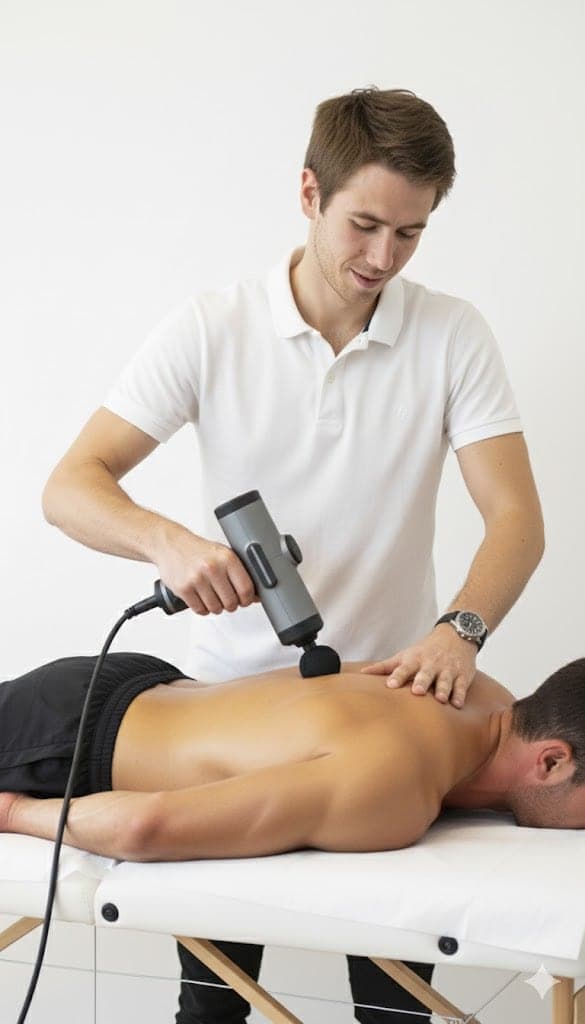
There are areas I leave alone. I do not work directly on the abdomen, I avoid deep pressure on the inner thigh and behind the knee, and I keep away from very deep work around the ankles and lower calf. Everything else — back, hips, glutes, shoulders, neck, arms, upper legs, feet — is treated with the same attention I give any other client.
What changes from trimester to trimester
I adjust three things as pregnancy progresses: position, depth and where I spend the time. Nothing about the plan is fixed, and I ask at the start of every session what has changed since the last one.
| Stage | Position | Emphasis |
|---|---|---|
| First trimester | Usually prone or supine, as normal | Neck, shoulders and general tension; lighter overall |
| Second trimester | Side-lying from around week 16 to 20 | Low back, hips and glutes as the pelvis starts to tilt |
| Third trimester | Side-lying, more frequent position changes | Low back, hips, upper back, calves and feet; shorter blocks on each area |
In the first trimester most women do not yet have mechanical complaints, and some prefer to wait until after the twelfth week before booking, which is entirely reasonable. When I do treat early, I keep it moderate and treat it as a normal session with a little more caution.
The second trimester is when the low back and hip pattern usually starts, and it is the stage where I think the work does the most good, because tissue is not yet as tired and the changes are still building. In the third trimester I spend less time in any one position, work the calves and feet more, and keep the session comfortable rather than ambitious.
The complaints I see most often in Paphos
The presentation I see most often across Paphos, Chlorakas and the surrounding villages is a one-sided low back and buttock ache that gets worse after standing or walking and eases with rest. On the table it is usually the deep hip rotators, gluteus medius and quadratus lumborum that are tight and tender, and working them slowly, side-lying, tends to change how the area feels for a few days at a time.
The second most common is upper back and neck tension between the shoulder blades, often described as burning after sitting or feeding, and often coming with headaches. This responds well to steady work on the rhomboids, upper trapezius and the muscles along the neck, and it is one area where the mechanical tool is genuinely useful because it can hold even pressure for longer than my hands.
- One-sided low back and buttock ache — hips, glutes and QL
- Burning between the shoulder blades — rhomboids and upper trapezius
- Aching, heavy calves and feet late in the day — gentle calf and foot work
- Rib and side tension as the ribcage widens — intercostals and lats, lightly
- Broken sleep from not being able to get comfortable — general, slower work
I want to be honest about what massage does here. It reduces muscle tension and pain, it helps sleep, and it makes the last months more comfortable. It does not change how the pelvis is built, and I will not tell you it makes labour shorter, because I do not know that and no one working on your muscles can promise it. If you feel better between sessions and can move more, that is the result I am aiming for. Some clients book every two to three weeks in the second and third trimesters, others come once when things get bad; both are fine, and the fifth session is free if you do choose regular visits. Prices are the same as any other treatment on the pricing page, €90 for 60 minutes and €130 for 90.
What I can and cannot help with
I can help with muscular back, hip, neck and shoulder pain in pregnancy, tired legs and feet, and the general tension that comes with not sleeping well; I cannot treat medical complications, and I do not offer anything for inducing labour or turning a baby. See a doctor first if you have bleeding, unexplained pain in the abdomen, a severe headache with visual changes, sudden swelling of the face or hands, calf pain in one leg only, or any reduction in the baby's movements — those are not massage matters and I would ask you to get them checked before we book.
For a straightforward pregnancy I do not require a doctor's note, but if you have a diagnosed complication such as high blood pressure, gestational diabetes or a placental issue, I ask you to check with your midwife or doctor and to tell me what they said. If you are on bed rest, I will usually suggest we wait. Once the baby has arrived, the same side-lying and back-focused approach carries over well into postnatal massage if the aches move to the neck and shoulders from feeding.
Frequently asked questions
Is prenatal massage safe?
For an uncomplicated pregnancy, massage from someone who knows how to position you and where not to press is considered safe, and it is widely used for muscular pain. I keep the pressure comfortable, avoid the abdomen and a few other areas, and treat side-lying from mid-pregnancy. If your pregnancy has a complication, ask your midwife or doctor before booking and tell me what they said.
When in pregnancy can I book?
Some women prefer to wait until after the first twelve weeks, and I am happy with that. Others book earlier for neck and shoulder tension and I treat that as a normal, slightly gentler session. From the second trimester onwards, when back and hip pain usually begins, is when most clients start and when I think the work makes the biggest difference to comfort.
Do you use the mechanical tool during pregnancy?
Yes, but at a lower depth and with more checking than for a non-pregnant deep tissue client. The advantage of the tool is even, sustained pressure without me leaning weight through you, which suits side-lying work on the hips and upper back. I still use my hands for the neck, feet and any area where I want more feedback, and I never use it on the abdomen.
How often should I have prenatal massage?
Most of my regular pregnant clients come every two to three weeks in the second and third trimesters, with the fifth visit free. If you are only troubled late on, a couple of sessions in the last month is common. There is no schedule you must follow; book when your back or hips are telling you to and we can decide from there.
Do you come to my home anywhere in the Paphos area?
I am based in Chlorakas and cover Paphos town, Kato Paphos, Tala, Peyia, Emba, Kissonerga, Coral Bay and the villages around them. I bring the table and everything else, and a pregnant client can stay in comfortable clothes and lie down afterwards, which is one of the reasons I think mobile treatment suits pregnancy well. Message me on WhatsApp with your location and I will confirm.
What should I wear and can I stay partly dressed?
Wear whatever you find comfortable; many women keep underwear or loose shorts on and I drape everything else with towels. Side-lying makes it easy to stay covered while I work on the back and hips. If you would rather I only work through clothing on certain areas, tell me and I will adjust — comfort matters more than technique in this kind of session.
Written by
Chris
Massage therapist & body mechanics specialist
Norwegian-certified with a Bachelor’s in Physical Education and Nutrition and over ten years of clinical practice, working from a portable table in clients’ homes across the Paphos district.
- Norwegian-certified
- BSc Physical Education & Nutrition
- 10+ years clinical practice
- Based in Chlorakas · all of Paphos district
- No call-out fee anywhere in Paphos district
Last reviewed
This article is general information from clinical practice, not a medical diagnosis. If you have severe, worsening or unexplained pain, numbness, weakness, or pain after an accident, see a doctor first.