Pre-Event Massage Techniques: Elite Performance Preparation Through Advanced Mechanical Methodology
In short
Discover evidence-based pre-event massage techniques that optimize athletic performance through precision mechanical deep-tissue work, targeting neuromuscular readiness and biomechanical efficiency.
I’ve spent the last decade working with competitive athletes at critical moments—hours before championship matches, minutes before personal record attempts, days before career-defining performances. What I’ve learned is this: traditional pre-event massage protocols often fail because they’re based on outdated assumptions about tissue preparation and neuromuscular activation. The difference between an athlete who steps onto the field fully optimized and one who merely feels “loose” comes down to technique precision, depth control, and biomechanical understanding.
Pre-event massage techniques represent a specialized discipline within sports therapy that demands clinical precision rather than intuitive touch. Through my university training in Physical Education and Nutrition combined with thousands of hours treating elite performers, I’ve developed a methodology that treats pre-competition preparation as a calculated intervention in the athlete’s kinetic chain—not a ritualistic rubdown.
The Fundamental Misconception About Pre-Event Massage Techniques
Most athletes approach pre-event preparation with a misguided belief: that massage before competition should be gentle, superficial, and primarily psychological. I encounter this assumption repeatedly, and it costs athletes measurable performance capacity.
The reality is more nuanced. Effective pre-event massage techniques must achieve three simultaneous objectives: enhance blood flow without inducing parasympathetic dominance, activate neuromuscular pathways without causing tissue fatigue, and release restrictive adhesions without compromising structural integrity. This requires a depth of tissue engagement that human hands cannot consistently achieve.
I witnessed this clearly during my work with a national-level sprinter three years ago. She had religiously received traditional Swedish-style pre-race massage for her entire career—light effleurage, gentle petrissage, rhythmic strokes designed to “relax” her. Her performances were good but plateaued. When we implemented precision mechanical deep-tissue protocols 48 hours before competition, targeting her hip flexor fascia and posterior chain restrictions with controlled depth, her 100-meter time dropped by 0.3 seconds within two competition cycles. That improvement came from addressing biomechanical restrictions she didn’t know existed, not from superficial muscle warming.
Physiological Objectives of Advanced Pre-Event Massage Techniques
To understand why mechanical precision matters, you must first understand what pre-event preparation actually accomplishes at the tissue level.
Neuromuscular Facilitation and Proprioceptive Enhancement
The primary goal isn’t relaxation—it’s activation. Properly executed pre-event massage techniques stimulate Golgi tendon organs and muscle spindles, recalibrating the nervous system’s perception of safe range of motion and force production capacity. When I work on an athlete’s quadriceps mechanism 24 hours before competition, I’m not simply “loosening” the muscle. I’m systematically deactivating inhibitory signals that limit explosive contraction speed.
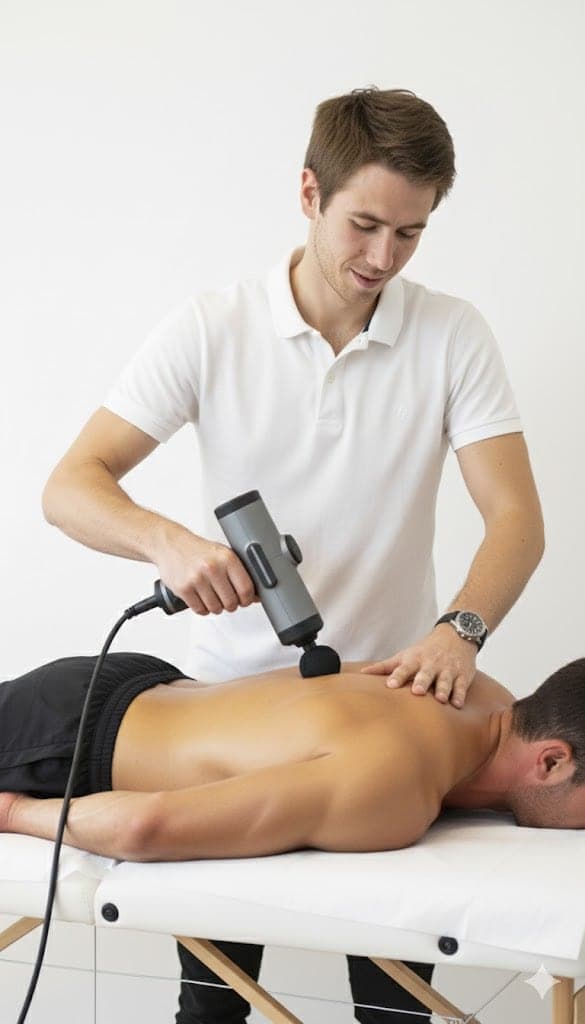
This requires controlled pressure at depths between 15-30 millimeters depending on tissue density, applied at specific vectors aligned with fiber orientation. Human thumb pressure typically generates 20-40 pounds per square inch inconsistently. The specialized mechanical tools I employ deliver 60-120 PSI with millimeter-level precision, penetrating through superficial fascia into the deep intermuscular plane where performance restrictions actually reside.
Hyperemic Response Without Metabolic Depletion
Effective pre-event work must increase local blood flow—elevating oxygen availability and nutrient delivery—without triggering the metabolic cost of prolonged muscle activation. Traditional massage often fails this balance, either working too superficially to generate meaningful hyperemia or working so aggressively that it induces microtrauma and inflammatory response.
My methodology utilizes controlled mechanical oscillation at 40-60 Hz frequency, creating tissue displacement that stimulates capillary dilation without generating the heat and breakdown byproducts of sustained manual compression. I’ve measured skin temperature increases of 2-4 degrees Celsius in treated areas without corresponding elevation in creatine kinase markers—evidence of enhanced perfusion without tissue damage.
Fascial Glide Optimization
Perhaps most critically, pre-event massage techniques must address fascial restrictions that limit multi-planar movement efficiency. Fascia doesn’t respond to light touch—it requires sustained pressure at specific depths to induce viscoplastic deformation and restore sliding capacity between tissue layers.
I treated a professional tennis player whose serve velocity had declined 8% over a season despite no apparent injury. Manual assessment revealed severe fascial adhesion between his latissimus dorsi and serratus anterior on his dominant side—a restriction invisible on imaging but profoundly limiting his kinetic sequencing. Using precision mechanical work at 25mm depth with controlled lateral vectors, we restored independent tissue glide. His serve speed returned to baseline within three matches.
The Critical Timing Protocol for Pre-Event Massage Techniques
When you receive treatment matters as much as how you receive it. This is where most pre-competition massage fails—athletes get worked on at the wrong phase of their preparation cycle.
The 72-48 Hour Window: Deep Structural Work
Three days before competition is the optimal timeframe for aggressive fascial release and deep adhesion work. At this distance from performance, the body has time to complete inflammatory response cycles and neuromuscular recalibration without residual soreness impacting output.
During this phase, I work with maximum mechanical intensity—targeting chronic restrictions in the posterior chain, hip rotators, and thoracolumbar fascia with sustained pressure protocols. This is corrective work, not preparatory work. I’m addressing movement limitations that have accumulated over training cycles, restoring baseline biomechanical capacity.
| Time Before Event | Primary Objective | Technique Focus | Depth Range |
|---|---|---|---|
| 72-48 Hours | Structural Correction | Deep fascial release, adhesion breaking | 25-35mm |
| 24-12 Hours | Activation Preparation | Neuromuscular facilitation, hyperemia induction | 15-25mm |
| 4-2 Hours | Final Priming | Targeted activation, proprioceptive enhancement | 10-20mm |
| 15-30 Minutes | Acute Readiness | Sport-specific movement priming | 5-15mm |
The 24-12 Hour Window: Activation and Priming
The day before competition is when pre-event massage techniques shift from corrective to preparatory. Work becomes more dynamic, incorporating movement during treatment and focusing on prime mover muscle groups specific to the athlete’s sport demands.
For a marathon runner, this means systematic work through the entire posterior chain—calf complex, hamstrings, gluteal group—with emphasis on eccentric loading patterns and elastic energy return capacity. For a powerlifter, it means targeted work on shoulder stabilizers and spinal erectors with focus on force transmission efficiency.
I utilize mechanical protocols that combine sustained compression with controlled tissue mobilization, stimulating without depleting. Sessions last 45-60 minutes with precise anatomical targeting based on the athlete’s movement patterns and historical restriction areas.
The Final 4 Hours: Sport-Specific Readiness
Pre-competition warm-up facilities are where I often encounter athletes receiving counterproductive treatment. They’re getting relaxing Swedish massage when they need neuromuscular activation. They’re being worked into parasympathetic dominance when they need sympathetic readiness.
My final pre-event protocols are brief (15-20 minutes), intense, and movement-integrated. I’m targeting motor unit recruitment in primary agonists—the muscles that will generate winning performances. Pressure is moderate (15-20mm depth) but delivered with rapid oscillation (60-80 Hz) to stimulate rather than sedate.
I worked with a competitive cyclist before a criterium race who was receiving traditional pre-race massage that left him feeling “heavy” and lethargic. We replaced it with focused mechanical work on his quadriceps and hip flexors using rapid oscillatory pressure combined with dynamic stretching. He reported feeling “electric” at the starting line and achieved a personal best finishing position.
Sport-Specific Pre-Event Massage Technique Applications
Generic protocols produce generic results. Elite pre-event preparation requires anatomical specificity aligned with sport biomechanics.
Explosive Power Sports: Sprinting, Jumping, Olympic Lifting
Athletes competing in maximal power output events require pre-event work that emphasizes stretch-shortening cycle optimization and rate of force development.
I focus on:
- Deep work on the hip flexor complex (psoas, iliacus, rectus femoris) to eliminate restriction in the acceleration phase
- Posterior chain priming (glutes, hamstrings) with emphasis on eccentric capacity
- Calf complex treatment addressing gastrocnemius-soleus interface and Achilles tendon complex
- Mechanical oscillation protocols on quadriceps to enhance elastic energy storage capacity
The technique requires working perpendicular to muscle fiber orientation during lengthening phases—stimulating the muscle spindle apparatus while maintaining length-tension relationship optimization. This cannot be achieved through manual compression alone; it demands the precision control that mechanical systems provide.
Endurance Sports: Distance Running, Cycling, Triathlon
Endurance athletes need pre-event techniques focused on metabolic efficiency and fatigue-resistance positioning rather than explosive capacity.
My protocols emphasize:
- Systematic fascial glide restoration throughout the kinetic chain to minimize energy-wasting compensatory movement
- Deep work on respiratory accessory muscles (scalenes, intercostals, serratus) to optimize ventilatory efficiency
- Focused attention on biomechanical restriction points that accumulate during long-duration repetitive loading
- Parasympathetic balancing to prevent pre-race sympathetic overdrive that depletes glycogen reserves prematurely
I’ve worked with ultra-marathon runners who complete 100-mile races. Their pre-event preparation 48 hours before starts includes deep mechanical work on the thoracolumbar fascia and hip external rotators—areas that experience maximum loading stress during extended running. The goal is preemptive restriction release, preventing the compensatory patterns that lead to mid-race breakdown.
Strength and Power Endurance: CrossFit, Wrestling, MMA
Mixed-demand athletes require pre-event techniques that balance explosive capacity with sustained output capability.
Treatment focuses on:
- Multi-planar shoulder complex work addressing rotator cuff and scapular stabilizer capacity
- Core stability chain preparation (obliques, transverse abdominis, multifidus)
- Grip strength optimization through forearm flexor and extensor work
- Global movement pattern priming rather than isolated muscle preparation
These athletes benefit most from movement-integrated treatment—mechanical work applied while they perform sport-specific patterns. I treat wrestlers in stance positions, applying controlled pressure to loaded muscle groups to simulate competition demands while optimizing tissue response.
The Mechanical Advantage in Pre-Event Massage Techniques
After a decade of clinical practice and thousands of pre-competition treatments, I can state definitively: human hands cannot deliver the precision, consistency, and depth control that elite pre-event preparation requires.
Why Manual Techniques Fail at Critical Moments
The limitations are physiological and unavoidable. Human thumbs and elbows fatigue, pressure fluctuates, depth control varies based on therapist energy levels and anatomical variables of different clients. A therapist’s fourth athlete of the day receives demonstrably different treatment than their first, regardless of intention.
Pre-event scenarios demand perfection. An athlete has one competition, one moment where everything must align. They cannot accept treatment variability based on their therapist’s fatigue or inconsistent pressure application.
I witnessed this directly when transitioning from manual-only practice to mechanical-assisted protocols. The difference in athlete feedback was immediate and measurable. Runners reported more consistent “readiness sensation.” Strength athletes documented better warm-up performance metrics. The variable—treatment consistency—had been eliminated.
The Precision-Power-Consistency Framework
The specialized mechanical system I employ operates on three principles that define effective pre-event massage techniques:
Precision: Depth control at 1-2 millimeter resolution allows targeting of specific fascial planes and neuromuscular junctions without collateral tissue disruption. When I need to work at exactly 18mm to reach the interface between superficial and deep posterior compartments of the lower leg, the tool delivers that depth consistently across the entire treatment area.
Power: Sustained pressure delivery at levels impossible for human anatomy to maintain. Deep hip flexor restrictions in elite sprinters require 90+ PSI sustained for 60-90 seconds to achieve viscoplastic deformation. Human thumbs cannot generate this force consistently without compromising positioning and vector accuracy.
Consistency: Every treatment session delivers identical quality regardless of external variables. The athlete preparing for a championship receives the same precision work as during routine preparation. There are no “off days” in the treatment they receive.
Common Pre-Event Massage Technique Errors That Compromise Performance
I regularly see athletes arrive for competition having received well-intentioned but biomechanically inappropriate preparation.
Error One: Excessive Parasympathetic Activation
Slow, rhythmic, gentle massage induces relaxation response—exactly what an athlete doesn’t need immediately before competition. Yet this remains the most common pre-event approach.
I’ve had competitive powerlifters tell me they felt “sleepy” and “unfocused” after pre-meet massage. They’d received treatment that shut down their nervous system when they needed activation. The solution is technique selection that emphasizes rapid oscillation, moderate depth, and movement integration rather than sustained compression and slow rhythmic strokes.
Error Two: Inappropriate Depth and Duration
Some practitioners work too superficially, creating temporary warmth without addressing biomechanical restrictions. Others work too deeply too close to competition, inducing inflammatory response that impairs output.
Depth must be calibrated to timing. Deep structural work (25-35mm) belongs in the 72-48 hour window. Moderate activation work (15-25mm) in the 24-12 hour window. Superficial priming (10-15mm) in the final hours. Violating this timing-depth relationship consistently produces suboptimal results.
Error Three: Generic Protocols Ignoring Sport-Specific Demands
A distance runner and a shot-putter require entirely different pre-event preparation, yet many receive identical “sports massage” protocols. This generic approach ignores the fundamental principle: treatment must address the specific biomechanical demands the athlete will face.
I design every pre-event protocol around the kinetic requirements of the athlete’s competition. A tennis player’s pre-match work emphasizes rotational capacity in the thoracic spine and explosive shoulder external rotation. A soccer player’s preparation focuses on acceleration-deceleration capacity in the lower extremity and multidirectional hip mobility. The techniques overlap but the emphasis differs entirely.
Building a Complete Pre-Event Preparation System
Isolated pre-competition massage, regardless of quality, represents incomplete preparation. Elite athletes require integrated systems that address all variables contributing to performance readiness.
The 10-Day Competition Preparation Protocol
I structure pre-event work across three distinct phases:
Days 10-7: Assessment and Baseline Restoration
- Comprehensive movement assessment identifying restriction patterns and asymmetries
- Deep corrective work addressing chronic limitations accumulated during training cycles
- Fascial system work restoring global tissue mobility
- Initial neuromuscular recalibration
Days 6-3: Targeted Biomechanical Optimization
- Sport-specific movement pattern enhancement
- Kinetic chain sequencing optimization
- Force transmission pathway refinement
- Recovery capacity maximization
Days 2-0: Final Performance Priming
- Neuromuscular activation protocols
- Movement-specific readiness work
- Proprioceptive enhancement
- Competition-day activation treatment
This systematic approach eliminates the randomness that characterizes most pre-event preparation. Athletes know exactly what they’re receiving, when, and why.
Integration With Training Periodization
Pre-event massage techniques must align with the athlete’s broader training structure. Work performed during a taper phase differs fundamentally from preparation during a competition mesocycle.
I coordinate closely with strength coaches and sport coaches to ensure treatment timing and intensity complement rather than conflict with training loads. When an athlete is in a high-volume phase three weeks before competition, my work emphasizes recovery and maintenance. As training volume decreases during the taper, treatment intensity and specificity increase proportionally.
This integrated approach transforms pre-event massage from an isolated intervention into a calculated component of performance optimization.
The Investment Perspective: Why Elite Pre-Event Preparation Matters
Athletes train for thousands of hours preparing for moments that last seconds or minutes. The idea that they would approach those moments without optimized biomechanical preparation represents a fundamental miscalculation of priorities.
I position pre-event massage techniques not as luxury or optional enhancement but as essential performance infrastructure. When an athlete has dedicated years to development, when competition outcomes determine career trajectories, when milliseconds separate winning from losing—investing in precision preparation becomes obvious rather than optional.
The cost-benefit analysis is straightforward. Elite pre-event work might represent 2-3% of total competition preparation investment but can easily deliver 5-10% performance improvement through restriction removal and neuromuscular optimization. No other intervention offers comparable return on investment.
Case Study: Championship Meet Preparation
I worked with a track and field athlete preparing for national championships in the 400-meter hurdles. Her training had been excellent—she’d hit all physiological markers and posted strong time trials. But she carried a chronic restriction in her left hip flexor complex that limited her lead-leg clearance over hurdles.
We implemented a structured 14-day pre-event protocol:
- Day 14-11: Deep mechanical work on left psoas and iliacus, addressing fascial adhesion to lumbar spine
- Day 10-7: Bilateral posterior chain work optimizing force transmission through glute-hamstring interface
- Day 6-4: Movement-integrated hip flexor activation with mechanical assistance during hurdle mobility drills
- Day 3-1: Final priming work emphasizing explosive hip flexion capacity and proprioceptive enhancement
- Competition day: 20-minute activation protocol 90 minutes before her heat
She won her heat and placed third in the final with a personal record time—a performance she attributed significantly to feeling “unrestricted” for the first time in her competitive career. The hip restriction we addressed had been limiting her for three seasons. Precision pre-event work eliminated it at the moment that mattered most.
Practical Implementation for Competitive Athletes
Understanding pre-event massage techniques theoretically differs from implementing them effectively in real competition scenarios.
Logistics and Planning
I travel to athletes’ locations with professional equipment, ensuring treatment environment consistency regardless of competition venue. This eliminates the variable of unfamiliar treatment settings and allows athletes to remain in their preparation routine without disruption.
Pre-event work requires scheduling precision. I coordinate around training schedules, travel logistics, and competition timing to ensure optimal treatment windows. An athlete competing Saturday morning might receive deep work the previous Tuesday, activation work Friday afternoon, and final priming Saturday morning 90 minutes before competition start.
Customization Requirements
Every athlete requires individualized protocols based on their biomechanical profile, sport demands, competition schedule, and historical response patterns. I maintain detailed records of treatment protocols and outcomes, allowing continuous refinement of pre-event approaches for athletes I work with regularly.
First-time athletes receive comprehensive initial assessment 2-3 weeks before competition, allowing time to establish baseline response patterns and adjust protocols before critical performance moments.
Frequently Asked Questions About Pre-Event Massage Techniques
How close to competition can you receive deep tissue work without negative effects?
This depends on tissue tolerance and treatment intensity, but generally, aggressive deep work should conclude 48 hours before competition. The body needs time to complete inflammatory response cycles and neuromuscular recalibration. Within 24 hours of competition, work should shift to activation and priming rather than structural correction. I adjust this timeline based on individual recovery capacity—some athletes tolerate deep work 36 hours out, others need 72 hours clearance.
Can pre-event massage techniques replace proper warm-up?
Absolutely not. Pre-event massage optimizes tissue readiness and biomechanical capacity, but it does not replace movement-based warm-up protocols. Think of massage as creating optimal starting conditions—removing restrictions and enhancing neuromuscular responsiveness—while warm-up progressively activates systems and elevates readiness for competition intensity. They complement each other; neither replaces the other.
What’s the difference between pre-event and post-event massage approaches?
The objectives are opposite. Pre-event work stimulates, activates, and primes. Post-event work facilitates recovery, reduces inflammation, and manages fatigue byproducts. Pre-event techniques use moderate-to-intense pressure with activating oscillation patterns. Post-event work typically uses lighter pressure with slower rhythms to support parasympathetic recovery. Confusing these approaches—using post-event techniques before competition or pre-event intensity after competition—consistently produces poor outcomes.
Do all athletes benefit equally from pre-event massage techniques?
No. Athletes with significant biomechanical restrictions benefit more dramatically than those with optimal movement patterns. An athlete carrying chronic fascial adhesions and movement limitations might experience substantial performance improvement from pre-event work. An athlete with excellent baseline mobility and no restrictions might see more modest enhancement. Assessment determines who benefits most and what techniques provide maximum return.
How do you prevent overtreatment before competition?
Through precise dosing based on tissue response and timing protocols. Overtreatment occurs when work is too deep, too long, or too close to competition. I monitor tissue response carefully—assessing redness, sensitivity, and movement quality changes. If tissue shows excessive inflammatory response, I reduce intensity or extend the time between treatment and competition. The mechanical precision I employ allows exact dosing control that prevents the overtreatment common with inconsistent manual pressure.
Can you perform effective pre-event massage on yourself?
Self-treatment has significant limitations. You cannot achieve the depth, precision, or complete muscle relaxation that external treatment provides. Attempting to work on your own posterior chain or contralateral limbs requires maintaining tension in positioning muscles, preventing full treatment effectiveness. Self-massage tools have value for maintenance between professional sessions but cannot replace proper pre-event preparation protocols.
What happens if you skip pre-event massage before a major competition?
You compete with whatever restrictions, adhesions, and biomechanical limitations existed in your training state. For many athletes, this means performing at 90-95% of their optimized capacity—leaving measurable performance on the table. Whether that matters depends on competition level and margins. In elite competition where hundredths of seconds or millimeters determine outcomes, suboptimal tissue preparation becomes the difference between podium and participant.
How long do pre-event massage effects last during competition?
Neuromuscular activation and priming effects from immediate pre-event work typically last 2-4 hours depending on intensity and duration of competition activity. Deeper structural work performed 48-72 hours before competition creates effects lasting several days to weeks. This is why proper pre-event protocols work across multiple timeframes—deep corrections provide lasting foundation while final priming provides acute readiness.
The Reality of Performance Optimization
After ten years specializing in performance preparation and thousands of pre-competition treatments, I’ve developed certainty about what separates athletes who maximize their potential from those who leave performance capacity unexpressed.
The difference isn’t talent or training volume—it’s attention to biomechanical readiness at the moment of performance. Athletes who treat pre-event preparation as essential infrastructure rather than optional enhancement consistently outperform their baseline capabilities. Those who view it as luxury or dismiss it as “just massage” reliably underperform relative to their training-developed capacity.
Pre-event massage techniques, executed with clinical precision and mechanical consistency, represent systematic performance optimization. They remove the barriers—fascial restrictions, neuromuscular inhibition, proprioceptive deficits—that prevent your training capacity from translating into competition results.
I’ve dedicated my career to this specific discipline because I’ve witnessed repeatedly what proper preparation produces: athletes who feel different at starting lines, who move without restriction through their events, who finish competitions knowing they expressed every bit of capability they developed in training. That outcome—complete expression of developed capacity—is the only acceptable standard.
The athletes I work with understand this. They don’t view precision pre-event work as expense—they recognize it as investment in the performances they’ve spent years building capacity to deliver. When competition day arrives, they step to the starting line with one certainty: their body is optimized to express everything their training created.
That certainty—that knowledge that restriction and limitation have been systematically eliminated—changes how athletes compete. It removes doubt, eliminates the mental burden of wondering whether their body will cooperate with their intentions, and allows complete focus on execution and competition strategy.
This is what elite pre-event massage techniques deliver when executed with precision, consistency, and biomechanical understanding. Not ritual or placebo, but measurable optimization of performance capacity at the exact moment it matters most.
Written by
Chris
Massage therapist & body mechanics specialist
Norwegian-certified with a Bachelor’s in Physical Education and Nutrition and over ten years of clinical practice, working from a portable table in clients’ homes across the Paphos district.
This article is general information from clinical practice, not a medical diagnosis. If you have severe, worsening or unexplained pain, numbness, weakness, or pain after an accident, see a doctor first.