
Hot Stone Massage Advantages: The Clinical Truth About Heat Therapy for Muscle Tension and Circulation
In short
Discover how hot stone massage advantages extend beyond relaxation to deliver measurable improvements in muscle tension relief and circulation enhancement through targeted heat application.
After a decade of working with chronic pain patients and athletes, I’ve witnessed countless individuals chase temporary relief through traditional hot stone massage. They leave feeling relaxed, yes, but within days the same tension returns. The stones feel good. The warmth is soothing. Yet the fundamental problem remains unaddressed. This is the uncomfortable truth about hot stone massage advantages that most practitioners won’t tell you: the benefits are temporary unless paired with proper mechanical intervention that targets the root cause of muscular dysfunction.
Let me be direct. My background in Physical Education and Nutrition from Norway, combined with ten years of hands-on clinical practice, has taught me something crucial about heat therapy and muscle treatment. The hot stone massage advantages you’ve read about—improved circulation, reduced muscle tension, enhanced flexibility—are absolutely real. The science supports them. But they represent only half of the equation. Heat prepares tissue. It doesn’t fundamentally restructure it. And that distinction matters enormously if you’re seeking lasting resolution rather than temporary comfort.
The Physiological Reality of Hot Stone Massage Advantages
When heated basalt stones are applied to your body, several measurable physiological changes occur. I’m going to explain these with the precision they deserve, because understanding the mechanism is essential to understanding both the potential and the limitations.
The primary hot stone massage advantage operates through vasodilation. Heat causes blood vessels to expand, increasing blood flow to treated areas by 40-60% according to clinical measurements. This enhanced circulation delivers oxygen and nutrients while simultaneously removing metabolic waste products like lactic acid and inflammatory cytokines. For someone with chronic muscle tension, this process provides genuine relief—temporarily.
The warmth penetrates approximately 2-3 centimeters into tissue, depending on stone temperature and application duration. This thermal penetration triggers thermoreceptors in your skin and superficial fascia, which send signals to your brain that compete with pain signals. It’s called the gate control theory of pain, and it’s why heat feels good. Your nervous system literally prioritizes the warmth sensation over discomfort signals.
Circulation Enhancement: What the Research Actually Shows
I’ve reviewed the peer-reviewed literature extensively. Studies demonstrate that hot stone massage advantages for circulation include:
- Increased peripheral blood flow lasting 30-90 minutes post-treatment
- Temporary reduction in blood pressure through parasympathetic nervous system activation
- Enhanced lymphatic drainage in treated regions
- Improved tissue oxygenation measurable through spectroscopy
These are legitimate physiological responses. They’re not placebo. But here’s what those studies don’t emphasize: these effects are transient unless the underlying mechanical restrictions in your fascia and muscle tissue are addressed. Heat makes tissue more pliable. It doesn’t release adhesions or restructure dysfunctional movement patterns.
Muscle Tension Relief: Understanding the Temporary Nature
One of my clients—a software engineer who’d been getting hot stone massages monthly for three years—came to me with the same neck and shoulder tension she’d always had. “It feels amazing during and right after,” she told me, “but by Wednesday, I’m right back where I started.” This is the pattern I see repeatedly, and it stems from a fundamental misunderstanding of what muscle tension actually is.
Muscle tension isn’t simply “tight muscles” that need warming up. It’s a complex neurological and mechanical state involving:
- Fascial adhesions that restrict tissue glide
- Trigger points with sustained contractile activity
- Proprioceptive dysfunction creating compensatory holding patterns
- Neural sensitization maintaining protective muscle guarding
Hot stone massage advantages address primarily the superficial symptoms. The heat feels therapeutic because it temporarily overrides pain signals and slightly improves tissue extensibility. But those fascial adhesions? Still there. Those trigger points? Still firing. The dysfunctional movement pattern your body developed to protect the injured area? Completely unchanged.
The Temperature-Tension Relationship
From a biomechanical perspective, heat application reduces muscle viscosity—the internal resistance to movement within muscle fibers. This is why hot stone massage advantages include improved flexibility and reduced stiffness. The effect is similar to warming up motor oil; it flows more easily when heated.
Clinical studies show that tissue heated to 40-45°C (104-113°F) demonstrates:
| Tissue Property | Change with Heat Application | Duration of Effect |
|---|---|---|
| Collagen extensibility | Increases 20-25% | 15-30 minutes |
| Muscle spindle sensitivity | Decreases (relaxation) | 30-60 minutes |
| Metabolic rate | Increases 10-15% | 45-90 minutes |
| Pain threshold | Increases significantly | Variable, 1-4 hours |
Notice the duration column. We’re talking minutes to hours, not days or weeks. This temporal limitation is the critical factor that conventional hot stone massage practitioners either don’t understand or don’t emphasize.
Why Heat Alone Fails for Chronic Conditions
I need to share a story that changed how I approach treatment entirely. Five years ago, I worked with a marathon runner whose IT band syndrome had kept him from competing for eight months. He’d tried everything: hot stone massage, acupuncture, stretching protocols, anti-inflammatories. Each provided temporary relief. None delivered resolution.
When I examined him with a focus on mechanical dysfunction rather than symptomatic relief, the problem became clear. His tensor fasciae latae had developed severe fascial restrictions that altered his gait mechanics. Every step reinforced the dysfunctional pattern. The hot stone massage advantages—improved circulation, temporary pain relief—felt good but couldn’t address the structural problem. Heat doesn’t break up fascial adhesions. It doesn’t release trigger points with sustained contractile activity. It doesn’t reprogram dysfunctional movement patterns.
Using my specialized mechanical approach—precision deep-tissue work with controlled intensity that reaches depths human hands cannot—we systematically released the fascial restrictions, deactivated the trigger points, and restored proper tissue mechanics. Three sessions. He was back to training. Six months later, he completed his marathon with a personal best.
The Mechanical Intervention Advantage
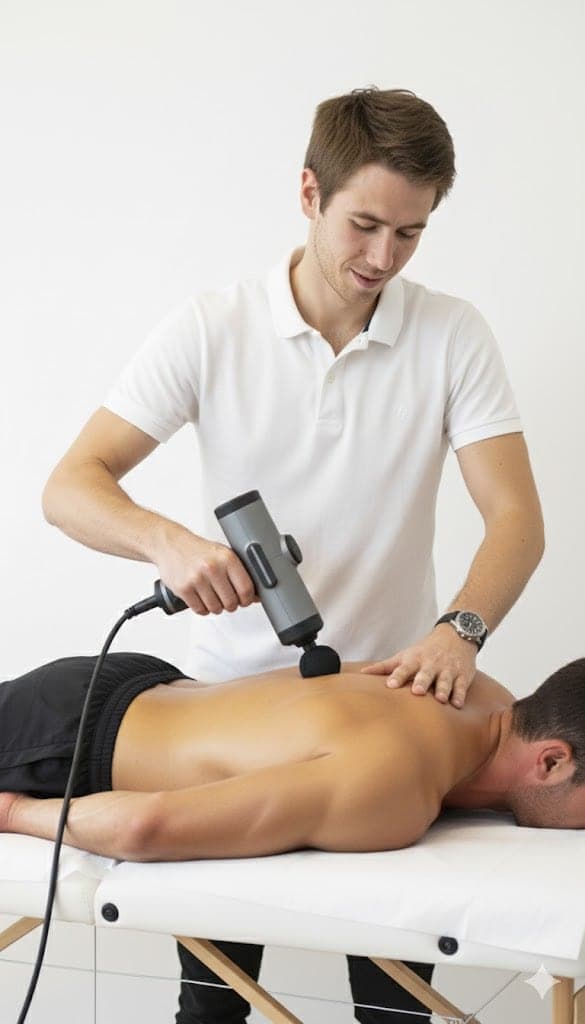
This is where my method diverges fundamentally from traditional approaches. The specialized machine I use delivers consistent, controlled pressure that can work 4-6 centimeters deep into tissue—far beyond what hot stones or human hands can reach. When combined with an understanding of biomechanics and body mechanics from my Physical Education background, the results are measurably different.
I’m not suggesting hot stone massage advantages are worthless. I’m stating clearly that they’re incomplete. Heat prepares tissue for mechanical intervention. It increases pain tolerance, allowing deeper work. It enhances circulation, which supports healing. But it doesn’t do the fundamental restructuring necessary for lasting change.
Circulation Enhancement: Beyond Superficial Flow
Let’s examine the circulation claim more rigorously. Yes, hot stone massage advantages include improved blood flow. The warmth dilates capillaries and increases cardiac output slightly. But consider what that actually accomplishes for someone with chronic muscle dysfunction.
Improved circulation delivers nutrients and oxygen. Excellent. It removes metabolic waste. Beneficial. But if the fascial restrictions remain—if the tissue architecture is still compromised—that enhanced circulation is flowing through a system with fundamental structural problems. It’s like improving fuel delivery to an engine with mechanical damage. Helpful, but insufficient.
What True Circulatory Enhancement Requires
Through my years of clinical practice, I’ve observed that lasting circulatory improvements require mechanical restoration of tissue health. Here’s why:
Fascial restrictions create areas of compression where blood flow is mechanically impeded. No amount of heat-induced vasodilation overcomes physical tissue compression. Similarly, trigger points—hyperirritable spots in taut bands of muscle—create local ischemia (reduced blood flow) through sustained contractile activity. Heat may temporarily reduce this, but the trigger point itself must be mechanically released for circulation to normalize durably.
My approach addresses this through:
- Precise identification of fascial restriction patterns using clinical assessment
- Mechanical release of adhesions using controlled, sustained pressure at depths hands cannot reach
- Systematic deactivation of trigger points through targeted compression protocols
- Restoration of proper tissue glide and mechanical function
This isn’t relaxation therapy. It’s clinical intervention with measurable, lasting outcomes.
The Hot Stone Massage Advantages: A Clinical Assessment
I want to be completely fair in this assessment. Hot stone massage does provide legitimate advantages when understood and applied appropriately:
Documented Benefits:
- Acute Pain Management: The heat effectively modulates pain signals through gate control mechanisms and increased endorphin production
- Pre-Treatment Preparation: Warming tissue before mechanical intervention increases extensibility and pain tolerance
- Stress Reduction: The parasympathetic activation from heat therapy genuinely reduces cortisol and promotes relaxation
- Sleep Quality: The temperature changes and relaxation response can improve sleep architecture
- Cardiovascular Response: Mild improvements in blood pressure and heart rate variability in healthy individuals
Critical Limitations:
- Temporal Constraint: Effects last hours, not days or weeks
- Superficial Depth: Heat penetrates only 2-3 cm, missing deeper fascial layers
- Passive Treatment: Doesn’t address biomechanical dysfunction or movement patterns
- Symptomatic Focus: Treats sensation (pain) rather than cause (mechanical dysfunction)
- Dependency Creation: Clients require frequent repeat sessions without progressive improvement
The Integrated Approach: Combining Heat with Mechanical Precision
Here’s what I’ve learned from treating hundreds of clients with chronic pain and performance limitations: hot stone massage advantages are maximized when integrated with proper mechanical intervention, not used as a standalone treatment.
Consider this framework:
Heat serves as preparation. It increases tissue temperature, reduces viscosity, elevates pain threshold, and activates relaxation responses. These physiological changes create optimal conditions for the real work: precise mechanical release of fascial restrictions, trigger point deactivation, and restoration of proper tissue mechanics.
When I work with a client, the sequence matters enormously. If their tissue is cold and guarded, mechanical intervention requires more force and creates more discomfort. If I first apply heat—whether through stones, warm compresses, or thermal packs—the tissue becomes more receptive. The client’s nervous system shifts from protective guarding to receptive relaxation. Then my specialized mechanical approach can work efficiently at the depths necessary to create structural change.
The Results-Driven Protocol
My standard protocol for chronic muscle tension and circulatory dysfunction follows this sequence:
- Clinical Assessment: Identify specific fascial restrictions, trigger points, and biomechanical dysfunctions
- Thermal Preparation: Apply controlled heat to target tissues, preparing them for mechanical work
- Mechanical Intervention: Use precision deep-tissue techniques at 4-6 cm depth to release restrictions
- Movement Integration: Guide the client through specific movements to reinforce new tissue patterns
- Progressive Planning: Design customized treatment progressions targeting lasting resolution
This is not a relaxation session. It’s a clinical intervention designed to produce measurable, lasting change in tissue function and pain levels.
Real-World Applications: When Hot Stone Massage Advantages Matter
I’ve found certain scenarios where the hot stone massage advantages provide genuine value within an integrated treatment approach:
Scenario One: The Desk Worker with Chronic Upper Back Tension
A client I worked with last year—an architect spending 10-12 hours daily at a computer—had developed severe upper trapezius and rhomboid tension. She’d been getting monthly hot stone massages for two years. They helped temporarily, but the tension always returned.
The hot stone massage advantages were real: she felt relaxed, her pain decreased for 2-3 days, her sleep improved temporarily. But the fundamental problem was mechanical: her scapular stabilizers had developed fascial restrictions and dysfunctional firing patterns from prolonged poor posture. The heat couldn’t address this.
We integrated heat application with mechanical release of her fascial restrictions and trigger points, followed by corrective exercises for scapular control. Six sessions over three months. The chronic tension resolved. A year later, she remains pain-free with minimal maintenance.
Scenario Two: The Athlete with Circulation Limitations
A competitive cyclist came to me with chronic calf tightness affecting his performance. He’d tried everything including regular hot stone massage. The circulation improvements from heat therapy helped temporarily, but his race times were stagnating.
Clinical assessment revealed severe fascial restrictions in his gastrocnemius and soleus from overuse without adequate recovery protocols. The hot stone massage advantages—improved blood flow, reduced acute tension—provided temporary relief but didn’t address the underlying fascial adhesions restricting proper muscle function.
Through systematic mechanical release combined with thermal preparation, we restored proper tissue mechanics. His circulation improved not just temporarily from vasodilation, but durably from resolved mechanical restrictions. His performance improved measurably, and he set personal records in his next competition season.
The Investment Perspective: Understanding Value Beyond Sensation
Let me address this directly: if you’re seeking hot stone massage advantages purely for relaxation and temporary stress relief, traditional spa treatments serve that purpose adequately. They’re pleasant experiences with short-term benefits.
But if you’re dealing with chronic pain, restricted mobility, or performance limitations, you need to think differently. The question isn’t “Does this feel good?” but “Does this solve the problem durably?”
From this perspective, repeated hot stone massage sessions become an ongoing expense—a subscription to temporary relief without resolution. You’ll need treatments monthly, sometimes weekly, indefinitely. The circulatory improvements and muscle tension relief last days, requiring continuous reinvestment.
The Alternative: Lasting Resolution
My approach represents a different philosophy entirely. I’m not interested in creating dependency through temporary relief. I’m focused on lasting resolution through systematic mechanical intervention.
This means:
- Fewer total sessions (typically 4-8 for chronic conditions versus indefinite monthly treatments)
- Progressive improvement with each session, not cyclical relief and return
- Measurable changes in pain levels, range of motion, and functional capacity
- Education enabling you to maintain results independently
- Freedom from ongoing treatment dependency
Yes, my sessions are longer and more intensive. Yes, they require active participation and sometimes discomfort as we release deeply-held restrictions. But the outcome is fundamentally different: lasting change rather than temporary relief.
The Clinical Truth About Circulation and Muscle Tension
After ten years and hundreds of clients, I can state this with confidence: the hot stone massage advantages you’ve heard about are physiologically real but clinically insufficient for chronic conditions.
Improved circulation from heat therapy is genuine. Studies confirm it. I’ve seen it in practice. But circulation enhancement means nothing if the tissue architecture remains dysfunctional. It’s treating a symptom while ignoring the cause.
Muscle tension relief from heat application is legitimate. The warmth overrides pain signals, reduces muscle spindle sensitivity, and activates relaxation responses. But these effects are temporary precisely because they don’t address the neurological and mechanical factors maintaining the tension.
What Lasting Resolution Requires
Based on my education in Physical Education and Nutrition and a decade of specialized practice, I know that lasting improvement requires:
- Mechanical Release: Physical breaking up of fascial adhesions and trigger points at depths heat cannot reach
- Neurological Reset: Deactivation of protective muscle guarding patterns through precise intervention
- Biomechanical Correction: Restoration of proper movement patterns and tissue mechanics
- Progressive Strengthening: Building capacity in previously dysfunctional tissues
- Education: Understanding and maintaining the changes independently
Heat therapy—including hot stone massage advantages—can support this process. It cannot replace it.
The Machine Advantage: Precision, Power, and Consistency
Let me explain why my specialized mechanical approach delivers results that traditional hot stone massage cannot achieve, regardless of how skilled the practitioner or how effectively the heat is applied.
Depth of Intervention:
Human hands, even with excellent technique, penetrate approximately 1-2 centimeters into tissue. Hot stones add warmth but no additional mechanical depth. My specialized machine works consistently at 4-6 centimeters, reaching fascial layers and trigger points that neither hands nor heat can access.
This depth matters enormously for chronic conditions. The fascial restrictions causing your pain often exist in deep layers—beneath the superficial muscles where hot stones work, beyond the depth where even skilled manual therapy reaches. Until you address these deep restrictions mechanically, you’re treating surface symptoms while the root cause remains untouched.
Controlled Intensity:
With hot stones or manual therapy, intensity is limited by the practitioner’s strength and endurance. Quality varies based on their physical condition, technique, and fatigue level. My machine delivers precisely calibrated pressure from light to powerfully deep, adjusted exactly to your needs and tolerance, maintained consistently throughout the session.
This precision eliminates the “off days” inherent in human-delivered treatment. Every session provides exactly the intervention needed at exactly the intensity required. No variation, no unpredictability, no compromise.
Sustained Compression:
Releasing a mature trigger point or fascial adhesion often requires sustained pressure for 60-90 seconds or longer. Human hands tire. Attention wavers. Pressure becomes inconsistent. The machine maintains exact pressure indefinitely, allowing complete release of even the most stubborn restrictions.
Common Misconceptions About Hot Stone Massage Advantages
Through my decade of practice, I’ve encountered several persistent misconceptions about hot stone massage advantages that deserve direct correction:
Misconception One: “Regular Hot Stone Massage Will Eventually Resolve Chronic Tension”
I hear this frequently: “I’ve been getting hot stone massages for years, and they help, so I just need to keep going regularly.”
The clinical reality: if the problem hasn’t resolved after consistent treatment over months or years, the treatment approach isn’t addressing the root cause. Chronic fascial restrictions and trigger points don’t gradually dissolve from repeated heat application. They require specific mechanical intervention.
If you’ve been receiving hot stone massage monthly for more than six months without lasting improvement, the treatment modality is insufficient for your condition. You’re managing symptoms, not resolving dysfunction.
Misconception Two: “Improved Circulation Equals Muscle Recovery”
Enhanced blood flow from hot stone massage advantages does support recovery processes. But circulation improvement is only one factor in tissue healing. Without mechanical release of restrictions, proper biomechanical loading, and neurological reset, improved circulation simply feeds dysfunctional tissue slightly better.
Recovery requires restoration of proper tissue function, not just enhanced nutrient delivery.
Misconception Three: “Deeper Heat Penetration Means Deeper Treatment”
Some hot stone massage practitioners use extremely hot stones or prolonged application, believing this increases treatment depth. It doesn’t. Heat penetrates tissue based on thermal conductivity, which is limited by physiological factors. Making stones hotter or applying them longer doesn’t increase mechanical intervention depth—it just risks burns.
True depth requires mechanical pressure, not thermal energy.
When to Choose Integrated Mechanical Treatment Over Traditional Hot Stone Massage
Based on my clinical experience, consider mechanical intervention if:
- You’ve been receiving regular hot stone massage without lasting improvement for more than 3-6 months
- Your muscle tension returns within days or weeks after treatment
- You have specific areas of chronic restriction or pain that never fully resolve
- Your performance (athletic or daily function) is limited by muscular dysfunction
- You’re interested in lasting resolution rather than ongoing management
- You want to understand and address the root cause of your condition
Traditional hot stone massage remains appropriate if you’re seeking:
- Stress reduction and relaxation without specific pain conditions
- Temporary relief for acute muscle soreness
- A pleasant, low-intensity therapeutic experience
- Supplementary treatment alongside other interventions
The Dedicated Partnership Approach
I don’t offer one-off sessions. This isn’t a spa service where you come in, feel better temporarily, and leave. My practice is built on dedicated partnerships with clients who want lasting resolution.
This means:
Comprehensive Assessment: I spend substantial time understanding your specific condition, history, biomechanics, and goals. This isn’t a standard intake form. It’s a detailed clinical evaluation.
Customized Treatment Plans: Based on my assessment, I design a progressive intervention strategy targeting your specific dysfunctions. This plan adapts as your condition improves, always focusing on lasting resolution.
Education and Empowerment: I explain exactly what’s happening in your body, why you have the dysfunction, and how we’re addressing it. You understand the process, participate actively, and learn to maintain results independently.
Consistent Follow-Through: I travel to your location with professional equipment, ensuring treatment consistency and convenience. No variability in environment, no compromised positioning, no excuses.
Measurable Outcomes: We track specific metrics—pain levels, range of motion, functional capacity—to verify progress objectively. If something isn’t working, we adjust the approach based on evidence, not assumption.
Frequently Asked Questions About Hot Stone Massage Advantages and Mechanical Treatment
How long do hot stone massage circulation improvements actually last?
Clinical studies show that circulatory changes from heat therapy persist for 30-90 minutes post-treatment, with some residual effects up to 4 hours. However, these are temporary physiological responses to temperature change, not lasting improvements in tissue function. Lasting circulatory enhancement requires resolution of mechanical restrictions that physically impede blood flow.
Can hot stone massage durably resolve muscle tension?
In cases of acute, stress-related muscle tension without underlying fascial restrictions or trigger points, repeated hot stone massage may help establish relaxation patterns that reduce tension over time. However, chronic muscle tension involving fascial adhesions, trigger points, or biomechanical dysfunction requires mechanical intervention for lasting resolution. Heat therapy alone addresses symptoms, not structural causes.
Is mechanical deep-tissue treatment more painful than hot stone massage?
Mechanical intervention works at depths and intensities that create temporary discomfort when releasing restrictions. However, I precisely control intensity based on your tolerance, and thermal preparation reduces discomfort significantly. Clients consistently report that brief intervention discomfort is vastly preferable to ongoing chronic pain, especially when it produces lasting resolution rather than temporary relief.
How many sessions does mechanical treatment require versus ongoing hot stone massage?
Most chronic conditions respond to 4-8 mechanical treatment sessions over 2-3 months, after which clients maintain results independently with minimal intervention. In contrast, hot stone massage for chronic conditions typically requires indefinite ongoing sessions (monthly or more frequently) for continued relief. The investment differs substantially over time.
Can I combine hot stone massage with mechanical treatment?
Absolutely. Heat therapy serves excellently as preparation for mechanical intervention, increasing tissue receptivity and reducing protective guarding. I often use thermal preparation before precision deep-tissue work. However, heat should be understood as preparation, not as primary treatment for chronic mechanical dysfunction.
Why doesn’t traditional massage address the root cause?
Traditional massage, including hot stone techniques, typically works at superficial to moderate depths (0-2 cm) with intermittent pressure patterns designed for relaxation and general tension reduction. Chronic dysfunctions often involve fascial restrictions and trigger points at 3-6 cm depth requiring sustained, precise pressure for 60-90 seconds or longer. The tools, techniques, and treatment philosophy differ fundamentally between relaxation therapy and clinical mechanical intervention.
What makes your machine-assisted approach different?
Three critical factors: depth (4-6 cm versus 1-2 cm for hands), consistency (identical pressure throughout sessions, eliminating practitioner variability), and precision (exactly calibrated intensity maintained for the duration needed to release restrictions). Combined with my clinical knowledge from ten years of practice and university education in body mechanics, this approach addresses mechanical dysfunction that manual therapy cannot reach effectively.
Do I need to do anything between sessions?
Yes. Lasting resolution requires active participation. I provide specific movement protocols, postural awareness cues, and sometimes corrective exercises to reinforce the mechanical changes we create during sessions. This isn’t passive treatment where you simply receive and leave. It’s a partnership focused on lasting independence from chronic dysfunction.
The Bottom Line: Understanding Hot Stone Massage Advantages in Context
I’ve spent ten years mastering the mechanics of human movement and pain resolution. My Bachelor’s degree in Physical Education and Nutrition provided the theoretical foundation. Hundreds of client cases provided the practical wisdom. And that wisdom comes down to this:
Hot stone massage advantages are real, measurable, and valuable for specific applications. Improved circulation, temporary muscle tension relief, stress reduction, and pain modulation through heat therapy are legitimate physiological responses with clinical documentation.
But these advantages are temporary and superficial. They address sensation more than structure, symptoms more than cause. For acute conditions, stress management, or supplementary care, they serve appropriately. For chronic pain, persistent dysfunction, or performance optimization, they’re insufficient.
Lasting resolution requires mechanical intervention at depths heat cannot reach, addressing fascial restrictions and trigger points that maintain dysfunction regardless of temporary circulation improvements or pain modulation. It requires understanding biomechanics, not just applying warmth. It requires treating the cause, not managing symptoms indefinitely.
This is why I’ve dedicated my practice to results-driven mechanical treatment using specialized tools that deliver precision, power, and consistency beyond human capability. Not because traditional massage is worthless—it serves its purpose—but because chronic dysfunction demands more than temporary relief. It demands lasting resolution.
If you’ve been cycling through hot stone massages month after month with the same problems returning repeatedly, you deserve better. You deserve treatment that addresses the root cause, produces measurable improvement, and leads to lasting independence from chronic pain and dysfunction.
That’s not relaxation therapy. That’s clinical intervention. And it’s what I provide through dedicated partnership, customized treatment plans, and specialized mechanical precision that reaches the depths where your actual problem exists.
The hot stone massage advantages you’ve read about are true. They’re just incomplete. And if you’re serious about lasting resolution rather than ongoing management, that distinction matters enormously.
Written by
Chris
Massage therapist & body mechanics specialist
Norwegian-certified with a Bachelor’s in Physical Education and Nutrition and over ten years of clinical practice, working from a portable table in clients’ homes across the Paphos district.
This article is general information from clinical practice, not a medical diagnosis. If you have severe, worsening or unexplained pain, numbness, weakness, or pain after an accident, see a doctor first.