Post-race massage Paphos: recovery work after the finish line
In short
Post-race massage Paphos: I come to your villa or hotel one to two days after the event, work the calves, hamstrings, glutes and hip flexors with mechanical deep-tissue tools, and leave you walking more freely.
If you have just finished a race in the Paphos district and your legs feel like they belong to someone else, this page explains what I do about it. My work with runners in Paphos is mechanical deep-tissue recovery, brought to your door in the day or two after the finish, not a rub-down in a race village tent.
Post-race massage Paphos is a phrase people search for after the marathon, the half, the trail events in the Akamas and the spring cycling sportives. What most of them want is simple: to walk down stairs again without wincing, and to get back to training without carrying the race around in their calves for a month. That is what this article covers.
What a race actually does to your legs
A hard race is not just fatigue. The repeated eccentric loading of a long run leaves small tears in the muscle fibres, mostly in the calves, hamstrings and quads. The body responds with inflammation, some swelling, and protective tightening. That tightening is why the day-two stiffness feels worse than the day-one tiredness.
If the muscles are left to shorten and knit back together on their own, some of that repair is untidy. Fibres heal with a little less glide between them, and the muscle stays a fraction shorter and stiffer than it was. On its own this is minor. Stacked across a season of racing, it is the pattern I see most often in Paphos runners who arrive with a "tight calf that never quite goes" or a hip that aches on every long run.
The presentation I meet most often after a race looks like this:
- Calves and soles of the feet that are tender to touch and stiff on the first steps in the morning
- Hamstrings that feel short and cramp when you bend to tie a shoe
- Deep gluteal soreness that makes sitting on hard chairs unpleasant
- Hip flexors that ache at the front of the hip after long or hilly courses
- A general sense of being "shorter" and heavier through the legs
None of this is dangerous. It is what a body looks like a day after asking a great deal of it. But it responds well to precise, deep, mechanical work, and it responds better in a specific window.
When to book post-race massage Paphos
Timing matters more than most people realise. There are three phases after a race, and each wants something different.
| Time after race | What the tissue is doing | What I recommend |
|---|---|---|
| 0–24 hours | Acute inflammation, swelling, very tender | Walk, eat, sleep, gentle movement; no deep work |
| 24–48 hours | Inflammation settling, stiffness peaking | The best window for a full recovery session |
| 3–7 days | Repair and remodelling under way | Still worthwhile; deeper, more specific work possible |
Straight after the finish, deep pressure on inflamed, freshly damaged tissue does more harm than good. Light circulatory work has a place, but that is not what I do and it is not what mechanical deep-tissue is for. I would rather you spent the first evening eating, drinking and sleeping.
By the next day or the day after, the swelling has come down enough that I can work into the deeper layers without fighting the body's own response. This is when a session makes the biggest difference to how the following week feels. If you missed that window and it is now day four or five, book anyway. The tissue is simply firmer and I work more slowly through it.
What I do in a post-race session
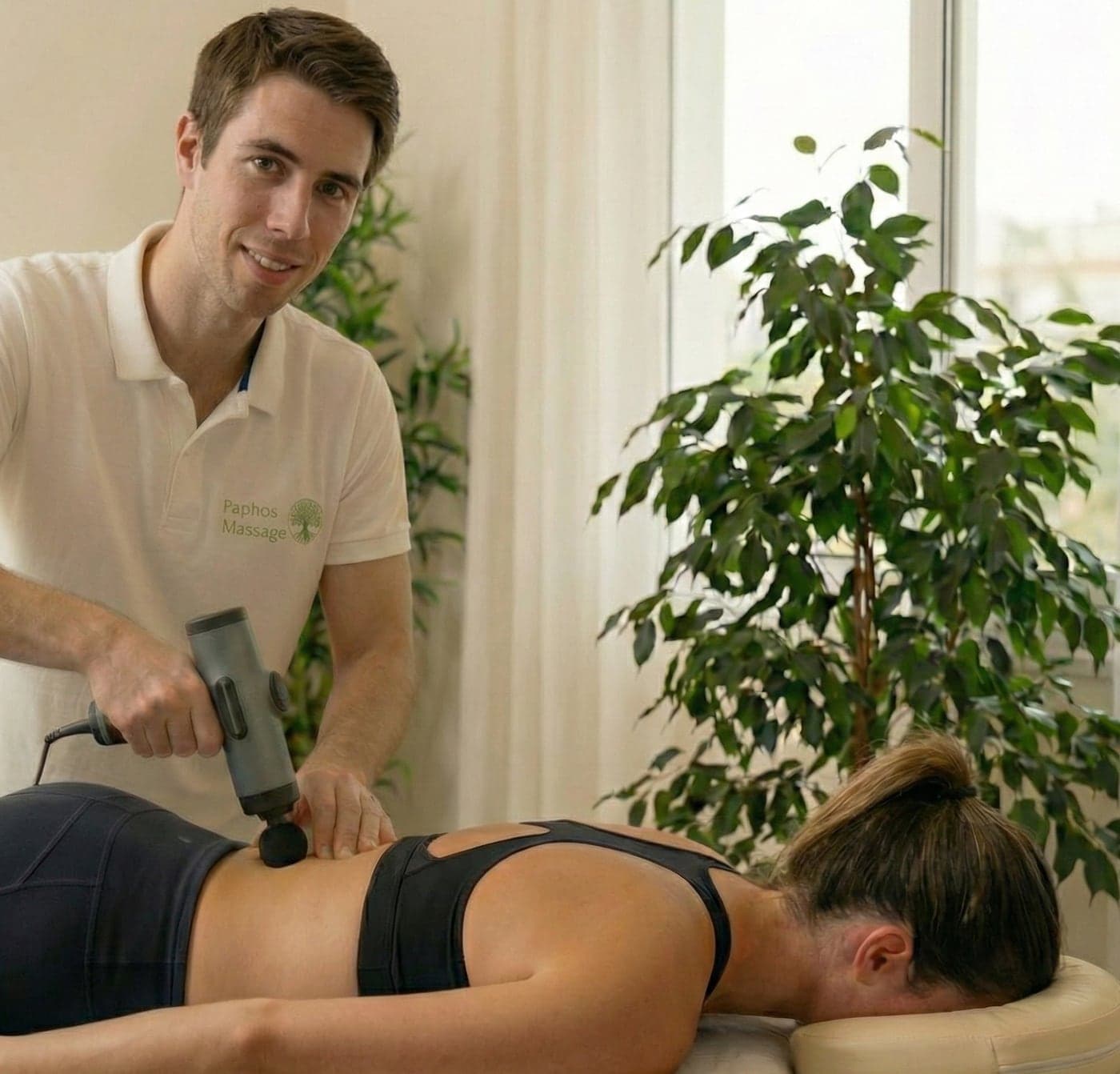
I set up a treatment table in your villa, apartment or hotel room and start by watching you move: a few steps, a squat, a reach. After a race, most people are guarding somewhere without knowing it, and that guarding tells me where the real restriction is before I put a hand on anything.
I use mechanical deep-tissue tools rather than relying on my hands alone. Sustained, consistent pressure at depth is what tight, post-race tissue responds to, and tools deliver that far more evenly than fingers and thumbs can over a full session. I control the depth by feel and by your feedback throughout.
The sequence I follow after most running events:
- Feet and deep calves — the soles, gastrocnemius, soleus and the deep posterior compartment, because restriction here pulls on everything above it
- Hamstrings and the back of the knee
- Glutes and the deep hip rotators, where a lot of the "cannot sit comfortably" soreness lives
- Hip flexors and quads, which often let go easily once the back of the leg has been treated
- Low back and, on request, shoulders and neck
I finish with a few minutes of guided movement so the nervous system registers the new range rather than snapping back to the guarded pattern. Ninety minutes suits a marathon or a triathlon; sixty covers a 10K, a half, or legs that were only moderately loaded.
The pressure is firm and at times uncomfortable, but it should never make you brace or hold your breath. Deep work that you cannot relax into is work being done to you, not for you, and it does not achieve as much.
Runners, cyclists and triathletes are not the same
The principle is the same but the priorities shift with the sport, and I adjust the plan on the day.
- Road and trail runners: calves, feet and hamstrings first; the trail events add tender quads from descents and more low-back involvement
- Cyclists after a sportive or a Troodos stage: hip flexors, quads and the front of the thigh dominate, with the neck and upper back tight from the riding position
- Triathletes: a mix of the two, plus the shoulders and lats from the swim; I still start at the feet because the run is the last and most damaging leg
- Walkers and hikers after a long Akamas route: calves and feet much like runners, often with more soreness at the front of the shin
If you race regularly rather than once a year, a session after every major event and something lighter mid-block, such as a sports massage, keeps the tightness from accumulating. That is a rhythm many of the Paphos runners and cyclists I see settle into.
Why I bring the treatment to you
The day after a race, the last thing anyone wants is a drive across town and a waiting room. So I come to you. I cover Paphos town, Kato Paphos, Chlorakas, Coral Bay, Peyia, Tala, Emba, Geroskipou and the surrounding villages, with a folding table and everything needed for a full session.
- No driving on stiff legs before or after treatment
- You can lie down, eat and rest immediately afterwards
- The window on day one or two is easier to keep when nobody has to travel
- I can start the guided movement in the space you will actually be recovering in
Sessions are €90 for 60 minutes and €130 for 90 minutes, and every fifth session is free. Full details are on the pricing page. Booking is by WhatsApp or phone; if you know your race date in advance, message me before the event and I will hold a slot for the day after.
What I can and can't help with
I can help with the ordinary aftermath of hard racing: stiff, tender, shortened muscles, deep gluteal and hip soreness, tight calves and feet, and the sense of not moving freely. I cannot fix a joint injury, a stress fracture or a torn muscle, and I do not try to. See a doctor first if you have sharp pain in one specific spot that worsens with weight-bearing, swelling in a joint, calf pain that is hot, red or one-sided, chest symptoms, dark urine after the race, or numbness anywhere. Once those have been ruled out, recovery work is safe and useful.
Frequently asked questions
How soon after a race should I book?
The best window is 24 to 48 hours after the finish. Straight after the race the tissue is inflamed and too tender for deep work, so I do not treat on the day. From the next day onward, once swelling has settled, I can work into the deeper layers where post-race stiffness sits. Later than that is still worthwhile; I simply work more slowly and adjust the depth to how the muscle presents.
Is a post-race session painful?
It is firm and at times uncomfortable, especially through the calves and glutes after a long event, but it should not make you brace or hold your breath. I adjust the pressure to what your tissue accepts on the day, and post-race work is generally a notch lighter than a mid-season deep-tissue session. Most people describe it as intense but relieving rather than painful.
Should I choose 60 or 90 minutes after a race?
Sixty minutes covers a 10K, a half marathon or a moderate sportive, working the calves, hamstrings, glutes and hips properly. Ninety minutes suits a full marathon, a triathlon, a long trail race or anything where the upper body also needs attention. If in doubt, tell me the event on WhatsApp and I will suggest a length rather than sell you the longer one by default.
Can I train again after the session?
Walk and move gently the same day and leave hard training for 24 hours. The tissue needs a little time to settle after deep work before it is loaded again. Most people find the first easy run afterwards feels lighter than they expected. If a session leaves you unusually sore beyond a day, ease back further and let me know so I can adjust next time.
Is there a mobile massage therapist near me in Paphos?
Yes. I am based in Chlorakas, just north of Paphos town, and I bring the table and equipment to your home, villa or hotel across Paphos town, Kato Paphos, Coral Bay, Peyia, Tala, Emba, Geroskipou and the nearby villages. Sessions are €90 for 60 minutes and €130 for 90 minutes. Booking is by WhatsApp or phone, and race-day-plus-one slots can be reserved in advance.
Do you only treat serious competitors?
No. The muscle response to a hard effort is the same whether it was your first 10K or your fifteenth marathon, and a first-time finisher is often stiffer than someone who races every month. I treat anyone who has pushed their legs harder than usual and wants to recover well, including walkers and hikers back from a long day in the Akamas.
Written by
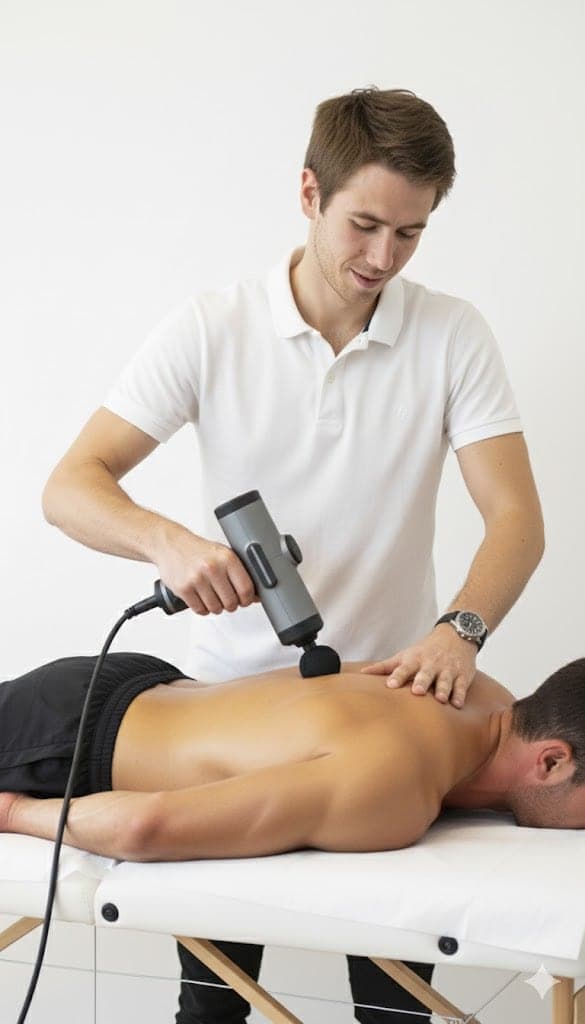
Chris
Massage therapist & body mechanics specialist
Norwegian-certified with a Bachelor’s in Physical Education and Nutrition and over ten years of clinical practice, working from a portable table in clients’ homes across the Paphos district.
- Norwegian-certified
- BSc Physical Education & Nutrition
- 10+ years clinical practice
- Based in Chlorakas · all of Paphos district
- No call-out fee anywhere in Paphos district
Last reviewed
This article is general information from clinical practice, not a medical diagnosis. If you have severe, worsening or unexplained pain, numbness, weakness, or pain after an accident, see a doctor first.