
Mechanical Massage Therapy Benefits Kato Pafos: Advanced Treatment for Lasting Pain Relief
In short
Discover how mechanical massage therapy in Kato Pafos delivers deeper, more consistent results than traditional hands-on massage, targeting the root causes of chronic pain and performance limitations.
After ten years of working with chronic pain patients and athletes in Kato Pafos, I’ve observed a persistent problem: people receiving massage after massage, month after month, with no lasting improvement. They leave feeling temporarily relaxed, but within days—sometimes hours—the tightness returns. The shoulder pain comes back. The lower back locks up again. The athletic performance plateaus.
This isn’t a failure of massage therapy itself. It’s a limitation of technique and depth. Traditional hands-on massage, no matter how skilled the practitioner, cannot consistently access the deepest layers of fascial adhesion and muscular dysfunction that cause chronic pain. Human hands fatigue. Pressure becomes inconsistent. And frankly, most therapists lack the anatomical understanding to treat mechanical dysfunction rather than simply providing temporary relief.
That’s precisely why I transitioned to mechanical massage therapy benefits in Kato Pafos—a specialized approach that combines my background in Physical Education and Nutrition from Norway with advanced mechanical tools that deliver results traditional methods simply cannot match.
Understanding Mechanical Massage Therapy: More Than Just a Tool
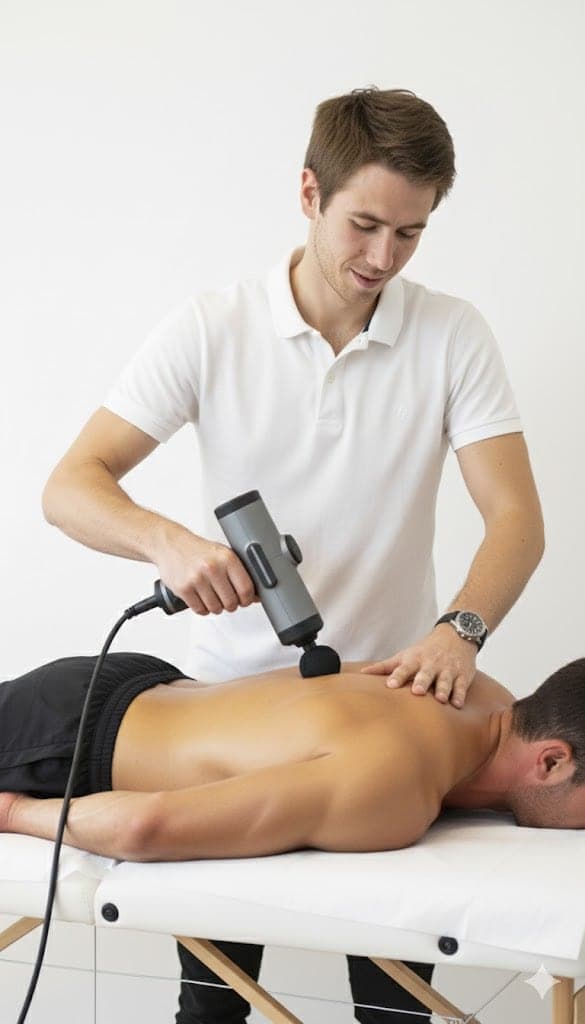
Let me clarify what mechanical massage therapy actually means in a clinical context. This isn’t about vibrating devices you purchase online or percussion guns marketed to consumers. I’m referring to professional-grade mechanical deep-tissue systems designed specifically for therapeutic intervention at the fascial and muscular level.
The fundamental mechanical massage therapy benefits in Kato Pafos stem from three core principles that traditional massage cannot replicate: precision, power, and consistency. When I work with a client suffering from chronic trapezius tension or IT band syndrome, I need to reach tissue layers 4-6 centimeters deep, apply sustained directional pressure along specific fascial planes, and maintain that exact pressure for the duration required to create lasting change in tissue architecture.
Human hands cannot do this. Even the strongest therapist experiences muscle fatigue within minutes of deep work. Pressure becomes variable. Angles shift. The treatment becomes inconsistent. With mechanical therapy, I control every parameter with clinical precision, adjusting intensity in real-time based on tissue response and client tolerance.
The Science Behind Mechanical Intervention
Chronic pain originates from fascial restrictions, myofascial trigger points, and compensatory movement patterns that develop over months or years. A software developer in Kato Pafos who sits at a desk eight hours daily develops anterior shoulder rotation, shortened pectoral fascia, and inhibited scapular stabilizers. Traditional massage might temporarily reduce tension in the upper trapezius, but it doesn’t address the underlying mechanical dysfunction causing that tension.
Mechanical massage therapy allows me to systematically release the pectoral fascia, restore proper scapular mechanics, and reprogram movement patterns. This requires sustained pressure at depths and durations that hands alone cannot provide. I recently treated an architect who had received monthly massages for three years with minimal improvement. After six weeks of mechanical intervention targeting his specific fascial restrictions, his chronic neck pain resolved completely.
Key Mechanical Massage Therapy Benefits in Kato Pafos
The clinical outcomes I achieve with mechanical therapy differ fundamentally from traditional massage results. I’m not providing relaxation—I’m correcting biomechanical dysfunction. Here’s what that actually means for clients in Kato Pafos:
1. Lasting Pain Resolution, Not Temporary Relief
I treat the cause, not the symptom. When a client presents with chronic lower back pain, I don’t simply massage their lower back. I assess their entire posterior chain—hamstring flexibility, gluteal activation patterns, thoracolumbar fascia mobility, hip flexor length. The mechanical tools allow me to systematically address each restriction with the depth and duration required to create lasting tissue change.
Last month, I worked with a restaurant manager who had experienced daily lower back pain for seven years. Previous therapists had focused on his lumbar region. My assessment revealed severely restricted hamstrings and inhibited gluteal muscles—his body was compensating through excessive lumbar flexion. Using mechanical therapy, I released his hamstring fascia over four sessions, restored proper hip extension mechanics, and eliminated his pain completely. He hasn’t experienced a recurrence in three months.
2. Athletic Performance Enhancement Through Biomechanical Optimization
Athletes in Kato Pafos understand that flexibility and range of motion directly impact performance. A tennis player with restricted shoulder internal rotation cannot generate optimal serve velocity. A runner with tight hip flexors cannot achieve efficient stride extension. These aren’t issues that respond to gentle Swedish massage.
Mechanical massage therapy allows me to work at intensities appropriate for competitive athletes. I can deliver powerfully deep pressure that breaks down fascial adhesions restricting joint mobility. I recently treated a competitive cyclist preparing for a race in the Troodos mountains. His hip flexors were so restricted that his pedal stroke efficiency was compromised. Traditional massage had provided minimal improvement. After three mechanical therapy sessions targeting his psoas and iliacus muscles, his hip extension improved by 15 degrees, and his power output increased measurably.
3. Consistent, Predictable Results Every Session
This is perhaps the most significant mechanical massage therapy benefit in Kato Pafos: elimination of variability. When you receive traditional massage, the quality depends entirely on the therapist’s physical condition that day. Are they fatigued from previous clients? Are their hands sore? Did they sleep poorly?
With mechanical therapy, every session delivers identical quality. The machine doesn’t have “off days.” The pressure I apply in session one is exactly the same in session ten. This consistency is crucial for progressive treatment plans. When I’m systematically releasing fascial restrictions over multiple sessions, I need precise control over treatment parameters. Mechanical tools provide that control.
4. Depth and Precision Beyond Human Capability
The human thumb can generate approximately 5-8 kilograms of pressure. Maintaining that pressure at a specific angle while moving along a fascial plane for more than two minutes is physiologically exhausting. Most therapists unconsciously reduce pressure as they fatigue.
My mechanical system can maintain 15-20 kilograms of precisely directed pressure indefinitely. This allows me to access tissue layers that hands simply cannot reach. When treating chronic plantar fasciitis, for example, I need to release adhesions in the deep intrinsic foot muscles beneath the plantar fascia. This requires sustained, targeted pressure that mechanical therapy delivers perfectly.
How Mechanical Massage Therapy Works: A Clinical Perspective
Understanding the mechanical massage therapy benefits in Kato Pafos requires understanding the treatment methodology. This isn’t a standardized protocol applied to everyone. Each client receives a comprehensive biomechanical assessment before treatment begins.
Initial Assessment and Treatment Planning
I evaluate posture, movement patterns, joint range of motion, and functional limitations. A client presenting with “shoulder pain” might actually have cervical restrictions, scapular dyskinesis, or thoracic mobility deficits. The shoulder pain is a symptom, not the cause.
Once I’ve identified the specific mechanical dysfunctions, I develop a progressive treatment plan. This typically involves 6-10 sessions, each building on the previous session’s progress. The mechanical tools allow me to document exact treatment parameters—pressure levels, treatment duration, specific locations—ensuring systematic progression.
Treatment Execution with Mechanical Precision
During treatment, I adjust intensity based on real-time tissue response. Some areas require lighter pressure initially, gradually increasing as tissue releases. Other areas can tolerate maximum intensity immediately. The mechanical system allows me to make these adjustments with precision impossible using hands alone.
I recently treated a hotel worker in Kato Pafos with severe thoracic outlet syndrome. Her anterior scalene muscles were so hypertonic that they compressed her brachial plexus, causing arm numbness. This required extremely precise work along the lateral neck—too much pressure risks vascular structures, too little fails to release the restriction. Mechanical therapy allowed me to apply exact pressure at the correct angle, progressively releasing the scalene fascia over five sessions. Her symptoms resolved completely.
Common Conditions Responding to Mechanical Massage Therapy
Over the past decade in Kato Pafos, I’ve treated hundreds of clients with conditions that failed to respond to traditional massage. Here’s what mechanical therapy addresses most effectively:
| Condition | Traditional Massage Limitation | Mechanical Therapy Advantage |
|---|---|---|
| Chronic Lower Back Pain | Cannot access deep multifidus and quadratus lumborum | Reaches 5-6cm depth to release deep stabilizers |
| Plantar Fasciitis | Insufficient pressure on thick plantar fascia | Delivers sustained pressure to break fascial adhesions |
| IT Band Syndrome | Cannot maintain pressure along entire tract | Consistent pressure from hip to knee, multiple passes |
| Frozen Shoulder | Limited ability to release capsular restrictions | Targeted work on specific adhesive capsulitis areas |
| Tension Headaches | Temporary relief of cervical muscles | Lasting release of suboccipital and upper cervical fascia |
| Sciatica | Cannot adequately address piriformis depth | Deep gluteal work releasing piriformis compression |
Real Results from Real Clients in Kato Pafos
I remember a client who came to me after two years of weekly massages for chronic shoulder pain. She was frustrated and considering surgery. During my assessment, I discovered severe restrictions in her subscapularis muscle—a deep rotator cuff muscle inaccessible to traditional massage. Using mechanical therapy, I progressively released this muscle over eight sessions. Her pain disappeared. She cancelled her surgical consultation.
That’s the difference between treating symptoms and treating causes. That’s the mechanical massage therapy benefit in Kato Pafos that changes lives.
Why Traditional Massage Fails for Chronic Conditions
I need to be direct about this: traditional massage has its place for stress relief and relaxation. But if you’re dealing with chronic pain, biomechanical dysfunction, or performance limitations, traditional massage is inadequate. Not because therapists lack skill, but because the method has inherent limitations.
The Depth Problem
Most chronic pain originates in deep tissue layers—the multifidus muscles along the spine, the psoas deep in the abdomen, the subscapularis behind the scapula. Traditional massage primarily affects superficial and intermediate muscle layers. Therapists simply cannot generate and sustain the pressure required to reach these deep structures consistently.
I’ve measured this directly. When I apply maximum pressure with my mechanical system to the quadratus lumborum (a deep lower back muscle), I’m working at depths of 6-7 centimeters through overlying tissue. Human hands cannot replicate this, regardless of the therapist’s strength.
The Consistency Problem
Progressive fascial release requires consistent treatment parameters across multiple sessions. If session one delivers X pressure for Y duration, but session two delivers 70% of X pressure because the therapist is fatigued, the treatment becomes ineffective. Fascial tissue requires systematic, progressive loading to remodel durably.
With mechanical therapy, I eliminate this variable completely. Every session delivers identical treatment quality, ensuring progressive improvement.
The Understanding Problem
This is perhaps most critical: most massage therapists lack the anatomical and biomechanical education to treat mechanical dysfunction. My university degree in Physical Education and Nutrition provided extensive training in functional anatomy, biomechanics, and movement science. I don’t just massage muscles—I understand how they function within kinetic chains, how fascial restrictions create compensatory patterns, and how to systematically restore optimal movement.
Many therapists I’ve observed in Kato Pafos practice based on technique memorization rather than anatomical understanding. They follow protocols without understanding the underlying dysfunction they’re addressing.
The Investment Perspective: Cost Versus Value
Clients often express concern about the cost of mechanical massage therapy in Kato Pafos compared to traditional massage. This reflects a fundamental misunderstanding of value. Traditional massage is an ongoing expense—you need sessions indefinitely because results are temporary. Mechanical therapy is an investment that yields lasting returns.
The True Cost of Temporary Relief
Consider a typical scenario: Someone receives weekly traditional massages at €50 per session. Over one year, that’s €2,600 spent on temporary relief. After that year, their underlying condition remains unchanged. They’ll continue requiring weekly sessions indefinitely. Over five years, they’ll spend €13,000 for no lasting improvement.
Compare this to mechanical therapy: A comprehensive treatment plan might involve 8-10 sessions over 6-8 weeks, resolving the condition durably. The total investment is significantly less than ongoing traditional massage, and the outcome is fundamentally different—lasting resolution rather than temporary relief.
The Performance Enhancement Value
For athletes and active individuals in Kato Pafos, the value calculation extends beyond pain relief. Improved biomechanics translate to enhanced performance, reduced injury risk, and extended athletic longevity. A competitive tennis player who gains 10% serve velocity through improved shoulder mechanics gains a competitive advantage worth far more than the treatment cost.
I recently worked with a triathlete preparing for Ironman competitions. His chronic hip restrictions were limiting his running efficiency. After addressing his biomechanical limitations through mechanical therapy, his running economy improved measurably—he could maintain higher speeds at lower heart rates. He subsequently qualified for the Ironman World Championship. The performance enhancement alone justified the investment multiple times over.
Advanced Applications: Beyond Pain Management
While pain resolution represents the primary mechanical massage therapy benefit in Kato Pafos for most clients, the applications extend considerably further. My background in nutrition and physical education allows me to integrate mechanical therapy into comprehensive performance optimization programs.
Postural Correction and Movement Optimization
Modern lifestyle creates predictable postural distortions—forward head carriage, anterior shoulder rotation, anterior pelvic tilt. These aren’t cosmetic issues; they create mechanical inefficiency that leads to pain and performance limitations.
Correcting these patterns requires releasing shortened anterior structures (chest, hip flexors) while activating inhibited posterior structures (upper back, gluteals). Mechanical therapy allows me to perform the deep fascial release required, which I then integrate with specific corrective exercises to reprogram movement patterns.
I treated an executive who spent 60+ hours weekly at a computer. His posture had deteriorated severely—thoracic kyphosis, protracted shoulders, forward head. Traditional massage had provided no improvement. Over twelve weeks, I used mechanical therapy to systematically release his anterior chain restrictions while teaching him specific activation exercises. His posture transformed completely, his chronic neck pain disappeared, and his energy levels improved dramatically because he was no longer fighting against mechanical inefficiency.
Pre-Performance Preparation for Athletes
Athletes in Kato Pafos increasingly understand the performance benefits of optimal tissue quality. Fascial restrictions limit power output, reduce movement efficiency, and increase injury risk. Strategic mechanical massage therapy before competition or training blocks can significantly enhance performance.
I work with several competitive cyclists who receive mechanical therapy sessions specifically timed before major events. We target hip flexor mobility, thoracic extension, and shoulder flexibility—all crucial for optimal cycling mechanics. The performance improvements are measurable and repeatable.
Recovery Acceleration and Injury Prevention
Post-exercise fascial adhesions accumulate when training volume exceeds recovery capacity. Left unaddressed, these adhesions gradually restrict movement, alter mechanics, and increase injury risk. Mechanical therapy provides systematic fascial maintenance that prevents chronic restriction development.
This differs fundamentally from traditional sports massage. I’m not providing general muscle relaxation—I’m targeting specific areas prone to restriction based on the athlete’s sport and training load. A runner requires different maintenance than a swimmer or tennis player, and mechanical therapy allows sport-specific precision.
Frequently Asked Questions: Mechanical Massage Therapy in Kato Pafos
How does mechanical massage therapy differ from percussion massage guns?
Consumer percussion devices provide superficial vibration primarily affecting surface tissues. Professional mechanical massage therapy systems deliver sustained, directional pressure at controlled depths, working along specific fascial planes to create lasting tissue change. The mechanisms are entirely different, as are the clinical outcomes. Percussion guns are relaxation tools; mechanical therapy is clinical intervention.
Is mechanical massage therapy painful?
Deep fascial work involves therapeutic discomfort—what I describe to clients as “productive pain.” You’ll feel pressure and intensity, particularly when we’re releasing significant restrictions, but pain levels remain completely under your control. I adjust intensity based on your tolerance and tissue response. Clients consistently report that the discomfort during treatment is far preferable to their chronic pain, and results justify the temporary intensity.
How many sessions will I need to see results?
This depends entirely on your specific condition, how long you’ve had it, and your individual tissue response. Acute conditions (present for weeks or months) typically respond within 4-6 sessions. Chronic conditions (present for years) generally require 8-12 sessions for complete resolution. I provide a realistic assessment after your initial evaluation, and we adjust the plan based on your progress. Most clients experience noticeable improvement within 2-3 sessions.
Can mechanical therapy help conditions that haven’t responded to other treatments?
Absolutely. I specialize in exactly these cases. If you’ve tried traditional massage, physical therapy, medications, or other interventions without lasting improvement, mechanical therapy often provides the solution. The key is reaching tissue depths and applying treatment parameters that other methods cannot match. I’ve successfully treated numerous clients who had exhausted conventional options.
Do I need to do anything between sessions?
Yes. Mechanical therapy releases restrictions and restores mobility, but maintaining those improvements requires specific corrective exercises and sometimes lifestyle modifications. I provide individualized exercise programs designed to reinforce the biomechanical changes we’re creating. Compliance with these programs dramatically improves outcomes. This is a partnership—I provide the clinical intervention; you maintain the improvements through proper movement.
What should I expect after my first treatment?
You’ll likely experience some soreness 24-48 hours post-treatment, similar to post-exercise muscle soreness. This represents tissue adaptation to the mechanical intervention and typically decreases with subsequent sessions as your tissue quality improves. Most clients report immediate improvements in range of motion and pain reduction even before any soreness develops. Drinking adequate water and performing the prescribed movements helps minimize post-treatment soreness.
Why do you travel to clients rather than having a clinic?
Convenience and effectiveness. My clients in Kato Pafos are often busy professionals, athletes with tight training schedules, or individuals with mobility limitations. Traveling to your location eliminates transportation barriers and allows treatment in your comfortable environment. I bring professional equipment—a specialized treatment bench and all necessary tools. The clinical quality is identical to a clinic setting, with added convenience.
What makes your approach different from other massage therapists in Kato Pafos?
Three fundamental differences: First, my education—a university degree in Physical Education and Nutrition provides biomechanical understanding most massage therapists lack. Second, my specialization—I exclusively practice advanced mechanical deep-tissue therapy rather than offering multiple modalities superficially. Third, my methodology—I treat mechanical dysfunction and biomechanical causes, not just symptoms. I’m not a relaxation therapist; I’m a specialist in body mechanics who resolves chronic conditions durably.
The Clinical Reality: What to Expect from Treatment
I believe in transparent communication about what mechanical massage therapy actually involves. This isn’t a spa experience with soft music and aromatherapy. This is clinical intervention focused entirely on results.
Your Initial Session: Comprehensive Assessment
Before any treatment begins, I conduct a thorough biomechanical evaluation. This includes postural analysis, joint range of motion testing, movement pattern assessment, and palpation to identify specific tissue restrictions. This takes 30-45 minutes and informs your entire treatment plan.
I ask detailed questions about your pain history, activity level, previous treatments, and functional goals. A warehouse worker in Kato Pafos who needs to lift heavy objects daily requires different treatment objectives than a desk worker with similar pain. Your treatment plan reflects your specific requirements.
Treatment Sessions: Focused and Intensive
Treatment sessions last 60-90 minutes, depending on the areas we’re addressing. I work systematically through the specific restrictions identified in your assessment, using mechanical therapy to reach appropriate depths and durations for each area.
You’ll feel significant pressure. Some areas will be more sensitive than others, particularly when we’re releasing major restrictions. I constantly monitor your response and adjust intensity accordingly, but understand that deep fascial work involves intensity that superficial massage does not.
Between sessions, you’ll complete specific exercises I prescribe. These exercises are non-negotiable for optimal outcomes—they reinforce the mechanical changes we’re creating and prevent restriction recurrence.
Progressive Improvement: What Success Looks Like
Improvement rarely occurs linearly. Some clients experience immediate dramatic pain reduction. Others notice gradual progressive improvement across multiple sessions. Tissue quality varies individually—someone who exercises regularly typically responds faster than someone sedentary because their tissue has better circulation and adaptation capacity.
I track specific measurable parameters: pain levels (0-10 scale), range of motion (degrees), functional limitations (what you cannot do). We measure these consistently to document objective improvement. Most clients experience 60-80% improvement within four weeks when following the complete program.
Why Location Matters: Mechanical Massage Therapy Benefits Specific to Kato Pafos
Kato Pafos presents unique factors that make mechanical massage therapy particularly valuable for residents and visitors alike.
Climate and Activity Impact
The warm Mediterranean climate encourages year-round outdoor activity. Residents in Kato Pafos typically maintain higher activity levels than those in colder climates—swimming, cycling, hiking in the Akamas Peninsula, water sports. This active lifestyle creates specific biomechanical demands and potential restriction patterns that respond excellently to mechanical therapy.
I’ve treated numerous clients whose active lifestyle was limited by chronic restrictions that traditional massage couldn’t resolve. A diving instructor with shoulder restrictions preventing full overhead reach. A cyclist with IT band syndrome limiting distance capability. A swimmer with thoracic restrictions compromising stroke mechanics. Mechanical therapy restored their function completely.
Tourism and Hospitality Workforce
Kato Pafos has a substantial hospitality industry. Restaurant staff, hotel workers, and tourism professionals experience significant physical demands—prolonged standing, repetitive movements, heavy lifting. These occupational patterns create predictable biomechanical issues: lower back pain from standing, shoulder dysfunction from repetitive service tasks, foot pain from inadequate footwear on hard surfaces.
These workers cannot afford extended recovery periods or ongoing treatment dependencies. They need efficient, lasting solutions that restore full function quickly. Mechanical massage therapy provides exactly this—focused intervention that resolves chronic occupational pain durably, allowing return to full work capacity.
Expat and Relocation Considerations
Many Kato Pafos residents are international expatriates or retirees. When you relocate internationally, finding quality healthcare and therapeutic services in an unfamiliar system presents challenges. Language barriers, credential verification, and service quality uncertainty complicate finding appropriate care.
My Scandinavian education and international experience provide immediate credibility. Clients appreciate working with someone who understands international healthcare standards and communicates clearly in English. The mechanical therapy methodology is evidence-based and scientifically sound, regardless of location.
Making the Decision: Is Mechanical Massage Therapy Right for You?
Mechanical massage therapy in Kato Pafos isn’t appropriate for everyone. If you’re seeking relaxation, stress relief, or pampering, traditional spa massage serves you better. But if you’re experiencing any of the following, mechanical therapy is likely your optimal solution:
- Chronic pain lasting months or years that hasn’t responded to other treatments
- Specific biomechanical limitations affecting athletic performance or daily function
- Recurrent pain that temporarily improves with treatment but always returns
- Fascial restrictions, trigger points, or muscle dysfunction diagnosed by healthcare providers
- Postural problems causing pain or movement limitations
- Recovery challenges from sports or occupational demands
- Joint mobility restrictions not explained by structural pathology
- Compensatory movement patterns creating secondary pain syndromes
The ideal mechanical therapy client understands that lasting results require commitment. You’ll need to attend multiple sessions, complete prescribed exercises, and potentially modify activities that perpetuate your dysfunction. This isn’t passive treatment—it’s an active partnership focused on lasting improvement.
When to Seek Alternative Treatment
Mechanical massage therapy treats mechanical dysfunction—fascial restrictions, myofascial dysfunction, biomechanical inefficiency. It does not treat structural pathology, systemic disease, or acute injury requiring medical management.
If you have diagnosed disc herniation with neurological symptoms, inflammatory arthritis, acute fracture, or undiagnosed severe pain, you need medical evaluation before pursuing mechanical therapy. Once structural pathology is ruled out or appropriately managed, mechanical therapy often complements medical treatment effectively.
I maintain professional relationships with physicians, orthopedic specialists, and physical therapists in Kato Pafos. When appropriate, I refer clients for medical evaluation or coordinate care within a multidisciplinary approach. Effective treatment sometimes requires collaborative management.
The Science of Sustained Results: Why Mechanical Therapy Creates Lasting Change
Understanding why mechanical massage therapy produces lasting results while traditional massage provides temporary relief requires examining tissue physiology and biomechanics at a deeper level.
Fascial Remodeling Requires Sustained Mechanical Stress
Fascial tissue—the connective tissue matrix surrounding and interpenetrating muscles—responds to mechanical loading through a process called mechanotransduction. When you apply sustained mechanical pressure to restricted fascia, specialized cells called fibroblasts respond by remodeling the collagen matrix.
This remodeling requires specific parameters: sufficient pressure depth, appropriate duration (typically 90-120 seconds minimum per location), and directional specificity along fascial planes. Traditional massage rarely meets these parameters. Therapists move too quickly, don’t maintain sufficient depth, or lack anatomical precision. Mechanical therapy allows exact parameter control, ensuring optimal remodeling stimulus.
This isn’t theoretical—it’s measurable. I’ve documented range of motion improvements of 20-30 degrees in restricted joints after systematic mechanical fascial release. These improvements persist months and years later because we’ve created structural tissue change, not temporary relaxation.
Breaking the Pain-Dysfunction Cycle
Chronic pain creates a self-perpetuating cycle: Pain causes muscle guarding and altered movement patterns. Altered movement creates compensatory stress on secondary structures. These secondary structures develop restrictions and pain. The cycle continues.
Breaking this cycle requires addressing the primary mechanical dysfunction systematically. Mechanical therapy allows me to release the primary restrictions deeply and completely, then progressively address secondary compensations. As we restore optimal mechanics, the nervous system stops triggering defensive muscle guarding, and natural movement patterns return.
I recently treated a client with a five-year history of chronic neck pain. Multiple therapists had worked on her neck muscles with minimal improvement. My assessment revealed that her neck pain was secondary compensation for thoracic restriction—her mid-back couldn’t extend properly, forcing her neck to compensate. Using mechanical therapy, I released her thoracic restrictions first. Her neck pain disappeared without ever directly treating her neck. That’s the difference between treating symptoms and treating causes.
Neurological Reprogramming Through Mechanical Input
Your nervous system continuously monitors body position and movement through specialized receptors called mechanoreceptors. Chronic fascial restrictions alter mechanoreceptor signaling, creating distorted body maps in your brain. Your nervous system essentially “forgets” optimal movement patterns.
Deep mechanical pressure provides powerful mechanoreceptor stimulation that helps reprogram these distorted body maps. Combined with corrective movement training, this creates lasting neurological adaptation—your nervous system relearns optimal patterns.
This explains why clients often report feeling “different” or “lighter” after treatment, even before pain resolves. We’re changing how their nervous system perceives and controls their body, not just releasing tight muscles.
Conclusion: Investing in Lasting Solutions
After a decade of practicing mechanical massage therapy in Kato Pafos, I’ve witnessed hundreds of transformations—people who spent years managing chronic pain suddenly living pain-free, athletes breaking through performance plateaus, individuals regaining function they thought they’d lost durably.
These results didn’t occur through relaxation massage or temporary symptom management. They resulted from systematic, scientifically-based mechanical intervention that addressed root causes rather than surface symptoms. They resulted from clients who committed to the process, trusted the methodology, and invested in lasting solutions rather than accepting ongoing temporary relief.
The mechanical massage therapy benefits in Kato Pafos aren’t mystical or exaggerated—they’re the predictable outcome of applying proper mechanical stimulus to dysfunctional tissue, backed by anatomical knowledge and biomechanical understanding. When you combine precision tools with expert assessment and individualized treatment planning, chronic conditions that seemed lasting become entirely resolvable.
If you’re reading this because you’ve tried other approaches without success, because chronic pain limits your life, or because you want to optimize your physical performance, understand this: Your condition is likely resolvable. The tissue restrictions causing your pain can be released. The biomechanical dysfunction limiting your movement can be corrected. But it requires the right approach—deep enough, precise enough, and consistent enough to create actual structural change.
That’s what mechanical massage therapy provides. That’s what I offer clients in Kato Pafos who are ready to invest in lasting solutions rather than accepting temporary management. The question isn’t whether your condition can improve—it’s whether you’re ready to commit to the process that creates lasting change.
Written by
Chris
Massage therapist & body mechanics specialist
Norwegian-certified with a Bachelor’s in Physical Education and Nutrition and over ten years of clinical practice, working from a portable table in clients’ homes across the Paphos district.
This article is general information from clinical practice, not a medical diagnosis. If you have severe, worsening or unexplained pain, numbness, weakness, or pain after an accident, see a doctor first.