
Massage Therapy Benefits Coral Bay: Advanced Mechanical Deep-Tissue Treatment for Lasting Pain Relief
In short
Discover how massage therapy benefits Coral Bay residents through advanced mechanical deep-tissue treatment. Get lasting pain relief with precision-engineered bodywork that addresses root causes, not symptoms.
After a decade of working with the human body, I’ve learned something most people discover too late: traditional massage isn’t designed to fix your problems durably. It’s designed to make you feel better temporarily. That’s the business model—you keep coming back because the relief never lasts. When I arrived in Coral Bay with my specialized mechanical deep-tissue equipment and my background in Physical Education and Nutrition from Norway, I made a decision: I would only work with clients who wanted real, measurable, lasting results.
The massage therapy benefits Coral Bay residents are experiencing through my method are fundamentally different from what they’ve tried before. I’m not offering relaxation. I’m not providing a spa experience. I’m delivering clinical, results-driven bodywork that targets the mechanical root of chronic pain, restricted movement, and performance limitations. This is body mechanics optimization, not symptom management.
Why Traditional Massage Fails to Deliver Lasting Massage Therapy Benefits
Let me be direct: most massage therapists are working within a framework that cannot produce lasting change. The human hand, no matter how skilled, has inherent limitations. Pressure dissipates across the surface area of the palm and fingers. Consistency varies based on the therapist’s energy level, mood, and whether they’ve already treated five clients that day. Depth is restricted by the physical strength and stamina of the practitioner.
I’ve seen this pattern hundreds of times in Coral Bay. A client tells me they’ve been getting massage for months or even years. They feel better for two or three days after each session. Then the pain returns. The tension rebuilds. They book another appointment. The cycle continues because the underlying mechanical dysfunction—the actual structural cause of their discomfort—has never been addressed.
The tissue layers where chronic tension lives are often 3-4 centimeters deep. Getting there with sufficient pressure to create lasting change requires force that human hands simply cannot generate consistently without causing surface bruising or failing to penetrate to the target depth. This is not a criticism of manual therapists. It’s an acknowledgment of human biomechanical reality.
The Science Behind True Massage Therapy Benefits in Coral Bay
When we talk about massage therapy benefits, we need to understand what’s actually happening at the tissue level. Chronic pain and restricted movement originate from fascial adhesions, myofascial trigger points, and compensatory tension patterns that have developed over months or years. These aren’t surface-level problems. They’re structural dysfunctions embedded in the deepest layers of your soft tissue.
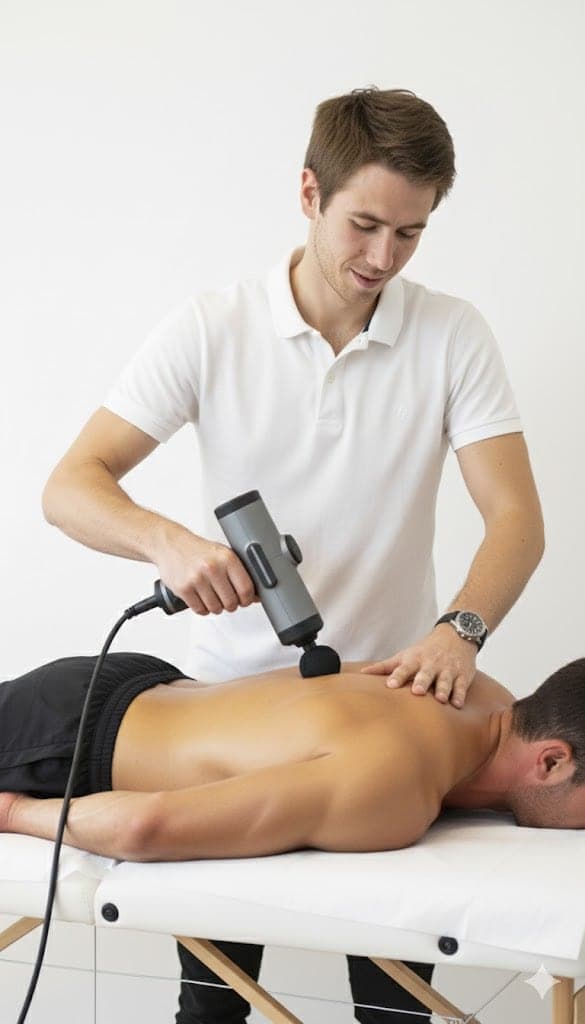
My approach uses a precision-engineered mechanical tool that delivers three things traditional massage cannot: consistent depth penetration, controlled pressure modulation, and sustained mechanical advantage. This isn’t a percussion device or a vibration tool. This is a specialized instrument designed specifically for advanced deep-tissue work, and I’ve spent ten years mastering its application to human body mechanics.
Fascial Release and Structural Integration
Fascia is the connective tissue network that surrounds every muscle, organ, and structure in your body. When fascia becomes restricted through injury, poor posture, or repetitive strain, it creates tension patterns that pull your body out of optimal alignment. I work through these fascial layers systematically, releasing adhesions that may have been limiting your movement for years.
During a session, we’re not just “loosening tight muscles.” We’re restoring proper sliding mechanics between tissue layers, reestablishing optimal length-tension relationships in your musculature, and removing the mechanical interference that prevents your body from functioning as an integrated system. This is the foundation of lasting massage therapy benefits.
Trigger Point Deactivation
Myofascial trigger points—hyperirritable nodules within taut muscle bands—are responsible for a significant percentage of chronic pain cases I see in Coral Bay. These points refer pain to other areas, creating patterns that confuse most practitioners. A trigger point in your gluteus medius might be causing your knee pain. A restriction in your subscapularis could be the source of your “tennis elbow.”
Deactivating these points requires precise pressure applied at the exact location for a sustained duration. My mechanical approach allows me to maintain that pressure at depths and intensities that would be impossible with manual therapy, while simultaneously protecting the surrounding tissue from unnecessary trauma.
Massage Therapy Benefits Coral Bay Athletes Are Experiencing
I work extensively with athletes and active individuals in Coral Bay, and the performance gains they achieve through proper bodywork are substantial. When your body mechanics are optimized, you don’t just feel better—you move better, recover faster, and perform at higher levels.
Consider the case of a competitive cyclist I treated last year. He’d been dealing with chronic IT band syndrome for eighteen months. He’d tried stretching, foam rolling, sports massage, and physical therapy. Nothing provided lasting relief. Within three sessions of deep fascial work targeting his tensor fasciae latae, gluteal complex, and quadriceps, his symptoms resolved completely. Six months later, he’s still pain-free and has improved his race times.
This isn’t magic. This is mechanical problem-solving applied to the human body. His IT band wasn’t the problem—it was the symptom. The problem was a dysfunctional movement pattern originating from fascial restrictions in his hip complex. Once we addressed the cause, the symptom disappeared durably.
| Athletic Goal | Mechanical Dysfunction | Treatment Focus | Expected Outcome |
|---|---|---|---|
| Increased Running Speed | Hip Flexor Restriction | Psoas and Iliacus Release | Improved stride length and power |
| Enhanced Swimming Performance | Shoulder Internal Rotation Deficit | Subscapularis and Posterior Capsule Work | Greater range of motion and reduced injury risk |
| Better Tennis Serve | Thoracic Spine Mobility Loss | Paraspinal and Intercostal Release | Increased rotational power and accuracy |
| Improved Golf Swing | Lat Dorsi Adhesions | Latissimus and Serratus Release | Smoother mechanics and distance gains |
The Real Massage Therapy Benefits: Pain Elimination, Not Pain Management
Most people in Coral Bay who come to me have accepted pain as part of their daily life. They’ve been told they need to “manage” their condition. They’ve been given exercises, ergonomic advice, and prescriptions. What they haven’t been given is someone who will actually fix the underlying problem.
I had a client—a 52-year-old office manager—who’d been dealing with tension headaches three to four times per week for over five years. She’d seen neurologists, tried medications, modified her workspace, and received regular massage. The headaches continued. When I evaluated her, I found severe restrictions in her suboccipital triangle and upper trapezius, combined with forward head posture that had created a chronic load imbalance.
We worked through the deepest layers of her posterior neck musculature over six sessions. The pressure required to reach the sphenoid and occipital attachments was substantial—far beyond what manual therapy could safely deliver. Her headaches decreased in frequency immediately. After three months, they were gone entirely. Two years later, she remains symptom-free.
Why Depth Matters for Lasting Results
The massage therapy benefits Coral Bay clients experience through my work are directly related to the depth I can achieve with my mechanical method. Superficial massage feels pleasant, but it doesn’t create structural change. To alter chronic tension patterns, you must work through every fascial layer until you reach the periosteal attachments where muscles connect to bone.
This level of work is uncomfortable. I won’t pretend otherwise. But discomfort during treatment is fundamentally different from pain in your daily life. One lasts thirty minutes and produces lasting change. The other continues indefinitely and limits your quality of life. My clients understand this distinction. They’re willing to invest in intensive treatment because they’re done with temporary relief.
Precision, Power, and Consistency: The Three Pillars of My Method
When I explain my approach to new clients, I emphasize three qualities that define the massage therapy benefits they’ll experience: precision, power, and consistency.
Precision: Targeted Treatment of Specific Structures
My mechanical tool allows me to focus pressure on areas as small as a few square millimeters. When I’m deactivating a trigger point in your infraspinatus or releasing an adhesion between your rhomboid and serratus anterior, that precision is essential. I’m not applying general pressure to a broad area. I’m targeting the exact structure that’s causing your dysfunction.
This precision also means I can work around vulnerable structures safely. I can deliver deep pressure to your quadratus lumborum without risking your kidneys. I can access your deep hip rotators without compromising your sciatic nerve. This level of control simply doesn’t exist with manual techniques.
Power: Depth That Creates Lasting Change
The pressure I can generate with my equipment reaches depths that would require three or four hands stacked on top of each other to achieve manually—and even then, you’d lack the controlled modulation necessary to work safely at those depths. This power allows me to release restrictions that have been limiting your body mechanics for years.
I can adjust the intensity precisely based on your tissue response, pain tolerance, and treatment goals. For athletes requiring aggressive fascial work, I can deliver substantially more force than traditional massage. For clients with more sensitive tissue or acute conditions, I can work with lighter pressure that’s still more effective than standard manual therapy because of the mechanical advantage and depth penetration.
Consistency: Every Session Delivers Equal Results
Perhaps the most significant advantage of my method is consistency. I don’t have “off days.” The machine doesn’t get tired. The pressure in minute forty-five of your session is identical to the pressure in minute five. This reliability means your treatment plan progresses predictably, and your results are reproducible.
When clients experience the massage therapy benefits this consistency provides, they often express frustration about the variability they experienced with traditional massage. They couldn’t understand why one session would provide significant relief while the next, with the same therapist, seemed less effective. The answer is simple: human inconsistency. My method eliminates that variable entirely.
Understanding the Investment: Cost Versus Value in Massage Therapy Benefits
I need to address something directly: my service is not cheap. I’m not competing on price, and I’m not offering discount packages or introductory specials. What I’m offering is lasting resolution of mechanical dysfunction that’s been limiting your life.
Let’s look at the economics rationally. If you’ve been getting massage every two weeks for pain management, you’re spending perhaps a per-session fee (see current pricing). Over a year, that’s a wide range of costs. Over five years, it’s a wide range of costs. And at the end of those five years, you still have the same problem you started with because you’ve been treating symptoms, not causes.
My approach typically requires 4-8 intensive sessions to resolve chronic conditions, followed by occasional maintenance as needed. The upfront investment is higher, but the long-term value is dramatically superior because we’re actually fixing your problem. You’re not buying temporary relief. You’re buying lasting mechanical correction.
The Coral Bay Advantage: Mobile Service and Personalized Treatment
One of the unique massage therapy benefits I provide to Coral Bay residents is complete mobility. I travel to your location with professional equipment, including a specialized treatment bench and all necessary tools. This isn’t a compromise in quality—it’s a strategic decision that benefits both my clients and my practice.
When I come to you, you’re in a familiar, comfortable environment. You don’t have to drive before or after treatment. You can immediately rest, hydrate, and allow your body to integrate the work we’ve done. This is particularly important after intensive deep-tissue sessions, which can temporarily alter your proprioception and coordination as your nervous system adapts to new movement patterns.
The mobile approach also allows me to observe your living and working environment, which often provides valuable insight into the mechanical dysfunctions we’re addressing. I can see your desk setup, your sleeping arrangement, your daily movement patterns. This environmental context informs my treatment strategy and allows me to provide specific recommendations for preventing recurrence.
Who Benefits Most from Advanced Mechanical Deep-Tissue Work
The massage therapy benefits Coral Bay clients experience through my method are most dramatic for specific populations:
Chronic Pain Sufferers Who’ve “Tried Everything”
If you’ve been dealing with persistent pain that hasn’t responded to conventional treatment, you’re an ideal candidate. My clients typically arrive after exhausting other options. They’ve done physical therapy, chiropractic, acupuncture, and traditional massage. Nothing has provided lasting relief because nothing has addressed the deep fascial restrictions and mechanical dysfunctions that are causing their symptoms.
Competitive and Serious Recreational Athletes
Athletes understand that their body is their instrument. Small improvements in movement mechanics translate directly to performance gains. The massage therapy benefits they experience include increased power output, enhanced recovery rates, improved flexibility, and reduced injury risk. I work with runners, cyclists, swimmers, tennis players, golfers, and CrossFit athletes who demand measurable results.
Professionals With Demanding Physical Jobs
If your work involves repetitive movements, awkward postures, or sustained physical demands, you’re accumulating mechanical stress that will eventually create pain and limitation. Tradespeople, healthcare workers, and manual laborers benefit substantially from proactive bodywork that prevents the development of chronic conditions rather than waiting to treat them after they’ve become debilitating.
Individuals Committed to Long-Term Health Optimization
Some clients come to me not because they’re in pain, but because they understand that optimal body mechanics are foundational to long-term health and quality of life. They’re making a strategic investment in maintaining their physical capability as they age. This is the most sophisticated approach to healthcare: prevention and optimization rather than reaction and management.
Common Conditions and the Massage Therapy Benefits That Resolve Them
Over ten years, I’ve worked with virtually every musculoskeletal complaint you can imagine. Here are the conditions where I consistently see dramatic, lasting results:
- Chronic Lower Back Pain: Usually caused by quadratus lumborum dysfunction, psoas restrictions, or gluteal weakness patterns. Deep work through the lumbar erectors, QL, and hip complex resolves the majority of cases durably.
- Frozen Shoulder and Rotator Cuff Issues: Almost always involves subscapularis adhesions, posterior capsule restrictions, and compensatory tension in the upper trapezius and levator scapulae. Aggressive shoulder work produces remarkable range of motion improvements.
- Tension Headaches and Migraines: Frequently originate from suboccipital triangle restrictions, upper trapezius trigger points, and forward head posture. Deep posterior neck work combined with postural correction eliminates most headache patterns.
- Sciatica and Piriformis Syndrome: Deep gluteal work targeting the piriformis, gemelli, and obturator internus relieves sciatic nerve compression. Most “sciatica” isn’t actually a spine problem—it’s a soft tissue problem.
- Tennis Elbow and Golfer’s Elbow: Despite the names, these are usually caused by proximal dysfunction in the shoulder and upper back. Local elbow treatment alone rarely succeeds. Comprehensive upper extremity work resolves the mechanical cause.
- Plantar Fasciitis and Foot Pain: The foot is rarely the problem. Calf restrictions, particularly in the soleus and deep posterior compartment, create compensatory stress on the plantar fascia. Deep lower leg work eliminates most chronic foot pain.
- IT Band Syndrome: The IT band itself cannot be “released”—it’s a tendinous structure. The problem is always proximal dysfunction in the hip abductors and TFL. Treating the cause eliminates the symptoms.
- Chronic Neck Pain and Stiffness: Modern life creates universal neck dysfunction. Deep work through all seven cervical levels, combined with scapular stabilizer optimization, restores proper neck mechanics.
The Treatment Process: What to Expect from Massage Therapy in Coral Bay
When you commit to working with me, you’re entering a dedicated partnership focused on resolving your mechanical dysfunction durably. This isn’t a transactional relationship where you book a session and receive a service. This is a collaborative process where we’re working together toward specific, measurable goals.
Initial Assessment and Goal Setting
Our first session begins with a comprehensive assessment. I need to understand not just where you’re experiencing symptoms, but the entire chain of mechanical dysfunction that’s creating those symptoms. I’ll evaluate your posture, movement patterns, tissue quality, and pain referral patterns. I’ll ask detailed questions about your work, athletic activities, injury history, and daily habits.
Then we’ll establish clear, specific goals. “I want to feel better” isn’t a goal—it’s a wish. “I want to run a half-marathon without knee pain” is a goal. “I want to work at my desk for eight hours without developing a headache” is a goal. The massage therapy benefits you experience will be directly related to how clearly we define success.
Progressive Treatment Protocol
Deep fascial work is progressive. Your first session will be intensive, but I’m working within the adaptation capacity of your tissue. As your body responds and restrictions release, subsequent sessions become more aggressive and target deeper layers. This is why results improve over a series of treatments rather than appearing instantly after one session.
Most clients require 4-6 sessions to resolve chronic conditions, spaced 7-10 days apart initially to allow tissue adaptation between treatments. Acute conditions may require fewer sessions. Complex, long-standing dysfunctions may require more. I’ll provide an honest assessment of what I expect your treatment progression to look like.
Integration and Maintenance
After we’ve achieved your primary goals, maintenance requirements vary based on your activities and demands. Athletes may benefit from monthly or quarterly sessions to maintain optimal mechanics under high training loads. Office workers may need only occasional work to prevent the reaccumulation of tension patterns. Some clients, after achieving full resolution of their dysfunction, don’t require any maintenance at all.
Why Body Mechanics Education Matters for Lasting Massage Therapy Benefits
My background in Physical Education and Nutrition from Norway informs every treatment I provide. I’m not just a massage therapist—I’m an educator helping you understand how your body works and why it’s developed the problems you’re experiencing.
During our sessions, I explain what I’m finding, why it’s causing your symptoms, and how the mechanical relationships in your body have created compensatory patterns. This education is as valuable as the hands-on work because it empowers you to make better decisions about your movement, training, and daily activities.
I provide specific homework when appropriate—not generic stretches you can find on YouTube, but targeted interventions based on your unique mechanical situation. A runner with chronic hamstring strains might need specific glute activation work before runs. An office worker with neck tension might need hourly position changes and specific movement breaks. These recommendations are individualized and purposeful.
Distinguishing Real Treatment from Wellness Theater
The massage therapy benefits available in Coral Bay vary dramatically in quality and purpose. Most massage is “wellness theater”—it feels good, it’s relaxing, and it provides temporary stress relief, but it doesn’t create mechanical change. That’s fine if temporary relaxation is your goal, but don’t confuse it with treatment.
Real treatment is uncomfortable. It requires your active participation and communication. It produces results that you can measure objectively—increased range of motion, decreased pain levels, improved performance metrics. And it focuses on root causes rather than symptom relief.
I’m not competing with day spas or relaxation massage. I’m providing a fundamentally different service for people who have specific mechanical problems they want resolved durably. If you want aromatherapy and gentle Swedish massage, I’m not your provider. If you want your chronic shoulder pain eliminated so you can return to competitive swimming, we should talk.
The Science of Mechanical Advantage in Deep-Tissue Work
Let me explain why my tool-assisted method produces superior massage therapy benefits compared to manual therapy. This isn’t marketing—it’s physics and biomechanics.
The human hand has a contact area of approximately 20-40 square centimeters depending on the technique used. When a therapist applies 20 kilograms of force through their hands, that pressure is distributed across that entire contact area. The pressure reaching the target tissue is therefore relatively diffuse.
My mechanical tool has a contact area of approximately 2-4 square centimeters depending on the attachment used. When I apply 20 kilograms of force through this tool, that same force is concentrated into a much smaller area, dramatically increasing the pressure per square centimeter. This concentration allows deep penetration while minimizing surface trauma.
Additionally, the mechanical advantage of the tool means I can sustain high pressure for extended periods without fatigue. Manual therapists cannot maintain maximum pressure throughout a 60-minute session—it’s physiologically impossible. My method delivers consistent pressure from the first minute to the last, ensuring thorough treatment of all targeted structures.
Frequently Asked Questions About Massage Therapy Benefits in Coral Bay
How is your method different from percussion massage devices?
Percussion devices deliver rapid, repetitive impacts that stimulate neurological responses and increase blood flow. They work primarily on superficial layers and provide temporary relief through nervous system modulation. My method uses sustained, controlled pressure to mechanically release deep fascial restrictions and deactivate trigger points. The mechanisms and outcomes are completely different.
Is this treatment painful?
Deep fascial work is intense and can be uncomfortable, particularly when working through chronic restrictions. However, we’re always working within your tolerance, and you maintain control over intensity throughout the session. The discomfort during treatment is productive—it’s creating mechanical change. Most clients describe it as “good pain” that feels necessary and effective.
How many sessions will I need?
This varies based on the severity and chronicity of your condition. Most chronic pain cases require 4-8 sessions for complete resolution. Acute issues may resolve in 1-3 sessions. Complex, long-standing dysfunctions involving multiple body regions may require more extensive work. I provide an honest assessment after your initial evaluation.
Do you accept insurance?
I don’t work with insurance companies. My service is private pay, and you’re responsible for payment at the time of service. Some clients successfully submit receipts to their insurance for partial reimbursement, but I cannot guarantee coverage. This payment structure allows me to focus entirely on your results rather than on satisfying insurance requirements.
Can you fix my problem if other treatments haven’t worked?
If your problem is mechanical—caused by fascial restrictions, muscle dysfunction, or movement pattern issues—then yes, I can likely resolve it. If your problem is structural (bone deformities, disc herniations, arthritis) or systemic (fibromyalgia, autoimmune conditions), I cannot cure it, but I can often significantly improve your function and reduce your symptoms by optimizing the mechanical efficiency of your musculoskeletal system.
What should I do before and after treatment?
Come well-hydrated and avoid eating a large meal immediately before your session. Wear comfortable, loose clothing that allows access to the treatment areas. After treatment, continue hydrating, avoid intense exercise for 24 hours, and allow your body time to integrate the changes. Some soreness is normal for 24-48 hours post-treatment as your nervous system adapts to new movement patterns.
Do you work on athletes actively training?
Yes, but timing matters. Aggressive deep-tissue work should not be scheduled immediately before competition or high-intensity training. I typically work with athletes during lower-intensity training periods or between competitive seasons. Maintenance work during peak training is lighter and focused on sustaining optimal mechanics without disrupting preparation.
How do I know if I’m a good candidate for your method?
You’re an ideal candidate if you have chronic pain that hasn’t responded to conventional treatment, if you’re an athlete looking to optimize performance, or if you’re committed to investing in long-term body mechanics optimization. You’re not a good candidate if you’re looking for relaxation massage, if you’re unwilling to tolerate intensive treatment, or if you’re not prepared to follow through with a complete treatment protocol.
The Investment in Your Physical Future
The massage therapy benefits Coral Bay residents experience through my work extend far beyond temporary pain relief. You’re making an investment in your physical capability for decades to come. Every year you live with mechanical dysfunction is a year your body is developing compensatory patterns that will eventually create additional problems.
I’ve watched clients transform not just their pain levels, but their entire relationship with their body. Athletes who’d accepted declining performance as inevitable suddenly find they’re improving again. Office workers who’d resigned themselves to daily headaches discover they can work full days without discomfort. People who’d stopped activities they loved because of pain return to hiking, playing tennis, or working in their garden.
These outcomes are the real measure of massage therapy benefits. Not how you feel immediately after a session, but how your life changes when your body mechanics are optimized and your pain is durably resolved.
If you’re ready to stop managing symptoms and start addressing causes, if you understand that real results require intensive work and investment, and if you’re committed to a partnership focused on lasting resolution rather than temporary relief, then we should talk. The massage therapy benefits available through advanced mechanical deep-tissue work are waiting for you in Coral Bay—delivered to your location, on your schedule, with the precision, power, and consistency that creates lasting change.
Written by
Chris
Massage therapist & body mechanics specialist
Norwegian-certified with a Bachelor’s in Physical Education and Nutrition and over ten years of clinical practice, working from a portable table in clients’ homes across the Paphos district.
This article is general information from clinical practice, not a medical diagnosis. If you have severe, worsening or unexplained pain, numbness, weakness, or pain after an accident, see a doctor first.