
Massage therapist near me Paphos: how to choose the right one
In short
Searching for a massage therapist near me Paphos usually means chronic pain, not a treat. Choose on assessment, specialisation and honesty about limits. I bring mechanical deep-tissue treatment to your home across the Paphos district.
When someone types "massage therapist near me Paphos" into a phone, they are usually already in pain and want it dealt with rather than pampered. I am Chris, a mobile therapist based in Chlorakas, and I cover every village and town in the Paphos district. This is how I would choose a therapist if I were the one searching.
The honest starting point is that "near me" is a poor filter. Distance matters, but far less than whether the person understands why your shoulder, back or hip hurts in the first place. In a district where a therapist can come to your home, proximity almost stops mattering. What is left is the question that counts: can this person help you, and will they tell you plainly if they cannot?
Massage therapist near me Paphos: why nearest is rarely right
Most of these searches land on the same handful of listings, sorted by how close they are and how many stars they have. Neither tells you much. Reviews mostly measure how pleasant the hour felt, and a pleasant hour is not the same thing as a shoulder that lifts further the following week.
The pattern I see most often across the district is people who have been to three or four therapists, each of whom worked on the spot that hurt, and each of whom gave a few days of relief. Nobody asked why that spot was overloaded. The neck that keeps tightening is often doing the job of a stiff upper back; the calf that keeps cramping is often protecting a hip that does not extend properly. Treat the sore point alone and it comes back.
So before you compare distance or price, compare approach. The questions that separate a therapist from a relaxation service are simple.
What a proper first session looks like
A first session should not begin with you face down on the table within two minutes. If it does, the treatment is a routine, not a response to you. In my own practice, the first fifteen minutes or so are spent talking and watching before any oil comes out.
I want to know how the pain started, what makes it better or worse, what you do all day, how you sleep and what has already been tried. Then I watch a few basic movements: how you bend, turn, reach and squat, and where you shift weight or brace to avoid something. Only after that do I put hands on, and by then I usually have a working idea of which tissues are actually restricting the movement and which are merely complaining about it.
Here is a rough contrast between what I would expect and what I hear people describe.
| Stage | A therapeutic first session | A routine relaxation session |
|---|---|---|
| Before touching | History, movement screen, clear goal | Brief form, choice of oil |
| During | Pressure adjusted to feedback, works around the sore area | Same sequence for everyone |
| At the end | What was found, home advice, honest timeline | "See you next week" |
| Between sessions | Something specific to do or change | Nothing |
None of this needs a clinic. On a proper folding table in your living room I can do all of it, and I usually learn more from seeing the chair you work from or the bed you sleep in than I would in a treatment room.
Techniques and what each one is actually for
Menus of massage styles confuse people, and I understand why. The names describe methods, not problems, and most people are shopping for a problem to go away. Here is the plain version.
- Relaxation or Swedish massage — long, flowing strokes at moderate pressure. Good for stress and general tension. Not designed to change a stubborn mechanical restriction.
- Deep-tissue massage — slower, more specific work into deeper muscle and fascia. Useful for long-standing tightness, but only when the therapist has the precision to work deep without simply pressing harder.
- Sports massage — deep-tissue principles applied around training and competition. Its value depends entirely on whether the therapist understands the demands of your sport.
- Trigger-point work — sustained pressure on irritable knots that refer pain elsewhere. Effective when the therapist knows the referral maps; frustrating when they do not.
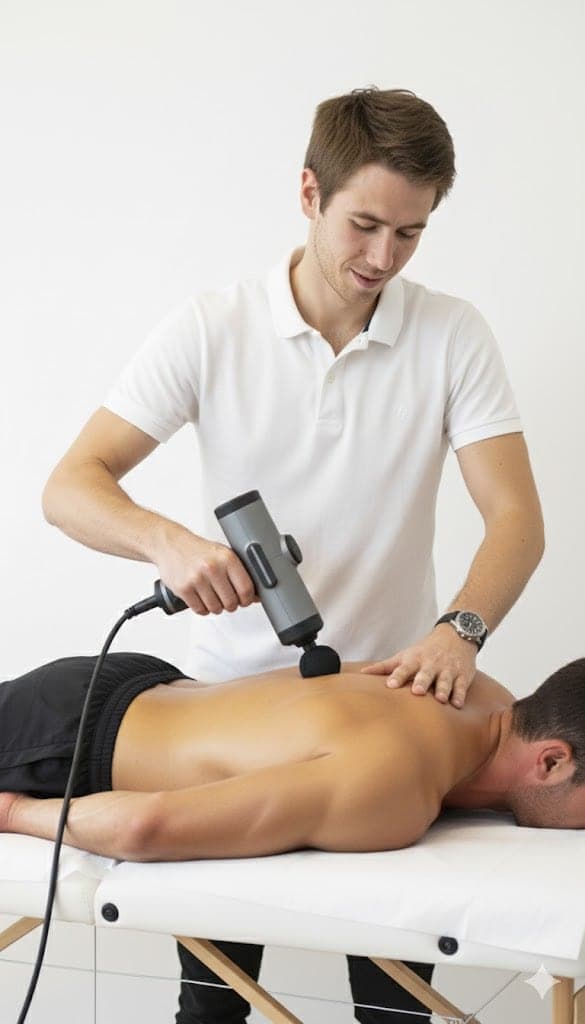
- Mechanical deep tissue — my specialism. I use a mechanical tool alongside my hands to deliver consistent, controllable depth into tissue that hands tire of reaching. It lets me work longer at a precise pressure without fatigue, and to grade intensity finely from cautious to very firm.
The technique matters less than the reasoning behind it. A therapist who chooses the method after assessing you is worth more than one who offers a long list and asks which you would like. If your issue is genuinely mechanical — a hip that will not extend, a thoracic spine that will not rotate, a calf that guards every morning — then depth, precision and consistency are what change it, and that is where I spend my time. If you want to see how I apply this to athletes specifically, my sports massage page covers it in more detail.
Questions worth asking before you book
Nobody minds being asked sensible questions before they treat you. If they do, that is your answer. These are the ones I would ask, and the sort of reply I would want to hear.
A useful extra: ask what happens if the first session does not help. A therapist worth using will say they will change the plan or refer you on, not that you should simply keep coming.
Red flags I would walk away from
I have inherited a lot of clients from other therapists over ten years, so I hear the same warning signs repeatedly. None of these prove someone is poor at the work, but together they should make you cautious.
- Promises of a fixed result — nobody can honestly say a chronic problem will be resolved in a set number of visits. Bodies do not read schedules.
- Identical treatment for everyone — if the sequence never changes regardless of your complaint, the complaint is not being treated.
- Pressure to buy a large package up front — before you have felt one session, there is no basis for a commitment.
- "Pain means it is working" — some deep work is uncomfortable, but treatment that leaves you bruised and guarding for days is doing harm, not good.
- No interest in referral — a therapist who never mentions doctors or physiotherapists either has never met a problem outside their scope or does not recognise them.
The opposite signs are equally telling: someone who asks more than they talk, adjusts pressure the moment you flinch, and tells you what they found rather than how relaxed you should feel.
What I do differently, and where I fit
I am one person, not a clinic. I hold a BSc in Physical Education and Nutrition, I trained and certified in Norway, and I have spent over ten years narrowing my practice down to mechanical deep-tissue work for people whose pain has a movement cause. I drive to you across the Paphos district from Chlorakas with a professional table and everything the session needs, and the pricing is fixed and simple: €90 for 60 minutes, €130 for 90, and every fifth session is free. The full breakdown is on the pricing page.
I can help with the mechanical side of things: muscles and fascia that have shortened, tightened or started guarding, and the aches, restricted movement and recurring tension that follow. I cannot help with, and will not pretend to help with, anything that needs a diagnosis first. See a doctor first if pain arrived after a fall or accident, if it wakes you at night and does not ease with a change of position, if there is numbness, weakness, fever, unexplained weight loss, or if you are on blood thinners or have a clotting history. If you tell me any of that on WhatsApp, I will say so before we book rather than after.
Where I fit best is the group I described at the top: people who have tried a few things, are tired of relief that lasts three days, and want someone to look at the whole pattern rather than the sore spot. If that is you, I am close enough, wherever in the district you are.
Frequently asked questions
Is there a mobile massage therapist near me in Paphos?
Yes. I am based in Chlorakas and travel to homes, villas and holiday rentals throughout the Paphos district, from Kato Paphos and Geroskipou to Tala, Peyia, Coral Bay and the villages inland. I bring a professional table, linens and oil, so nothing is required of you beyond a little floor space. Booking is by WhatsApp or phone, and I will tell you honestly whether I am the right person for your problem before we fix a time.
How is a mobile session different from visiting a clinic?
Clinically it is the same work on the same kind of table. Practically, you skip the drive, you are treated in the environment where the problem lives, and you can lie down afterwards instead of getting back in the car. I also see things at home — the office chair, the sofa you fall asleep on — that help explain the pattern. The only trade-off is that I need a space roughly two metres by three.
How many sessions will I need?
I would be wary of anyone who gives a firm number before assessing you, so I will not either. Simple, recent tightness often settles quickly; a pattern that has been building for years usually needs a short series, followed by occasional maintenance if the cause, such as long desk hours, is still there. What I promise is that we agree how to measure progress and that I say plainly if the plan is not working.
Does deep-tissue massage have to hurt?
No. Deep work can be uncomfortable in a way most people describe as a good ache, and I adjust pressure continually to what you tell me. Pain that makes you brace or hold your breath is counterproductive because the muscle simply tightens against it. The mechanical tool I use is helpful here because it lets me grade intensity precisely rather than leaning in harder, and it holds a steady depth without my hands fatiguing.
What should I do before and after a session?
Before, drink some water, eat something light rather than a large meal, and wear or have to hand loose clothing. Afterwards, gentle movement is better than lying still for the rest of the day, keep hydrated, and expect some tenderness for a day or so. I will give you one or two specific things to do between sessions; those are usually where lasting change actually happens, more than on the table.
How do I book, and what does it cost?
Message me on WhatsApp or ring, tell me roughly what is going on and where you are, and we will find a slot. It is €90 for 60 minutes and €130 for 90, with travel across the district included and every fifth session free. There is no deposit and no package to buy in advance; you decide after the first session whether it was worth continuing.
Written by
Chris
Massage therapist & body mechanics specialist
Norwegian-certified with a Bachelor’s in Physical Education and Nutrition and over ten years of clinical practice, working from a portable table in clients’ homes across the Paphos district.
- Norwegian-certified
- BSc Physical Education & Nutrition
- 10+ years clinical practice
- Based in Chlorakas · all of Paphos district
- No call-out fee anywhere in Paphos district
Last reviewed
This article is general information from clinical practice, not a medical diagnosis. If you have severe, worsening or unexplained pain, numbness, weakness, or pain after an accident, see a doctor first.