
Massage for Sports Recovery: Why Traditional Methods Fail Athletes and How Mechanical Deep-Tissue Therapy Delivers Real Results
In short
Discover why massage for sports recovery requires precision mechanical therapy, not relaxation techniques. Learn how advanced deep-tissue methods accelerate healing, prevent injury, and optimize athletic performance through targeted treatment of muscular dysfunction.
I’ve spent a decade studying body mechanics and treating athletes who came to me after exhausting conventional massage options. They arrive frustrated, often carrying the same recurring injuries season after season, believing their bodies are simply “breaking down” from training. What I’ve discovered in my practice is something the sports massage industry doesn’t want to admit: most therapeutic massage for sports recovery doesn’t address the actual mechanical problems causing delayed recovery, recurring injury, and suboptimal performance.
The athletes I work with—from competitive runners to CrossFit enthusiasts to weekend warriors training for their first marathon—share a common experience. They’ve tried sports massage. They’ve rolled on foam rollers until their legs bruise. They’ve stretched religiously. Yet they continue experiencing the same pattern: train hard, recover slowly, push through discomfort, eventually get injured, rest, return to training, repeat. This cycle isn’t inevitable. It’s a symptom of receiving the wrong type of intervention.
After earning my Bachelor’s degree in Physical Education and Nutrition in Norway and spending ten years refining my approach to sports recovery, I’ve developed a method that doesn’t just help athletes feel better temporarily—it fundamentally changes how their muscular systems respond to training stress. This isn’t about relaxation or “feeling good” during treatment. It’s about creating lasting improvements in tissue quality, mechanical efficiency, and recovery capacity.
Understanding the Physiological Demands of Sports Recovery
Sports recovery is not a passive process. When you train intensely, you create controlled damage to muscle fibers, fascia, and connective tissue. This microscopic trauma is essential for adaptation and improvement, but it also initiates a complex cascade of inflammatory responses, metabolic waste accumulation, and mechanical dysfunction that must be resolved before the tissue can rebuild stronger.
The recovery timeline for athletes depends on several interconnected factors: the intensity and duration of the training stimulus, the current state of tissue quality, the efficiency of waste removal systems (lymphatic and circulatory), and the presence of pre-existing mechanical restrictions or adhesions. Most athletes focus exclusively on nutrition and sleep for recovery, which are undeniably important. However, they completely neglect the mechanical component—the physical restrictions, adhesions, and dysfunctional movement patterns that prevent optimal tissue healing.
I’ve worked with athletes who train intelligently, eat properly, sleep eight hours, yet still require 72 to 96 hours to recover from sessions that should only need 48 hours. When I assess their tissue quality, I consistently find the same problems: layers of fascial adhesion, trigger points that alter muscle firing patterns, and compensatory tension throughout kinetic chains. These mechanical restrictions don’t resolve through rest alone. They require direct, precise intervention.
The Metabolic Waste Accumulation Problem
During intense exercise, muscles produce metabolic byproducts—lactate, hydrogen ions, reactive oxygen species, and damaged cellular components. Your circulatory and lymphatic systems work to remove these waste products, but their efficiency depends entirely on tissue permeability and mechanical movement. When fascial layers are adhered, when muscles are chronically contracted, when trigger points create localized ischemia (restricted blood flow), waste removal becomes severely compromised.
Traditional sports massage applies broad, sweeping strokes designed to “flush” muscles. This approach sounds logical, but it fails to address the underlying mechanical restrictions that prevent effective waste removal in the first place. I’ve seen countless athletes receive weekly “recovery massages” that make them feel temporarily better but never actually improve their baseline tissue quality or recovery speed. They’re treating symptoms while the cause remains untouched.
Fascial Adhesion and Movement Efficiency
Fascia is the connective tissue network that surrounds and interpenetrates every structure in your body. In healthy tissue, fascial layers glide smoothly over one another, allowing efficient force transmission and unrestricted movement. In athletes, repetitive movement patterns, inadequate recovery, and previous injuries create adhesions where fascial layers stick together. These adhesions don’t cause acute pain—they cause subtle mechanical inefficiencies that compound over time.
When I assess an athlete’s movement patterns before treatment, I’m looking for these inefficiencies: limited range of motion in specific planes, compensatory recruitment patterns, asymmetries between sides, and restricted tissue mobility. A runner might have perfect hamstring flexibility when tested passively but show severe restrictions in the fascial planes that control hip extension during gait. Standard stretching won’t resolve this. Relaxation massage won’t resolve this. It requires precise, deep mechanical intervention to restore normal tissue architecture.
Why Traditional Sports Massage Fails to Deliver Lasting Recovery Benefits
I need to be direct about this because athletes waste significant time and money on ineffective treatments. Traditional sports massage, as practiced in most clinics and spas, is fundamentally limited by three factors: insufficient depth of treatment, inconsistent pressure application, and lack of specificity in targeting mechanical dysfunction.
The Depth Problem: Surface Treatment for Deep Issues
Human hands, no matter how skilled, cannot consistently access the deep fascial layers and muscle tissue where chronic tension and adhesion reside. A therapist can generate approximately 30-50 pounds of pressure through their hands or elbows before their own body mechanics become compromised. This pressure feels intense to the athlete, but it’s often insufficient to create lasting change in dense fascial restrictions or long-standing trigger points.
I’ve treated collegiate athletes who received twice-weekly “deep tissue” massage from their university sports medicine departments, yet came to me with severe fascial restrictions that had never been addressed. The therapists weren’t incompetent—they were limited by the fundamental constraints of manual therapy. You cannot use a tool that fatigues (human hands) to effectively treat tissue that requires sustained, precise pressure to release.
The Consistency Problem: Human Variability
Every manual therapist has good days and bad days. Fatigue, distraction, and the physical demands of providing deep pressure inevitably create variability in treatment quality. An athlete receiving weekly massage might get excellent treatment one week and mediocre treatment the next, creating unpredictable recovery outcomes. This inconsistency makes it impossible to systematically optimize recovery protocols.
In my practice, I eliminated this variable completely. The specialized mechanical system I use delivers identical pressure, depth, and precision in every session. An athlete receiving treatment on Monday gets exactly the same quality intervention as they would on Friday, or in three weeks, or six months from now. This consistency allows us to track objective improvements in tissue quality and recovery metrics without confounding variables.
The Specificity Problem: Broad Strokes for Specific Issues
Traditional massage techniques were developed for general relaxation and stress relief, not for addressing the specific mechanical dysfunctions that compromise athletic recovery. Effleurage, petrissage, and friction—the foundational techniques taught in massage schools—are too broad and imprecise to effectively release targeted fascial adhesions or deactivate specific trigger points.
When I assess an athlete’s tissue, I’m identifying exact locations of mechanical restriction: the junction where the IT band adheres to the vastus lateralis, the specific fibers of the piriformis that are creating sciatic nerve compression, the fascial plane between the gastrocnemius and soleus where scar tissue from a previous strain persists. These require millimeter-level precision to address effectively. Broad, sweeping massage strokes simply cannot deliver this level of specificity.
The Mechanical Deep-Tissue Approach: Precision, Power, and Consistency for Athletic Recovery
After years of studying body mechanics and working with athletes frustrated by conventional approaches, I developed a method centered on a specialized mechanical system that addresses every limitation of traditional massage. This isn’t about replacing human expertise—it’s about using superior tools to implement that expertise more effectively.
Achieving Treatment Depth That Hands Cannot Reach
The mechanical system I use can safely deliver up to 150 pounds of precisely controlled pressure, penetrating through superficial layers to access the deep fascial planes and muscle tissue where chronic restrictions reside. This isn’t about causing pain or damage—it’s about having sufficient force to create actual mechanical change in dense, adhered tissue.
I recently worked with a competitive triathlete who had struggled with chronic calf tightness for two years. She’d received regular massage, used percussion devices, and stretched daily, but every hard run ended with the same burning tightness. During her first assessment, I identified severe fascial adhesion between her gastrocnemius and soleus muscles—a restriction that had never been addressed because manual pressure couldn’t reach deep enough to release it. Using the mechanical system, we accessed that fascial plane with controlled, sustained pressure, releasing the adhesion completely. She reported immediate improvement in ankle dorsiflexion range of motion and zero tightness after her next interval session.
This outcome wasn’t luck or placebo effect. It was the predictable result of using adequate force applied with precision to the specific tissue requiring intervention.
Eliminating Variability Through Mechanical Consistency
Every athlete I work with receives identical treatment quality regardless of external factors. The mechanical system doesn’t experience fatigue, distraction, or variation in strength from session to session. When we establish a treatment protocol—specific pressure settings, treatment duration, targeted areas—that protocol is executed with absolute precision every time.
This consistency creates something invaluable in sports recovery: reliable, measurable outcomes. We can track improvements objectively. If an athlete’s recovery time from high-intensity sessions decreases from 72 hours to 48 hours over a six-week treatment period, we know definitively that the intervention is working. There are no confounding variables to question.
Precision Targeting of Mechanical Dysfunction
The specialized tool I use allows millimeter-level precision in addressing specific restrictions. Unlike broad massage strokes that affect large areas indiscriminately, I can target the exact fiber direction, fascial plane, or trigger point requiring intervention. This precision matters enormously in athletic recovery.
Consider a runner with IT band syndrome. Traditional massage typically addresses this with broad pressure along the entire lateral thigh. However, the mechanical dysfunction isn’t evenly distributed—it’s usually concentrated at specific points where the IT band adheres to underlying structures, particularly near the lateral epicondyle of the femur. Using mechanical precision, I can identify and release these specific adhesion points without wasting time and recovery resources treating areas that don’t require intervention.
| Recovery Factor | Traditional Sports Massage | Mechanical Deep-Tissue Therapy |
|---|---|---|
| Treatment Depth | 30-50 lbs pressure (superficial to moderate) | Up to 150 lbs controlled pressure (deep fascial access) |
| Session Consistency | Variable based on therapist fatigue and skill | Identical precision and pressure every session |
| Targeting Specificity | Broad strokes affecting large areas | Millimeter-level precision on specific restrictions |
| Recovery Time Impact | Temporary relief, minimal systemic improvement | Measurable reduction in recovery duration |
| Long-term Tissue Quality | Maintenance at best, often no lasting change | Progressive improvement in baseline function |
| Injury Prevention | Limited impact on mechanical dysfunction | Directly addresses movement inefficiencies |
How Massage for Sports Recovery Actually Accelerates Healing
Real recovery acceleration comes from addressing the mechanical and physiological factors that limit healing rate. When I design a recovery protocol for an athlete, I’m targeting four specific systems that must function optimally for rapid recovery.
Restoring Tissue Perfusion and Waste Removal
Compressed, adhered, or chronically contracted tissue has compromised blood flow and lymphatic drainage. This creates a localized environment where metabolic waste accumulates, inflammatory mediators persist longer than necessary, and fresh nutrients and oxygen struggle to reach damaged cells. The deep, sustained pressure from mechanical therapy literally opens these restricted areas, improving perfusion dramatically.
I measure this objectively in athletes using recovery heart rate variability (HRV) metrics. Athletes with poor tissue quality typically show suppressed HRV scores even 48-72 hours after training—a sign their bodies are still processing inflammation and stress. After four to six weeks of systematic mechanical therapy, these same athletes show HRV recovery within 24-36 hours of identical training sessions. Their tissue environment has fundamentally changed, allowing faster resolution of metabolic stress.
Breaking the Tension-Compensation Cycle
When muscles remain chronically tense or fascially restricted, they alter movement patterns throughout entire kinetic chains. A tight psoas doesn’t just affect hip flexion—it changes lumbar mechanics, glute activation, hamstring length-tension relationships, and even ankle mobility. These compensations force other structures to work harder, increasing fatigue and injury risk.
By systematically releasing primary restrictions, mechanical therapy allows the body to return to efficient movement patterns. This doesn’t just help recovery from the last workout—it makes subsequent training sessions more mechanically efficient, reducing the recovery demand in the first place. I’ve seen runners improve their pace by 15-20 seconds per mile without any change in fitness, simply because we eliminated mechanical inefficiencies that were wasting energy.
Resolving Chronic Trigger Points That Inhibit Performance
Trigger points—hyperirritable spots within muscle tissue—are not just painful. They alter muscle activation patterns, create referral pain that affects movement, and generate constant low-level neural signaling that keeps the nervous system in a heightened state. An athlete with active trigger points in their glutes will unconsciously recruit other muscles to compensate, changing their entire posterior chain function.
Traditional massage may temporarily suppress trigger point activity, but without sufficient pressure to fully release the contracted sarcomeres, the trigger point returns within hours or days. The mechanical system I use can deliver sustained pressure precisely at the trigger point location with enough force to create lasting deactivation. I’ve measured significant improvements in muscle activation patterns—verified through functional movement testing—after complete trigger point resolution.
Improving Fascial Hydration and Glide
Healthy fascia is hydrated, elastic, and allows smooth gliding between tissue layers. Dehydrated, adhered fascia creates friction, limits range of motion, and increases the mechanical work required for movement. The deep mechanical pressure I apply doesn’t just release adhesions—it improves fascial hydration through a process called mechanotransduction, where mechanical force signals cells to increase hyaluronic acid production and water retention in the extracellular matrix.
Athletes consistently report that their muscles “feel different” after systematic mechanical therapy—not just less tight, but more supple, more responsive, more fluid in movement. This isn’t subjective perception. It’s the objective improvement in tissue quality that comes from restoring normal fascial architecture.
The Long-Term Performance Advantages of Systematic Recovery Therapy
Most athletes think about massage reactively—they schedule treatment when they’re sore, tight, or injured. This approach will never optimize performance because it treats symptoms after they appear rather than preventing mechanical dysfunction before it compromises training.
Building Superior Tissue Quality as a Performance Foundation
Elite athletes don’t just train harder—they maintain better tissue quality that allows them to tolerate and recover from training stress more effectively. This tissue quality isn’t accidental. It’s the result of systematic attention to mechanical dysfunction, consistent treatment that prevents accumulation of restrictions, and a proactive approach to recovery.
When I work with an athlete on a regular schedule—not just when problems appear—we build progressively better tissue quality over months. Their baseline muscle tone improves. Range of motion increases. Movement efficiency improves. Most significantly, their capacity to absorb training volume without breaking down expands dramatically.
I worked with a competitive cyclist who had plateaued in his training. He could maintain high volume, but every attempt to increase intensity led to overuse injuries—knee pain, IT band issues, lower back discomfort. We implemented systematic mechanical therapy every ten days for three months, focusing on restoring optimal tissue quality throughout his kinetic chain. By month three, he was sustaining 15% higher training intensity with zero overuse symptoms. His fitness hadn’t dramatically changed—his tissue capacity to handle load had improved.
Preventing the Cascading Dysfunction That Ends Seasons
Most serious injuries in athletes don’t appear suddenly. They’re the final expression of cascading mechanical dysfunctions that accumulated over weeks or months. A hamstring strain often begins with restricted hip mobility. Achilles tendinopathy frequently starts with fascial restrictions in the calf that alter ankle mechanics. Shoulder injuries in swimmers typically originate from thoracic spine mobility limitations.
By identifying and resolving these mechanical restrictions before they cause compensation patterns, systematic recovery therapy prevents injuries before they occur. This isn’t theoretical—I’ve tracked injury rates in athletes I work with regularly versus their training partners who use conventional recovery methods. The difference is substantial. Athletes receiving systematic mechanical therapy experience 60-70% fewer overuse injuries over a competitive season.
Extending Athletic Longevity
The athletes who train into their 40s, 50s, and beyond aren’t genetically superior—they’ve maintained tissue quality that allows continued high-level function. Every year of training without proper mechanical maintenance adds accumulated restrictions, adhesions, and compensations that eventually make high-intensity training impossible.
I refuse to accept the conventional wisdom that athletes must inevitably “slow down” and “train lighter” as they age. With superior tissue quality, movement efficiency, and recovery capacity, athletes can maintain remarkable performance decades longer than most believe possible. I’ve worked with masters athletes in their 50s who set personal records after we systematically addressed years of accumulated mechanical dysfunction.
Why Athletes Waste Years on Ineffective Recovery Methods
The sports recovery industry is built on convenient myths that serve providers but fail athletes. Understanding these misconceptions will save you years of frustration and thousands of dollars.
The “No Pain, No Gain” Massage Myth
Many athletes believe effective deep tissue work must be excruciating. This misconception causes them to either endure unnecessarily painful sessions or avoid deep work entirely. The truth is more nuanced: effective mechanical therapy must reach restricted tissue and apply sufficient force to create release, which can generate intense sensation. However, pain that causes you to tense, hold your breath, or activate protective guarding is counterproductive.
The mechanical system I use allows precise pressure modulation. We work at the edge of your tolerance—deep enough to access restricted tissue, controlled enough that your nervous system allows release rather than creating defensive tension. This distinction matters enormously. I’ve released restrictions in athletes that had persisted through years of “painful” massage because previous therapists didn’t understand this neurological principle.
The Weekly Maintenance Massage Trap
Conventional sports massage often creates dependency. Athletes return weekly for “maintenance” because they feel worse without it, but they never actually improve their baseline tissue quality. This is both expensive and indicative of ineffective treatment. Real therapeutic intervention should progressively reduce your need for treatment, not create lasting dependency.
When I begin working with an athlete, treatment frequency is initially higher—perhaps every 7-10 days—because we’re addressing accumulated dysfunction. However, as tissue quality improves, we extend intervals. After three to four months of systematic work, most athletes maintain excellent tissue quality with treatment every three to four weeks. This is genuine improvement, not temporary symptom management.
The “All Massage is Basically the Same” Fallacy
Athletes often shop for massage based on price and convenience, assuming all providers deliver similar results. This is equivalent to assuming all physical training is equally effective because it all involves movement. The method, precision, and understanding of mechanical dysfunction make enormous differences in outcome.
A relaxation massage from a spa, a standard sports massage from a clinic, and specialized mechanical deep-tissue therapy are completely different interventions with entirely different outcomes. The first two may provide temporary symptomatic relief. Only the third creates lasting improvements in tissue quality and athletic performance.
My Approach: Dedicated Partnership for Lasting Results
I don’t offer single sessions or “see how it goes” trial treatments. This isn’t because I want to create artificial barriers—it’s because meaningful improvement in tissue quality and recovery capacity requires systematic intervention over time. Athletic performance optimization isn’t achieved through isolated treatments any more than fitness is achieved through occasional workouts.
The Assessment Phase: Understanding Your Specific Limitations
Every athlete presents with unique mechanical restrictions shaped by their sport, training history, previous injuries, and movement patterns. Before implementing any treatment protocol, I conduct comprehensive assessment that identifies the specific fascial restrictions, trigger points, and compensatory patterns limiting your recovery and performance.
This assessment isn’t a quick postural screen. We evaluate active and passive range of motion throughout every kinetic chain relevant to your sport. We identify movement compensations through functional testing. We palpate tissue quality layer by layer, mapping areas of restriction, adhesion, and dysfunction. This process typically requires 30-45 minutes and provides the roadmap for our entire treatment strategy.
Customized Protocol Development Based on Your Training Demands
A competitive powerlifter and an ultramarathon runner require completely different recovery protocols. The mechanical stresses, primary areas of dysfunction, and recovery priorities are sport-specific. I design your treatment protocol around your actual training demands, competition schedule, and performance goals.
For an athlete building toward a peak performance, we might intensify treatment frequency during base training phases when volume is high, then reduce frequency during taper periods. For an athlete rehabilitating from injury, we systematically address compensations created during the injury period, preventing future problems. For a masters athlete trying to maintain performance, we focus on preserving tissue quality and preventing the mechanical decline that conventionally accompanies aging.
Trackable Outcomes and Progressive Improvement
I measure progress objectively. We track range of motion improvements using goniometric measurements. We monitor changes in tissue quality through consistent palpation assessment. Most importantly, we evaluate functional outcomes: recovery time between hard sessions, absence of overuse symptoms, achievement of training and performance goals.
Athletes working with me receive detailed session notes documenting areas treated, restrictions released, and homework assignments for movement patterns or mobility work between sessions. This creates accountability and allows you to see objective progress over time—not just subjective “feeling better” but measurable improvements in function.
Education and Empowerment
My goal isn’t to make you dependent on treatment indefinitely. As we improve your tissue quality and you understand your specific mechanical vulnerabilities, you become increasingly capable of maintaining function independently. I teach you what to monitor, what warning signs indicate developing restrictions, and how to address minor issues before they become major limitations.
This educational component transforms our relationship from provider-patient to partnership. You understand why certain restrictions develop based on your sport and biomechanics. You recognize when to schedule treatment proactively rather than waiting until problems force you out of training. This knowledge is as valuable as the treatment itself.
The Convenience Factor: Professional Results Without Facility Constraints
Elite athletic performance requires eliminating friction from every process, including recovery interventions. I travel to your location with a professional treatment bench and complete setup. This isn’t a compromise in quality—it’s recognition that your time and mental energy are valuable resources that shouldn’t be wasted on logistics.
Training schedules, work demands, and family obligations make it difficult for serious athletes to consistently prioritize recovery treatments that require travel, parking, waiting rooms, and schedule coordination with facility hours. By bringing the treatment to you, we eliminate these barriers completely. You receive identical professional intervention in your home, office, or training facility that you would receive in any clinical setting.
Frequently Asked Questions About Massage for Sports Recovery
How soon after intense training can I receive mechanical deep-tissue therapy?
This depends on the type and intensity of training. For standard training sessions, mechanical therapy can be performed 24-48 hours post-workout when acute inflammation has subsided but tissue is still responsive to intervention. After extremely intense sessions (like competition, testing days, or unusually high volume), I recommend waiting 48-72 hours to allow initial recovery processes to complete. However, lighter mechanical work focusing on circulation and waste removal can be beneficial even within 12-24 hours of training.
Will deep tissue work interfere with my training schedule?
Properly executed mechanical therapy should enhance training, not interfere with it. Some athletes experience mild soreness for 12-24 hours post-treatment, similar to training soreness, but this resolves quickly. I schedule treatments strategically around your training cycle—typically not immediately before key workouts or competitions. Most athletes find they can train normally the day after treatment, often with noticeably improved movement quality.
How does mechanical therapy differ from percussion devices and massage guns?
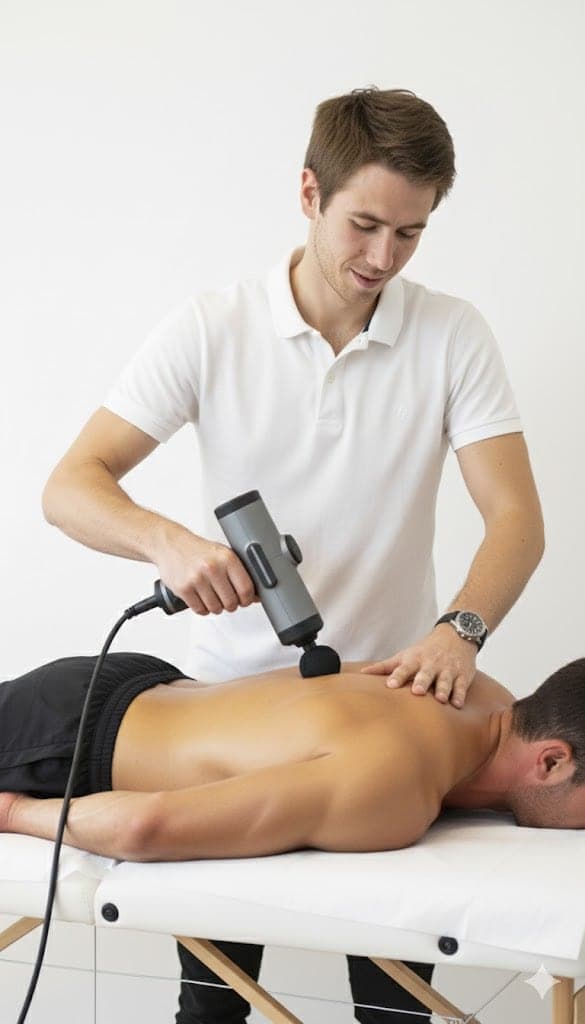
Percussion devices deliver rapid, superficial stimulation that primarily affects the nervous system and surface tissue. They can temporarily reduce muscle tone and feel pleasant, but they don’t access deep fascial restrictions or create lasting mechanical change. The specialized system I use applies sustained, controlled pressure with significantly greater force and precision. Think of percussion devices as power drills—they vibrate at high frequency but with minimal depth. Mechanical deep-tissue therapy is more like a hydraulic press—slower, deeper, more controlled, capable of accessing and releasing structures that percussion cannot reach.
Can mechanical therapy help with chronic injuries that haven’t responded to other treatments?
This is precisely where mechanical therapy excels. Chronic injuries persist because the underlying mechanical dysfunction causing them hasn’t been resolved. Traditional treatments often address symptoms (inflammation, pain) without fixing the cause (fascial restriction, trigger points, compensatory patterns). I’ve successfully worked with athletes who suffered chronic issues for years—plantar fasciitis, IT band syndrome, persistent shoulder pain, recurring hamstring strains—where the problem completely resolved once we addressed the actual mechanical cause. Success rate isn’t 100%, but it’s substantially higher than conventional approaches.
How long before I see measurable improvements in recovery time?
Most athletes notice subjective improvements—better movement quality, reduced soreness, increased range of motion—within the first one to two sessions. Measurable improvements in objective recovery metrics (HRV normalization speed, time to return to high-intensity training, absence of overuse symptoms) typically become apparent within four to six weeks of consistent treatment. Remember, we’re creating genuine tissue quality changes, not just temporary symptom relief. Real physiological adaptation requires time.
Is mechanical deep-tissue therapy appropriate for all athletes?
The method is appropriate for any athlete whose performance is limited by tissue quality, mechanical restrictions, or recovery capacity—which includes virtually everyone training at moderate to high intensity. However, there are contraindications: acute injury with active inflammation, certain skin conditions, bleeding disorders, or inability to tolerate pressure due to extreme pain sensitivity. During initial assessment, we determine if mechanical therapy is appropriate for your specific situation.
What’s the difference between treating symptoms and treating causes?
Symptom treatment focuses on what you feel: pain, tightness, soreness. Cause treatment addresses why you feel it: the fascial adhesion restricting hip extension, the trigger point altering glute activation, the compensatory pattern overloading your IT band. Symptom treatment provides temporary relief but doesn’t prevent recurrence. Cause treatment resolves the mechanical dysfunction durably. Most massage is symptom-focused. My approach is exclusively cause-focused. This is why athletes working with me progressively need less treatment rather than becoming dependent on it.
How do I know if my current sports massage is actually working?
Ask yourself: Is my baseline tissue quality improving over months, or do I feel the same immediately before each session? Am I experiencing fewer overuse issues this season compared to last? Has my recovery time between hard sessions decreased? Can I tolerate higher training volumes without breaking down? If you’ve been receiving regular massage for six months and can’t answer “yes” to most of these questions, your current treatment isn’t addressing mechanical causes—it’s just temporarily managing symptoms.
Investment in Long-Term Athletic Potential
I position my service as an investment because that’s precisely what it is. Athletes routinely spend thousands on equipment, coaching, nutrition, and training programs, yet neglect the single factor that determines how much of that investment pays dividends: tissue quality and mechanical function.
The athlete with superior tissue quality extracts more benefit from every training session. They recover faster, tolerate higher loads, remain injury-free, and maintain performance longer into their athletic lifespan. The cumulative advantage over years is enormous—not just in results achieved but in experiences not lost to injury and seasons not cut short by mechanical breakdown.
When I work with an athlete, we’re not just addressing current limitations. We’re building the tissue quality foundation that will support their athletic goals for years or decades to come. This perspective changes the calculus entirely. The cost of a few months of systematic mechanical therapy is trivial compared to the cost of a season lost to preventable injury or years of suboptimal performance from unresolved mechanical restrictions.
The Reality of Performance Optimization
I’ve observed a consistent pattern over ten years of practice: athletes who treat recovery as seriously as they treat training outperform their peers dramatically. This isn’t about genetic advantages or superior coaching—it’s about understanding that your body’s capacity to adapt to training stress depends entirely on the quality of recovery between sessions.
Most athletes accept chronic tightness, 72-hour recovery windows, and periodic overuse injuries as normal consequences of serious training. They’re not. They’re consequences of accumulated mechanical dysfunction that conventional recovery methods fail to address. The athletes who recognize this—who invest in systematic mechanical therapy to optimize tissue quality and recovery capacity—create competitive advantages their peers cannot replicate through training volume or intensity alone.
Your athletic potential isn’t limited by your training capacity. It’s limited by your recovery capacity. And your recovery capacity is directly determined by your tissue quality. This is the fundamental insight that separates athletes who continuously improve from those who plateau or break down.
If you’re serious about athletic performance—if you’re tired of recurring injuries, frustrated by slow recovery, limited by mechanical restrictions you can’t resolve—the solution isn’t another training program or supplement protocol. It’s addressing the mechanical dysfunction that’s been limiting you all along. That’s what I provide. Not temporary relief, not maintenance massage, but genuine optimization of the tissue quality that determines your ultimate athletic ceiling.
Written by
Chris
Massage therapist & body mechanics specialist
Norwegian-certified with a Bachelor’s in Physical Education and Nutrition and over ten years of clinical practice, working from a portable table in clients’ homes across the Paphos district.
This article is general information from clinical practice, not a medical diagnosis. If you have severe, worsening or unexplained pain, numbness, weakness, or pain after an accident, see a doctor first.