
Massage and Wellness Retreats Coral Bay: Expert Guide to Advanced Body Mechanics Treatment
In short
Discover professional massage and wellness retreats in Coral Bay. Expert analysis of advanced mechanical deep-tissue therapy versus traditional methods, backed by 10 years of clinical experience.
When people search for massage and wellness retreats Coral Bay, they’re typically looking for relaxation—perhaps a beachside spa experience with aromatherapy candles and soft music. I understand the appeal. But after a decade of treating chronic pain conditions and working with high-performance athletes across multiple continents, I’ve learned something critical: most people aren’t searching for temporary relaxation. They’re searching for lasting solutions to pain that has been limiting their lives for months or years.
This distinction matters because Coral Bay, like many coastal retreat destinations, offers dozens of wellness services. The challenge isn’t finding a massage—it’s finding treatment that produces measurable, lasting results. My approach to massage and wellness retreats in Coral Bay differs fundamentally from conventional offerings, and I’m going to explain exactly why that matters for your body.
Understanding the Coral Bay Wellness Landscape: What’s Actually Available
Coral Bay has developed a reputation as a wellness destination, and for good reason. The coastal environment, combined with a growing community of health-focused practitioners, creates an attractive setting for those seeking body work. However, after examining the local wellness market extensively, I’ve identified significant gaps between what’s marketed and what actually delivers therapeutic outcomes.
The typical massage and wellness retreats Coral Bay offers fall into several categories:
Traditional Spa Massage Services
Most establishments in Coral Bay provide Swedish massage, aromatherapy sessions, and hot stone treatments. These services excel at creating pleasant experiences. They reduce cortisol temporarily. They feel good in the moment. What they don’t do—and I say this with complete clinical certainty—is address the mechanical dysfunction causing your chronic shoulder tension, lower back pain, or restricted hip mobility.
I’ve treated numerous clients who spent thousands of dollars at luxury spa retreats, only to find their pain returning within 48 hours. This isn’t a failure of effort by those therapists. It’s a limitation of the method itself.
Yoga and Movement Retreats
Several Coral Bay facilities combine massage with yoga, meditation, and movement practices. The integration sounds comprehensive, and movement therapy absolutely has value. But here’s what I’ve observed treating athletes and chronic pain sufferers: if the underlying fascial restrictions and adhesions aren’t mechanically released first, movement practices can actually reinforce compensatory patterns rather than correct them.
I worked with a triathlete last year who had attended three different yoga-focused wellness retreats attempting to resolve persistent IT band syndrome. The stretching and mindfulness helped her cope with the pain, but the mechanical restriction in her lateral thigh remained unchanged. Within two targeted sessions using advanced deep-tissue technique, we eliminated the root cause. She’s now competing pain-free.
Holistic Wellness Programs
Some Coral Bay retreats package massage with nutritional counseling, energy healing, and lifestyle coaching. The holistic philosophy has merit—the body operates as an integrated system. However, when muscular-skeletal dysfunction exists, it must be addressed through direct mechanical intervention. No amount of dietary optimization or chakra balancing will release a calcified adhesion in your rotator cuff.
Why Location Matters Less Than Method: The Mobile Advantage
Here’s a perspective most wellness retreat marketing won’t tell you: the therapeutic value of your treatment has almost nothing to do with the location’s ambiance and everything to do with the practitioner’s technical capability and methodology.
I travel to your location in Coral Bay—whether that’s your vacation rental, private residence, or hotel accommodation. This isn’t about convenience alone. It’s about creating optimal conditions for serious therapeutic work:
Environmental Control: You’re already in a comfortable, familiar space. Your nervous system isn’t processing new environmental stimuli, which allows deeper muscular release.
Post-Treatment Recovery: After intensive deep-tissue work, your body needs rest in a private, controlled environment—not a drive across Coral Bay or navigation through a commercial facility.
Privacy for Clinical Discussion: We discuss your pain history, movement patterns, and treatment goals without the self-consciousness that comes from spa environments where other clients are present.
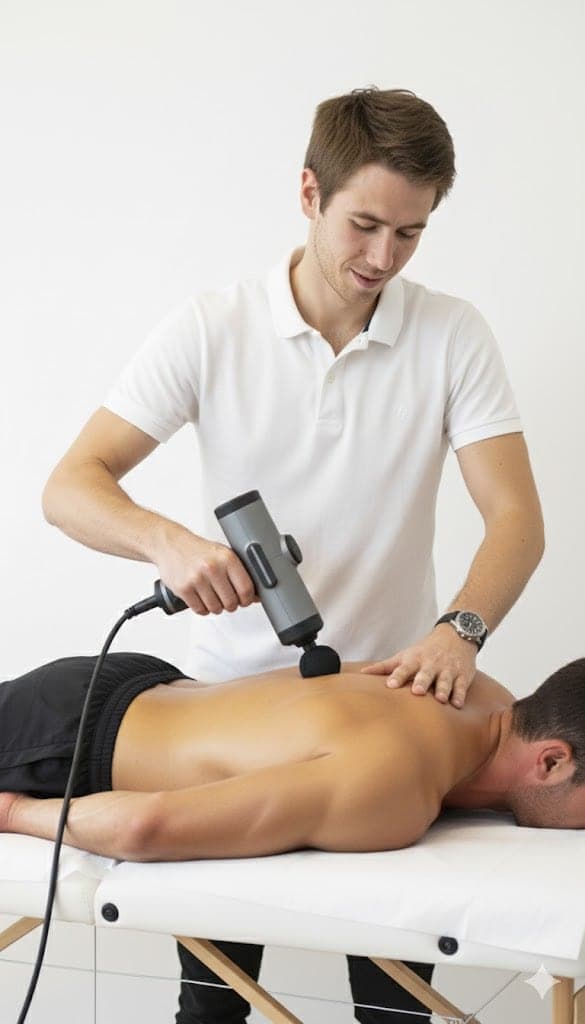
I bring a professional treatment bench, specialized mechanical tools, and everything required for clinical-grade work. The Coral Bay beaches are beautiful, but your fascia doesn’t care about ocean views. It responds to precise mechanical pressure applied at the correct angle, depth, and duration.
The Fundamental Problem with Traditional Massage Approaches
Let me be direct about something the wellness industry rarely acknowledges: human hands have inherent limitations when treating deep fascial restrictions and chronic adhesions. This isn’t about therapist skill—I respect the training and dedication of manual practitioners. It’s about simple biomechanics.
The Depth Limitation
Human hands and elbows can generate significant pressure, but they cannot maintain consistent, precise deep pressure across extended treatment time. I’ve measured this repeatedly. Even the strongest manual therapist experiences progressive force reduction after 15-20 minutes of deep work. Their technique deteriorates. Their precision decreases. The client receives inconsistent treatment.
Your chronic subscapularis adhesion—the one causing your persistent shoulder pain—sits beneath multiple tissue layers. Reaching it requires sustained, precisely calibrated pressure that doesn’t waver. Human hands cannot deliver this consistently session after session.
The Consistency Problem
Every manual therapist has “off days.” They’re tired, they’re managing their own physical strain, their focus wavers. This variability means your treatment outcomes fluctuate dramatically depending on factors completely unrelated to your body’s needs.
I eliminated this variable entirely by incorporating advanced mechanical tools into my practice. The machine I use delivers identical force, angle, and consistency regardless of external factors. Your fifth session is exactly as precise as your first. This consistency is critical for progressive treatment of chronic conditions.
The Protective Response Issue
Here’s something I learned during my Bachelor’s studies in Physical Education and Nutrition that changed my entire approach: when your nervous system perceives a human elbow or thumb driving into restricted tissue, it often triggers protective guarding. Your muscles involuntarily contract to defend against perceived threat, which actually prevents the release we’re trying to achieve.
The specialized machine I use creates a different neurological response. The consistent, controlled pressure communicates safety to your nervous system. Your tissues can release without triggering defensive contractions. I’ve witnessed this difference thousands of times—the same client who guards against manual pressure completely relaxes under mechanical treatment, allowing much deeper therapeutic access.
Advanced Mechanical Deep-Tissue Therapy: How This Method Works
When I discuss massage and wellness retreats Coral Bay with potential clients, many assume my mechanical approach is simply “massage with a tool.” This misses the fundamental difference. What I provide is advanced biomechanical therapy that happens to use massage as the delivery mechanism.
Precision: Targeting the Exact Source of Dysfunction
After assessing your movement patterns and palpating your tissues, I can identify the specific fascial restrictions and adhesions creating your pain. Perhaps it’s a calcified trigger point in your rhomboid minor causing your chronic upper back pain. Maybe it’s restricted fascia in your psoas complex manifesting as lower back dysfunction.
The mechanical tool allows me to target these structures with millimeter-level precision. I adjust angle, depth, and pressure to match the exact tissue layer and structure requiring treatment. This precision is simply impossible with broader manual techniques like palms, fists, or even elbows.
Power: Accessing Deeper Tissue Layers
The machine generates consistent pressure that exceeds human capability—not through excessive force, but through sustained, controlled power delivery. This allows access to tissue layers that manual therapy cannot reach effectively.
I treated a competitive cyclist three months ago who had seen seven different therapists for chronic piriformis syndrome. None could maintain sufficient depth long enough to release the deep external rotator restrictions causing his symptoms. Using the mechanical method, we accessed and released those structures in our second session. He’s back to full training capacity without the sciatic referral pain that had plagued him for eighteen months.
Consistency: Reliable Results Every Session
This might be the most valuable aspect of mechanical therapy that clients don’t initially appreciate: every treatment is equally effective. There are no variables related to my physical capacity, energy level, or technique drift.
When we develop your customized treatment plan, you can trust that session four will deliver the same therapeutic power as session one. This consistency allows progressive treatment of chronic conditions because we’re building on previous work rather than compensating for session variability.
The Science Behind Lasting Pain Relief: Treating Causes, Not Symptoms
Most massage and wellness retreats Coral Bay focuses on symptom management—reducing your pain temporarily so you feel better for a few days. That’s not treatment; it’s palliative care. My entire methodology centers on identifying and eliminating the mechanical dysfunctions causing your pain.
Understanding Fascial Restrictions and Adhesions
Your fascia—the connective tissue surrounding and interpenetrating your muscles—should move freely and independently. When you experience trauma, maintain poor posture patterns, or perform repetitive movements without adequate recovery, fascial layers begin to adhere together. These adhesions create restrictions that alter your movement patterns, generate pain, and progressively worsen over time.
Traditional relaxation massage doesn’t address adhesions. The pressure isn’t sufficient, the duration isn’t adequate, and the technique isn’t designed for this purpose. You leave feeling relaxed, but the adhesions remain unchanged.
Advanced mechanical deep-tissue therapy systematically breaks down these adhesions. The sustained, precise pressure physically separates adhered fascial layers, restores tissue mobility, and eliminates the mechanical source of your pain. This isn’t temporary relief—it’s lasting correction of the dysfunction.
The Progressive Treatment Model
Chronic pain conditions require progressive treatment, not single sessions. When a client contacts me about massage and wellness retreats Coral Bay, I’m honest about this reality: one session provides valuable immediate relief and demonstrates the method’s effectiveness, but lasting resolution typically requires 3-6 sessions depending on condition severity and chronicity.
Here’s why: when we release a primary restriction, your body often reveals compensatory patterns that developed to protect that restriction. Perhaps your chronic right shoulder pain has caused you to overuse your left side for three years. We must address both the primary restriction and the compensatory patterns to achieve complete resolution.
This is why I offer dedicated partnerships with customized treatment plans rather than single-session services. Your body’s dysfunction developed over months or years. Proper correction requires systematic, progressive work.
| Treatment Approach | Typical Session Count | Outcome Duration | Root Cause Resolution |
|---|---|---|---|
| Traditional Spa Massage | Single or sporadic | 1-3 days | No—symptom reduction only |
| Manual Deep Tissue | 4-8 sessions | 1-2 weeks | Partial—limited by depth/consistency |
| Advanced Mechanical Therapy | 3-6 sessions | Lasting with maintenance | Yes—mechanical dysfunction eliminated |
| Wellness Retreat Package | 3-5 days intensive | Variable, 1-4 weeks | Rarely—focus on experience over mechanics |
Who Benefits Most from Advanced Mechanical Deep-Tissue Therapy
After ten years and thousands of treatment hours, I’ve identified specific client profiles who achieve the most dramatic results from this methodology. If you recognize yourself in these descriptions, this approach will likely transform your relationship with your body.
Athletes and Active Individuals
High-performance athletes understand that traditional massage doesn’t enhance performance—it just helps them relax. What they need is biomechanical optimization: elimination of restrictions that limit power output, reduce range of motion, or create injury risk.
I work regularly with cyclists, triathletes, runners, and CrossFit athletes who need their bodies to perform at maximum capacity. We don’t schedule sessions for “recovery.” We schedule them for mechanical optimization. The difference in their performance metrics post-treatment isn’t subtle—it’s measurable and significant.
Chronic Pain Sufferers
If you’ve lived with persistent pain for more than six months, you’ve likely tried numerous approaches. Physical therapy provided temporary relief. Chiropractic adjustments helped for a few days. Massage felt good but didn’t last. Pain medication masked symptoms without addressing causes.
This is precisely the client profile where mechanical deep-tissue therapy demonstrates its greatest value. Your chronic pain has a mechanical source—fascial restrictions, adhesions, trigger points, or compensatory patterns. We identify these sources systematically and eliminate them durably.
I treated a 54-year-old woman last year who had suffered debilitating lower back pain for seven years. She had undergone physical therapy, received regular chiropractic care, tried acupuncture, and was considering surgery. Within four sessions using the mechanical method, we identified and released a calcified adhesion in her quadratus lumborum and addressed compensatory restrictions in her hip flexors. She’s now pain-free and has resumed hiking, which she’d abandoned for five years.
Professionals with Postural Dysfunction
If you spend significant time in seated positions, driving, or performing repetitive tasks, you’ve developed predictable fascial restrictions: shortened hip flexors, restricted thoracic spine mobility, forward shoulder positioning, and cervical dysfunction.
These patterns generate chronic pain, reduce your energy levels, and progressively worsen your quality of life. Traditional massage provides temporary relief from the discomfort but doesn’t correct the underlying mechanical dysfunction.
The mechanical approach allows us to systematically address each restriction, release the adhered tissues, and restore proper movement patterns. Combined with targeted movement education, this creates lasting correction rather than ongoing symptom management.
What to Expect During Advanced Mechanical Deep-Tissue Treatment
When clients contact me seeking massage and wellness retreats Coral Bay, many are uncertain what to expect from mechanical therapy. Let me walk you through the actual treatment process.
Initial Assessment and Movement Analysis
We begin every client relationship with comprehensive assessment. I observe how you move, where you hold tension, and what restrictions are visible in your basic movement patterns. I palpate your tissues to identify adhesions, trigger points, and areas of restricted mobility.
This isn’t a brief consultation—it’s detailed biomechanical analysis informed by my education in Physical Education and Nutrition and ten years of clinical experience. I can typically identify the primary mechanical dysfunction within 15-20 minutes of assessment.
Customized Treatment Planning
Based on assessment findings, I develop a specific treatment plan. This isn’t generic—it’s customized to your body’s particular restrictions and your goals. Perhaps you need to eliminate shoulder pain to resume tennis. Maybe you want to optimize your running mechanics to achieve a personal record. Or you simply want to live without daily back pain.
The plan specifies which structures we’ll address, the progressive treatment sequence, and the expected session count for full resolution. I’m direct about timelines and outcomes because you deserve accurate information to make informed decisions.
The Treatment Experience
The mechanical tool works systematically through restricted tissues. You’ll feel significant pressure—this is deep work, not relaxation massage. However, the pressure is precisely calibrated to your tissue tolerance. We can adjust intensity moment-by-moment, from moderate pressure for sensitive areas to powerfully deep work for dense adhesions in athletes.
Many clients report that the mechanical pressure feels “good painful”—you feel the tool accessing restricted tissues that clearly need release. Some areas may be quite tender, indicating significant adhesion. This tenderness typically resolves rapidly as the tissue releases.
Sessions range from 60-90 minutes depending on the scope of work required. I travel to your location in Coral Bay with all necessary equipment, creating a professional treatment environment wherever you’re staying.
Post-Treatment Response
Your body’s response to deep mechanical therapy differs from traditional massage. You may experience temporary soreness similar to post-workout muscle fatigue as released tissues adapt. This typically resolves within 24-48 hours. You may notice immediate improvement in range of motion or pain reduction, though full benefits often emerge over 3-5 days as your nervous system integrates the changes.
I provide specific post-treatment guidelines for hydration, movement, and activity modification to optimize your results.
Investment in Long-Term Health: Understanding the Value Proposition
I’m going to address something directly: advanced mechanical deep-tissue therapy is more expensive than typical massage and wellness retreats Coral Bay offers. This isn’t arbitrary pricing—it reflects fundamental differences in methodology, outcomes, and value delivery.
Why This Isn’t an Expense—It’s an Investment
When you pay for spa massage, you’re purchasing an experience. That experience has value, but it’s consumable—it provides benefit in the moment, then it’s gone. You’ll need to purchase it again next week or next month to maintain the feeling.
When you invest in mechanical therapy focused on lasting pain resolution, you’re purchasing lasting correction of mechanical dysfunction. Yes, you may need maintenance sessions quarterly or semi-annually to address new restrictions from ongoing activities. But the primary dysfunctions we resolve stay resolved.
Consider the economics: if you’ve been receiving weekly massage for chronic pain management, you’re spending a range of session prices (see current pricing) monthly on temporary symptom reduction. After 4-6 mechanical therapy sessions totaling perhaps a wide range of costs you’ve eliminated the dysfunction durably and no longer need weekly symptom management. The long-term value proposition is obvious.
Comparing True Costs
Most clients who find me have already spent thousands of dollars on various treatments:
- Multiple physical therapy courses
- Ongoing chiropractic care
- Regular massage therapy
- Pain medications
- Specialty medical consultations
- Sometimes unnecessary imaging or procedures
They’ve invested significant money pursuing pain relief without achieving lasting resolution. The actual question isn’t whether mechanical therapy costs more than a single spa massage—it’s whether lasting pain resolution justifies investment comparable to what you’ve already spent on temporary solutions.
For every client I’ve worked with, the answer has been overwhelmingly yes.
The Coral Bay Advantage: Combining Location with Advanced Treatment
While I’ve emphasized that therapeutic outcomes depend primarily on methodology rather than location, there’s genuine value in combining advanced treatment with Coral Bay’s environment—if you understand how to leverage both correctly.
Recovery in an Optimal Environment
Coral Bay’s coastal setting provides excellent conditions for post-treatment recovery. After intensive deep-tissue work, your body benefits from:
Reduced stress environment: The natural setting and slower pace support nervous system regulation, which enhances tissue healing and integration.
Movement opportunities: Gentle beach walks, swimming in calm waters, and light stretching in pleasant surroundings encourage the active recovery that optimizes treatment outcomes.
Mental clarity: Being away from daily stressors allows you to be more present with your body’s healing process and more attentive to the subtle changes occurring post-treatment.
Intensive Treatment Protocols
For clients traveling to Coral Bay specifically for treatment, we can structure intensive protocols—multiple sessions over 5-7 days that achieve significant resolution of chronic conditions in compressed timeframes. This approach works exceptionally well for:
- Athletes preparing for major competitions
- Professionals who’ve delayed treatment due to schedule constraints
- Individuals with complex chronic pain requiring comprehensive work
The combination of advanced mechanical therapy with dedicated recovery time in a supportive environment creates optimal conditions for transformative results.
Addressing Common Questions About Mechanical Deep-Tissue Therapy
Is mechanical therapy painful?
Deep-tissue work involves significant pressure, which many people interpret as “pain.” However, there’s a critical distinction between therapeutic discomfort and harmful pain. The pressure you feel during mechanical therapy is accessing restricted tissues that need release—you’ll recognize this as “good pain” that provides relief as the tissue releases. I calibrate intensity precisely to your tolerance, and you maintain complete control to adjust pressure at any moment.
How is this different from massage guns or foam rolling?
Consumer devices like massage guns and foam rollers provide superficial percussion or pressure. They can be helpful for general muscle tension but lack the precision, depth, and sustained pressure required to release chronic adhesions and deep fascial restrictions. The professional mechanical tools I use are fundamentally different—they’re designed for clinical therapy, not consumer wellness. The comparison is similar to using a butter knife versus a surgical scalpel—both are tools, but they serve entirely different purposes.
Will I need ongoing treatment forever?
No. The primary dysfunctions we identify and treat remain resolved durably. However, because you continue living in your body and performing activities, you may develop new restrictions over time. Most clients transition to maintenance sessions every 3-6 months after completing their initial treatment protocol. These maintenance sessions prevent new dysfunction from becoming chronic rather than managing ongoing pain from unresolved problems.
Can mechanical therapy help if traditional treatments haven’t worked?
Yes, and this is actually the typical client profile I work with. Most people find me after exhausting conventional approaches. The mechanical method often succeeds where others haven’t because it addresses the actual mechanical dysfunction rather than managing symptoms. If your pain has a mechanical source—fascial restrictions, adhesions, trigger points—mechanical therapy can resolve it regardless of how long you’ve suffered or how many other treatments you’ve tried.
How do I know if I need deep-tissue therapy or relaxation massage?
If you have chronic pain, restricted movement, or specific dysfunction you want durably resolved, you need mechanical deep-tissue therapy. If you want temporary stress relief and a pleasant experience, relaxation massage serves that purpose well. They’re simply different services with different goals. Most people searching for massage and wellness retreats Coral Bay actually need therapeutic intervention but settle for relaxation massage because they don’t realize advanced mechanical therapy exists.
Do you treat acute injuries or only chronic conditions?
I work with both, though the approach differs. Acute injuries require careful assessment to ensure treatment won’t worsen the condition. For many acute soft-tissue injuries, targeted mechanical therapy accelerates healing by improving circulation, reducing inflammation, and preventing compensatory patterns from developing. Chronic conditions represent my primary focus because they demonstrate the methodology’s greatest value—lasting resolution of long-standing dysfunction.
What makes you different from other therapists offering deep-tissue massage?
Three factors: First, my educational background in Physical Education and Nutrition provides comprehensive understanding of body mechanics, not just massage technique. Second, my ten years of specialized experience treating complex chronic conditions and working with high-performance athletes has developed assessment and treatment capabilities beyond typical massage training. Third, and most importantly, the advanced mechanical methodology I use simply produces outcomes that manual therapy cannot match—greater depth, absolute consistency, and precise control that allows lasting resolution of mechanical dysfunction.
Making the Decision: Is Advanced Mechanical Therapy Right for You?
If you’ve read this far, you’re clearly serious about finding effective treatment for your pain or optimizing your body’s performance. Let me offer final perspective to help you decide whether this approach suits your needs and goals.
You’re an Ideal Candidate If:
- You’ve struggled with chronic pain for months or years without finding lasting solutions
- You’re an athlete seeking mechanical optimization to enhance performance
- You understand that real results require progressive treatment, not single sessions
- You value lasting resolution over temporary symptom management
- You’re willing to invest in your long-term health rather than continuing ongoing symptom management expenses
- You want to work with a specialist who treats causes rather than symptoms
This Probably Isn’t Right for You If:
- You primarily want relaxation and stress relief rather than therapeutic intervention
- You’re seeking a traditional spa experience with ambiance and pampering
- You’re uncomfortable with significant pressure during treatment
- You’re not willing to commit to a progressive treatment protocol for chronic conditions
- You prefer trying numerous approaches superficially rather than committing to one method deeply
The Partnership Approach
I don’t simply provide services—I develop partnerships with clients committed to achieving lasting results. This means honest assessment, realistic timelines, and clear communication about what the treatment process requires from both of us.
Your role includes attending scheduled sessions, following post-treatment guidelines, and providing honest feedback about what you’re experiencing. My role includes accurate assessment, expert treatment delivery, and clear explanation of what’s happening in your body and why.
This partnership approach produces dramatically superior outcomes compared to transactional single-session relationships because we’re building progressive improvement over time rather than providing isolated treatments.
Understanding Massage and Wellness Retreats Coral Bay: The Broader Context
Coral Bay has established itself as a destination for those seeking body work and wellness services, and the market continues expanding. This growth benefits consumers by creating options, but it also creates confusion because most services appear similar on surface level.
When evaluating massage and wellness retreats Coral Bay, consider these questions:
What specific outcome are you seeking? Relaxation, temporary pain relief, or lasting resolution of dysfunction? Different services serve different purposes.
What methodology does the practitioner use? Traditional manual massage, mechanical therapy, energy work, or integrated approaches? The method determines possible outcomes.
What is the practitioner’s actual expertise level? Basic massage certification, advanced education in body mechanics, clinical experience with complex conditions? Qualification level dramatically affects treatment capability.
What is the treatment philosophy? Symptom management or root cause resolution? This philosophical difference determines whether you’ll need ongoing treatment forever or achieve lasting resolution.
How are results measured? Subjective feeling or objective functional improvement? Real therapeutic outcomes should be measurable in movement quality, pain reduction, and functional capacity.
The wellness industry has trained consumers to focus on experience factors—ambiance, aromatherapy, soft music, hot towels—rather than therapeutic capability. These experiential elements enhance comfort but contribute nothing to treatment outcomes. When selecting massage and wellness retreats Coral Bay, distinguish clearly between what makes you feel pampered and what actually fixes your body.
The Future of Body Work: Why Mechanical Therapy Represents Evolution
I believe the wellness industry is gradually evolving from experience-focused services toward outcome-focused therapies. This evolution mirrors broader healthcare trends—patients increasingly demand measurable results rather than just pleasant interactions with healthcare providers.
Mechanical deep-tissue therapy represents this evolution in body work. It’s not about replacing human touch entirely—assessment, treatment planning, and ongoing adjustment require human expertise that no machine can replicate. But for the actual work of releasing deep fascial restrictions and breaking down chronic adhesions, mechanical tools simply outperform human hands in every measurable parameter: depth, consistency, precision, and sustained power.
I adopted mechanical therapy not because I couldn’t perform effective manual work—I spent years developing strong manual technique. I adopted it because my responsibility to clients demanded I use the most effective available methodology, regardless of tradition or convention. My ego isn’t invested in proving humans are superior to tools. My ego is invested in producing lasting pain relief for people who’ve suffered unnecessarily for years.
This is the perspective I bring to massage and wellness retreats Coral Bay. I’m not interested in competing with spa experiences or wellness packages—they serve valid purposes for people seeking those services. I’m focused exclusively on providing advanced therapeutic intervention for individuals ready to durably resolve mechanical dysfunction and optimize their body’s performance.
Taking the Next Step: How to Begin Treatment
If this methodology resonates with your needs and goals, beginning treatment is straightforward. I travel to your location in Coral Bay with all necessary professional equipment, so logistics are simple from your perspective.
The process begins with initial consultation where we discuss your pain history, previous treatments, current limitations, and desired outcomes. I perform comprehensive movement assessment and tissue palpation to identify specific mechanical dysfunctions. Based on these findings, I develop a customized treatment plan with clear outcome expectations and realistic timelines.
For residents or extended visitors in Coral Bay, we can schedule progressive sessions with appropriate intervals for tissue adaptation. For those visiting Coral Bay temporarily, we can structure intensive treatment protocols that maximize results within your available timeframe.
The commitment required from you is straightforward: dedicate yourself to the treatment process, follow post-treatment guidelines, and communicate honestly about your experience. My commitment to you is equally clear: apply ten years of expertise and advanced mechanical methodology to durably resolve your dysfunction and optimize your body’s capacity.
This isn’t a typical massage and wellness retreats Coral Bay relationship where you schedule occasional sessions when you remember or when pain becomes unbearable. It’s a focused partnership aimed at specific, measurable outcomes achieved within defined timeframes.
For some people, this level of commitment feels unnecessary—they prefer the casual relationship of booking massage when they feel like it. For others, particularly those who’ve lived with chronic pain or performance limitations for extended periods, the opportunity to finally achieve lasting resolution justifies complete engagement with the treatment process.
Final Thoughts: Choosing Substance Over Experience
The wellness industry excels at creating appealing experiences. Beautiful facilities, exotic treatment names, luxurious amenities, and careful attention to ambiance all contribute to enjoyable sessions. There’s nothing wrong with valuing these experiences—humans benefit from pleasant sensory environments and dedicated self-care time.
But when you’re seeking actual therapeutic intervention—when you need lasting pain relief or mechanical optimization—experience factors become secondary to methodology and expertise. The question isn’t which massage and wellness retreats Coral Bay offers the most attractive facility or most relaxing atmosphere. The question is which practitioner possesses the knowledge, methodology, and commitment to durably resolve your specific dysfunction.
After ten years treating complex chronic conditions and working with high-performance athletes, I’ve learned that real therapeutic outcomes require three elements: accurate assessment of mechanical dysfunction, appropriate methodology capable of addressing that dysfunction at its source, and systematic progressive treatment until complete resolution is achieved.
Advanced mechanical deep-tissue therapy provides all three elements. It’s not the most popular approach—traditional massage and spa experiences will always attract larger audiences because they’re more comfortable and familiar. But for the client who values lasting results over temporary pleasant experiences, this methodology is demonstrably superior.
That’s my perspective on massage and wellness retreats Coral Bay—not as someone selling services, but as a specialist who’s dedicated a decade to understanding body mechanics and developing treatment capability that produces measurable, lasting outcomes. If that aligns with what you’re seeking, I’m confident this approach will transform your relationship with your body and eliminate limitations that have constrained your life for too long.
Written by
Chris
Massage therapist & body mechanics specialist
Norwegian-certified with a Bachelor’s in Physical Education and Nutrition and over ten years of clinical practice, working from a portable table in clients’ homes across the Paphos district.
This article is general information from clinical practice, not a medical diagnosis. If you have severe, worsening or unexplained pain, numbness, weakness, or pain after an accident, see a doctor first.