Injury Recovery Massage Geroskipou: Advanced Deep-Tissue Rehabilitation for Lasting Results
In short
Discover how precision mechanical deep-tissue massage accelerates injury recovery in Geroskipou. Expert-led rehabilitation targeting root causes, not symptoms, for lasting pain relief and optimal function.
Last month, I treated a 42-year-old construction worker in Geroskipou who had been limping for eight months following a workplace ankle injury. Three physiotherapy sessions and countless anti-inflammatory medications had provided temporary relief, but the chronic tightness in his calf and the compensatory lower back pain remained. Within four targeted sessions using my mechanical deep-tissue method, we eliminated the fascial restrictions that had locked his entire posterior chain into dysfunction. He returned to full work capacity without limitation.
This outcome wasn’t luck. It was the predictable result of addressing mechanical dysfunction at its source rather than superficially treating pain locations. After a decade of specializing in injury recovery massage in Geroskipou and throughout Cyprus, I’ve learned that most rehabilitation failures stem from one critical error: treating symptoms instead of identifying and resolving the biomechanical cascade that perpetuates injury.
Why Traditional Injury Recovery Methods Often Fall Short
The conventional approach to injury rehabilitation in Geroskipou typically follows a predictable pattern: rest, ice, compression, elevation, followed by gentle stretching and perhaps some manual therapy. This protocol addresses acute inflammation effectively, but it consistently fails to resolve the deeper mechanical compensations that develop during and after injury.
When you sustain an injury—whether it’s a sprained ankle, a rotator cuff strain, or chronic tennis elbow—your body immediately implements protective mechanisms. Surrounding musculature contracts to stabilize the injured area. Fascia thickens to create temporary support. Movement patterns shift to avoid pain. These adaptations serve you well during the acute phase, but they become the problem when they persist long after tissue healing completes.
I see clients weekly who healed from their original injury months or even years ago, yet they remain functionally limited by the compensatory patterns their bodies never released. The injury site itself is structurally sound, but the mechanical dysfunction radiating from it continues generating pain, weakness, and restricted movement. Standard massage approaches simply cannot access these deeper layers of dysfunction with sufficient precision and sustained pressure.
The Biomechanical Reality of Injury Recovery
Your body doesn’t operate in isolated segments. When your right shoulder suffers a rotator cuff strain, the compensation extends through your cervical spine, thoracic region, and even into your opposite hip. I frequently discover that a client’s persistent knee pain originated from an ankle injury they sustained years earlier—the knee simply became the weakest link in a chain of compensatory movement patterns.
This interconnected reality demands a treatment approach that can systematically address multiple layers of restriction across broad areas of tissue. Manual techniques, regardless of the therapist’s skill level, face inherent limitations in depth, consistency, and sustained pressure over extended treatment areas. Your therapist’s hands fatigue. Pressure varies. Deep restrictions remain partially addressed.
Advanced Mechanical Deep-Tissue Method for Injury Recovery
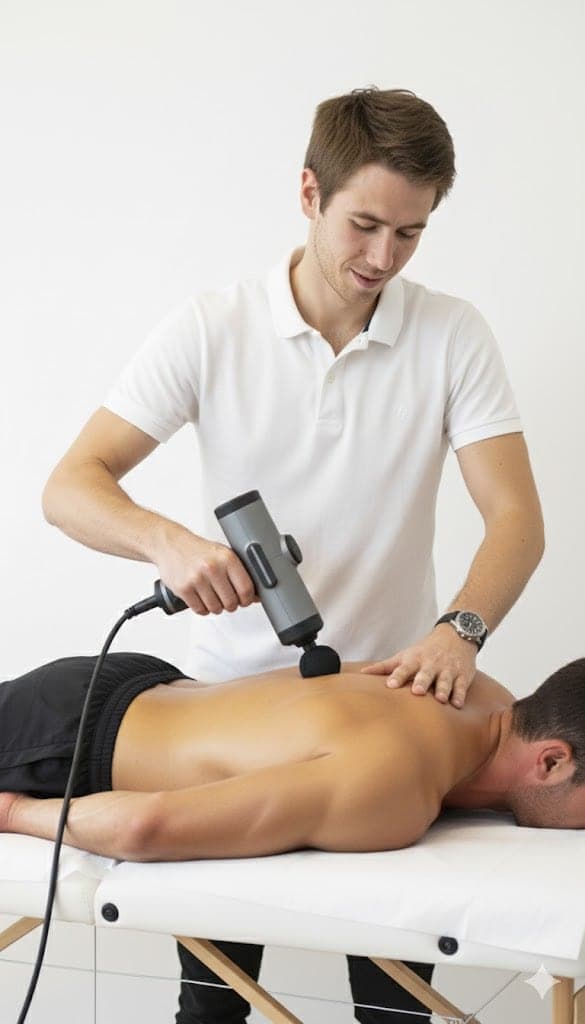
My approach to injury recovery massage in Geroskipou fundamentally differs from conventional methods because I utilize specialized mechanical tools designed for precision deep-tissue work. This isn’t a relaxation service—it’s a systematic biomechanical intervention targeting the root causes of persistent dysfunction.
The mechanical advantage is substantial and measurable. Where hands can sustain deep pressure for perhaps two to three minutes before fatiguing, my specialized equipment maintains consistent force for the entire duration required to achieve fascial release. Where manual pressure reaches perhaps three centimeters into tissue, mechanical intervention accesses restrictions four to six centimeters deep—the level where chronic compensations typically anchor themselves.
Precision: Targeting Specific Dysfunction Patterns
Every injury creates a unique pattern of compensation. A marathon runner recovering from plantar fasciitis develops entirely different restrictions than an office worker with the same diagnosis. The runner typically shows excessive tension through the posterior chain—calves, hamstrings, and lower back—from years of high-impact training. The office worker more commonly presents with anterior hip restrictions and weakened intrinsic foot musculature from prolonged sitting.
I assess these individual patterns during our initial session, mapping the mechanical dysfunctions that connect your injury site to your broader movement system. Then I systematically address each restriction with precisely calibrated pressure directed along fascial planes and muscle fiber orientation. This specificity accelerates recovery by ensuring we’re releasing actual restrictions rather than simply applying generalized pressure.
Power: Accessing Deep Tissue Layers Where Dysfunction Resides
The therapeutic difference between superficial and deep tissue work isn’t merely a matter of pressure intensity—it’s about accessing the structural layers where chronic compensations establish themselves. Superficial fascia responds relatively quickly to manual techniques. Deep fascia, particularly around major joints and through the thoracolumbar region, requires sustained mechanical advantage to achieve lasting change.
I can modulate force from light neuromuscular work to powerful deep-tissue intervention that would be physically impossible to sustain manually. For athletes recovering from injury, this capability is particularly valuable. We need to restore not just pain-free range of motion, but full functional capacity under load. That requires releasing restrictions at the deepest tissue layers where force transmission occurs during high-performance movement.
Consistency: Eliminating Variability for Predictable Outcomes
Perhaps the most significant advantage of mechanical intervention is consistency. Every session delivers the same therapeutic quality regardless of my physical state that day. The pressure depth, duration, and coverage area remain constant across your entire treatment protocol.
This consistency matters enormously for injury recovery. Your tissues need progressive, predictable stimulus to remodel effectively. When treatment quality varies—deeper one session, lighter the next—you lose the cumulative effect that drives lasting change. My method ensures each session builds systematically on the previous one, creating a reliable progression toward complete functional restoration.
The Injury Recovery Protocol: How We Achieve Lasting Results
Effective injury rehabilitation follows a specific sequence. We cannot skip stages, and we cannot rush the process. However, by addressing mechanical dysfunction systematically rather than chasing symptoms, we typically achieve complete recovery in dramatically less time than conventional approaches require.
| Recovery Phase | Primary Focus | Typical Duration | Key Outcomes |
|---|---|---|---|
| Acute Management | Reduce protective spasm, restore basic mobility | 1-2 sessions | Pain reduction, improved range of motion |
| Pattern Disruption | Break compensatory movement patterns | 3-4 sessions | Normalized movement, reduced compensation |
| Functional Restoration | Rebuild strength and coordination | 3-5 sessions | Full functional capacity restored |
| Performance Optimization | Enhance capacity beyond pre-injury baseline | 2-3 sessions | Improved performance, injury prevention |
Phase One: Acute Management and Initial Assessment
Even if you’re months past your initial injury, we begin with careful assessment of your current mechanical state. I’m evaluating not just your injury site, but your entire kinetic chain. How does your body currently distribute force? Where have compensations created secondary restrictions? Which movement patterns have degraded?
Initial treatment focuses on releasing the most acute restrictions—typically the protective muscle guarding immediately surrounding your injury. This work is often surprisingly relieving. Clients frequently report significant pain reduction after a single session because we’ve eliminated the excessive tension that was compressing nerves and restricting blood flow.
However, I’m explicit with clients that initial relief, while encouraging, isn’t the goal. We’re not managing pain; we’re rebuilding optimal function. That requires addressing the deeper mechanical issues that created vulnerability to injury in the first place.
Phase Two: Disrupting Compensatory Patterns
This phase represents the critical work that separates complete recovery from persistent limitation. Your body has established compensatory movement patterns—alternative ways of accomplishing tasks that avoid loading your injured area. These patterns served you during acute injury, but they now prevent complete recovery by maintaining abnormal tension distributions throughout your movement system.
I systematically address each compensation, working from the periphery toward the original injury site. For a shoulder injury, this typically means releasing restrictions through the neck, upper back, and chest before directly addressing the shoulder itself. For lower body injuries, we work through the hips, spine, and often the opposite leg.
This phase requires client commitment. We’re asking your nervous system to abandon protective strategies it has relied upon for weeks or months. You’ll feel different—sometimes uncertain—as normal movement patterns return. I guide you through this transition, helping you recognize what optimal movement feels like and coaching you away from reverting to dysfunctional patterns.
Phase Three: Functional Restoration and Load Tolerance
Once we’ve eliminated compensatory restrictions, we focus on rebuilding your capacity to tolerate normal loads and movement demands. This isn’t about returning to “good enough”—we’re targeting complete restoration of pre-injury function.
The mechanical deep-tissue work during this phase emphasizes tissue quality rather than simply restriction release. We’re ensuring that previously injured tissues can properly transmit force, that surrounding musculature can generate appropriate tension, and that your entire kinetic chain operates as an integrated system.
I also provide specific guidance about activity progression during this phase. Many people reinjure themselves by returning to full activity too quickly, not because their tissues aren’t healed, but because their movement patterns haven’t fully normalized. I help you recognize when you’re ready to progress and when you need additional mechanical work before advancing.
Phase Four: Performance Optimization and Prevention
Here’s where my approach diverges most dramatically from conventional rehabilitation. Most protocols stop at “return to normal activity.” I continue until we’ve optimized your movement capacity beyond your pre-injury baseline.
Why? Because if your movement system was optimal before injury, you likely wouldn’t have been injured. Most injuries result from accumulated mechanical inefficiencies—slight movement asymmetries, minor restrictions that gradually overload specific tissues, subtle compensations that shift stress to vulnerable structures.
By addressing these underlying inefficiencies, we don’t just recover from your current injury—we significantly reduce your risk of future injury. Athletes I work with in Geroskipou consistently report not just recovery, but improved performance metrics after completing the full protocol. They’re faster, stronger, and more resilient because we’ve eliminated restrictions that were limiting them long before they sustained injury.
Common Injuries and Specific Recovery Approaches
While every injury recovery follows the systematic protocol outlined above, specific injury types require particular attention to characteristic compensation patterns. Understanding these patterns allows us to accelerate recovery by anticipating and preemptively addressing predictable dysfunctions.
Lower Body Injury Recovery: Ankle Sprains, Knee Injuries, and Hip Dysfunction
Lower body injuries create ascending compensation patterns. An ankle sprain typically generates calf hypertonicity, knee tracking dysfunction, hip hiking on the injured side, and contralateral lower back tension. If we only address the ankle, we leave the entire compensatory chain intact.
I begin lower body injury recovery by establishing proper hip function. The hip is the foundation for lower extremity mechanics—if it isn’t stabilizing and rotating correctly, everything below it compensates. Once hip function normalizes, we can effectively address knee mechanics and finally ankle mobility. This top-down approach prevents the common pattern of treating the ankle repeatedly while hip dysfunction continues generating recurrent ankle instability.
Upper Body Injury Recovery: Shoulder Issues, Elbow Tendinopathies, and Neck Dysfunction
Shoulder injuries rarely exist in isolation. The shoulder depends entirely on scapular positioning, which depends on thoracic spine mobility, which depends on core stability. When a client presents with chronic rotator cuff pain that hasn’t resolved with standard treatment, I typically find the primary dysfunction in their thoracic spine or scapular stabilizers rather than the shoulder itself.
Upper body recovery requires extensive work through the neck, upper back, and chest. I spend considerable time releasing restrictions along the cervical spine and through the pectoralis minor and major. These areas almost universally develop excessive tension during shoulder injury recovery as the body attempts to stabilize through altered recruitment patterns.
Tennis elbow and golfer’s elbow—lateral and medial epicondylitis—respond particularly well to comprehensive mechanical treatment because these conditions are purely mechanical dysfunctions. The pain occurs at the elbow, but the dysfunction typically originates from forearm muscle imbalances, wrist restrictions, and shoulder positioning errors that overload the elbow tendons. By addressing the entire upper extremity chain, we eliminate the mechanical stress causing inflammation rather than simply treating the inflammation itself.
Spinal Injury Recovery: Back Pain, Disc Issues, and Postural Dysfunction
Spinal injuries present unique challenges because the spine serves both mobility and stability functions. Injury typically results in excessive stability—protective muscle guarding that severely limits movement. Recovery requires carefully progressive restoration of mobility without compromising necessary stability.
I approach spinal recovery by first establishing proper movement at the hips and thoracic spine. Most people with chronic low back pain have lost hip hinge mechanics and thoracic rotation capacity. Their lumbar spine attempts to provide mobility that should be occurring at adjacent segments. By restoring normal movement distribution across the entire spine and hips, we dramatically reduce lumbar stress.
For clients recovering from disc injuries, mechanical deep-tissue work focuses on the muscles that directly influence disc pressure—the psoas, quadratus lumborum, and deep spinal stabilizers. These muscles frequently maintain excessive tension long after acute disc symptoms resolve. Releasing them allows the spine to decompress naturally and restores normal load distribution across vertebral segments.
Why Injury Recovery Massage in Geroskipou Requires Specialized Expertise
Anyone can claim to offer injury recovery massage. The difference between effective treatment and wasted time comes down to expertise in biomechanics and clinical experience identifying dysfunction patterns. My educational background in physical education and nutrition, combined with a decade of clinical practice, allows me to assess and address injury recovery from a genuinely integrative perspective.
I understand force transmission through kinetic chains. I recognize how movement patterns degrade under injury stress. I can predict where compensations will develop based on the specific injury and the individual’s movement history. This expertise allows me to design treatment protocols that systematically address root causes rather than reflexively targeting pain locations.
The University Education Difference: Applied Biomechanics in Practice
My Bachelor’s degree in Physical Education from Norway provided comprehensive training in human movement science, biomechanics, and exercise physiology. This foundation allows me to understand injury recovery not just as tissue healing, but as mechanical system restoration.
When I assess your injury, I’m evaluating joint arthrokinematics—the specific gliding and rolling motions that occur between joint surfaces during movement. I’m analyzing muscle activation sequences to identify timing errors that create excessive joint stress. I’m assessing fascial continuity along anatomical trains to understand how restrictions in one region generate symptoms elsewhere.
This level of analysis simply isn’t available from practitioners without formal biomechanics education. Standard massage training focuses on techniques and protocols. University-level education in physical education develops the analytical framework necessary to understand why specific techniques work for specific dysfunctions and how to modify approaches based on individual mechanical presentations.
Ten Years of Clinical Pattern Recognition
Formal education provides the framework, but clinical experience develops pattern recognition. After treating hundreds of injury recovery cases over ten years, I can typically identify the primary dysfunction pattern within the first ten minutes of assessment. I’ve seen how knee pain following ankle sprains almost universally involves specific calf muscle restrictions. I know that persistent shoulder pain after a cycling crash typically includes scalene hypertonicity from prolonged forward-flexed positioning.
This experience accelerates your recovery because we don’t waste time on trial-and-error approaches. I know what to look for, where compensations typically develop for your specific injury, and what sequence of interventions will most efficiently restore function. Every case teaches me something that benefits future clients—patterns become clearer, assessment becomes more precise, and treatment protocols become more effective.
The Mobile Service Advantage: Professional Treatment at Your Location
I provide injury recovery massage throughout Geroskipou by traveling to your location with professional equipment. This mobile approach offers significant advantages for injury recovery beyond simple convenience.
When you’re recovering from injury, traveling to appointments often exacerbates your condition. Sitting in a car with an acute lower back injury, walking extended distances with knee dysfunction, or driving with shoulder pain—these activities create additional stress on injured tissues and reinforce compensatory patterns.
By bringing professional treatment to your home, office, or training facility, I eliminate these aggravating factors. You receive treatment in a familiar, comfortable environment without the physical stress of travel. We can schedule sessions more flexibly around your recovery needs rather than working within rigid clinic hours. And for athletes, I can provide treatment at training venues, allowing immediate return to modified activity when appropriate.
Professional Equipment and Environment
Mobile service doesn’t mean compromised quality. I arrive with a professional treatment bench, specialized mechanical tools, and everything required to deliver the same therapeutic intervention you would receive in a fixed clinic setting. The only difference is location—the treatment quality, equipment, and expertise remain constant.
I also bring knowledge of optimal positioning for specific injury types. For shoulder injuries, we might work with you positioned prone, supine, and side-lying during a single session to access different tissue layers. For spinal injuries, precise positioning is critical for both safety and effectiveness. My professional bench allows all necessary positioning adjustments to optimize treatment regardless of location.
Investment in Long-Term Function, Not Expense Management
I position my service as an investment rather than an expense because that accurately reflects the value proposition. When you receive effective injury recovery treatment, you’re not purchasing temporary pain relief—you’re investing in restored function that provides returns for years or decades.
Consider the alternative. You can pursue low-cost symptomatic treatment repeatedly, achieving temporary relief that requires ongoing sessions indefinitely. Or you can invest in comprehensive mechanical correction that resolves dysfunction durably. The second approach costs more initially but dramatically less over time because it eliminates the need for ongoing symptom management.
Most of my injury recovery clients in Geroskipou complete their protocols in eight to twelve sessions over two to three months. After completing treatment, they don’t require ongoing sessions because we’ve eliminated the mechanical dysfunctions generating their symptoms. They return to full function, often performing at higher levels than before injury, without continued therapeutic dependency.
Calculating the True Cost of Incomplete Recovery
Failed injury recovery carries enormous hidden costs. Beyond direct medical expenses, consider lost work productivity, diminished athletic performance, compromised quality of life, and the psychological burden of persistent limitation. Many people accept chronic pain or functional restriction as inevitable after injury simply because they never received treatment that addressed mechanical root causes.
I’ve worked with clients who spent years and thousands of euros on repeated physiotherapy, pain management, and symptomatic treatments without achieving lasting results. When we finally addressed their mechanical dysfunctions comprehensively, they wished they had invested in effective treatment immediately rather than accumulating years of partial relief and continued limitation.
Frequently Asked Questions: Injury Recovery Massage Geroskipou
How soon after injury can I begin deep-tissue treatment?
The optimal timing depends on injury severity and type. For most musculoskeletal injuries, we can begin modified treatment within one to two weeks after the acute phase. I don’t work directly on acutely inflamed tissues, but we can immediately address compensatory restrictions developing in surrounding areas. This early intervention prevents compensation patterns from becoming established, significantly reducing total recovery time. For post-surgical recovery, we typically begin once your surgeon clears you for massage—usually three to six weeks post-operation.
Will mechanical deep-tissue work hurt during injury recovery?
You’ll experience therapeutic discomfort—the sensation of releasing restricted tissue—but not injury-producing pain. I precisely control pressure intensity throughout treatment, and you maintain complete authority to request adjustment at any time. Most clients describe the sensation as “intense but relieving.” The critical distinction is that therapeutic discomfort decreases progressively as restrictions release, while pain that indicates tissue damage would intensify. My clinical experience allows me to work at the optimal intensity that maximizes release while maintaining complete safety.
How many sessions does complete injury recovery require?
Most injury recovery protocols require eight to twelve sessions over two to three months, though this varies significantly based on injury severity, chronicity, and individual factors. Acute injuries with minimal compensation typically resolve faster—sometimes in four to six sessions. Chronic injuries with extensive compensatory patterns may require fifteen to twenty sessions for complete restoration. During our initial assessment, I provide a realistic timeline based on your specific mechanical presentation.
Can this method help with injuries that haven’t responded to other treatments?
Yes, this situation represents a large portion of my practice. When standard treatments fail to resolve injury symptoms, it typically indicates that superficial interventions haven’t accessed the deeper mechanical dysfunctions maintaining your condition. The precision and depth capability of mechanical treatment allows us to address restrictions that manual techniques cannot effectively reach. I regularly achieve complete resolution for clients who have struggled with persistent symptoms for months or years after trying multiple conventional approaches.
Do you work with athletes requiring rapid return to competition?
Athletes represent a significant portion of my injury recovery practice in Geroskipou. The mechanical approach is particularly effective for athletic injury recovery because we can work more deeply and systematically than manual methods allow, accelerating tissue remodeling and functional restoration. However, I never compromise recovery quality for speed. My goal is complete mechanical restoration that allows you to return to competition without elevated reinjury risk. This sometimes requires difficult conversations about appropriate timelines, but it protects your long-term athletic career rather than sacrificing it for short-term competition participation.
What happens after completing the recovery protocol?
After completing your injury recovery protocol, you return to normal activity without ongoing treatment dependency. I provide specific guidance about movement patterns to maintain, activities to progress gradually, and warning signs that might indicate developing dysfunction. Some clients choose occasional maintenance sessions—perhaps quarterly or semi-annually—particularly athletes maintaining high training loads. However, this is optional rather than necessary because we’ve eliminated the mechanical dysfunctions that were causing your symptoms.
Can you address multiple injuries simultaneously?
Yes, and in fact this is often more effective than treating injuries sequentially. Multiple injuries typically share common mechanical dysfunctions—the same movement inefficiencies that made you vulnerable to one injury likely contributed to others. By addressing the underlying mechanical system comprehensively, we resolve multiple injury sites simultaneously while preventing future problems. I’ve worked with clients recovering from automobile accidents or complex athletic injuries involving multiple body regions, systematically restoring function across their entire movement system.
How do I know if mechanical deep-tissue work is appropriate for my injury?
Mechanical deep-tissue treatment is appropriate for virtually all musculoskeletal injuries once past the acute inflammatory phase. This includes sprains, strains, tendinopathies, post-surgical recovery, chronic pain conditions, and movement dysfunction. The primary contraindications are active infection, acute fractures, and certain systemic conditions that affect tissue integrity. During initial consultation, I review your complete injury history and any relevant medical information to ensure treatment safety and appropriateness. If mechanical intervention isn’t appropriate for your condition, I’ll refer you to the proper healthcare provider rather than proceeding with unsuitable treatment.
Beginning Your Recovery: The Path to Lasting Resolution
Injury recovery represents a critical decision point. You can accept partial recovery, ongoing symptom management, and functional limitation as inevitable. Or you can invest in comprehensive mechanical correction that eliminates dysfunction at its root, restores complete function, and prevents future injury. The difference between these outcomes isn’t luck or injury severity—it’s the quality and specificity of treatment you receive.
I’ve dedicated the past decade to mastering injury recovery through mechanical deep-tissue intervention because I witnessed too many people trapped in cycles of incomplete healing and recurrent injury. Standard approaches treat symptoms adequately but fail to address the mechanical dysfunctions that perpetuate problems. My method succeeds where conventional treatment stalls because we work deeper, more systematically, and with unwavering focus on lasting mechanical restoration rather than temporary symptom relief.
Every injury recovery case teaches me something that benefits future clients. The patterns become clearer, the assessment more precise, the treatment protocols more efficient. After hundreds of successful recoveries, I can confidently say that most persistent injury symptoms are entirely resolvable when we address mechanical dysfunction comprehensively. Your body wants to function optimally—we simply need to eliminate the restrictions preventing it from doing so.
If you’re recovering from injury in Geroskipou, you deserve treatment that resolves your condition durably rather than managing it indefinitely. You deserve expertise grounded in biomechanical science rather than generic protocols. You deserve mechanical intervention capable of accessing and releasing the deep restrictions maintaining your dysfunction. That’s what I provide—not as marketing promise, but as consistent clinical reality demonstrated through a decade of successful outcomes.
Your injury doesn’t define your future function. The treatment you choose determines whether you achieve complete recovery or settle for persistent limitation. I travel throughout Geroskipou with professional equipment, ready to begin your systematic return to optimal function. The question isn’t whether complete recovery is possible—it is. The question is whether you’re ready to invest in the comprehensive approach that makes it inevitable.
Written by
Chris
Massage therapist & body mechanics specialist
Norwegian-certified with a Bachelor’s in Physical Education and Nutrition and over ten years of clinical practice, working from a portable table in clients’ homes across the Paphos district.
This article is general information from clinical practice, not a medical diagnosis. If you have severe, worsening or unexplained pain, numbness, weakness, or pain after an accident, see a doctor first.