Certified sports massage therapist Paphos: how to check before you book
In short
A certified sports massage therapist in Paphos should be able to name their qualification, explain your problem in plain anatomical terms and tell you when not to treat. Ask those three things before you book a sports massage.
I am Chris, a Norwegian-certified therapist based in Chlorakas, and I have spent more than ten years doing sports massage in Paphos at people's homes. This guide is what I would tell a friend who asked me how to find a certified sports massage therapist Paphos wide without wasting money or getting hurt.
Massage in Cyprus sits in a regulatory grey zone. Physiotherapy is licensed; massage largely is not. Anyone can print "sports massage therapist" on a card, and I regularly meet people who have been through several practitioners before anything actually changed. Certification is not the whole answer, but it is the first filter, and knowing how to check it saves you time.
Why certification matters in an unregulated market
The body you are handing over has hundreds of muscles, layered fascia, nerves that run close to the surface at the elbow, knee and neck, and joints that do not appreciate being levered. Working on that safely means knowing what sits under your hands before you press. It also means knowing when pressing is the wrong idea entirely.
A formal education is not a badge for its own sake. It is what lets a therapist read a presentation instead of just responding to where you point. Someone with a background in anatomy and physiology will notice that a "tight hamstring" is behaving like sciatic irritation, or that a "knot" under the shoulder blade sits over a rib that is not moving. Those distinctions change the treatment and sometimes mean the treatment should not happen that day.
The mistakes I hear about most often are not exotic. They are heavy pressure applied to something already inflamed, work on a calf that should have been checked for a clot first, or months of relaxation-style massage sold as sports massage while the underlying restriction stayed exactly where it was.
What a certified sports massage therapist Paphos should be able to show you
Not all certificates are equal. A weekend course and a degree both produce a piece of paper. Here is what I would want to see, and what I can show you myself.
| What to ask about | Weak answer | Strong answer |
|---|---|---|
| Formal education | "I'm certified" with no detail | A named course or degree, where and how long |
| Anatomy and physiology | Not mentioned | Covered in depth, ideally with practical assessment |
| Contraindications | Not discussed at intake | Health history taken, red flags screened every time |
| Sports-specific training | General relaxation training only | Injury patterns, pre- and post-event work, rehab loading |
| Experience | Years unstated | Years and the type of clients they mostly see |
For transparency, my own background is a BSc in Physical Education and Nutrition, Norwegian therapist certification, and over ten years in practice, the majority of it as a mechanical deep-tissue specialist. I mention it not as a boast but because I think every therapist should be able to state it that plainly. If someone hesitates or changes the subject when you ask, that hesitation is the answer.
General massage is not sports massage
Sports massage is a different job from relaxation massage, even where the strokes overlap. It is aimed at mechanical problems: restricted fascial glide, over-recruited muscles, trigger points that refer pain elsewhere, and range-of-motion limits that change how you run, lift or sit. A therapist trained only in relaxation work can give a pleasant hour, but they are not equipped to change how your hip extends or why your calf keeps loading your plantar fascia.
Red flags I would walk away from
I have watched a lot of people arrive at my door after disappointing experiences elsewhere in Paphos and the villages around it. The same warning signs come up again and again.
- Vague credentials, or irritation when you ask about them
- Promises of instant or lasting relief before anyone has assessed you
- No health history taken, and no questions about medication, surgery or current pain
- The same routine for every body regardless of the problem
- "It has to hurt to work" as a philosophy, rather than pressure calibrated to your response
That last one deserves a sentence more. Effective deep work sits at the edge where sensation is strong but the muscle is not guarding against you. Push past that and the nervous system tightens the tissue you were trying to release. A therapist who takes pride in leaving you bruised is not demonstrating skill.
Questions worth asking on WhatsApp before you book
- What is your training, and where did you do it?
- Do you take a health history before the first session?
- Can you explain what you think is going on with my problem, in plain terms?
- What would make you decline to treat me?
- What is a realistic number of sessions, and how will we know it is working?
You will learn more from how these are answered than from any website. Someone confident in their competence answers quickly and specifically.
What treatment with me actually looks like
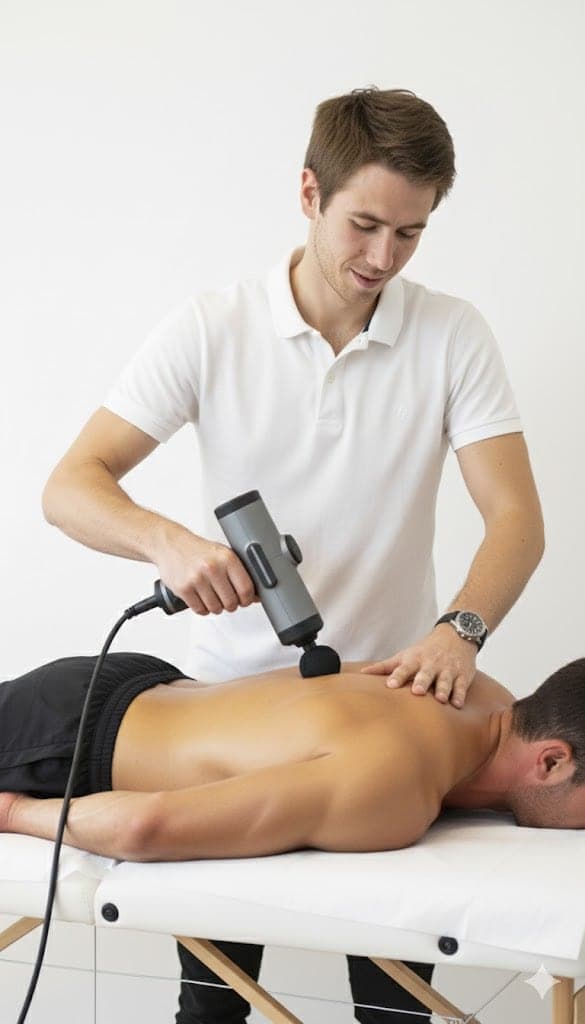
I work mobile, so the session happens in your living room or on your terrace anywhere in the Paphos district, from Peyia and Coral Bay down to Kato Paphos and out towards Kouklia. I bring a treatment bench, the mechanical deep-tissue device I use for the majority of the work, and towels. You supply the space and a floor that is reasonably level.
The first session starts with a short conversation and a look at how you move. I want to know when the pain started, what makes it worse, what you do for work and sport, and anything medical that changes the plan. That takes a few minutes and it decides what the rest of the hour looks like.
Why I use a machine for the deep work
For my first few years I worked entirely by hand. The technique was sound and people improved, but hands have limits: they tire, the pressure drifts, and dense tissue in the glutes, quadratus lumborum or thoracolumbar fascia resists them. I now do most of the deep work with a mechanical device that lets me hold a chosen pressure at a chosen angle for as long as the tissue needs, and dial that pressure up or down precisely for a heavily trained athlete or a sensitive back. It does not replace assessment or anatomy; it makes the delivery consistent, which matters more than most people expect.
A typical presentation I see in Paphos is a desk-bound lower back that turns out to be a hip flexor problem, or a runner's foot pain that starts further up the posterior chain. The treatment plan follows the mechanics, not the postcode of the pain. Sessions are €90 for 60 minutes or €130 for 90 minutes, and every fifth session is free; the details are on the pricing page. Chronic problems generally need more than one visit, and I will tell you at the first session what I think a reasonable plan looks like rather than leaving it open-ended.
What sports massage can and cannot do for you
Being clear about limits is part of being qualified. I can help with muscular tension, restricted range of motion, trigger points and referred pain, recovery from training load, and the stiffness that comes from long hours at a desk or behind a wheel. I cannot fix a structural problem, replace a diagnosis, or treat something that needs medical attention first. See a doctor first if you have unexplained swelling or heat in a limb, numbness or weakness that is getting worse, night pain that does not settle, a recent fall or blow you have not had checked, or a fever alongside your pain.
| Usually a good fit | Needs medical assessment first |
|---|---|
| Tight, sore muscles after training | Sudden calf pain with swelling or heat |
| Stiff neck and shoulders from desk work | Progressive numbness or weakness |
| Long-standing hip or lower back restriction | Pain following an untreated fall or accident |
| Runner's calf and foot tightness | Unexplained weight loss or night pain |
| Pre- and post-event preparation and recovery | Fever, infection or a recent surgical wound |
If you are somewhere in the middle, message me and describe it. I would rather tell you to see your GP than take a session I should not. Many of the people I see live in the villages north of town, and if you are looking for the same service closer to home there is a dedicated page for mobile massage in Pegeia.
Frequently asked questions
How do I verify a sports massage therapist's certification in Paphos?
Ask directly and expect a specific answer: the name of the course or degree, the country, and roughly how long it took. Then look it up. A genuine therapist has nothing to lose from the question and will usually welcome it. If the reply is vague, defensive or a list of adjectives rather than a qualification, treat that as your answer and keep looking.
What is the difference between a sports massage therapist and a physiotherapist?
Physiotherapists hold a regulated medical qualification and work across rehabilitation, exercise prescription and manual therapy. A sports massage therapist specialises in soft tissue: muscle, fascia, trigger points and the movement restrictions they create. The two often complement each other. My own training sits closer to the physiotherapy end in its anatomy and exercise-science content, but I do not diagnose and I refer on when something is outside my scope.
How many sessions will I need?
It depends on how long the problem has been there and how much of your day feeds it. Recent, single-cause tightness often settles quickly. Something you have carried for years, with the compensation patterns that go with it, takes longer, and I will say so at the first session. What you should expect either way is noticeable change fairly early on; if nothing is moving, the plan needs to change, not the number of bookings.
Is mechanical deep-tissue work painful?
It is strong rather than painful. Restricted tissue produces a clear, sometimes intense sensation under sustained pressure, but I keep the intensity below the point where you start guarding against it, because past that point the work stops being useful. The device lets me set that level precisely and hold it, and we talk throughout so you can tell me to ease off or go deeper.
Do you treat problems that are not sports injuries?
Yes. The label refers to the approach, not the client. Most of the people I see in Paphos are not competitive athletes; they are people with desk-related neck and back tension, hip and lower back restriction from sitting, tension headaches with a muscular component, or general stiffness they want addressed properly. If the problem lives in muscle, fascia or movement, the same assessment and deep-tissue methods apply.
Do you travel to me, and what do I need to have ready?
I come to you anywhere in the Paphos district with the bench, the device and towels. You need a room or shaded outdoor space large enough for a treatment table with me working around it, and ideally a floor that is level. Wear or bring shorts and a top that gives access to the area we are working on, and message me on WhatsApp with your location and a short description of the problem to arrange a time.
Written by
Chris
Massage therapist & body mechanics specialist
Norwegian-certified with a Bachelor’s in Physical Education and Nutrition and over ten years of clinical practice, working from a portable table in clients’ homes across the Paphos district.
- Norwegian-certified
- BSc Physical Education & Nutrition
- 10+ years clinical practice
- Based in Chlorakas · all of Paphos district
- No call-out fee anywhere in Paphos district
Last reviewed
This article is general information from clinical practice, not a medical diagnosis. If you have severe, worsening or unexplained pain, numbness, weakness, or pain after an accident, see a doctor first.