
Ergonomic Furniture Geroskipou: Transform Your Posture and Relieves Chronic Pain
In short
Discover how ergonomic furniture in Geroskipou addresses the root cause of postural dysfunction. Expert insights on selecting furniture that prevents mechanical stress and supports optimal body alignment.
I’ve spent the last decade working with clients across Cyprus who suffer from chronic pain, and I can tell you with absolute certainty: your furniture is either your greatest ally or your worst enemy. In Geroskipou, where many residents work from home or spend extended hours at desks, I’ve witnessed firsthand how poorly designed furniture creates a cascade of mechanical failures throughout the musculoskeletal system. The good news? Once you understand the biomechanics, selecting ergonomic furniture becomes a straightforward investment in your long-term health.
Let me be direct about something most people misunderstand: ergonomic furniture alone won’t fix years of accumulated tissue dysfunction and fascial adhesions. What it will do—and this is crucial—is prevent the continuous mechanical stress that created those problems in the first place. Think of it this way: if your body is a building, ergonomic furniture provides the proper foundation. But if the structure is already compromised, you need specialized intervention to restore it before that foundation can do its job effectively.
The Mechanical Reality of Poor Posture in Geroskipou Workspaces
During my years treating clients in Geroskipou, I’ve observed a consistent pattern. The average person sits for 8-12 hours daily, often in furniture designed with aesthetics rather than biomechanics in mind. This creates what I call “cumulative postural debt”—a progressive deterioration of tissue quality and joint positioning that manifests as pain, reduced performance, and eventually, chronic dysfunction.
The human spine evolved for movement, not sustained static positioning. When you sit in a conventional chair for hours, several mechanical problems occur simultaneously:
Posterior pelvic rotation flattens your lumbar curve, shifting load-bearing stress from the intervertebral discs’ central nucleus to their posterior annulus. Over months and years, this creates disc degeneration and nerve impingement.
Forward head translation increases the effective weight your cervical spine must support. For every inch your head moves forward, you add approximately 10 pounds of mechanical stress to the posterior cervical musculature and facet joints.
Scapular protraction and internal rotation shortens your pectoral muscles while overstretching and weakening the rhomboids and lower trapezius. This creates the rounded shoulder posture I see in nearly 80% of my new clients.
These aren’t just aesthetic issues—they’re mechanical failures that produce real tissue damage and inflammation.
What Actually Constitutes Ergonomic Furniture: A Clinical Perspective
I hold a Bachelor’s degree in Physical Education and Nutrition from Norway, and throughout my education and subsequent decade of practice, I’ve studied extensively how environmental factors influence body mechanics. Most “ergonomic” furniture in Geroskipou stores is marketed based on comfort rather than actual biomechanical support. True ergonomic design serves one purpose: maintaining optimal joint angles and tissue length-tension relationships during sustained positioning.
Here’s what genuinely matters when selecting ergonomic furniture:
Seating Dynamics and Lumbar Support Architecture
Your chair is the foundation of your postural system. A properly designed ergonomic chair must provide adjustable lumbar support that maintains the spine’s natural lordotic curve—typically 20-30 degrees of anterior pelvic tilt. This isn’t about “comfort” in the conventional sense; it’s about distributing compressive forces across the vertebral bodies rather than concentrating them on the posterior elements.
The seat pan depth should allow 2-3 centimeters of space between the seat edge and your popliteal fossa (back of knee). Excessive depth creates circulation restriction; insufficient depth fails to distribute weight properly across the thighs, increasing pressure on the ischial tuberosities.
I’ve worked with clients who spent thousands of euros on “executive chairs” that failed these basic criteria. One client, a software developer in Geroskipou, experienced chronic sciatic nerve irritation for three years. Within two weeks of switching to a properly adjusted ergonomic chair and receiving targeted deep-tissue treatment to release his piriformis and gluteal adhesions, his symptoms resolved completely.
Desk Height and Monitor Positioning: The Overlooked Variables
Most people focus exclusively on their chair while ignoring desk ergonomics. This is a critical error. Your desk height determines whether you can maintain neutral wrist positioning during keyboard use—essential for preventing median nerve compression and eventual carpal tunnel syndrome.
The optimal desk height positions your elbows at approximately 90-100 degrees of flexion when your shoulders are relaxed. Your keyboard should be at or slightly below elbow height, allowing your wrists to remain in neutral alignment rather than extended.
Monitor positioning is equally crucial for cervical spine health. The top of your screen should align with eye level, positioned 50-70 centimeters from your eyes depending on screen size and your visual acuity. This prevents the sustained cervical flexion that creates anterior head translation and subsequent posterior cervical strain.
Standing Desk Integration: Movement as Medicine
I advocate strongly for sit-stand desk solutions in Geroskipou, not because standing is inherently superior to sitting, but because variability is essential for tissue health. The human body thrives on movement diversity. Remaining in any single position—whether sitting or standing—for extended periods creates localized tissue ischemia and metabolic waste accumulation.
The optimal approach involves alternating between sitting and standing every 30-45 minutes. This variation stimulates circulation, prevents tissue adhesion formation, and maintains joint mobility throughout your working day.
However—and this is critical—standing at a desk with poor technique simply transfers mechanical stress from one area to another. I’ve treated numerous clients who developed plantar fasciitis and Achilles tendinopathy after transitioning to standing desks without proper guidance. Standing requires active engagement of your gluteal and core musculature to maintain pelvic neutrality. Most people compensate by hyperextending their lumbar spine and locking their knees, creating new problems.
The Furniture-Body System: Understanding the Interconnection
Here’s something most ergonomic furniture salespeople won’t tell you because they don’t understand body mechanics: furniture effectiveness depends entirely on your current tissue quality and motor control patterns. If you’ve spent years in poor posture, your tissues have adapted to those dysfunctional positions. Your hip flexors are chronically shortened, your thoracic spine is hyperkyphotic, and your deep cervical flexors are inhibited.
When you sit in an ergonomic chair that promotes proper positioning, those adapted tissues will actually create discomfort because they’re being placed in lengthened positions they haven’t experienced in years. Your nervous system interprets this as wrong, even though biomechanically it’s correct.
This is where my specialized approach becomes essential. Over the past decade, I’ve developed a protocol combining advanced mechanical deep-tissue massage with specific ergonomic recommendations. The massage component addresses the tissue dysfunction directly—releasing fascial adhesions, restoring tissue extensibility, and resetting muscle length-tension relationships. This creates the physiological foundation that allows ergonomic furniture to function as designed.
My Specialized Method: Precision Mechanical Tissue Treatment
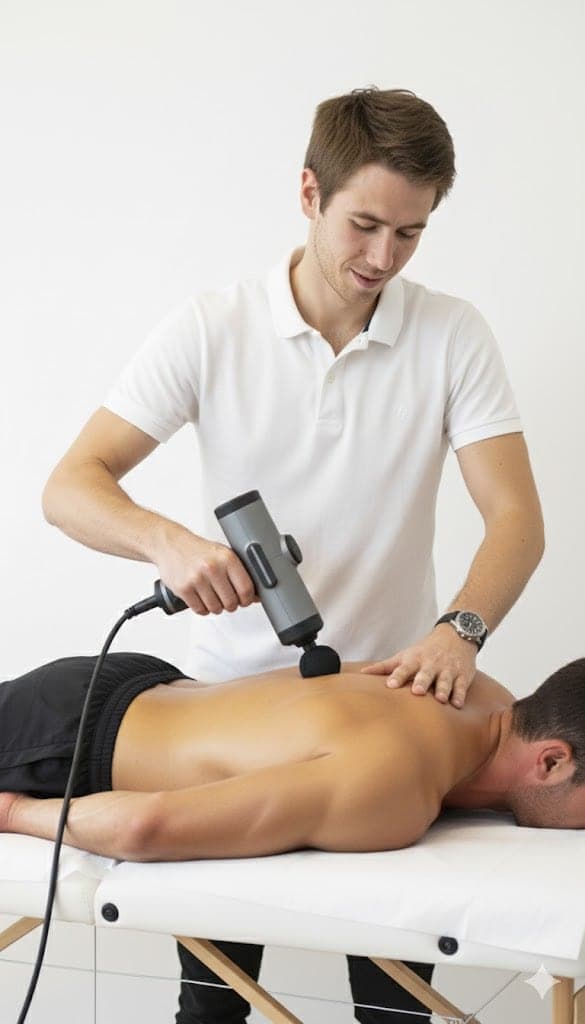
I don’t provide traditional relaxation massage—that’s not my specialty, and it’s not what produces lasting results. My approach uses a specialized mechanical tool that delivers precision, power, and consistency far beyond what human hands can achieve. This isn’t a massage gun or percussion device you buy online; this is a professional-grade instrument designed specifically for accessing and releasing deep fascial restrictions.
The mechanical advantage allows me to work at depths of 5-7 centimeters into tissue, reaching the deep spinal stabilizers, hip rotators, and thoracic musculature that conventional massage cannot effectively address. The precision means I can target specific trigger points and adhesions without causing unnecessary tissue trauma. The consistency ensures every treatment delivers identical therapeutic force—eliminating the “off days” that plague manual therapy.
I’ve used this method successfully with everyone from office workers in Geroskipou to professional athletes. One recent client, a competitive cyclist, came to me with chronic thoracic outlet syndrome that had resisted eighteen months of conventional physical therapy. After six sessions of targeted mechanical release combined with specific ergonomic interventions in his home office setup, his symptoms completely resolved. He recently set a personal record in competition.
The Investment Approach: Furniture Selection Strategy for Geroskipou Residents
I tell my clients plainly: quality ergonomic furniture represents a significant financial investment, but chronic pain and reduced performance capacity cost far more over time. A comprehensive ergonomic workstation—chair, adjustable desk, proper monitor arms, and keyboard trays—typically costs €1,500-3,000. That’s substantial, but consider the alternative: years of accumulated tissue damage, potential surgical intervention, and reduced quality of life.
| Furniture Component | Key Requirements | Expected Investment (EUR) |
|---|---|---|
| Ergonomic Office Chair | Adjustable lumbar support, seat depth adjustment, armrest customization | €400-800 |
| Electric Standing Desk | Memory height settings, stability at full height, minimum 120cm width | €500-1,200 |
| Monitor Arm System | Full range of motion, stable positioning, cable management | €100-250 |
| Ergonomic Keyboard/Mouse | Split design or negative tilt, vertical mouse positioning | €100-200 |
| Anti-Fatigue Mat | Varied terrain, adequate thickness (2cm minimum) | €50-100 |
Where to Source Quality Ergonomic Furniture in Geroskipou
Geroskipou has limited specialized ergonomic furniture retailers, which means most residents order from larger Cypriot suppliers or European sources. I’ve evaluated furniture from numerous manufacturers over the years, and I can tell you that price doesn’t always correlate with biomechanical quality.
The critical factor isn’t brand name—it’s adjustability. Your body’s dimensions and existing postural adaptations are unique. Furniture must accommodate your specific anthropometric measurements and provide the range of adjustment necessary to maintain optimal positioning as your tissues change and improve.
I recommend working with suppliers who offer trial periods and return policies. You cannot determine furniture effectiveness from a 5-minute showroom test. True evaluation requires 2-3 weeks of actual use, during which your body adapts and reveals whether the furniture genuinely supports proper mechanics.
Beyond Furniture: The Complete Postural Rehabilitation System
Here’s where I separate myself from conventional advice: ergonomic furniture is necessary but insufficient. I’ve worked with too many clients who invested in premium furniture yet continued experiencing pain because they never addressed the underlying tissue dysfunction.
Your body has spent years adapting to poor positioning. Those adaptations exist at the cellular level—shortened sarcomeres in chronically contracted muscles, collagen cross-linking in fascial planes, altered proprioceptive feedback from mechanoreceptors embedded throughout your tissues. Sitting in an ergonomic chair doesn’t reverse these changes; it merely stops further deterioration.
Reversing accumulated dysfunction requires targeted mechanical intervention. This is precisely why I developed my specialized treatment protocol. The mechanical tool I use can access and release restrictions that have existed for years or decades. It breaks down pathological collagen cross-links, restores normal tissue glide between fascial planes, and resets muscle resting tone.
I’ve treated hundreds of clients in Geroskipou and throughout Cyprus, and the pattern is consistent: those who combine proper ergonomic furniture with systematic tissue treatment achieve complete symptom resolution. Those who rely on furniture alone see improvement but plateau with residual dysfunction.
Implementation Protocol: My Recommended Approach for Geroskipou Residents
When a new client contacts me regarding postural pain, I explain my systematic approach clearly. This isn’t a spa treatment or one-time session—it’s a dedicated partnership aimed at lasting results.
Phase One: Assessment and Baseline Establishment
I begin with comprehensive postural and movement assessment. This isn’t subjective observation; I’m evaluating specific biomechanical markers: pelvic tilt angle, thoracic kyphosis degree, scapular positioning relative to the thoracic wall, cervical lordosis, and functional movement patterns during common tasks.
I also assess tissue quality through palpation and resistance testing. Where are the primary adhesions? Which muscle groups show hypertonicity versus inhibition? What compensation patterns has your nervous system developed?
This assessment provides the baseline data that guides both treatment protocol and furniture recommendations. A client with severe anterior pelvic tilt and psoas hypertonicity needs different ergonomic support than someone with posterior pelvic rotation and gluteal weakness.
Phase Two: Intensive Tissue Treatment
The initial treatment phase typically involves 4-6 sessions spaced 5-7 days apart. This frequency is essential—tissue remodeling requires consistent mechanical stimulus. During each session, I use the specialized mechanical tool to systematically release identified restrictions, working from superficial to deep layers.
The depth and intensity I can achieve with this instrument is remarkable. I regularly work at forces exceeding 40 kilograms per square centimeter—impossible to sustain manually—while maintaining absolute precision. This allows me to access the deep hip rotators, multifidus, and other spinal stabilizers that are typically untouched by conventional massage.
I travel to your location in Geroskipou with a professional treatment bench and all necessary equipment. The environment must be controlled—proper positioning is essential for accessing specific tissue planes effectively.
Phase Three: Ergonomic Implementation and Habit Formation
As tissue quality improves, ergonomic furniture becomes increasingly effective. I provide specific guidance on furniture selection based on your individual biomechanics and work requirements. This isn’t generic advice—it’s customized recommendations accounting for your specific postural patterns and the changes we’re creating through treatment.
I also teach active positioning strategies. Ergonomic furniture provides passive support, but optimal posture requires active muscular engagement. You need to relearn proper motor patterns—how to engage your transverse abdominis for spinal stability, how to maintain scapular retraction without excessive muscular effort, how to breathe diaphragmatically rather than with accessory muscles.
Phase Four: Maintenance and Optimization
Once we’ve achieved baseline correction—typically after 6-8 weeks—the focus shifts to maintenance and performance optimization. Many of my clients continue with monthly sessions to address any emerging restrictions before they become problematic. This proactive approach prevents the accumulation of new dysfunction and maintains the results we’ve achieved.
Common Mistakes I See with Ergonomic Furniture in Geroskipou
My decade of experience has shown me the same errors repeatedly. These mistakes undermine even the best furniture investments:
Incorrect adjustment persistence: Most people adjust their furniture once and never modify it again. Your body changes—both daily fluctuation and long-term adaptation. Furniture adjustment should be dynamic, responding to how your body feels and functions.
Ignoring seated dynamics: People remain motionless in their ergonomic chairs, defeating the purpose entirely. Even optimal positioning becomes pathological if sustained without movement. I teach clients to perform micro-movements every 15-20 minutes—pelvic tilts, scapular retractions, cervical rotations—maintaining tissue circulation and joint mobility.
Compensation for flexibility limitations: When your hip flexors are tight, you can’t sit with proper pelvic positioning regardless of chair quality. You compensate by perching on the seat front or slumping backward. The furniture can’t overcome tissue restrictions—those require direct treatment.
Neglecting peripheral ergonomics: I see clients with perfect desk setups who crane their necks to see poorly positioned secondary monitors or reach excessively for phones and documents. Comprehensive ergonomics addresses your entire workspace, not just primary elements.
The Performance Dimension: Beyond Pain Relief
While most people seek my services for pain elimination, the performance benefits of optimal posture extend far beyond discomfort resolution. Proper biomechanical positioning directly influences cognitive function, respiratory capacity, and overall systemic health.
Research demonstrates that upright, aligned posture increases lung capacity by 15-30% compared to slouched positioning. This directly affects oxygen delivery to tissues, including your brain. I’ve had numerous clients report improved mental clarity and reduced afternoon fatigue after correcting their posture through combined treatment and ergonomic intervention.
Mechanical efficiency also improves dramatically. When your joints are properly aligned, force transmission follows optimal vectors, reducing muscular work requirements for basic tasks. One client, an architect in Geroskipou, reported that his neck and shoulder pain resolved completely, but more significantly, he could work 2-3 hours longer before experiencing fatigue. His productivity increased measurably—he completed projects faster without working additional hours.
Athletic performance improvements are particularly dramatic. Proper posture optimizes the length-tension relationship of force-producing muscles. I’ve worked with tennis players, runners, and CrossFit athletes who achieved significant performance gains purely through postural correction and associated tissue release. Better positioning means more efficient force production and reduced injury risk.
Real Client Outcomes: The Evidence of Effectiveness
I measure success through objective outcomes, not subjective satisfaction. Over the past decade, I’ve documented consistent results across diverse client populations in Geroskipou and throughout Cyprus.
A recent client, a 42-year-old accountant, came to me with chronic cervicogenic headaches occurring 4-5 times weekly for over two years. She had tried conventional physiotherapy, pain medication, and various ergonomic chairs without lasting improvement. After our comprehensive assessment, I identified severe upper trapezius and suboccipital hypertonicity with associated trigger points, combined with significant forward head posture—her ear was positioned 8 centimeters anterior to her shoulder landmark.
We implemented a treatment protocol combining intensive mechanical release of the posterior cervical and upper thoracic musculature with specific ergonomic modifications to her home office. I adjusted her monitor height, modified her keyboard positioning, and taught her active cervical positioning strategies.
Within three weeks, her headache frequency decreased to once weekly. By week eight, headaches had resolved completely. More importantly, her forward head posture improved by 6 centimeters—a dramatic structural change that required both tissue release and proper environmental support to achieve and maintain.
Another client, a 38-year-old who manages a retail business in Geroskipou, experienced chronic low back pain that significantly impaired his quality of life. He couldn’t play with his children without pain, struggled with basic tasks like gardening, and had difficulty sleeping due to discomfort. Multiple medical consultations suggested surgical intervention as the eventual solution.
My assessment revealed massive dysfunction throughout his posterior chain—chronically shortened hip flexors, inhibited gluteals, and severe paraspinal hypertonicity with extensive fascial restriction. His office setup forced him into persistent lumbar flexion throughout 8-10 hour workdays, continuously aggravating the underlying tissue dysfunction.
Our treatment focused initially on releasing the deep hip rotators, psoas complex, and lumbar erector spinae through intensive mechanical work. Simultaneously, we implemented a standing desk solution with specific height and positioning parameters. I taught him proper standing mechanics—maintaining slight knee flexion, active gluteal engagement, and neutral pelvic positioning.
The results were transformative. Pain levels decreased progressively over six weeks. By three months, he was completely asymptomatic. He now exercises regularly, engages fully with his family, and reports the best physical function of his adult life. He avoided surgery entirely through addressing root mechanical causes rather than managing symptoms.
The Science Behind Mechanical Tissue Treatment
I want to explain why my specialized mechanical approach produces superior results compared to conventional manual therapy or standard massage. This isn’t subjective opinion—it’s based on physiological principles and mechanical physics.
Human hands, regardless of therapist skill, cannot generate sustained deep pressure without fatigue. Manual therapists typically achieve 10-15 kilograms of force before experiencing muscular exhaustion that degrades treatment quality. My mechanical tool delivers 30-50 kilograms of precisely controlled force continuously, accessing tissue depths impossible through manual means.
The mechanical advantage also provides critical consistency. Every treatment delivers identical therapeutic stimulus—there are no “off days” where my fatigue or condition affects results. This consistency is essential for progressive tissue remodeling. Your body responds to reliable, repeated mechanical stimulus by reorganizing collagen structure, reducing inflammatory mediators, and restoring normal tissue properties.
The precision dimension cannot be overstated. I can target specific trigger points and adhesions with millimeter accuracy. This focused approach minimizes unnecessary tissue trauma while maximizing therapeutic effect on pathological structures. Manual therapy inherently affects larger tissue areas with less precision—an unavoidable limitation of hand size and proprioceptive feedback.
Investment vs. Expense: The Economics of Comprehensive Postural Care
I position my services as an investment, not an expense, because the economic reality supports this framing completely. Consider the actual costs of unaddressed postural dysfunction:
- Chronic pain medication: €50-150 monthly, ongoing indefinitely
- Reduced work productivity: Estimated 20-30% efficiency loss when working with pain
- Medical consultations and diagnostic imaging: €200-500 per episode
- Potential surgical intervention: €5,000-15,000 plus recovery time
- Reduced quality of life: Inability to engage in activities you enjoy, priceless but profoundly impactful
My comprehensive approach—combining specialized mechanical treatment with ergonomic optimization—typically requires an initial investment of €2,000-3,500 (including both treatment sessions and quality furniture). This achieves lasting resolution in most cases, eliminating ongoing costs entirely.
The return on investment becomes obvious when viewed across even a single year, let alone over decades. More importantly, the non-monetary returns—restored function, enhanced performance, improved quality of life—represent value that cannot be quantified but profoundly impacts your daily experience.
Frequently Asked Questions About Ergonomic Furniture and Postural Treatment in Geroskipou
Will an ergonomic chair alone fix my back pain?
No. An ergonomic chair prevents continued mechanical stress that worsens existing dysfunction, but it cannot reverse accumulated tissue damage and fascial restrictions. You need active treatment to release existing pathology combined with proper furniture to prevent recurrence. I’ve never seen a client achieve complete pain resolution through furniture alone when significant tissue dysfunction exists.
How long does it take to see results from your treatment approach?
Most clients experience measurable improvement within 2-3 sessions. Significant pain reduction typically occurs by week 3-4. Complete resolution of chronic dysfunction requires 6-8 weeks of systematic treatment combined with proper ergonomic implementation. The timeline varies based on dysfunction severity and duration—problems that developed over years require time to reverse completely.
Is your mechanical treatment painful?
The treatment is intensive but should remain within tolerable limits. I adjust force and depth continuously based on your feedback and tissue response. Some discomfort during deep tissue release is normal—this represents mechanical breaking of adhesions and restoration of tissue mobility. However, excessive pain causes protective muscular guarding that prevents effective treatment. I work at the therapeutic threshold—enough intensity to create change without triggering counterproductive protective responses.
Can I just buy the mechanical tool you use and treat myself?
No. The instrument I use is professional-grade and requires extensive training to apply effectively and safely. More importantly, you cannot achieve proper positioning and angles working on yourself. Effective deep tissue treatment requires external mechanical advantage and precise positioning that self-application cannot provide. The commercial massage devices available online are percussion tools that work superficially—they’re completely different from the specialized equipment I employ.
What makes your approach different from physiotherapy or chiropractic care?
Physiotherapy typically focuses on exercise prescription and movement reeducation—valuable components but insufficient when significant tissue restriction exists. Chiropractic emphasizes joint manipulation—again useful but doesn’t address the muscular and fascial dysfunction that creates and maintains joint restrictions. My approach targets the tissue pathology directly through mechanical release while simultaneously addressing the environmental and postural factors that caused the problem initially. It’s comprehensive rather than component-focused.
How do I maintain results long-term after completing treatment?
Three elements ensure lasting results: continued use of proper ergonomic furniture, implementation of the movement strategies I teach, and periodic maintenance sessions to address emerging restrictions before they become problematic. Most clients benefit from monthly or quarterly maintenance treatments combined with consistent application of ergonomic principles. The key is prevention—addressing small dysfunctions before they accumulate into major problems.
Do you accept insurance for your services?
I operate on a private-pay basis, which allows me to provide the time and attention necessary for effective treatment without insurance company limitations. A typical session requires 60-90 minutes—far longer than most insurance-covered treatments allow. However, I provide detailed documentation that many clients successfully submit for reimbursement depending on their specific insurance coverage. The investment in comprehensive care produces better outcomes than multiple shorter insurance-covered sessions that fail to address root causes.
Can ergonomic furniture help with conditions like sciatica or disc herniation?
Proper ergonomic furniture reduces mechanical stress that exacerbates these conditions, but it doesn’t treat the underlying pathology. Sciatica typically results from piriformis syndrome, disc herniation, or facet joint dysfunction—all conditions that require specific treatment intervention. However, continuing to sit in poorly designed furniture while undergoing treatment is counterproductive. The furniture component is essential for preventing re-aggravation, but it must be combined with treatment that addresses the actual tissue pathology.
Taking Action: Your Path to Lasting Postural Correction
If you’re experiencing chronic pain, reduced performance, or simply recognize that your current furniture setup isn’t supporting your body properly, I encourage you to take decisive action. The pattern I’ve observed over ten years is consistent: people wait far too long before seeking effective intervention. They try various partial solutions—buying a lumbar cushion, taking pain medication, hoping the problem resolves spontaneously—while the underlying dysfunction progressively worsens.
Comprehensive postural correction requires two elements working in concert: proper ergonomic furniture that prevents ongoing mechanical stress, and specialized treatment that reverses accumulated tissue dysfunction. Neither component alone achieves lasting results, but combined, they create the foundation for complete resolution and optimized physical function.
I travel to your location in Geroskipou with professional equipment and everything necessary for effective treatment. We begin with thorough assessment, develop a customized treatment protocol based on your specific dysfunction patterns, and implement ergonomic modifications tailored to your work requirements and body mechanics.
This is an investment in your long-term health and performance capacity. The alternative—continuing with suboptimal furniture and untreated tissue dysfunction—guarantees progressive deterioration and eventually more invasive interventions. The choice is clear when you understand the mechanics involved.
Your posture determines how your body functions at the most fundamental level. It affects everything from breathing capacity to digestive function, from cognitive performance to athletic capability. Optimizing this foundation through proper ergonomic support and targeted tissue treatment represents perhaps the highest-return health investment you can make.
I’ve dedicated the past decade to developing and refining an approach that produces lasting results. My education in Physical Education and Nutrition from Norway provided the theoretical foundation, but the real expertise comes from thousands of hours working directly with clients, observing what actually produces lasting change versus temporary symptom management.
The specialized mechanical tool I use, combined with comprehensive ergonomic guidance, addresses both the tissue pathology and the environmental factors that created it. This dual approach is what separates my method from conventional treatments that focus on only one dimension of the problem.
Your body has remarkable capacity for adaptation and healing when provided the proper mechanical stimulus and environmental support. I’ve witnessed dramatic transformations in clients who had resigned themselves to chronic dysfunction—people who believed surgery was inevitable, who thought pain was their lasting reality. By addressing root mechanical causes rather than managing symptoms, we achieve outcomes that many consider impossible.
The residents of Geroskipou deserve access to this level of specialized care. Whether you work in an office, run a business, or engage in athletic pursuits, your postural health directly impacts your performance and quality of life. The ergonomic furniture component provides the environmental foundation; my specialized treatment provides the tissue correction necessary to utilize that foundation effectively.
Contact me to begin your journey toward lasting postural optimization. This isn’t a quick fix or temporary relief—it’s a systematic approach to transforming how your body functions at the most fundamental mechanical level. The investment you make today prevents years of progressive dysfunction and positions you for optimal performance in everything you do.
Your body is the only one you get. Treat it as the remarkable biomechanical system it is, providing the support and care necessary for optimal function. The combination of proper ergonomic furniture and specialized mechanical tissue treatment represents the gold standard for postural correction—an approach backed by biomechanical science and proven through thousands of successful client outcomes across my decade of professional practice.
Written by
Chris
Massage therapist & body mechanics specialist
Norwegian-certified with a Bachelor’s in Physical Education and Nutrition and over ten years of clinical practice, working from a portable table in clients’ homes across the Paphos district.
This article is general information from clinical practice, not a medical diagnosis. If you have severe, worsening or unexplained pain, numbness, weakness, or pain after an accident, see a doctor first.