
Deep Tissue Massage for Injury Recovery: A Clinical Approach to Lasting Healing
In short
Discover how advanced deep tissue massage targets injury recovery at its source. Learn why mechanical precision delivers lasting results where traditional methods fail, backed by clinical expertise.
After a decade of working with injured clients—from weekend warriors to professional athletes—I’ve witnessed a fundamental problem in how most people approach injury recovery. They chase symptom relief instead of addressing the mechanical dysfunction causing their pain. This distinction isn’t semantic; it’s the difference between temporary comfort and lasting healing.
Deep tissue massage for injury recovery, when executed with clinical precision and advanced methodology, doesn’t just accelerate healing—it reconstructs the body’s mechanical integrity at the tissue level. My education in Physical Education and Nutrition from Norway combined with ten years of specialized practice has taught me that successful injury recovery demands more than good intentions. It requires precision, consistency, and the willingness to work at depths where actual change occurs.
Understanding Deep Tissue Massage for Injury Recovery: Beyond Surface Treatment
Let me be direct: most massage therapists are trained for relaxation, not rehabilitation. There’s nothing wrong with relaxation—it has its place. But when you’re recovering from a rotator cuff injury, chronic IT band syndrome, or persistent lower back dysfunction, you need mechanical intervention at the fascial and muscular level where scar tissue, adhesions, and compensation patterns have embedded themselves.
Deep tissue massage for injury recovery operates on a fundamentally different principle than conventional bodywork. We’re targeting myofascial restrictions that have developed protective patterns around injured tissue. These patterns, while initially protective, become the primary obstacle to complete recovery. Your body essentially “locks down” around an injury, creating compensatory movement patterns that persist long after the initial trauma has healed.
The Biomechanics of Injury and Compensation
When tissue is injured, your nervous system initiates a cascade of protective responses. Muscles surrounding the injury site contract, blood flow becomes restricted, and fascia—the connective tissue wrapping every muscle fiber—begins to bind and thicken. This is appropriate in the acute phase. The problem emerges when these protective patterns become chronic.
I’ve treated a 43-year-old executive who suffered a hamstring strain playing tennis eighteen months before we met. The initial injury had “healed,” yet he still experienced pain and limited range of motion. Traditional physical therapy had plateaued. When I assessed his posterior chain, the hamstring itself wasn’t the primary issue anymore—his entire kinetic chain from his lumbar spine through his calf had developed compensatory tension patterns. His glutes had essentially stopped firing properly, forcing his hamstring to work overtime. This is textbook compensation mechanics, and it’s why superficial treatment fails.
Why Traditional Massage Falls Short in Injury Recovery
Human hands, regardless of the therapist’s strength or intention, have inherent limitations. Therapists fatigue. Pressure becomes inconsistent. Depth is limited by the practitioner’s physical capacity and the body’s protective reflexes against uncontrolled pressure. These aren’t criticisms—they’re biomechanical facts.
For genuine injury recovery, we need to reach the deep fascial layers where restrictions have formed. This requires sustained, controlled pressure at specific angles and intensities that human hands simply cannot maintain consistently. I learned this not from theory but from practice—years of watching clients improve to a point, then plateau, because the tools available couldn’t access the root mechanical dysfunction.
Advanced Mechanical Deep Tissue Massage: Precision Technology for Injury Recovery
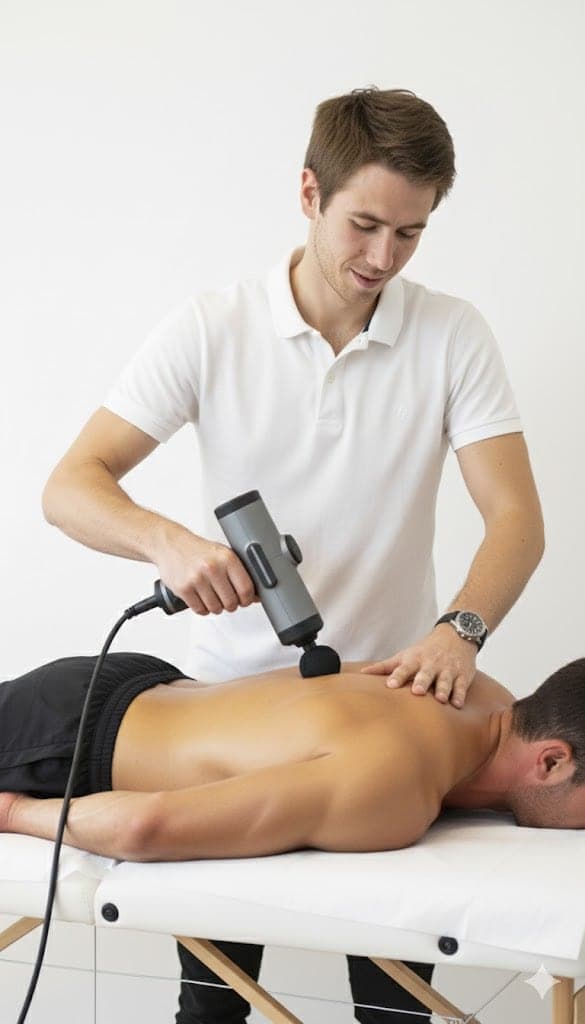
This realization led me to develop my current methodology, which represents a fundamental evolution in deep tissue massage for injury recovery. I utilize a specialized mechanical device that delivers what I call the three pillars of effective rehabilitation: Precision, Power, and Consistency.
Precision: Targeting the Exact Source of Dysfunction
The mechanical approach allows me to work with millimeter-level accuracy. When I’m releasing adhesions in the subscapularis muscle—a common culprit in shoulder injuries—I can maintain a specific angle and sustained pressure that would be impossible to replicate manually. The machine doesn’t tire, doesn’t shake, doesn’t vary in pressure due to fatigue or angle changes.
This precision extends to how we progress through treatment phases. Early in recovery, we work at moderate depths, focusing on increasing blood flow and beginning to mobilize superficial restrictions. As tissue responds and the nervous system begins to trust the process, we systematically increase depth and intensity. This progressive overload principle—borrowed from athletic training—allows us to continuously challenge and remodel tissue without overwhelming the body’s adaptive capacity.
Power: Working Where Change Actually Occurs
I won’t sugarcoat this: effective deep tissue massage for injury recovery isn’t always comfortable. We’re working at depths where chronic restrictions have formed—sometimes over months or years. These layers don’t release with gentle encouragement; they require controlled, sustained mechanical force.
The machine I use can deliver significantly more pressure than human hands while remaining completely controlled. For a high-level CrossFit athlete I treated with chronic hip impingement, we worked at intensities that would be impossible to achieve manually. His hip flexors, iliopsoas, and deep hip rotators had developed severe restrictions from years of heavy squatting with suboptimal mechanics. The mechanical advantage allowed us to reach these structures effectively, something manual therapy had failed to accomplish over six months of treatment elsewhere.
But power without control is just force. This is why the adjustability of the mechanical system is crucial—I can modulate intensity in real-time based on tissue response, client tolerance, and the specific structure being addressed.
Consistency: Eliminating the Variable of Human Fatigue
Perhaps the most underappreciated advantage of mechanical deep tissue massage is consistency. I don’t have “off days.” The treatment you receive today will be identical in quality and intensity to the treatment you receive next week. This consistency is vital for injury recovery because tissue remodeling requires progressive, predictable stimulus.
When I manually treated clients earlier in my career, the quality of treatment varied with my energy levels, the number of clients I’d seen that day, and countless other factors. Now, whether you’re my first client of the day or my last, the mechanical precision remains constant. This consistency accelerates recovery timelines because we’re delivering reliable stimulus that your body can adapt to predictably.
The Clinical Protocol: How Deep Tissue Massage Facilitates Injury Recovery
Effective treatment isn’t about booking an appointment and hoping for the best. It’s a structured, progressive process built on biomechanical principles and clinical assessment.
Initial Assessment and Movement Analysis
Every injury recovery protocol begins with comprehensive assessment. I’m examining not just the injury site but the entire kinetic chain. A knee injury, for instance, is almost never just about the knee. I’m assessing ankle mobility, hip stability, core function, and movement patterns that may have contributed to the injury or developed as compensation.
I use functional movement screening to identify asymmetries and restrictions. How does your squat pattern look? Can you maintain neutral spine during hip hinge movements? Where do you lose tension or control? These assessments reveal the mechanical story of your injury—not just what hurts, but why.
Phased Treatment Approach
Deep tissue massage for injury recovery follows a systematic progression through distinct phases:
Phase 1: Inflammation Management and Initial Mobilization
In the early stages, particularly if we’re working with recent injury, the goal is to enhance circulation without aggravating inflammation. We use moderate depth to begin mobilizing superficial fascial restrictions and encouraging lymphatic drainage. This isn’t aggressive work—it’s strategic preparation for deeper intervention.
Phase 2: Deep Fascial Release and Adhesion Breaking
As tissue becomes responsive, we progressively increase depth and intensity. This is where the mechanical advantage becomes most apparent. We’re systematically working through layers of restriction, releasing adhesions, and beginning to restore normal tissue texture. I can feel—and you can often hear—tissue releasing during this phase. That’s not damage; that’s remodeling.
A runner I treated for chronic plantar fasciitis exemplifies this phase. Her plantar fascia had thickened significantly, developing nodules and adhesions. Manual therapy had provided temporary relief but no lasting change. Using the mechanical device, we could deliver sustained pressure directly into the fascial restrictions at intensities that would have been impossible manually. Over six sessions, we documented measurable reduction in fascial thickness and complete resolution of her morning pain.
Phase 3: Integration and Performance Optimization
Once primary restrictions are released, we shift focus to integration and optimization. This involves working the entire kinetic chain to ensure balanced function, addressing any remaining compensatory patterns, and often pushing into performance enhancement territory. For athletes, this is where we prepare tissue for sport-specific demands.
The Role of Active Recovery and Movement Re-education
Deep tissue massage for injury recovery isn’t passive treatment. Between sessions, I prescribe specific movement protocols designed to reinforce the changes we’re creating manually. This might include mobility work, activation exercises for inhibited muscles, or sport-specific movement pattern training.
The tissue changes we create during treatment provide a window of opportunity—typically 48-72 hours—where your nervous system is particularly receptive to new movement patterns. If we release chronic tightness in your hip flexors but you immediately return to sitting all day with poor posture, we’ve accomplished little. The treatment creates possibility; your movement habits determine whether that possibility becomes lasting change.
Clinical Evidence: Mechanisms of Action in Deep Tissue Massage
Understanding how deep tissue massage facilitates injury recovery requires examining the physiological mechanisms at play. This isn’t mystical—it’s mechanical and biochemical intervention with predictable outcomes.
Fascial Remodeling and Collagen Reorganization
Fascia responds to mechanical stimulus by remodeling its collagen structure. When we apply sustained pressure, we’re essentially signaling tissue to reorganize along functional lines of tension rather than random, restrictive patterns. This process—called thixotropy—allows bound, gel-like fascia to become more fluid and mobile.
Research in manual therapy has demonstrated that sustained pressure can reduce fascial density and improve tissue extensibility. The mechanical approach amplifies this effect by allowing longer treatment times at optimal pressure without therapist fatigue compromising treatment quality.
Breaking the Pain-Tension Cycle
Chronic injury creates a vicious cycle: pain causes muscle tension, tension restricts blood flow, restricted blood flow increases metabolic waste accumulation, waste products sensitize pain receptors, which increases pain. Deep tissue massage for injury recovery interrupts this cycle at multiple points.
By mechanically releasing muscle tension, we immediately improve local circulation. Enhanced blood flow delivers oxygen and nutrients while removing metabolic waste. This reduces chemical irritation of pain receptors. Simultaneously, the pressure signals from the massage compete with pain signals in the nervous system—a phenomenon called “gate control theory”—providing immediate pain relief that allows tissue to relax further.
Trigger Point Deactivation and Referred Pain Resolution
Many chronic injury patterns involve trigger points—hyperirritable spots in muscle that refer pain to distant locations. I’ve treated countless clients whose “knee pain” actually originated from trigger points in their vastus lateralis or whose “headaches” traced back to upper trapezius and suboccipital trigger points.
Deep tissue massage for injury recovery systematically deactivates these trigger points through sustained, precise pressure. The mechanical device allows me to maintain optimal pressure—enough to elicit the local twitch response and subsequent relaxation, but controlled enough to avoid overwhelming the nervous system’s protective responses.
| Physiological Mechanism | Clinical Effect | Timeline for Observable Change |
|---|---|---|
| Fascial thixotropy and collagen remodeling | Improved tissue extensibility and reduced restriction | Immediate to 72 hours post-treatment |
| Enhanced local circulation and metabolite clearance | Reduced inflammation and pain sensitization | 24-48 hours post-treatment |
| Trigger point deactivation | Resolution of referred pain patterns | Immediate to 1 week |
| Nervous system desensitization | Reduced protective muscle guarding | 2-4 sessions |
| Movement pattern optimization | Improved biomechanics and reduced compensation | 4-8 weeks with consistent work |
Addressing Common Injuries: Specific Applications of Deep Tissue Massage
While principles remain consistent, different injury types require modified approaches. Let me walk through several common scenarios from my clinical practice.
Shoulder Injuries: Rotator Cuff and Impingement Syndromes
Shoulder dysfunction is rarely isolated to one structure. A “rotator cuff injury” typically involves imbalances between the rotator cuff muscles, overactive upper trapezius and levator scapulae, restricted pectoralis minor, and poor scapular stability. Deep tissue massage for injury recovery in the shoulder requires addressing this entire complex.
I worked with a 38-year-old who had struggled with shoulder impingement for two years. MRI showed minor rotator cuff fraying but nothing requiring surgery. Physical therapy had helped somewhat, but he still couldn’t press overhead without pain. Assessment revealed severe restrictions in his subscapularis, teres major, and latissimus dorsi—muscles that control internal rotation and scapular positioning.
Using the mechanical device, we could access these deep structures effectively. The subscapularis, in particular, requires working through the axilla at specific angles—extremely difficult manually. Over eight sessions, we systematically released these restrictions while he performed prescribed activation exercises for his lower trapezius and serratus anterior. He returned to full overhead pressing within twelve weeks.
Lower Back Injuries: Beyond the Erectors
Lower back pain is perhaps the most common complaint I address, and it’s almost always multifactorial. The typical pattern involves overactive erector spinae, inhibited multifidus, tight hip flexors pulling the pelvis into anterior tilt, and poor core stability.
Deep tissue massage for injury recovery in the lumbar spine focuses on releasing compensatory tension while strategically avoiding overworked structures. Counter-intuitively, we often spend minimal time on the painful erector muscles themselves—they’re overworked, not the cause. Instead, we focus on the hip flexors, quadratus lumborum, and thoracolumbar fascia to restore balanced mechanics.
The mechanical precision allows us to work the QL and iliopsoas at depths that create lasting change. These structures, when chronically shortened, pull the lumbar spine into positions that strain other tissues. Releasing them fundamentally changes spinal mechanics.
Running Injuries: IT Band Syndrome, Plantar Fasciitis, and Achilles Tendinopathy
Running injuries follow predictable patterns because running is repetitive loading with minimal variation. When mechanics are suboptimal—even slightly—that deficit multiplies over thousands of foot strikes.
IT band syndrome, for instance, isn’t actually an IT band problem—the iliotibial band itself doesn’t get “tight.” Rather, the tensor fasciae latae and gluteus maximus (which insert into the IT band) become overactive, often compensating for weak hip abductors. Deep tissue massage for injury recovery addresses the TFL and glute max directly while incorporating activation work for the hip abductors.
I treated a marathon runner who had struggled with IT band pain for three training cycles. Previous treatment had focused on foam rolling the IT band itself—painful and ineffective. We shifted focus to releasing his TFL, working the gluteus medius and minimus to restore proper function, and addressing fascial restrictions along his entire lateral chain. Combined with running gait modifications, he completed his next marathon pain-free.
Athletic Performance Injuries: Overuse and Compensation Patterns
Athletes present unique challenges because they’re operating at the limits of their tissue capacity. Small mechanical inefficiencies become amplified under high training loads. A powerlifter’s squat mechanics, a tennis player’s serve motion, a cyclist’s pedal stroke—these repetitive, high-force movements expose and exploit any mechanical dysfunction.
Deep tissue massage for injury recovery in athletic populations isn’t just about healing—it’s about optimization. We’re not returning to baseline; we’re enhancing capacity beyond pre-injury levels. This requires aggressive treatment of restrictions combined with sophisticated movement pattern work.
The Investment Framework: Why Quality Treatment Delivers Lasting Results
I’m going to address something most practitioners avoid: the economics of effective treatment. Quality deep tissue massage for injury recovery is an investment in your long-term function, not an expense to minimize.
Consider the typical path many people follow: They develop pain. They try rest, which provides temporary relief. Pain returns. They try over-the-counter solutions—massage guns, foam rollers, topical treatments. Maybe they book a relaxation massage, which feels good but changes nothing. Pain persists. Eventually, they see a doctor who prescribes anti-inflammatories or physical therapy. These help to a point, but the underlying mechanical dysfunction remains.
This path is expensive—not necessarily in dollar terms per session, but in cumulative cost, time lost, performance degraded, and quality of life diminished. You’re treating symptoms repeatedly without addressing causes.
The True Cost of Incomplete Recovery
What’s the cost of living with chronic shoulder restriction that prevents you from training the way you want? What’s the value of resolving back pain that’s been limiting your professional performance for years? How do you quantify improved sleep quality when neck tension finally releases?
I’ve watched clients spend thousands of dollars on treatments that provided temporary relief without creating lasting change. The investment in comprehensive, mechanically-sound treatment is higher per session but dramatically lower in total cost because we’re creating lasting resolution, not managing chronic symptoms.
The Dedicated Partnership Model
Effective injury recovery isn’t transactional—it’s a partnership. I don’t offer quick fixes or promise overnight transformations. What I provide is systematic, progressive treatment based on clinical assessment and biomechanical principles, combined with movement education that ensures lasting results.
This means we’re working together over weeks or months, progressively addressing layers of dysfunction, constantly reassessing, and adapting the treatment plan based on your tissue response and functional improvements. The mechanical consistency of my treatment method ensures that each session builds on the previous one—we’re not starting over each time you walk in.
Logistics and Treatment Experience: Professional Care in Your Environment
One frequently overlooked aspect of effective treatment is the environment and logistics. I travel to your location with a professional treatment bench and all necessary equipment. This isn’t just convenience—it’s strategic.
Treatment immediately post-session, your nervous system is in a heightened state of receptivity. The last thing you need is to navigate traffic and stress, which re-engages protective tension patterns. Being able to immediately rest, hydrate, and integrate the treatment in your own environment significantly enhances results.
Additionally, many of my clients are high-level professionals or athletes whose schedules don’t accommodate traditional clinic appointments. By bringing professional-grade equipment and expertise to your location, we remove logistical barriers to consistent treatment—and consistency is fundamental to successful injury recovery.
Beyond Recovery: Performance Optimization and Preventive Maintenance
Once we’ve resolved your primary injury concern, many clients transition into performance optimization and maintenance protocols. This is where deep tissue massage evolves from rehabilitation to enhancement.
Preventive Treatment for High-Demand Activities
If you’re training seriously—whether for competition or personal goals—you’re constantly creating microtrauma and compensatory patterns. Regular deep tissue work prevents these minor issues from becoming major injuries. We’re identifying and addressing restrictions before they compromise movement quality or create pain.
I work with several executives who travel extensively and have demanding physical hobbies. They’re not recovering from injury—they’re maintaining optimal function despite significant physical and postural demands. For them, consistent treatment is injury prevention and performance insurance.
Sport-Specific Preparation and Recovery
Athletes benefit from periodized deep tissue work that aligns with their training cycles. Pre-competition, we focus on ensuring optimal mobility and tissue quality without inducing soreness. Post-competition or heavy training blocks, we work more aggressively to accelerate recovery and address accumulated tension.
A competitive cyclist I work with schedules aggressive sessions during his off-season when we can work deeply without affecting training. During racing season, we maintain tissue quality with less intensive sessions timed to avoid important competitions. This strategic approach maximizes benefit while managing recovery demands.
Frequently Asked Questions About Deep Tissue Massage for Injury Recovery
How soon after injury can I begin deep tissue massage treatment?
This depends entirely on the injury type and severity. For acute injuries with active inflammation, we typically wait 48-72 hours before beginning treatment, and initial sessions focus on circulation enhancement rather than aggressive tissue work. For chronic injuries or post-surgical recovery (after physician clearance), we can often begin immediately with appropriate modifications. The key is matching treatment intensity to tissue readiness—pushing too hard too soon can aggravate inflammation, while waiting too long allows compensation patterns to solidify.
Why is mechanical treatment superior to manual deep tissue massage?
Three fundamental advantages: precision, power, and consistency. The mechanical device allows me to maintain specific pressure and angles for extended periods without fatigue affecting quality. I can work at depths and intensities impossible to achieve manually while maintaining complete control. Most importantly, treatment quality remains constant—you receive the same precision whether you’re my first client of the day or my last. Human limitations are biomechanical facts, not criticisms of manual therapists.
How many sessions will I need to recover from my injury?
This isn’t something I can answer without assessment. Acute injuries with minimal compensation often respond within 4-6 sessions. Chronic conditions involving significant compensatory patterns may require 8-12 sessions or more. The key variables are injury duration, degree of tissue change, your body’s healing capacity, and how consistently you perform prescribed movement work between sessions. I provide honest timelines after initial assessment based on what I’m finding in tissue quality and movement patterns.
Is deep tissue massage painful? How intense should treatment feel?
Effective deep tissue massage for injury recovery exists at the edge of discomfort—challenging enough to create change, controlled enough to avoid triggering protective responses. You should feel significant pressure and intensity, but not sharp, overwhelming pain. I describe it as “good pain”—the sensation of release rather than damage. We’re constantly communicating during treatment, and intensity is adjusted based on tissue response and your tolerance. The goal is working at the maximum effective depth, which varies by individual and even by session.
What should I do between treatment sessions to maximize results?
Active participation between sessions is crucial. I prescribe specific mobility work, activation exercises, and sometimes movement pattern modifications based on your injury and assessment findings. Hydration is critical—tissue remodeling requires adequate fluid. Sleep quality affects recovery significantly. For the first 24-48 hours post-treatment, avoiding extremely intense training allows tissue to adapt to the changes we’ve created. These aren’t recommendations—they’re requirements for optimal outcomes.
Can deep tissue massage replace physical therapy or medical treatment?
I work within my scope of practice as a specialist in mechanical soft tissue treatment. For many musculoskeletal conditions involving soft tissue restriction and compensation patterns, my approach can be the primary intervention. However, I’m not diagnosing pathology or replacing medical evaluation when indicated. If you have significant structural damage, neurological involvement, or acute traumatic injury, medical evaluation is appropriate. I work collaboratively with physicians and physical therapists when necessary—good patient care isn’t territorial.
Why do you travel to clients instead of operating from a fixed clinic?
Professional convenience meets clinical wisdom. High-level professionals and athletes often have schedules that don’t accommodate clinic appointments. By bringing professional-grade equipment to your location, we remove logistical barriers to consistent treatment. More importantly, immediate post-treatment rest in your own environment enhances results. You’re not re-engaging stress and tension patterns by driving home through traffic. You can immediately implement recovery protocols—hydration, rest, prescribed movement—that consolidate treatment effects.
What makes your approach different from standard sports massage or physical therapy?
Fundamental philosophy and methodology. Most massage therapy emphasizes relaxation; I’m focused exclusively on mechanical intervention for measurable functional improvement. Standard physical therapy often emphasizes exercise with manual therapy as supplementary; I’m providing intensive soft tissue work that creates the foundation for effective movement training. The mechanical precision of my treatment method allows depths and consistency that manual approaches cannot replicate. Combined with my education in biomechanics and decade of specialized experience, you’re receiving mechanical intervention informed by sophisticated understanding of how the body moves and compensates.
The Path Forward: Committing to Complete Recovery
If you’re reading this because you’re injured, frustrated with incomplete recovery, or tired of managing symptoms without resolution, understand this: your body is capable of remarkable healing when provided appropriate stimulus and conditions.
Deep tissue massage for injury recovery, executed with clinical precision and mechanical advantage, addresses dysfunction at its source. We’re not managing your injury—we’re resolving the mechanical restrictions and compensation patterns preventing complete healing. This requires your active participation, consistency, and willingness to invest in treatment that actually creates change rather than temporary relief.
My background in Physical Education and Nutrition combined with ten years of specialized practice has taught me that successful outcomes require more than technique—they require partnership between practitioner and client, systematic progression based on tissue response, and uncompromising commitment to quality over convenience.
The mechanical approach I’ve developed represents the evolution of deep tissue massage from art to science—maintaining the clinical judgment and individualized assessment of skilled practice while eliminating the variability and limitations of purely manual treatment. This combination of human expertise and mechanical precision delivers outcomes that neither can achieve independently.
Your injury is telling a story about how your body moves, compensates, and adapts under load. Complete recovery requires understanding that story, addressing its root causes, and systematically rebuilding mechanical integrity from the tissue level upward. This is what I provide—not quick fixes or symptomatic relief, but comprehensive, results-driven treatment that creates lasting change.
If you’re ready to move beyond managing symptoms toward actual resolution, that conversation begins with honest assessment of what’s happening in your tissue and movement patterns, followed by systematic intervention that respects your body’s healing capacity while consistently challenging it toward optimal function. This is injury recovery done properly—intensive, progressive, and lasting.
Written by
Chris
Massage therapist & body mechanics specialist
Norwegian-certified with a Bachelor’s in Physical Education and Nutrition and over ten years of clinical practice, working from a portable table in clients’ homes across the Paphos district.
This article is general information from clinical practice, not a medical diagnosis. If you have severe, worsening or unexplained pain, numbness, weakness, or pain after an accident, see a doctor first.