
Deep Tissue Massage for Golfers: The Mechanical Solution to Performance and Pain
In short
Discover how advanced mechanical deep tissue massage addresses the root biomechanical dysfunctions that limit your golf performance, delivering measurable flexibility improvements and lasting relief from chronic tension.
I’ve worked with golfers for a decade now, and I’ve noticed something that always surprises them during our first session: they don’t realize how locked up their bodies truly are until we address the deep fascial restrictions that have accumulated over years of repetitive motion. A 52-year-old club champion came to me last spring complaining about persistent lower back pain that flared every time he practiced. Within three sessions using my mechanical deep tissue approach, his rotational capacity increased by 23 degrees, and the pain that had plagued him for four seasons completely resolved. That’s not luck—that’s what happens when you treat the biomechanical cause rather than just massaging the symptomatic area.
Golf is a sport of precision, and your body is the most critical piece of equipment you own. Yet most golfers invest thousands in clubs, lessons, and technology while ignoring the fundamental limitation: restricted fascial mobility and chronic muscular compensation patterns that directly sabotage swing mechanics. Deep tissue massage for golfers isn’t about relaxation or temporary relief. It’s about systematically restoring optimal tissue quality so your body can execute the movements your instructor is teaching you.
Why Traditional Massage Fails Golfers
Let me be direct: the standard Swedish massage or casual sports rub you get at a spa will not address the deep myofascial restrictions that limit your golf performance. I’ve seen dozens of golfers who spent years getting weekly “massages” without any lasting improvement in their flexibility, range of motion, or chronic pain patterns. They were paying for symptom management, not structural correction.
The golf swing requires coordinated rotation through multiple planes of motion, generating forces that stress the thoracolumbar fascia, hip flexors, rotator cuff complex, and the entire posterior chain. When these tissues develop adhesions, trigger points, and compensatory tension patterns—which they inevitably do through thousands of swings—superficial pressure simply cannot reach the depth required for mechanical release.
The Depth Problem
Human hands, no matter how skilled, cannot consistently deliver the precise, sustained pressure necessary to release chronic deep tissue restrictions. A therapist might reach 2-3 centimeters of depth before their own strength gives out or their technique compromises. The problematic tissues in golfers—the deep hip rotators, the quadratus lumborum, the subscapularis, the deep spinal erectors—often lie 4-6 centimeters beneath the surface. You’re essentially trying to renovate the foundation of a house by painting the exterior walls.
The Consistency Problem
Manual therapy quality varies dramatically session to session. The therapist had a difficult client before you. They’re tired. Their technique shifts. You’re getting inconsistent treatment for a problem that requires systematic, progressive intervention. I eliminated this variable entirely when I adopted mechanical deep tissue work—the machine delivers identical precision every single session.
How Deep Tissue Massage Transforms Golf Performance
When I explain my method to golfers, I start with basic biomechanics. Your golf swing is a kinetic chain—energy transfers from the ground through your feet, ankles, knees, hips, spine, shoulders, arms, and finally into the club. Any restriction anywhere in that chain creates a “leak” where power dissipates and compensation patterns emerge.
The most common dysfunction I encounter in golfers is restricted thoracic rotation coupled with overactive lumbar compensation. You’re trying to create 90-110 degrees of shoulder turn, but your thoracic spine only gives you 45 degrees because the deep intercostal and paraspinal tissues are locked down. Your body compensates by hyperextending and rotating through the lumbar spine—a structure designed for stability, not rotation. Over time, this creates the chronic low back pain that 60-70% of serious golfers experience.
The Mechanical Release Protocol
My approach targets the specific tissues that restrict your swing mechanics. We’re not randomly “working out knots.” We’re systematically releasing the myofascial structures that limit your kinetic chain function:
Phase One: Hip Complex Liberation The deep hip rotators—piriformis, gemelli, obturators—control internal and external rotation during your backswing and downswing. When these tissues are restricted, your pelvis cannot properly dissociate from your thorax, destroying sequencing and forcing compensations through your spine. I use the mechanical tool to work 5-6 centimeters deep into these structures, releasing adhesions that hands cannot reach. Most golfers experience immediate improvement in hip rotation range of motion—typically 15-20 degrees per side after the first session.
Phase Two: Thoracolumbar Fascial Reset The thoracolumbar fascia is the critical connective tissue bridge between your lower body and upper body. In golfers, this tissue becomes chronically loaded and develops densifications that restrict rotation. The mechanical precision of my tool allows me to address the multiple layers of this fascial complex, working perpendicular to fiber direction to create lasting tissue reorganization. This isn’t about “loosening tight muscles”—it’s about restoring optimal tissue architecture.
Phase Three: Shoulder Girdle Optimization The golf swing demands extraordinary mobility from your shoulder complex, particularly in the lead shoulder. The subscapularis, infraspinatus, and the deep posterior rotator cuff tissues frequently develop compensatory hypertonicity and trigger points. I address these structures with controlled, progressive mechanical pressure that traditional hands cannot achieve, restoring glenohumeral rhythm and reducing the injury risk that comes from impingement patterns.
The Flexibility Factor: Why Range of Motion Determines Your Game
I had a 38-year-old golfer come to me two years ago. Scratch handicap, serious student of the game, frustrated because his ball-striking consistency had plateaued despite intensive coaching. His instructor kept telling him to “turn more” and “stay behind the ball,” but his body simply couldn’t execute the positions. When I assessed him, his seated trunk rotation measured 42 degrees to the right, 38 degrees to the left. For context, optimal golf performance requires 55-60 degrees of functional rotation.
After eight weeks of twice-weekly mechanical deep tissue work, his rotation improved to 61 degrees right, 58 degrees left. His ball speed increased by 4 mph. His consistency—measured by shot dispersion—improved by 28%. His instructor remarked that he suddenly looked like a different golfer. Nothing changed except his tissue quality and available range of motion.
Flexibility Versus Mobility: The Critical Distinction
Many golfers confuse flexibility with mobility. They stretch daily, practice yoga, do mobility drills—yet still feel restricted in their swing. Here’s the reality: if you have fascial adhesions, trigger points, and chronic myofascial tension, stretching will not resolve the restriction. You’re pulling on a locked door and expecting it to open.
True mobility requires tissue quality. The fascia must be hydrated, pliable, and free of densifications. The muscle fibers must be able to lengthen and contract through their full physiological range without interference from trigger points or cross-linkages. This is what mechanical deep tissue massage delivers—it changes the actual quality of the tissue, not just temporarily lengthening it.
Measurable Results
I track objective metrics with every golfer I work with because I’m interested in outcomes, not anecdotal feelings. Here’s what we typically observe:
| Metric | Baseline Average | After 8 Sessions | Percentage Improvement |
|---|---|---|---|
| Seated Trunk Rotation (degrees) | 43 | 59 | 37% |
| Hip Internal Rotation (degrees) | 28 | 41 | 46% |
| Lead Shoulder Flexion (degrees) | 162 | 178 | 10% |
| Toe-Touch Distance (cm from floor) | -12 | +3 | Full ROM achieved |
| Reported Pain Level (0-10 scale) | 5.8 | 0.9 | 84% reduction |
These aren’t minor improvements. These are biomechanical transformations that directly translate to swing efficiency, power production, and injury prevention.
Common Pain Patterns in Golfers and Their Mechanical Solutions
During my decade of specialized work, I’ve identified five dominant pain patterns that affect golfers. Each has a specific biomechanical cause, and each responds predictably to targeted mechanical deep tissue intervention.
Pattern One: Low Back Pain with Loss of Extension
This typically originates from chronic overload of the quadratus lumborum and deep lumbar erectors, combined with restricted hip mobility forcing excessive lumbar compensation. The golfer experiences pain during the backswing and follow-through, often with morning stiffness and difficulty bending forward.
The solution isn’t strengthening your “core” or getting adjusted. It’s releasing the chronically contracted deep paraspinal tissues and restoring hip rotational capacity so your lumbar spine stops being forced into ranges it cannot safely tolerate. I spend significant time working 4-5 centimeters deep along the transverse processes, addressing tissue layers that hands simply cannot access.
Pattern Two: Lead Shoulder Impingement
The lead shoulder (left for right-handed golfers) experiences massive forces during the downswing. Over time, the subscapularis and anterior capsule become hypertonic, the posterior cuff weakens, and the humeral head begins tracking superiorly during elevation, creating impingement. The golfer experiences pain during the backswing and often cannot sleep on that shoulder.
Traditional treatment focuses on “strengthening the rotator cuff” through exercises. This fails because the underlying problem is tissue quality—the subscapularis is locked down, preventing normal scapulohumeral rhythm. My mechanical approach allows me to access this deep anterior shoulder muscle with precision that manual therapy cannot achieve, restoring proper joint mechanics.
Pattern Three: Trail Hip Restriction with Knee Pain
The trail hip (right for right-handed golfers) must achieve significant internal rotation during the backswing. When the deep hip rotators are restricted, the body compensates by creating rotation through the knee—a joint designed for flexion and extension, not rotation. This creates abnormal shear forces and often presents as medial knee pain.
I’ve worked with golfers who underwent unnecessary knee imaging and treatment because no one assessed their hip mobility. Once we release the piriformis, gemelli, and deep hip rotators using mechanical precision, the knee pain resolves within weeks because we’ve eliminated the compensatory stress.
Pattern Four: Neck and Upper Trap Tension
Golfers frequently report chronic neck tightness and upper trapezius tension. This almost always stems from poor thoracic mobility forcing the cervicothoracic junction to compensate for lack of rotation lower in the spine. The golfer is essentially “wringing” their neck to create the shoulder turn their thoracic spine cannot provide.
The solution isn’t massaging the neck and traps—that’s treating the symptom. We need to restore thoracic rotation by releasing the deep intercostal tissues, the multifidi, and the thoracolumbar fascia. When the thoracic spine can rotate properly, the neck tension disappears without directly addressing it.
Pattern Five: Elbow Tendinopathy (Golfer’s Elbow)
Medial epicondylitis in golfers typically results from excessive grip pressure combined with restricted shoulder and thoracic mobility. When the kinetic chain is dysfunctional, the forearm flexors work overtime to control the club, leading to chronic overload at the common flexor origin.
I address this through a counterintuitive approach: I spend minimal time on the forearm and extensive time restoring mobility through the shoulder girdle, thoracic spine, and hips. Once the kinetic chain functions properly, the excessive demand on the forearm tissues disappears, and the tendinopathy resolves.
The Machine Advantage: Why Precision Matters
I made the transition to mechanical deep tissue work seven years ago after recognizing the fundamental limitations of manual therapy. I was working myself into chronic overuse injuries trying to deliver the depth and consistency my clients needed, and even at my best, I couldn’t consistently access the tissues that required intervention.
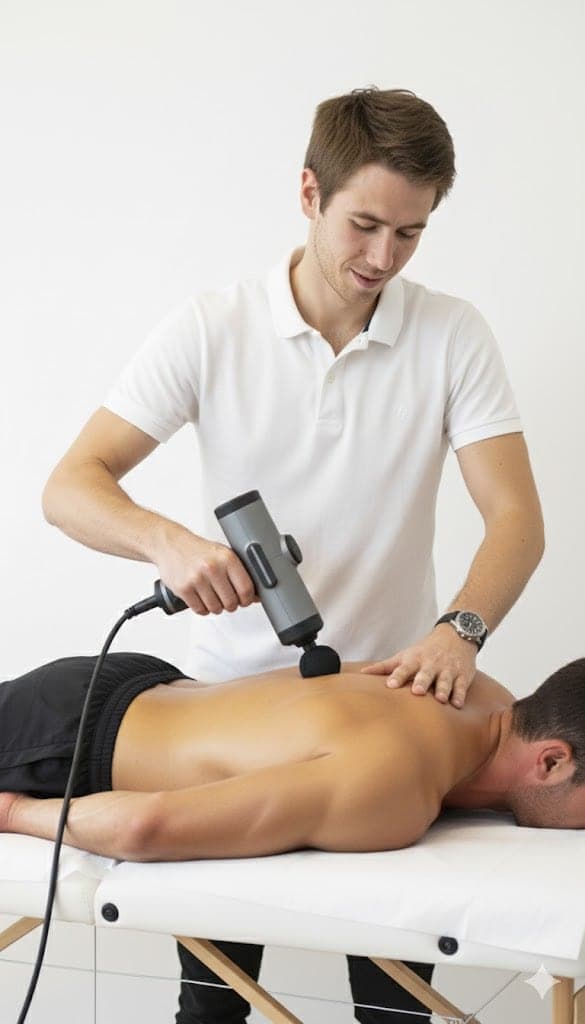
The specialized mechanical tool I use delivers three critical advantages that human hands cannot match:
Advantage One: Controlled Depth The tool allows me to work systematically from superficial to deep, progressively addressing tissue layers without compromising precision. I regularly reach 6-7 centimeters of depth in larger golfers when addressing deep hip rotators or thoracolumbar fascia—depths that are physiologically impossible for manual pressure to achieve consistently.
Advantage Two: Sustained Pressure Effective fascial release requires sustained pressure over time—typically 90-120 seconds on a specific vector to achieve viscoelastic deformation. Manual therapists fatigue. Their pressure wavers. The mechanical tool maintains identical pressure for as long as necessary, ensuring complete tissue response.
Advantage Three: Reproducible Results Every golfer I work with receives identical quality treatment every session. There are no “off days,” no fatigue-related degradation of technique. This consistency is essential because we’re implementing a progressive program designed to systematically restore tissue quality over multiple sessions.
Why Deep Tissue Massage is an Investment, Not an Expense
I’ve had countless conversations with golfers who hesitate at my pricing structure. They compare it to a cheaper massage at the local spa or a session with a general massage therapist. This comparison reveals a fundamental misunderstanding of what we’re doing.
When you work with me, you’re not purchasing massage. You’re investing in biomechanical optimization that will improve your golf performance, reduce your injury risk, and enhance your quality of life for years to come. The golfer I mentioned earlier who gained 23 degrees of rotation and eliminated his chronic back pain—how much is that worth? How many rounds did he miss over the previous four years due to pain? How much enjoyment did he lose? How much did he spend on equipment changes, lessons, and treatments that didn’t address the root cause?
The Real Cost of Dysfunction
Consider the actual financial and quality-of-life cost of chronic biomechanical dysfunction:
- Average annual spending on golf lessons: a wide range of costs
- Equipment upgrades attempting to “fix” swing issues: a wide range of costs
- Chiropractic, physical therapy, or medical treatment for pain: a wide range of costs
- Rounds missed due to pain or injury: 8-15 per year
- Diminished enjoyment and performance: Incalculable
Meanwhile, a comprehensive program of mechanical deep tissue work—typically 8-12 sessions to achieve lasting biomechanical change—represents a fraction of this cost while addressing the actual underlying problem.
What to Expect: The Timeline of Transformation
Golfers frequently ask me how quickly they’ll see results. The answer depends on your starting condition, but the general pattern is predictable based on a decade of experience with hundreds of clients.
Session 1-2: Assessment and Initial Release
During our first session, I conduct a comprehensive biomechanical assessment. I’m looking at rotation capacity, hip mobility, shoulder function, spinal segmental motion, and pain patterns. I’m identifying the specific restrictions that limit your swing and cause your symptoms.
The initial mechanical deep tissue work often produces immediate improvements in range of motion—you’ll notice easier rotation, reduced pain, and better overall movement quality. However, these early gains are not yet stable. We’re beginning the process of tissue reorganization, but we haven’t yet created lasting structural change.
Session 3-6: Progressive Adaptation
This is where the transformation accelerates. Your tissues are beginning to adapt to the mechanical stimulus, reorganizing their architecture and releasing chronic tension patterns. You’ll notice that the improvements from each session last longer. Your pain decreases significantly. Your swing feels more fluid, more powerful, less effortful.
Many golfers report that their instructor notices immediate differences during this phase. Comments like “you’re turning so much better” or “your sequence is finally correct” are common. This isn’t because your swing mechanics improved—it’s because your body can finally execute what your brain has always known to do.
Session 7-12: Consolidation and Optimization
By this phase, we’re fine-tuning. The major restrictions are resolved. The chronic pain is gone or minimal. Now we’re optimizing—addressing residual compensations, ensuring balance between right and left sides, preventing new dysfunctions from developing.
This is also when we begin spacing sessions further apart. Instead of twice weekly, we move to weekly, then biweekly. We’re transitioning from intensive intervention to maintenance and optimization. Many of my long-term clients see me monthly simply to maintain optimal tissue quality and catch any new restrictions before they become problematic.
The Home Program: Maintaining Your Results
I’m not interested in creating dependency. My goal is to durably resolve your biomechanical limitations so you can play golf pain-free for decades. Once we’ve achieved optimal tissue quality and restored proper movement patterns, maintaining those results requires intelligent self-management.
I provide every golfer with a customized program based on their specific needs:
Targeted Mobility Work Not generic stretching—specific movements that maintain the mobility we’ve restored in your individual problem areas. For most golfers, this includes thoracic rotation drills, hip mobility sequences, and shoulder maintenance work. Ten minutes daily is sufficient once we’ve done the intensive restoration work.
Movement Pattern Reinforcement Your nervous system needs to be retrained to use your new available range of motion. I teach specific drills that reinforce proper movement sequencing and prevent old compensatory patterns from re-emerging. This bridges the gap between our mechanical deep tissue work and your actual golf performance.
Self-Monitoring Guidelines I teach you to recognize the early signs of tissue dysfunction so you can address problems before they become chronic. Most golfers can identify when they need a tune-up session—usually a specific feeling of restriction or the beginning of a familiar pain pattern. Addressing these early prevents regression.
Frequently Asked Questions About Deep Tissue Massage for Golfers
Is deep tissue massage painful?
The sensation during treatment is not “painful” in the traditional sense—it’s intense, focused pressure that most clients describe as “good pain” or “therapeutic discomfort.” The mechanical tool allows me to precisely control the intensity, adjusting in real-time to your tissue tolerance. We’re working at the edge of your comfort zone, not beyond it, because excessive pain triggers protective muscle guarding that prevents effective release. Most golfers find the sensation deeply satisfying because they can feel the chronic tension releasing.
How is this different from sports massage?
Sports massage is typically superficial, focusing on muscle relaxation and circulation enhancement. It’s preparatory work for athletic performance or recovery work after competition. What I do is structural intervention—I’m changing tissue architecture at the deep fascial level, releasing chronic restrictions, and restoring biomechanical function. Sports massage might make you feel relaxed; mechanical deep tissue work changes how your body moves.
How long do the results last?
Once we’ve achieved complete tissue reorganization—typically after 8-12 sessions—the results are lasting unless new dysfunction develops through injury or prolonged inactivity. The fascia has reorganized, the trigger points are resolved, the movement patterns are restored. Maintenance sessions every 4-8 weeks help prevent new restrictions from accumulating, but you’re not dependent on ongoing intensive treatment.
Can I play golf between sessions?
Absolutely. In fact, I encourage you to play and practice between sessions. Your nervous system needs to integrate the new mobility we’re creating, and golf-specific movement is the best way to reinforce proper patterns. Most golfers notice immediate improvements in their game as their tissue quality improves. The only guideline is to avoid excessive volume immediately after intensive sessions—your tissues are adapting and need recovery time just like after hard training.
Will this help my swing speed?
Indirectly, yes. Swing speed is a function of efficient kinetic chain sequencing and the ability to generate and transfer force from the ground through your body into the club. When biomechanical restrictions are resolved, several things happen: your rotation capacity increases, your sequencing improves, your body can achieve more powerful positions without compensation, and you can apply force more efficiently. Most golfers see 3-6 mph increases in club head speed after comprehensive treatment, not because they got “stronger” but because their body can finally execute an efficient sequence.
What if I’ve tried massage before without results?
This is the most common statement I hear from new clients. You’ve tried traditional massage, perhaps for years, without lasting improvement. This doesn’t mean massage “doesn’t work for you”—it means you weren’t receiving the specific type of intervention your tissues required. Superficial techniques cannot address deep fascial restrictions. Manual therapy cannot consistently reach the problematic tissues in larger athletes. The mechanical precision and depth I deliver is fundamentally different from what you’ve experienced before. The proof is in the objective measurements—rotation increases, pain scales decrease, performance metrics improve.
Do I need to do anything to prepare for sessions?
Arrive well-hydrated and avoid eating a heavy meal immediately before treatment. The mechanical work is intensive, and your tissues respond better when you’re properly hydrated. Wear comfortable clothing that allows access to the areas we’re treating. I provide everything else—professional treatment bench, all necessary tools and equipment. Because I travel to your location, we can work in an environment where you’re comfortable and we have adequate time without rushing.
How do you address both sides of the body when golfers have asymmetrical sport demands?
This is a sophisticated question that reveals understanding of golf’s unique demands. The golf swing creates inherent asymmetries—your lead side and trail side experience completely different forces and develop different restrictions. I don’t treat both sides identically. I assess each side independently and address the specific dysfunctions present. Often, the lead side needs more shoulder and thoracic work, while the trail side needs more hip and lower back attention. The goal is functional symmetry—both sides capable of fulfilling their distinct roles in your swing mechanics.
The Partnership Approach: Long-Term Success
I don’t offer single sessions. This isn’t about temporary relief—it’s about lasting biomechanical transformation, and that requires a systematic approach over time. When you work with me, we establish a partnership focused on your long-term golf performance and quality of life.
This means several things practically:
Customized Treatment Plans After the initial assessment, I design a specific program targeting your individual restrictions and dysfunctions. We’re not following a generic protocol—we’re addressing your body’s unique compensation patterns and limitations.
Progressive Intervention Each session builds on the previous one. We’re systematically working through layers of dysfunction, from superficial compensations to deep structural restrictions. This requires continuity and progression over multiple sessions.
Objective Tracking We measure your progress quantitatively. Rotation range, pain scales, flexibility metrics, and your subjective experience on the golf course. This data tells us whether the intervention is working and allows us to adjust the approach if needed.
Integration with Your Golf Development I want to know what your instructor is working on with you. I want to understand your performance goals. The mechanical deep tissue work should integrate seamlessly with your overall golf development, removing biomechanical limitations so you can execute what your instructor teaches.
Why Golfers Choose Mechanical Deep Tissue Work
The golfers I work with long-term share certain characteristics. They’re serious about their game but frustrated that physical limitations prevent them from improving. They’ve spent significant money on equipment and instruction without achieving the results they expected. They’re dealing with chronic pain that diminishes their enjoyment and limits their playing frequency. They recognize that their body is the fundamental limiting factor in their golf performance.
These golfers understand that superficial interventions won’t solve deep structural problems. They’re willing to invest in a comprehensive approach because they recognize the return: years of improved performance, pain-free golf, and enhanced quality of life both on and off the course.
I had a 47-year-old client tell me recently: “I spent a substantial sum on new clubs last year thinking it would fix my slice. Turns out I couldn’t rotate properly because my hips and thoracic spine were locked up. Your work gave me the physical capacity to actually use the swing my instructor was teaching me. I wish I’d found you five years ago.”
This is the reality that serious golfers eventually face: equipment and instruction can only take you as far as your biomechanics allow. If your body cannot move properly, no amount of technology or coaching will overcome that fundamental limitation.
The Science of Fascial Release and Golf Performance
Understanding why mechanical deep tissue work is so effective requires basic knowledge of fascial biology. The fascial system is a three-dimensional web of connective tissue that envelops and interpenetrates every muscle, organ, and structure in your body. It’s not inert wrapping—it’s a dynamic, adaptive tissue that responds to mechanical loading.
When you perform thousands of golf swings, the fascia in specific areas experiences repetitive stress. Over time, this creates cross-linking, densification, and adhesions within the fascial matrix. These restrictions limit tissue glide, reduce muscle efficiency, and alter joint biomechanics. Your nervous system adapts by creating compensatory movement patterns that allow you to continue functioning despite these restrictions.
The problem is that compensation has limits. Eventually, the compensatory patterns themselves create dysfunction, pain develops, performance degrades, and injury risk increases. This is the typical progression I see in golfers who come to me after years of chronic issues.
Mechanical Stimulus and Tissue Remodeling
Fascia responds to mechanical stimulus through a process called mechanotransduction. When you apply sustained, directional pressure to fascial tissue, you create deformation that triggers cellular-level responses: increased hydration, collagen remodeling, reduction of cross-links, and restoration of tissue glide.
The key word is “sustained.” Brief, superficial pressure—typical of most massage—does not create sufficient mechanical stimulus to trigger meaningful tissue reorganization. You need deep, controlled, sustained pressure applied with specific vectors relative to tissue fiber orientation. This is exactly what my mechanical approach delivers with a precision and consistency that manual therapy cannot achieve.
Taking Action: The First Step
If you’re a golfer dealing with chronic pain, limited flexibility, or frustrating performance plateaus despite quality instruction, the solution is likely simpler than you think: your tissues need professional intervention to restore their optimal quality and function.
I’ve built my practice on delivering measurable results through advanced mechanical deep tissue work that addresses root biomechanical causes, not surface-level symptoms. This isn’t relaxation therapy—it’s structural intervention designed to durably optimize your body’s capacity to perform the golf swing.
I travel to your location with professional equipment, providing dedicated partnership focused on your long-term success. We’ll establish a customized program based on your specific restrictions, implement progressive mechanical treatment over multiple sessions, and track objective improvements in your mobility, pain levels, and golf performance.
The golfers who invest in this approach consistently report the same outcome: they wish they’d done it years earlier. The chronic issues they accepted as inevitable—the back pain, the restricted rotation, the performance limitations—resolve systematically through proper intervention. They play more golf, enjoy it more, and perform at levels they thought were no longer possible.
Your body determines your golf ceiling. The only question is whether you’ll continue accepting limitations that can be durably resolved, or whether you’ll invest in the structural intervention that allows you to play your best golf for decades to come.
Written by
Chris
Massage therapist & body mechanics specialist
Norwegian-certified with a Bachelor’s in Physical Education and Nutrition and over ten years of clinical practice, working from a portable table in clients’ homes across the Paphos district.
This article is general information from clinical practice, not a medical diagnosis. If you have severe, worsening or unexplained pain, numbness, weakness, or pain after an accident, see a doctor first.