
Couples Massage Packages Emba: Advanced Mechanical Deep-Tissue Treatment for Two
In short
Discover precision-engineered couples massage packages in Emba that deliver lasting pain relief and improved performance through advanced mechanical deep-tissue therapy—not traditional spa relaxation.
I need to address something directly: When most people search for couples massage packages in Emba, they’re thinking about candles, ambient music, and synchronized Swedish massage strokes. That’s not what I provide. After ten years specializing in mechanical deep-tissue therapy and a Bachelor’s degree in Physical Education and Nutrition, I’ve developed a method that treats the cause of muscular dysfunction, not just its symptoms. And yes, couples can absolutely benefit from this approach together—in fact, sharing this experience often creates a deeper understanding between partners about the body mechanics affecting their daily lives.
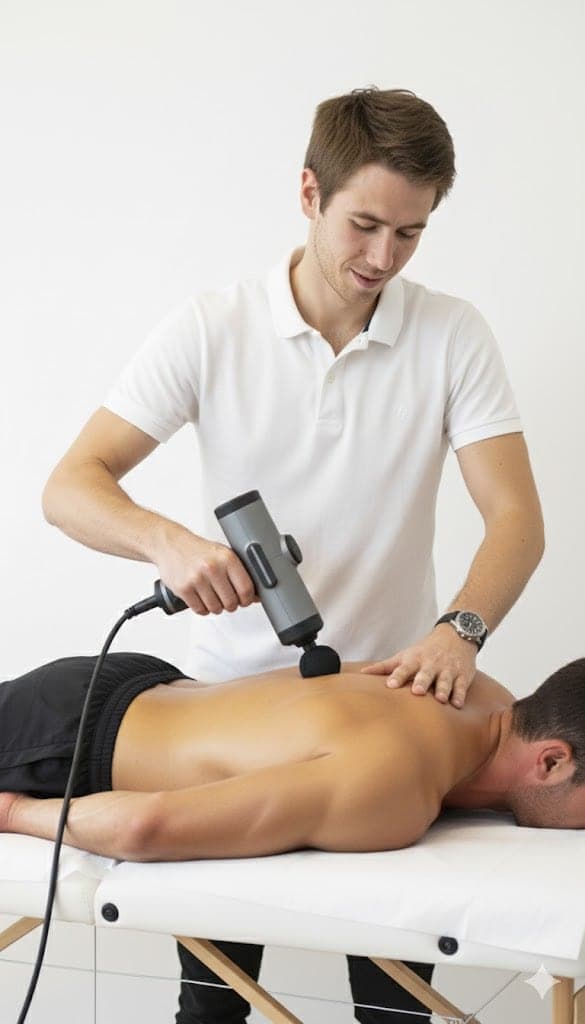
The couples massage packages I offer in Emba represent something fundamentally different from conventional spa experiences. This is clinical, results-driven bodywork using specialized mechanical tools that achieve depth, precision, and consistency impossible with human hands alone. I travel directly to your location with professional equipment, and I work with both partners to address chronic tension patterns, athletic performance limitations, or postural dysfunctions that have accumulated over months or years.
Why Mechanical Deep-Tissue Therapy Differs from Traditional Couples Massage
Let me share a story that illustrates this distinction. Last year, I worked with a couple in their late thirties—both desk professionals with escalating neck and lower back complaints. They had tried numerous spa packages together, enjoyed the temporary relaxation, but watched their pain patterns return within days. When they contacted me, the wife was skeptical: “How can a machine be better than skilled hands?”
The answer lies in biomechanics, not mysticism. Human thumbs and elbows, no matter how trained, fatigue. Pressure diminishes. Angles shift imperceptibly. My specialized mechanical system maintains exact calibrated force throughout the entire treatment session. This isn’t about replacing the human element—I’m controlling every adjustment, reading tissue response, modifying approach constantly—but the tool eliminates the physical limitations that compromise depth and consistency.
The Three Pillars: Precision, Power, and Consistency
Traditional massage therapy operates within inherent human constraints. I’ve documented this extensively through my practice:
Precision: The mechanical tool I use accesses myofascial layers at specific depths that manual pressure simply cannot reach sustainably. When treating couples with similar postural dysfunctions—common in partners who share workspace ergonomics or physical activities—this precision allows me to target identical trigger points with reproducible force parameters.
Power: For athletic couples or those with severe chronic tension, the intensity required to create lasting structural change exceeds what therapists can deliver manually without compromising their own body mechanics. I adjust power levels precisely to each partner’s tissue density, pain threshold, and therapeutic goals. The wife in my earlier example needed moderate-to-deep myofascial release; her husband, a competitive cyclist, required significantly deeper work on his IT bands and piriformis. Both received optimal treatment intensity during the same session.
Consistency: This might be the most critical factor for couples massage packages in Emba. When you’re investing in a shared wellness experience, you deserve identical treatment quality every single time. My mechanical system eliminates “off days.” The pressure at minute one equals the pressure at minute sixty. This reliability is essential when building customized treatment plans for two people simultaneously.
What Couples Massage Packages in Emba Actually Include
I don’t offer pre-packaged spa experiences with predetermined sequences. Each couples massage package in Emba begins with comprehensive biomechanical assessment of both partners. This evaluation typically reveals fascinating patterns—often, couples develop compensatory movement strategies that mirror or complement each other’s dysfunctions.
Initial Consultation and Assessment
Before any mechanical work begins, I spend 20-30 minutes understanding each person’s:
- Primary pain complaints and their duration
- Occupational movement patterns and ergonomic challenges
- Athletic activities, training loads, and performance goals
- Previous treatment history and results (or lack thereof)
- Daily functional limitations affecting quality of life
This assessment isn’t questionnaire-based superficiality. I’m evaluating gait patterns, postural alignment, range of motion restrictions, and palpating tissue quality. For couples, I’m also identifying interdependent factors—does one partner’s shoulder dysfunction affect how they interact physically? Does shared childcare create symmetrical lumbar strain patterns?
Customized Mechanical Deep-Tissue Protocol
The treatment itself addresses identified dysfunctions systematically. Unlike spa massage that follows relaxation-focused routines, my mechanical protocols target:
Adhesive scar tissue: Old injuries that have healed with restricted mobility, creating compensation patterns throughout the kinetic chain.
Chronic trigger points: Hyperirritable nodules in taut muscle bands that refer pain to distant body regions, often mimicking other conditions.
Fascial restrictions: The three-dimensional connective tissue web that, when restricted, limits movement efficiency and creates pain patterns resistant to conventional treatment.
Postural dysfunction: Accumulated adaptations to repetitive movements or sustained positions that gradually degrade biomechanical efficiency.
For each couple, I develop synchronized or complementary treatment sequences. Sometimes partners benefit from simultaneous work on similar regions—addressing matching upper trap tension from shared computer postures. Other times, treatment focuses on complementary body regions that affect how the couple functions together in activities like hiking, dancing, or even sleeping position comfort.
The Mobile Advantage: Professional Treatment at Your Emba Location
I travel to your location in Emba with complete professional equipment. This isn’t a compromise on quality—the specialized mechanical system I use is fully portable, and I bring a professional treatment bench designed specifically for deep-tissue work. The hydraulic adjustment ensures optimal positioning for accessing different muscle groups at correct angles.
Why In-Home Treatment Matters for Couples
There’s a practical reason beyond convenience. When couples experience advanced bodywork together in their own environment, they can immediately apply insights to their daily movement patterns. After releasing deep hip flexor restrictions, I can assess how each partner sits at their actual desk, uses their real kitchen counter, or navigates their home’s specific layout. This contextual application dramatically improves long-term results.
I’ve worked with couples who discovered their mattress firmness was sabotaging treatment outcomes. Others realized their evening routine—how they sit watching television—was recreating the exact tension patterns we’d just released. These observations only happen when treatment occurs in the actual environment where dysfunctions develop.
Athletic Couples: Performance Optimization Through Shared Sessions
A significant portion of my couples massage packages in Emba serve athletic partners. These sessions address performance enhancement, injury prevention, and recovery optimization simultaneously. The mechanical system’s adjustable intensity proves essential—one partner might need aggressive IT band work while the other requires thorough calf compartment release, both at very different pressure levels.
Case Study: Competitive Runners Preparing for Marathon Season
I worked with a couple training for Rotterdam Marathon. Both experienced recurring issues—he struggled with chronic Achilles inflammation; she battled persistent IT band syndrome. Traditional sports massage provided temporary relief but never resolved the underlying biomechanical causes.
Through mechanical deep-tissue protocols over twelve weeks, we addressed:
| Partner | Primary Dysfunction | Treatment Focus | Outcome |
|---|---|---|---|
| Male, 38 | Achilles tendinopathy | Deep calf compartment release, plantar fascia mobilization | Pain-free marathon completion, 12-minute PR |
| Female, 36 | IT band syndrome | TFL and glute medius trigger points, hip capsule mobility | No mid-race IT band pain, improved stride mechanics |
What made this successful wasn’t treating symptoms—it was identifying that his Achilles issues stemmed from restricted ankle dorsiflexion causing excessive soleus compensation, while her IT band pain originated from weak hip abduction allowing femoral internal rotation during foot strike. The mechanical system let me access these dysfunctions at their source: deep posterior compartment adhesions in his case, and profound TFL trigger points in hers.
They both completed the marathon pain-free. More importantly, they understood their bodies’ mechanical requirements and could modify training loads accordingly.
Addressing Chronic Pain Patterns in Non-Athletic Couples
Not every couple seeking massage packages in Emba has athletic goals. Many are simply exhausted from persistent pain that degrades daily life quality. These cases often prove the most satisfying because the transformation can be profound.
The Desk Professional Partnership
Modern work creates predictable dysfunction patterns. When both partners spend forty-plus hours weekly at computers, they develop remarkably similar postural adaptations: protracted shoulders, forward head carriage, thoracic kyphosis, and shortened hip flexors from prolonged sitting.
I recently treated a couple—both software developers—whose relationship was suffering because chronic pain made them irritable and reduced their energy for shared activities. Weekend hiking trips had ceased. Evening walks felt impossible. They’d normalized discomfort as an inevitable consequence of their careers.
Through six biweekly sessions focusing on mechanical deep-tissue release of:
- Upper trapezius and levator scapulae trigger points causing cervicogenic headaches
- Pectoralis minor restrictions perpetuating rounded shoulder postures
- Psoas and iliacus adhesions limiting hip extension during gait
- Thoracolumbar junction restrictions compromising spinal segmental mobility
Both reported dramatic improvements. The husband’s daily headaches resolved completely. The wife’s lower back pain—present for seven years—diminished to occasional minor discomfort during long drives. They resumed hiking. More significantly, they reported feeling “present” with each other again, no longer distracted by constant physical discomfort.
This is what I mean by treating causes rather than symptoms. Conventional massage might have relaxed their muscles temporarily, but it wouldn’t have addressed the deep fascial restrictions and trigger point networks maintaining their pain patterns.
Investment vs. Expense: The Economics of Effective Treatment
Let me be direct about cost. My couples massage packages in Emba represent a significant investment compared to spa treatments. This pricing reflects specialized expertise, advanced equipment, and most importantly, results that last.
Calculating True Value
Consider the typical spa massage experience: pleasant, relaxing, and gone within three days. If you’re seeking ongoing relaxation, that model works fine. But if you’re addressing chronic pain, postural dysfunction, or performance limitations, repeatedly purchasing temporary relief becomes extraordinarily expensive over time.
My approach focuses on lasting resolution. We’re restructuring tissue, releasing adhesions, deactivating trigger points, and restoring biomechanical efficiency. This takes multiple sessions—I’m transparent about that—but the goal is lasting change, not perpetual treatment dependency.
For athletic couples, consider the cost of compromised training, injury recovery time, and suboptimal performance. For desk professionals, calculate the cumulative impact of daily pain on work productivity, sleep quality, and relationship satisfaction. When you frame treatment correctly—as an investment in long-term functional capacity—the economics become clear.
What to Expect During Your First Couples Session in Emba
I want to set realistic expectations. This is clinical bodywork, and it can be intense. The mechanical system accesses tissue depths that often haven’t been properly treated before. Discomfort during treatment is common—I’m asking chronically tense muscles to release patterns they’ve maintained for months or years.
The Treatment Process
Each partner typically receives 60-90 minutes of focused mechanical work. I usually treat one person while the other observes, then switch. This allows you to see the methodology and understand what’s happening to your own tissue.
Initial passes: I begin with broader mechanical strokes to assess tissue quality, identify restrictions, and warm superficial layers. This isn’t the deep work yet—it’s diagnostic and preparatory.
Targeted release: Once I’ve mapped dysfunctional areas, I systematically address them with appropriate depth and duration. For adhesive scar tissue, this might mean sustained pressure with specific directional bias. For trigger points, it involves precise compression until the tissue releases—you’ll often feel this as a sudden decrease in discomfort and increased pliability.
Integrated assessment: Throughout treatment, I’m constantly reassessing. Has range of motion improved? Has pain referral pattern changed? Is the tissue responding optimally or do I need to modify approach?
Post-treatment guidance: After mechanical work concludes, I provide specific instructions for the following 48 hours. Hydration becomes critical—we’ve released metabolic waste products trapped in restricted tissue. Movement patterns may feel different; I explain what to expect and how to support the changes we’ve created.
Post-Treatment Reality
You’ll likely experience muscle soreness for 24-48 hours after your first session. This is fundamentally different from injury pain—it’s the result of deep tissue mobilization and metabolic waste clearing. Some clients describe it as similar to post-workout soreness. Others say it feels like their muscles are “reorganizing.”
This temporary discomfort proves we’ve achieved sufficient depth to create change. Superficial relaxation massage doesn’t produce this response because it doesn’t access the dysfunctional tissue layers we’re targeting.
Building a Customized Treatment Plan for Couples
After initial assessment and first treatment, I develop individualized protocols for each partner that align with your shared goals. This isn’t cookie-cutter programming—it’s based on objective findings, subjective response, and desired outcomes.
Typical Treatment Frequency
For chronic pain resolution or significant postural dysfunction, I generally recommend:
Intensive phase: Weekly or biweekly sessions for 4-6 weeks, establishing momentum and addressing primary restrictions.
Progressive phase: Sessions every 2-3 weeks for 8-12 weeks, maintaining gains while addressing secondary compensations.
Maintenance phase: Monthly or as-needed sessions to sustain optimal function and prevent recurrence.
Athletic couples preparing for specific events might compress this timeline. Others with less severe dysfunction might extend it. The key is consistent progression toward measurable functional improvement.
Frequently Asked Questions About Couples Massage Packages in Emba
Can we receive simultaneous treatment?
No. The specialized mechanical system and my methodology require complete focus on each individual. I treat one partner while the other can observe, rest, or handle other activities. This sequential approach ensures both receive full attention and optimal results.
How does mechanical therapy differ from massage guns or foam rolling?
Consumer percussion devices and foam rollers provide superficial stimulation—they’re useful tools but lack the precision, depth, and controlled progression necessary for addressing true dysfunction. My specialized system operates at entirely different force levels with adjustable parameters I modify constantly based on tissue response. It’s the difference between a home toolkit and professional-grade surgical instruments—both might look similar superficially, but the capability and results are incomparable.
Is this appropriate for beginners or only athletes?
The methodology applies equally to all fitness levels. I adjust intensity, focus areas, and treatment goals based on individual needs. A sedentary desk worker and an elite athlete both benefit from properly released fascial restrictions and deactivated trigger points—the specific tissues addressed and treatment intensity differ, but the fundamental principles remain constant.
What if one partner has significantly lower pain tolerance?
This is common and perfectly manageable. The mechanical system offers precise intensity control. I work within each person’s therapeutic window—the level where we’re creating positive tissue change without exceeding pain tolerance that would cause protective guarding. Effective treatment doesn’t require maximum pain; it requires appropriate depth sustained for sufficient duration.
How long before we notice results?
This varies based on dysfunction severity and chronicity. Acute issues often respond dramatically within 1-2 sessions. Chronic patterns established over years require more systematic work—expect measurable improvement within 3-4 sessions, with continuing enhancement as we address deeper layers and secondary compensations. I document objective measures like range of motion, pain scale ratings, and functional capacity so progress remains evident even when subjective perception varies.
Do you provide exercises or just treatment?
When appropriate, I prescribe specific corrective exercises or movement modifications. However, my primary focus is releasing restrictions that prevent proper movement in the first place. Many clients have performed prescribed exercises for months without benefit because underlying fascial adhesions or trigger points prevented correct movement patterns. Once we’ve restored tissue quality mechanically, exercise becomes far more effective.
What happens if we miss sessions or need to pause treatment?
Life happens—I understand that. However, consistency matters for optimal results, particularly during the intensive phase. Missing sessions extends the timeline and may allow partially resolved dysfunctions to re-establish. If you need to pause treatment, I provide guidance on maintaining gains through the interruption period.
Can this help with specific conditions like sciatica or frozen shoulder?
Many clients seeking couples massage packages in Emba are actually dealing with specific orthopedic issues. My mechanical approach has successfully addressed piriformis syndrome mimicking sciatica, adhesive capsulitis (frozen shoulder), thoracic outlet syndrome, and numerous other conditions. However, I’m not providing medical diagnosis or claiming to cure diseases—I’m releasing muscular and fascial dysfunctions that often underlie or contribute to these presentations. If you have diagnosed conditions, I work complementarily with your medical treatment, not as replacement.
Why Emba Location Matters for Effective Treatment
Providing couples massage packages directly in Emba offers distinct advantages beyond convenience. When I bring professional equipment to your location, we eliminate travel fatigue that can compromise treatment response. You’re relaxed in familiar surroundings, which reduces cortisol levels and improves tissue receptivity to mechanical work.
Post-treatment, you can immediately rest in your own bed, maintain hydration easily, and avoid the physical stress of commuting after deep bodywork. For couples, this means you can support each other through the initial recovery period without logistical complications.
Additionally, treating you in your environment lets me observe the specific ergonomic factors contributing to your dysfunctions. I can evaluate your actual workspace, seating, sleeping arrangements, and daily movement patterns—then provide contextually relevant modifications that directly address causative factors.
The Partnership Approach: Long-Term Results Require Collaboration
I need to emphasize something crucial: optimal outcomes require partnership, not passive consumption. I bring specialized expertise and advanced mechanical methodology, but you bring commitment to the process.
This means:
- Attending scheduled sessions consistently during intensive phases
- Following post-treatment guidelines regarding hydration, activity modification, and prescribed exercises
- Communicating openly about pain levels, response to treatment, and any concerns
- Understanding that lasting change requires time and multiple sessions
- Being willing to modify habitual movement patterns that perpetuate dysfunction
Couples who approach treatment as active participants rather than passive recipients consistently achieve superior results. When both partners commit to the process together, you also create mutual accountability and shared understanding of the biomechanical principles we’re addressing.
Beyond Pain Relief: Optimizing Daily Function and Quality of Life
While pain resolution motivates most clients initially, the ultimate goal extends further: optimizing how your body functions in daily life. This means improved movement efficiency, enhanced athletic performance, better sleep quality, increased energy levels, and restored capacity for activities that chronic pain had eliminated.
For couples, this optimization creates compound benefits. When both partners function better physically, you can engage more fully in shared activities. Weekend adventures become possible again. Physical intimacy improves when pain doesn’t limit movement. Sleep quality increases when your partner isn’t restless from discomfort.
I’ve seen relationships genuinely strengthen when chronic pain resolves. Physical suffering creates psychological stress, irritability, and withdrawal. As we systematically address the biomechanical causes of that suffering, clients consistently report feeling more present, engaged, and energized in their relationships.
Taking the First Step: Booking Your Couples Assessment
If you’ve read this far, you’re likely experiencing chronic issues that conventional approaches haven’t resolved. Perhaps you’ve tried numerous spa massages, physical therapy programs, or other interventions with limited lasting benefit. Maybe you’re athletes hitting performance plateaus despite proper training. Or possibly you’re simply exhausted from persistent pain degrading your daily life quality.
My couples massage packages in Emba offer a fundamentally different approach: clinical, mechanical, results-driven bodywork that addresses dysfunction at its source. This is an investment in long-term functional capacity, not an expense for temporary symptom relief.
The initial session includes comprehensive assessment of both partners, identification of primary dysfunctions and contributing factors, and first targeted mechanical treatment. You’ll leave with clear understanding of what we’re addressing, realistic timeline expectations, and specific protocols moving forward.
I travel to your Emba location with professional equipment, ensuring convenience without compromising treatment quality. Sessions are scheduled at times that work for your shared calendar, and I work around your existing commitments.
The question isn’t whether this approach works—ten years of practice and countless resolved cases demonstrate efficacy. The question is whether you’re ready to invest in lasting resolution rather than continuing to manage symptoms indefinitely.
For couples committed to optimizing their physical function together, sharing this experience creates not just improved individual outcomes, but deeper mutual understanding of the biomechanical principles governing your daily comfort and performance. That shared knowledge proves invaluable as you maintain and build upon the results we achieve.
Your body operates according to mechanical principles—when we identify and correct dysfunctions in that mechanical system, lasting improvement follows naturally. That’s not philosophy or wishful thinking; it’s biomechanical reality based on objective tissue response to appropriately applied force.
If you’re ready to address the causes of your discomfort rather than temporarily managing symptoms, my couples massage packages in Emba provide the specialized expertise and advanced methodology necessary for lasting results.
Written by
Chris
Massage therapist & body mechanics specialist
Norwegian-certified with a Bachelor’s in Physical Education and Nutrition and over ten years of clinical practice, working from a portable table in clients’ homes across the Paphos district.
This article is general information from clinical practice, not a medical diagnosis. If you have severe, worsening or unexplained pain, numbness, weakness, or pain after an accident, see a doctor first.