Massage cost Paphos: what a clinical session is and what it buys
In short
Massage cost Paphos, plainly: €90 for 60 minutes and €130 for 90 minutes at your home, hotel or villa, every fifth session free. Most soft-tissue problems I treat settle in a short course rather than open-ended weekly appointments.
People ask me about price before anything else, and I understand why. My rates are on the pricing page: €90 for 60 minutes, €130 for 90 minutes, and every fifth session is free. This article is about what that money buys, and how to judge whether a course of treatment is worth it for your particular problem.
I am a one-man mobile practice based in Chlorakas, working across the Paphos district. The massage cost Paphos residents and visitors pay me is not really the question that matters. The question is what a session does that a cheaper hour of general relaxation does not, and how many of them you are likely to need before you can stop.
What you are actually paying for
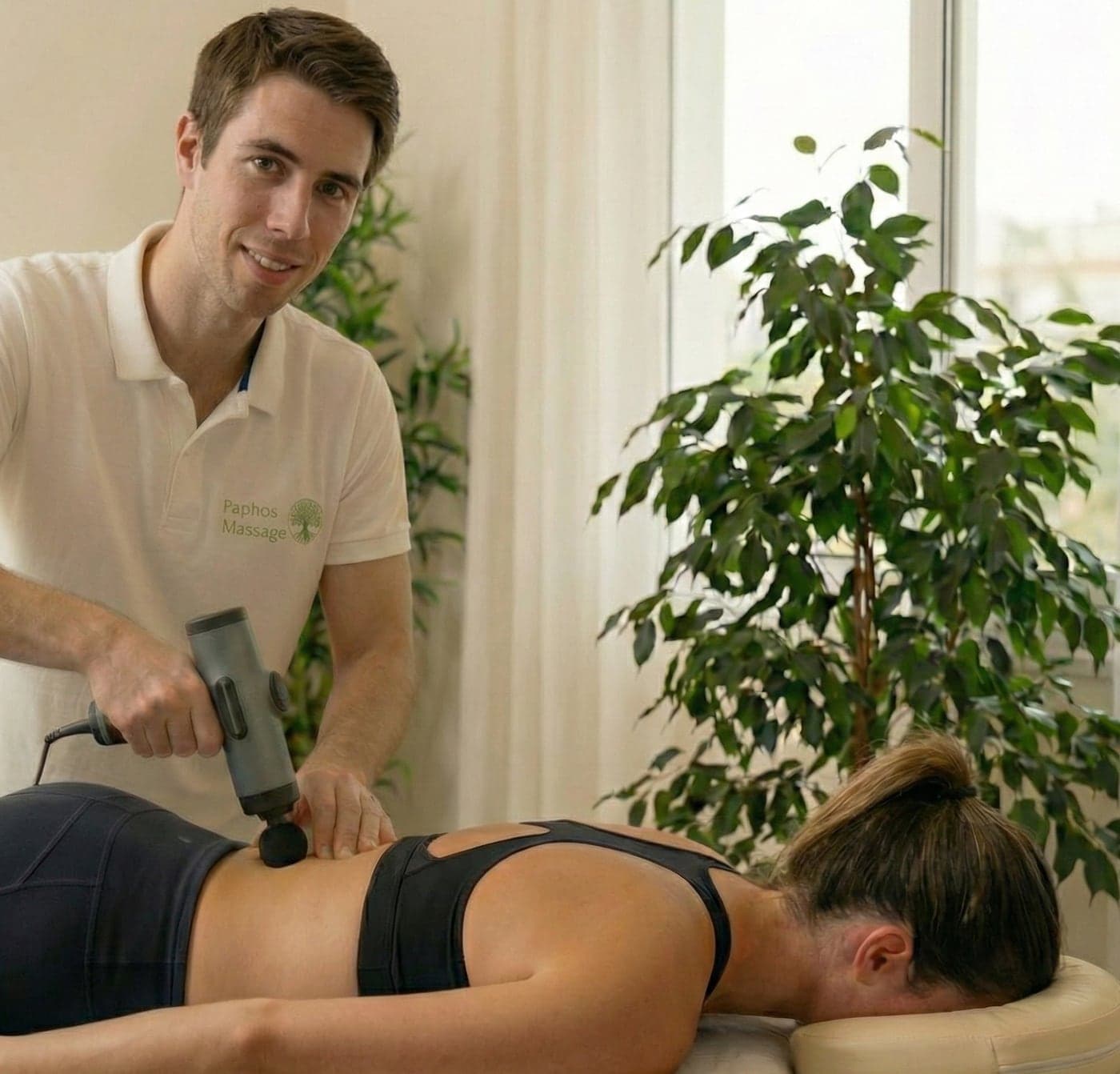
I trained in Norway, hold a BSc in Physical Education and Nutrition, and have spent more than ten years working almost exclusively with mechanical deep-tissue treatment. What arrives at your door is not just a table and a pair of hands. It is an assessment, a treatment aimed at a specific tissue problem, and a plan for how many visits it should take.
Most of the price difference between a clinical session and a relaxation massage sits in three things:
- Assessment before treatment. I spend the first part of a first session finding out where the restriction actually is, which is often not where the pain is felt.
- Depth and precision. Mechanical deep-tissue work reaches layers that a hand-only session tends to skate over, and holds consistent pressure for as long as the tissue needs.
- A finishing point. The aim is a short course that ends, not a standing weekly appointment.
How I set the massage cost in Paphos
I keep the price list short on purpose. Two durations, one loyalty rule, no packages that lock you in and no add-ons that quietly raise the total. If a problem is not going to respond to my kind of work, I would rather say so on the first visit than sell you a fifth session.
| Session | Price | Best suited to |
|---|---|---|
| 60 minutes | €90 | One region: a shoulder, a lower back, a hip and thigh, a calf |
| 90 minutes | €130 | Two related regions, or a stubborn area that needs time to release |
| Every 5th session | Free | People on a course of treatment or maintaining a result |
The 90-minute session is often the better value for injury work, because a good deal of the first session goes on assessment and on getting the tissue to accept deeper pressure. That leaves the 60-minute option better suited to follow-ups, once I already know what I am working on.
How many sessions a problem usually needs
This is where the real cost sits, and it is the part most price lists ignore. A cheap hour that needs repeating indefinitely costs more than a dearer session that ends the problem. I cannot promise a number in advance, but after ten years I can describe the patterns I see most often.
- Recent muscular tightness — a calf that seized during a run, a neck locked after a long flight — often eases well within one or two sessions.
- Established restrictions that have been there for months, such as a chronically tight lower back or a shoulder that catches, tend to need a short course of three to six sessions spaced a week or so apart.
- Long-standing patterns where the body has learned to compensate around an old problem take longer, and I usually suggest reviewing progress after three sessions rather than committing further up front.
- Maintenance for people who train hard or sit long hours is a personal choice, and the every-fifth-free rule is designed with them in mind.
I would rather under-promise. If a problem is improving but not gone after three sessions, we talk about whether continuing makes sense. If it has not shifted at all, that is useful information too, and usually a sign you need a different kind of practitioner.
Comparing the real cost of the alternatives
Nobody weighs massage cost in isolation. The sensible comparison is against what else you might spend on the same problem, and against the cost of leaving it alone.
- Repeated relaxation massage. Pleasant, and I have nothing against it, but for an injury it tends to become a weekly habit that manages the symptom without changing the tissue. Over a season that can cost more than a focused course.
- Physiotherapy. Excellent for movement retraining and post-surgical work. Many people I see have done their exercises diligently and still carry a deep restriction that no amount of stretching reaches. The two approaches sit well side by side.
- Painkillers and anti-inflammatories. Cheap per packet, but they mask rather than resolve, and long-term use has its own costs.
- Doing nothing. The most expensive option for a good many people. A tight hip becomes a sore back; a guarded shoulder becomes a stiff neck. Each new area is another thing to treat.
For someone whose problem is squarely mechanical, a course of deep-tissue massage is often the most direct route, and the shortest. For problems that are not mechanical, it is the wrong purchase, and I will say so.
The mobile part of the price
Because I come to you, some people assume there is a hidden travel premium. There is not. The prices above are the whole cost, whether you are in Kato Paphos, Tala, Pegeia or a villa up towards Tsada. What you save is the part of the day that a clinic visit takes: driving, parking, waiting, driving home stiff.
A few practical points about the mobile setup:
- I bring a professional table, the mechanical equipment and linens. You need a space roughly the size of a double bed and a little room to walk round it.
- Sessions can happen at homes, holiday lets, hotels and villas. Evenings and weekends are usually possible.
- You finish the session and stay where you are, which matters more than it sounds after deep work on a back or hip.
For visitors, the convenience is obvious. For residents on a course of treatment, it is the difference between something that fits into a week and something that gets postponed until the problem is worse.
What I can and cannot help with
I work best with mechanical soft-tissue problems: tight, restricted, sore muscle and fascia that has stopped moving properly. That covers a great deal of what people in the Paphos district contact me about, from desk-bound necks to runners' calves and the lower-back stiffness that follows a long flight or a long drive.
Please see a doctor first if you have unexplained weight loss, night pain that wakes you, numbness or weakness in a limb, pain following a fall or accident, fever with your back or joint pain, or any pain that is getting steadily worse regardless of what you do. Those are not massage problems, and I would rather send you on than take your money.
Frequently asked questions
How much does a mobile massage in Paphos cost?
A 60-minute session is €90 and a 90-minute session is €130, at your home, hotel or villa anywhere in the Paphos district. There is no separate travel charge and no booking fee. Every fifth session is free, which mostly benefits people on a short course of treatment or those who book regular maintenance. Full details are on the pricing page.
Is 60 or 90 minutes better value for an injury?
For a first session on a specific problem, 90 minutes is usually the better use of money, because assessment and getting the tissue to accept deeper pressure take time before the productive part of the work begins. Once I know the area, 60-minute follow-ups are often enough. If you are unsure, tell me what is going on when you message and I will suggest which suits.
How many sessions will I need?
I cannot say for certain before I have seen you, and I distrust anyone who claims otherwise. Recent tightness often settles in one or two sessions. Established restrictions more commonly need three to six, spaced about a week apart. Anything long-standing I prefer to review after three sessions rather than ask you to commit further up front. If nothing has changed by then, I say so.
Do you offer packages or discounts?
The only discount is that every fifth session is free, which works out at 20 per cent off for anyone on a course. I deliberately do not sell prepaid packages, because they create pressure to keep coming when a problem has already resolved, or when it is clear that a different approach is needed. Paying as you go keeps both of us honest about whether the treatment is working.
Can I claim the cost on health insurance?
Some private policies reimburse massage therapy and some do not, and the rules vary widely between insurers and countries. I am happy to provide a receipt with my details and the treatment given so that you can submit a claim, but I cannot tell you in advance whether your particular policy will pay. Check the wording of your policy or ask your insurer directly before booking.
How do I book, and how do I pay?
Send me a WhatsApp message or call. Tell me roughly what the problem is, where you are staying or living, and when suits, and I will confirm a time. Payment is at the end of the session. If you would like to talk through whether my kind of treatment is right for your problem before committing, ask, and I will give you an honest answer.
Written by
Chris
Massage therapist & body mechanics specialist
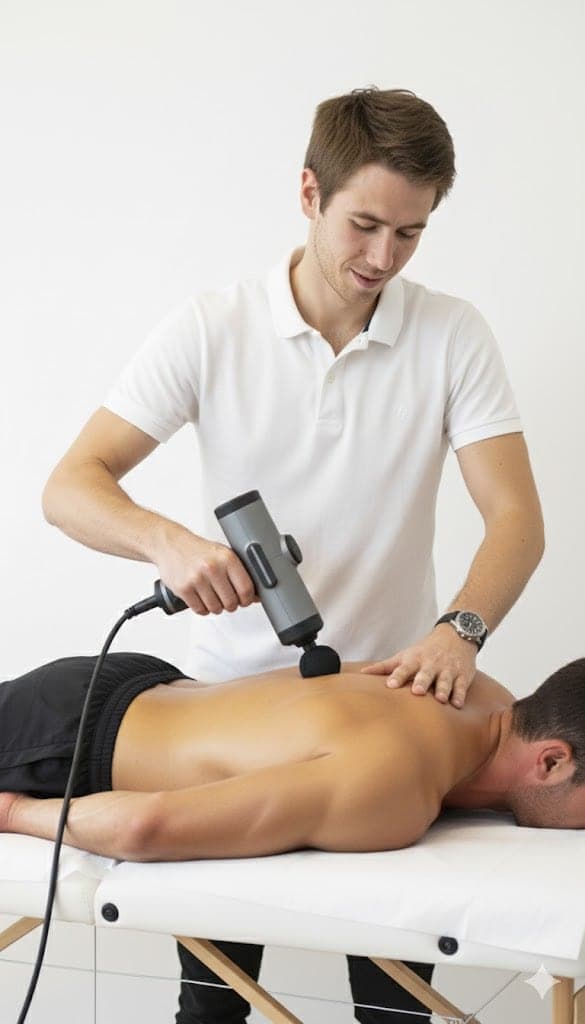
Norwegian-certified with a Bachelor’s in Physical Education and Nutrition and over ten years of clinical practice, working from a portable table in clients’ homes across the Paphos district.
- Norwegian-certified
- BSc Physical Education & Nutrition
- 10+ years clinical practice
- Based in Chlorakas · all of Paphos district
- No call-out fee anywhere in Paphos district
Last reviewed
This article is general information from clinical practice, not a medical diagnosis. If you have severe, worsening or unexplained pain, numbness, weakness, or pain after an accident, see a doctor first.