
Coral Bay therapeutic massage: advanced mechanical deep-tissue treatment for lasting pain relief
In short
Experience revolutionary Coral Bay therapeutic massage with advanced mechanical deep-tissue techniques. University-trained specialist delivers lasting pain relief through precision treatment at your location.
I’ll never forget the moment I realized traditional massage therapy wasn’t enough. It was during my third year practicing in Coral Bay when a construction worker came to me, practically dragging his left shoulder behind him. He’d been to four different massage therapists over six months, spending hundreds of dollars on treatments that provided only temporary relief. “Doc,” he said, “I need something that actually works.” That conversation fundamentally changed how I approach therapeutic massage in Coral Bay.
After completing my Bachelor’s degree in Physical Education and Nutrition from Norway and accumulating over a decade of hands-on experience, I’ve witnessed countless clients trapped in cycles of temporary relief followed by recurring pain. This isn’t acceptable in my practice. When someone seeks Coral Bay therapeutic massage from my clinic, they’re not just getting another relaxation session – they’re investing in a scientifically-driven approach that targets the root cause of their dysfunction, not merely the symptoms.
The difference lies in understanding that true therapeutic massage transcends the limitations of human hands. While traditional massage can provide momentary comfort, advanced mechanical deep-tissue therapy delivers the precision, power, and consistency necessary for lasting structural change. This isn’t massage as entertainment; this is corrective treatment designed to optimize your body’s mechanical function for decades to come.
My specialized approach combines clinical expertise with cutting-edge mechanical technology, creating treatment protocols that eliminate guesswork and deliver measurable results. When I travel to your location in Coral Bay with my professional equipment, you’re receiving the same level of precision you’d expect from any advanced medical intervention – because that’s exactly what this is.
Understanding the Science Behind Advanced Mechanical Deep-Tissue Therapy
The human fascial system operates like an intricate web of tension and support throughout your entire body. When I first began studying body mechanics during my university training, I was struck by how interconnected these systems truly are. A restriction in your thoracic spine can manifest as shoulder pain. Tight hip flexors can create compensatory patterns that result in chronic neck tension. This is why surface-level massage, regardless of how skilled the practitioner, often fails to create lasting change.
My mechanical deep-tissue approach addresses these interconnected dysfunctions through three fundamental principles that no human hands can replicate. First, the depth of penetration reaches layers of tissue that manual therapy simply cannot access. I’m talking about working through multiple fascial layers to reach the deepest myofascial restrictions – the ones causing your compensatory movement patterns and chronic pain cycles.
Second, the precision of application allows me to target specific anatomical structures with millimeter accuracy. When I’m treating a client’s subscapularis muscle, for example, I can isolate that exact tissue without affecting surrounding structures. This surgical-level precision prevents the common issue of creating new areas of irritation while attempting to treat existing problems.
Third, the consistency of pressure and technique eliminates the variables that plague traditional massage. Every stroke delivers exactly the intended force for exactly the intended duration. There are no “off days” in my practice – your Tuesday treatment will be identical in quality and effectiveness to your Saturday session.
This isn’t theoretical knowledge; it’s based on treating hundreds of clients in Coral Bay who’ve experienced the difference between temporary relief and lasting correction. The construction worker I mentioned earlier? He returned to full work capacity within three weeks and hasn’t experienced shoulder dysfunction in over two years. That’s the power of addressing causation rather than symptom management.
Why Traditional Massage Fails: The Fundamental Limitations
I need to be direct about something that many in the massage industry won’t tell you: traditional manual massage, no matter how well-intentioned, operates within severe physiological limitations. During my early years practicing Coral Bay therapeutic massage, I performed thousands of manual treatments and consistently observed the same frustrating pattern – clients would feel better for 3-7 days, then return with the same complaints.
The primary limitation is depth. Human hands, regardless of strength or technique, cannot generate sufficient pressure to create lasting change in deep fascial restrictions. I can press as hard as physically possible, but I’m still working primarily in superficial and intermediate tissue layers. The deep fascial planes where chronic restrictions develop remain largely untouched.
Furthermore, manual pressure is inherently inconsistent. Fatigue sets in, technique varies based on the practitioner’s physical state, and the pressure application becomes uneven across different areas of treatment. I’ve seen clients receive dramatically different treatments from the same therapist on consecutive visits simply due to these human variables.
Perhaps most importantly, traditional massage typically addresses areas of pain rather than areas of dysfunction. A client complains of lower back pain, so the therapist works on the lower back. But what if that pain originates from restricted hip flexors creating compensatory lumbar extension? What if the real problem is thoracic immobility forcing excessive movement in the lumbar spine? Manual therapy rarely identifies and addresses these mechanical relationships.
I learned this lesson definitively when treating a professional athlete who’d been receiving high-level manual therapy for chronic hamstring injuries. Despite treatments from Olympic-level therapists, she continued experiencing recurring strains every 4-6 months. My mechanical assessment revealed the issue wasn’t in her hamstrings at all – it was restricted fascial planes in her anterior hip creating compensatory recruitment patterns. Three sessions of targeted mechanical work eliminated her injury pattern durably.
This is why I don’t offer traditional massage in my Coral Bay practice. When someone needs real structural change, they need methods that can actually create real structural change.
The Revolutionary Mechanical Advantage: Precision, Power, and Consistency
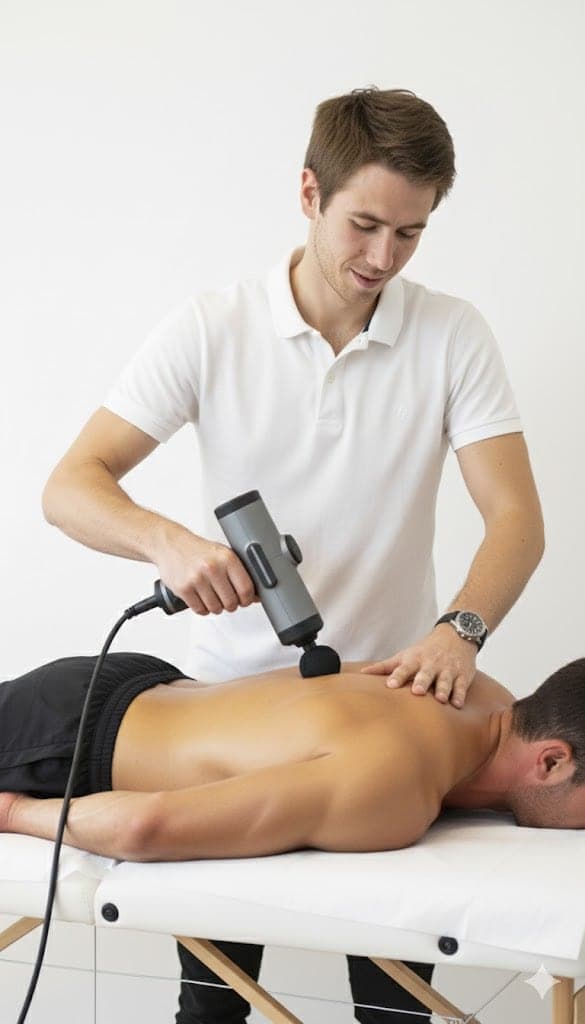
The specialized equipment I utilize in my Coral Bay therapeutic massage practice represents a paradigm shift in how we approach soft tissue dysfunction. This isn’t simply a “massage gun” or vibrating device – it’s a precision medical instrument capable of delivering controlled mechanical force to specific anatomical targets with surgical accuracy.
The power differential is immediately apparent. Where human hands might generate 15-20 pounds of pressure before fatigue sets in, my mechanical system delivers precise force ranging from gentle lymphatic work to deep fascial release that would be impossible through manual methods. But more importantly, this force is delivered with complete consistency throughout the entire treatment session.
Consider the precision aspect: when I’m addressing restrictions in your serratus anterior muscle, I can isolate individual fascicles and work along specific fiber orientations. The mechanical tip can navigate between ribs, work around bony landmarks, and target tissue layers that manual pressure would never reach. This isn’t approximation; it’s anatomical precision.
I remember treating a concert pianist from Coral Bay who’d developed focal dystonia in her right hand. Multiple specialists had attempted various interventions, but the mechanical restrictions causing her neurological symptoms were located in deep cervical fascial planes. Using traditional manual therapy, these areas would be completely inaccessible. With mechanical precision, I could address the exact anatomical structures contributing to her condition. She returned to professional performance within six weeks.
The consistency factor eliminates one of the most frustrating aspects of traditional massage therapy – variability. Your treatment protocol is delivered identically every session, allowing us to build progressively on previous work rather than starting over each time. This cumulative effect is essential for creating lasting structural changes.
Most importantly, the mechanical advantage allows me to work deeper with less discomfort. Because the force application is so precise, I can achieve greater tissue penetration without the broad pressure that creates pain and guarding responses. Clients consistently report that deeper work feels more comfortable than shallow manual pressure.
Treating Causes, Not Symptoms: A Revolutionary Philosophy
The fundamental philosophy driving my Coral Bay therapeutic massage practice centers on a simple premise: if we’re not addressing the mechanical cause of your dysfunction, we’re not providing therapy – we’re providing temporary symptom management. This distinction represents the difference between long-term health investment and ongoing expense cycles.
During my university training in physical education and nutrition, I became fascinated by the body’s compensatory patterns. When one system fails, others adapt to maintain function. These adaptations, while initially protective, eventually become the primary source of dysfunction. Traditional massage treats the areas that hurt, but rarely addresses the areas that aren’t working properly.
For example, I recently treated a Coral Bay resident experiencing chronic thoracic outlet syndrome. She’d received months of manual therapy focused on her symptomatic neck and shoulder region. However, my assessment revealed that restricted posterior hip capsules were creating compensatory postural patterns that placed excessive demand on her cervical region. The real problem was 18 inches away from her symptoms.
My mechanical treatment protocol addressed her hip restrictions first, then worked systematically through the compensatory chain. Within two weeks, her thoracic outlet symptoms had resolved completely, and she’s maintained symptom-free status for over eight months. This outcome would have been impossible focusing solely on symptomatic areas.
This causative approach requires extensive anatomical knowledge and clinical experience to identify these mechanical relationships. It’s not enough to know where muscles attach; you must understand how fascial restrictions in one region create movement compensations throughout the entire kinetic chain. This is why my treatments often focus on areas that seem unrelated to your primary complaints.
The investment mindset is crucial here. Symptom-based therapy requires ongoing sessions to maintain temporary relief. Cause-based therapy requires intensive initial intervention to create lasting structural change. My clients typically experience resolution within 3-6 sessions rather than requiring monthly maintenance indefinitely.
When someone asks me about the cost difference between my services and traditional massage, I explain it this way: you can spend the session price (see current pricing) monthly for years managing symptoms, or invest in definitive treatment that eliminates the need for ongoing intervention. The mathematics of long-term health investment versus ongoing expense management speaks for itself.
Advanced Treatment Protocols for Complex Conditions
The mechanical precision available in my Coral Bay therapeutic massage practice allows for treatment protocols that would be impossible through traditional methods. I’ve developed specific approaches for complex conditions that require surgical-level accuracy combined with the safety of non-invasive intervention.
Chronic pain conditions, particularly those involving fascial restrictions and compensatory movement patterns, respond exceptionally well to mechanical intervention. I recently treated a construction foreman who’d been managing chronic lower back pain for over five years. His previous treatments included multiple cortisone injections, extensive physical therapy, and regular massage therapy. Despite these interventions, his pain levels consistently ranged from 6-8 out of 10.
My assessment revealed significant restrictions in his thoracolumbar fascia creating compensatory lumbar hypermobility. Traditional manual therapy couldn’t generate sufficient force to address these deep fascial adhesions. Using mechanical intervention, I could systematically work through multiple fascial layers, breaking up adhesions and restoring normal tissue mobility patterns.
The treatment protocol involved three phases: first, addressing the deep fascial restrictions using controlled mechanical force; second, restoring normal movement patterns through specific tissue mobilization techniques; third, maintaining the corrections through targeted strengthening protocols. His pain levels dropped to 0-2 within three weeks and have remained there for over a year.
Athletic performance optimization represents another area where mechanical precision provides significant advantages. I work with several professional and semi-professional athletes in the Coral Bay area, focusing on optimizing their biomechanical efficiency rather than simply treating injuries after they occur.
For these clients, I utilize the mechanical system to identify and address subtle restrictions that would never be detected through manual palpation. A restriction of just 5-10% in shoulder internal rotation might not create symptoms, but it can reduce throwing velocity by 8-12 mph in baseball players. These performance limitations are only detectable and addressable through mechanical precision.
Post-surgical rehabilitation also benefits tremendously from mechanical intervention. The precision allows for targeted work around surgical sites without compromising healing tissues. I can address compensatory patterns that develop during recovery periods, preventing secondary dysfunctions from becoming established.
The Mobile Advantage: Professional Treatment in Your Environment
One aspect of my Coral Bay therapeutic massage practice that consistently surprises clients is the professional quality achievable through mobile service. When I arrive at your location, I’m bringing the same level of clinical precision and mechanical capability that you’d find in any advanced medical facility.
The decision to operate as a mobile practice wasn’t just about convenience – it was about optimizing treatment outcomes. Many clients experience significant stress simply traveling to appointments, especially when dealing with chronic pain conditions. This stress response can create muscle guarding and tension patterns that interfere with treatment effectiveness.
Additionally, receiving treatment in your own environment allows for immediate integration of postural corrections and movement recommendations. I can assess your actual work station, sleeping environment, and daily movement patterns, then provide specific modifications that support the structural changes we’re creating through treatment.
I remember treating a software developer in Coral Bay who’d been experiencing chronic cervical dysfunction. In a clinical setting, I would have addressed his tissue restrictions and provided general postural advice. However, seeing his actual workstation revealed specific ergonomic issues that were perpetuating his problems. We made real-time adjustments to his setup while his tissues were still responsive from treatment, dramatically accelerating his recovery.
The professional bench and equipment I transport provide the same stability and positioning options available in fixed clinical locations. Clients consistently comment that they expected compromise in treatment quality due to the mobile format, but instead experience superior results due to the reduced stress and environmental optimization.
From a practical standpoint, mobile service eliminates the time and energy expenditure of traveling to appointments. For busy professionals, parents, and individuals managing chronic conditions, this convenience factor often makes the difference between consistent treatment adherence and sporadic intervention.
The logistics are straightforward: I handle all setup and breakdown procedures, bringing everything necessary for professional treatment delivery. Your only responsibility is providing adequate space for the treatment bench, typically a 8×6 foot area in any room with reasonable privacy.
Client Success Stories: Transforming Lives Through Advanced Intervention
The most compelling evidence for advanced mechanical intervention comes from the dramatic life changes experienced by my Coral Bay clients. These aren’t subtle improvements or temporary relief – these are fundamental transformations in how people experience their bodies and engage with daily activities.
Sarah, a 45-year-old teacher, came to me after three years of progressive fibromyalgia symptoms. She’d been managing widespread pain through medication and had significantly reduced her physical activities. Multiple massage therapists had attempted to help, but the generalized nature of her condition made targeted intervention difficult through manual methods.
Using mechanical precision, I could systematically address the fascial restrictions throughout her body that were contributing to her pain amplification. The treatment protocol involved identifying and correcting compensatory patterns that had developed as she unconsciously protected painful areas. Within six weeks, her pain levels had decreased by over 70%, and she’d resumed hiking and yoga activities she’d abandoned years earlier.
Marcus, a professional landscaper, presented with chronic shoulder impingement that was threatening his career. He’d received multiple cortisone injections and extensive physical therapy without significant improvement. The mechanical assessment revealed that his impingement wasn’t actually caused by shoulder pathology – it was secondary to restricted fascial planes in his anterior chest limiting normal scapular movement.
Traditional massage would have focused on his symptomatic shoulder region. My mechanical approach addressed the causative restrictions in his pectoral fascia and anterior chest wall. Three sessions later, his shoulder pain had completely resolved, and he’s maintained full function for over 18 months while continuing his physically demanding work.
Jennifer, a competitive runner, had been struggling with recurring IT band syndrome that limited her training and racing. She’d tried everything – multiple therapists, different shoes, gait analysis, strength training protocols. The mechanical evaluation revealed significant restrictions in her deep hip capsular tissues creating compensatory movement patterns during running.
Addressing these deep restrictions required mechanical intervention that could penetrate layers manual therapy couldn’t reach. The results were immediate – her knee pain resolved within one week, and she’s since completed two marathons without recurrence. More importantly, her running efficiency improved significantly due to optimized hip mechanics.
These transformations share common elements: they involve addressing causative factors rather than symptoms, they require precision intervention beyond manual capabilities, and they result in lasting improvements rather than temporary relief. This is what distinguishes true therapeutic intervention from symptom management.
Investment vs. Expense: Understanding the Economics of Effective Treatment
The financial aspect of advanced Coral Bay therapeutic massage requires perspective that extends beyond individual session costs. When clients compare my services to traditional massage pricing, they’re often comparing fundamentally different approaches to health management – investment versus ongoing expense.
Traditional massage therapy typically requires monthly or bi-weekly sessions to maintain symptomatic relief. At a per-session fee, clients easily spend a wide range of costs annually for temporary management of chronic conditions. Over five years, this represents a wide range of costs in ongoing expenses without addressing underlying causes.
My advanced mechanical intervention typically resolves chronic conditions within 3-6 sessions. While individual session costs are higher due to the specialized equipment and expertise involved, the total investment for lasting resolution is significantly lower than ongoing management costs. More importantly, clients regain full function and eliminate the hidden costs of reduced activity and diminished quality of life.
I recently calculated the five-year costs for a client who’d been managing chronic back pain through traditional methods. Between massage therapy, chiropractic adjustments, pain medication, and reduced work productivity, his annual expenses exceeded a substantial sum. My intervention resolved his condition durably in four sessions, eliminating all ongoing costs while restoring his full earning capacity.
The productivity gains alone often justify the investment. Chronic pain conditions typically reduce work efficiency by 15-30%. For professionals earning a wide range of costs annually, this represents significant economic impact that extends far beyond treatment costs. Eliminating pain-related productivity losses can increase annual earning capacity by a wide range of costs.
Consider the lifestyle costs of chronic dysfunction: reduced recreational activities, limited travel options, decreased social engagement, and compromised sleep quality. These factors affect relationship satisfaction, career advancement, and overall life satisfaction in ways that are difficult to quantify but profoundly important.
From an insurance perspective, many health savings accounts and flexible spending arrangements cover therapeutic massage services, particularly when provided for specific medical conditions. The advanced nature of my intervention often qualifies for coverage that wouldn’t apply to relaxation-focused massage.
When clients understand that they’re investing in lasting resolution rather than temporary management, the economic decision becomes straightforward. The question isn’t whether my services cost more per session – it’s whether ongoing symptom management or definitive treatment resolution provides better long-term value.
Specialized Applications for Athletic Performance Enhancement
Athletic performance optimization represents one of the most rewarding applications of advanced mechanical intervention in my Coral Bay therapeutic massage practice. The precision available through mechanical systems allows for identification and correction of subtle restrictions that can significantly impact performance metrics.
I work regularly with golfers, tennis players, swimmers, and runners who’ve reached performance plateaus despite excellent training protocols and coaching. Often, these plateaus result from mechanical restrictions that limit optimal movement patterns rather than fitness or skill deficits.
A competitive tennis player I treated was experiencing declining serve velocity despite intensive strength training. Traditional massage therapy had focused on his serving arm and shoulder region without significant improvement. My mechanical assessment revealed restrictions in his thoracic spine and posterior hip capsule that were limiting his kinetic chain efficiency.
The serve motion requires sequential energy transfer from the legs through the core to the serving arm. Restrictions anywhere in this chain create compensatory patterns that reduce power output and increase injury risk. Using mechanical precision, I addressed the specific fascial restrictions limiting his rotation and extension patterns.
Within three weeks, his serve velocity increased by 12 mph, and his consistency improved dramatically. More importantly, the optimized movement patterns reduced stress on his shoulder joint, eliminating the chronic soreness that had been limiting his training volume.
Runners represent another population that benefits tremendously from mechanical intervention. Running efficiency depends on optimal fascial tension relationships throughout the legs and pelvis. Small restrictions can create significant energy losses over distance events.
I recently worked with a marathon runner who’d been unable to break a 3:30 personal best despite years of dedicated training. The mechanical evaluation revealed asymmetric hip capsule mobility that was creating compensatory movement patterns and reducing his stride efficiency by approximately 8%.
Correcting these restrictions through mechanical intervention improved his running economy significantly. His next marathon resulted in a 3:21 finish – a nine-minute personal best at age 41. The improvement came not from increased fitness but from optimized mechanical function.
Injury prevention represents perhaps the most valuable aspect of performance-focused treatment. By identifying and addressing restrictions before they create compensatory patterns, we can eliminate many common athletic injuries. This proactive approach keeps athletes competing rather than recovering.
The Science of Deep Fascial Release and Structural Integration
Understanding the physiological mechanisms underlying advanced mechanical intervention requires examining how deep fascial restrictions develop and how mechanical precision can restore optimal tissue function. This isn’t theoretical knowledge – it’s practical understanding developed through treating hundreds of complex cases in my Coral Bay practice.
Fascial tissue forms a continuous three-dimensional web throughout the body, transmitting forces and maintaining structural integrity. When this system functions optimally, movement is efficient and pain-free. However, trauma, repetitive stress, inflammation, and compensatory patterns can create areas of restricted mobility within the fascial matrix.
These restrictions don’t simply affect local tissue – they create tension patterns that can influence function throughout the entire system. A restriction in plantar fascia can create compensatory patterns that eventually manifest as cervical dysfunction. This is why symptom-based treatment often fails to provide lasting results.
Manual therapy attempts to address these restrictions through applied pressure, but several factors limit its effectiveness. First, human hands cannot generate sufficient force to create lasting change in deep fascial adhesions. Second, manual pressure distributes across large surface areas, reducing precision in targeting specific restrictions. Third, manual techniques cannot maintain consistent pressure throughout extended treatment protocols.
Mechanical intervention overcomes these limitations through controlled force application, surgical precision, and unlimited consistency. The mechanical system can deliver precisely calibrated pressure to specific anatomical targets while maintaining that pressure for whatever duration necessary to create tissue change.
The physiological response to mechanical intervention involves several mechanisms. Mechanical forces stimulate fibroblast activity, promoting tissue remodeling and improved fascial mobility. The precise pressure application triggers neurological responses that reduce protective muscle guarding. Most importantly, the consistent force application allows for progressive lengthening of restricted fascial structures.
I’ve observed these mechanisms repeatedly in my practice. Clients often experience immediate improvements in range of motion following mechanical treatment, indicating rapid changes in fascial mobility. These improvements typically continue developing for 48-72 hours post-treatment as the tissue remodeling process continues.
The integration aspect involves ensuring that newly restored mobility becomes incorporated into functional movement patterns. This requires specific movement education and strengthening protocols designed to maintain the structural changes achieved through mechanical intervention.
Comprehensive Assessment and Treatment Planning
The foundation of effective advanced mechanical intervention lies in comprehensive assessment that identifies not just symptomatic areas, but the entire pattern of dysfunction contributing to the client’s condition. My assessment protocol, developed through years of practice in Coral Bay, goes far beyond traditional massage evaluation methods.
The initial evaluation begins with detailed history-taking that explores not just current symptoms, but the entire timeline of dysfunction development. I need to understand what initiated the problem, how it’s progressed, what factors worsen or improve symptoms, and what previous interventions have been attempted. This information reveals patterns that guide treatment planning.
Postural assessment involves systematic evaluation of alignment relationships throughout the body. I’m looking for compensatory patterns, asymmetries, and structural relationships that might not be obvious to the untrained eye. A forward head posture, for example, creates predictable compensations in the thoracic spine, shoulder girdle, and hip complex.
Movement analysis reveals functional restrictions that static assessment might miss. I observe how clients perform basic movements like reaching overhead, rotating their spine, or walking. These movement patterns often expose the true sources of dysfunction – the areas that aren’t moving properly and forcing other areas to compensate.
Palpatory assessment using both manual techniques and mechanical evaluation identifies specific tissue restrictions. The mechanical system allows for precise identification of restrictions that would be impossible to detect manually. I can assess tissue density, mobility, and responsiveness to applied force with unprecedented accuracy.
Treatment planning involves creating specific protocols that address the identified dysfunctions in order of priority. Primary restrictions – those causing compensatory patterns throughout the system – receive attention first. Secondary restrictions and compensatory patterns are addressed systematically to restore optimal function.
Each treatment session builds on previous work, progressively restoring normal tissue mobility and function. I track objective measures like range of motion, pain levels, and functional improvements to ensure consistent progress toward established goals.
The comprehensive approach ensures that treatment addresses the complete pattern of dysfunction rather than isolated problem areas. This systematic method is what allows for lasting resolution rather than temporary symptom management.
Frequently Asked Questions About Advanced Mechanical Intervention
How does mechanical deep-tissue therapy differ from traditional massage?
The fundamental difference lies in precision, power, and consistency. Traditional massage relies on human hands, which are limited by strength, endurance, and accuracy. My mechanical system delivers precisely calibrated force to specific anatomical targets with surgical accuracy. While traditional massage might apply 15-20 pounds of pressure inconsistently across broad areas, mechanical intervention can deliver controlled force ranging from gentle lymphatic work to deep fascial release that penetrates layers manual therapy cannot reach. The consistency factor eliminates practitioner variables – every treatment delivers identical quality and precision. Most importantly, mechanical intervention addresses causative restrictions rather than symptomatic areas, creating lasting structural change rather than temporary relief.
Is the mechanical treatment painful or uncomfortable?
Counterintuitively, mechanical precision often feels more comfortable than manual pressure. Because the force application is so targeted and controlled, I can achieve greater tissue penetration without the broad pressure that creates pain responses. The mechanical system allows for precise intensity control, starting gently and increasing pressure gradually as tissues respond. Most clients report that deeper mechanical work feels more comfortable than shallow manual massage. Any discomfort experienced during treatment is productive discomfort – the sensation of restricted tissues releasing rather than pain from excessive pressure. The precision also eliminates the common issue of working around painful areas, allowing for direct treatment of problem tissues with minimal discomfort.
How many sessions are typically required to see lasting results?
Most chronic conditions respond definitively within 3-6 sessions of advanced mechanical intervention. This timeline depends on several factors: the duration and complexity of the dysfunction, the client’s overall health status, and adherence to post-treatment recommendations. Acute conditions often resolve in 1-2 sessions, while complex chronic patterns might require 4-6 sessions for complete resolution. The key difference from traditional massage is that we’re creating cumulative structural changes rather than providing temporary relief. Each session builds on previous work, progressively restoring optimal tissue function. Once the underlying restrictions are corrected, results are typically lasting, eliminating the need for ongoing maintenance sessions.
What conditions respond best to this advanced treatment approach?
Chronic pain conditions involving fascial restrictions respond exceptionally well to mechanical intervention. This includes chronic back pain, neck dysfunction, shoulder impingement, hip restrictions, and complex regional pain syndromes. Athletic performance limitations caused by movement restrictions see dramatic improvements through mechanical precision. Post-surgical rehabilitation benefits from the ability to work precisely around healing tissues while addressing compensatory patterns. Conditions that have failed to respond to traditional massage, physical therapy, or other manual interventions often resolve quickly with mechanical treatment. The common factor is that these conditions involve deep fascial restrictions that require precision and power beyond manual capabilities.
Can this treatment help with stress-related tension and anxiety?
Absolutely, though my approach differs significantly from relaxation-focused massage. Chronic stress creates specific patterns of muscular tension and fascial restriction that contribute to anxiety cycles. By addressing these structural restrictions mechanically, we can break the physical component of stress responses. Many clients report significant improvements in sleep quality, mental clarity, and stress tolerance following treatment. The precision intervention eliminates physical tension patterns that contribute to anxiety, while the lasting nature of results provides lasting relief from stress-related physical symptoms. However, my focus remains on structural correction rather than relaxation therapy – the stress relief comes as a beneficial side effect of optimized physical function.
What should I expect during and after a treatment session?
During treatment, you’ll experience precisely controlled pressure applied to specific areas identified during assessment. The sensation is distinct from traditional massage – more targeted and often surprisingly comfortable despite working deeper than manual methods. Sessions typically last 60-90 minutes, with time spent on assessment, treatment, and post-treatment movement education. Immediately following treatment, you’ll likely notice improved mobility and reduced tension in treated areas. The 24-48 hours following treatment involve continued tissue remodeling, with improvements often developing progressively. I provide specific movement recommendations and activities to support the structural changes. Most clients report sleeping better the night after treatment and experiencing continued improvements for several days post-session.
How does the mobile service work practically?
I bring everything necessary for professional treatment delivery to your location in Coral Bay. This includes a professional treatment bench, all mechanical equipment, and sanitation supplies. Setup requires approximately 8×6 feet of space in any room with reasonable privacy. I handle all setup and breakdown procedures – your only requirement is providing adequate space. The mobile format often enhances treatment effectiveness by eliminating travel stress and allowing for immediate integration of postural corrections in your actual environment. Many clients are surprised that mobile service provides superior results compared to clinical settings due to reduced stress and environmental optimization. Scheduling is typically more flexible than traditional clinical appointments, accommodating your daily routine rather than disrupting it.
What makes your approach superior to other massage therapists in Coral Bay?
The combination of advanced education, specialized equipment, and results-focused philosophy creates outcomes that traditional massage cannot achieve. My Bachelor’s degree in Physical Education and Nutrition, combined with over a decade of practical experience, provides the clinical knowledge necessary to identify and address complex dysfunction patterns. The mechanical intervention system delivers precision, power, and consistency impossible through manual methods. Most importantly, my approach treats causative factors rather than symptoms, creating lasting resolution rather than temporary management. While other practitioners focus on relaxation or symptom relief, my treatments optimize mechanical function for enhanced performance and eliminated pain patterns. The mobile delivery system and comprehensive assessment protocol further distinguish my services from traditional massage offerings in the Coral Bay area.
Making the Investment in Long-Term Health Optimization
The decision to pursue advanced mechanical intervention represents a fundamental shift from symptom management to health optimization. Throughout my decade of practice in Coral Bay, I’ve observed countless clients transform their lives through this investment in definitive treatment rather than ongoing management of chronic conditions.
The mathematics of health investment versus ongoing expense management demonstrates clear long-term advantages. Traditional approaches to chronic pain and dysfunction typically require ongoing sessions, medications, and lifestyle limitations that accumulate significant costs over time. Advanced mechanical intervention requires intensive initial investment to create lasting structural changes, eliminating ongoing costs while restoring full function and performance.
Beyond financial considerations, the quality of life improvements achieved through definitive treatment cannot be quantified. Clients consistently report transformations in their relationship with physical activity, work performance, sleep quality, and overall life satisfaction. These improvements extend to family relationships, career advancement, and recreational pursuits that chronic pain had limited or eliminated.
The professional validation that comes from addressing the root cause of dysfunction, rather than managing symptoms indefinitely, provides confidence and peace of mind that traditional approaches cannot deliver. Clients know their condition has been resolved durably rather than temporarily suppressed.
If you’re experiencing chronic pain, movement restrictions, or performance limitations that have resisted previous treatment attempts, advanced mechanical intervention may provide the definitive solution you’ve been seeking. My mobile practice serves the entire Coral Bay area, bringing professional-grade equipment and clinical expertise directly to your location.
The initial consultation involves comprehensive assessment to determine whether your condition would benefit from mechanical intervention. This evaluation identifies specific dysfunction patterns and develops targeted treatment protocols designed to restore optimal function durably.
Contact me to schedule your comprehensive assessment and begin the journey from chronic dysfunction to optimized performance. This investment in advanced treatment represents the most direct path to lasting resolution of structural problems that have limited your function and quality of life.
Your body is capable of optimal function – sometimes it just requires the precision and expertise to unlock that potential. Advanced mechanical intervention provides the tools and knowledge necessary to achieve lasting transformation rather than temporary relief.
Written by
Chris
Massage therapist & body mechanics specialist
Norwegian-certified with a Bachelor’s in Physical Education and Nutrition and over ten years of clinical practice, working from a portable table in clients’ homes across the Paphos district.
This article is general information from clinical practice, not a medical diagnosis. If you have severe, worsening or unexplained pain, numbness, weakness, or pain after an accident, see a doctor first.