Massage for cyclists Paphos: what actually helps riders
In short
Massage for cyclists Paphos: mechanical deep-tissue work on quads, hip flexors, glutes and the thoracic spine, timed around your rides, at your home. €90 for 60 minutes, €130 for 90.
I have treated riders across the Paphos district for years, from weekend Akamas loops to people preparing for stage events. Most arrive with the same handful of problems, and most have had massage that felt pleasant and changed little. This article explains what I actually do in massage for cyclists in Paphos, and how to judge whether it suits you.
Cycling is a repetitive, fixed-position sport. Thousands of pedal strokes in a flexed hip and rounded thoracic spine produce a predictable pattern of tightness, and that pattern is what any useful massage for cyclists Paphos riders book should be built around. Relaxation is a pleasant by-product; it is not the objective.
What cycling does to the body that massage can address
The riding position loads a small number of structures very hard and leaves others under-used. Over months this shows up as dense, guarded tissue that resists ordinary hands-on work. The pattern I find in almost every rider who has been on the bike for more than a couple of seasons looks like this:
| Region | What cycling does to it | What I usually find |
|---|---|---|
| Quadriceps and hip flexors | Repeated flexion and extension under load | Dense rectus femoris, restricted iliopsoas, limited hip extension |
| Glutes and hamstrings | Under-recruited in a saddle position | Poor glute activation, tight hamstring attachments |
| Calves and soleus | Constant ankle work through the stroke | Thick, guarded soleus and deep posterior compartment |
| Thoracic spine and shoulders | Held in sustained flexion | Stiff thoracic extension, tight pecs, overworked neck extensors |
| Lower back | Compensates for restricted hips | Guarding in the lumbar erectors, thoracolumbar fascia tension |
None of this is a diagnosis; it is the mechanical picture I map before I start. The lower back is the clearest example. Riders point to their lumbar spine, but the restriction that drives it usually sits in the hips, so pressing on the sore spot alone gives short-lived relief.
How I choose massage for cyclists Paphos riders actually need
I am a mechanical deep-tissue specialist. That means I use instrument-assisted pressure alongside my hands, because dense, long-standing tissue responds better to sustained, calibrated force than to a therapist's forearm that tires halfway through a session. My background is a BSc in Physical Education and Nutrition, a Norwegian therapist certification and more than ten years of hands-on practice, most of it with people who train.
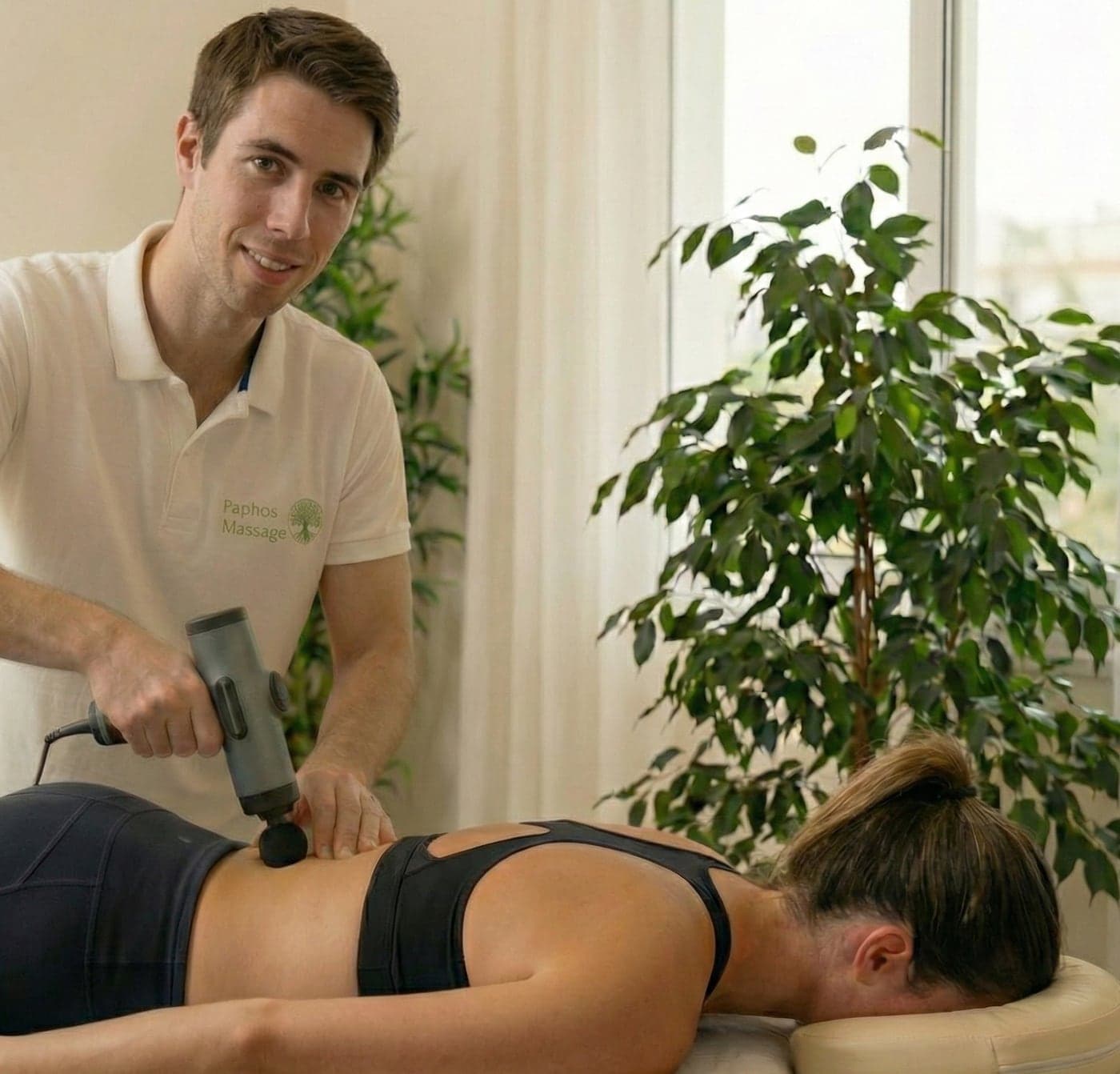
The method is straightforward and I follow it in the same order every time:
I do not promise outcomes. Tissue changes at its own pace and depends on how much you keep riding while we work. What I can say is that riders who come back for a second and third session usually report freer hips, easier breathing on the bars and less morning stiffness, and those are the changes I aim for.
The complaints I see most often in riders here
The presentation I see most often around Paphos and Chlorakas is a rider in their second or third season of serious mileage who has developed one of a small set of problems. Each has a typical driver, and treating that driver is what separates useful work from a nice hour on the table.
- Lower back ache during and after long rides. Usually restricted hip flexors tipping the pelvis forward, with under-active glutes and over-working lumbar erectors. I release the iliopsoas complex and thoracolumbar fascia and give simple glute activation work.
- Lateral knee pain and IT band irritation. The band is fascia and does not stretch; the driver is normally an over-active tensor fasciae latae and weak gluteus medius. I work the TFL and gluteal attachments and the lateral chain, and I will tell you if your saddle height or cleat position looks like part of it.
- Anterior hip tightness or clicking. Often a shortened psoas that has become dense at its lumbar attachments. This is one of the areas where instrument-assisted pressure earns its place.
- Neck and shoulder tension from the drops. Driven by a stiff thoracic spine forcing the neck to extend. I work the intercostals, pecs, levator scapulae and upper trapezius attachments together.
- Achilles or calf soreness. Frequently a guarded soleus and deep posterior compartment loading the tendon unevenly, rather than a problem in the tendon itself.
If you have already had a scan or a diagnosis, bring it. It changes what I do and what I leave alone.
Timing treatment around training and events
When you have a session matters almost as much as what happens in it. Deep work is a load on the body, and putting it in the wrong place in your week can leave you flat on a key ride.
Because I come to you, the timing is easy to get right. You do not have to fit a clinic's opening hours around a training plan, and you can lie down afterwards instead of driving across town with warm, freshly worked tissue.
What a session at your home looks like
I am a one-man mobile practice based in Chlorakas, just north of Paphos town, and I cover the whole Paphos district. I bring a professional treatment table, the mechanical device, linens and oil, so all you need is a room with a couple of metres of floor space and a place to park.
- Sixty minutes is enough for a focused problem: hips and lower back, or the whole posterior chain
- Ninety minutes covers the full cycling pattern from calves to neck, and is what I suggest for a first visit
- I can also see you at a rented villa or hotel if you are here for a training camp
- Wear or bring shorts; I work with towels and only expose the area being treated
Prices are €90 for 60 minutes and €130 for 90 minutes, and every fifth session is free. Full details are on the pricing page. Booking is by WhatsApp or phone; tell me roughly what you ride and where it hurts and I will suggest a duration. If your problem is more general than cycling-specific, my sports massage in Paphos page describes the broader approach I take with anyone who trains.
What I can and cannot help with
I can help with muscular tightness, restricted range of motion, overuse soreness and the recovery side of a training block; I cannot treat joint injuries, nerve symptoms or anything that needs imaging or medication, so see a doctor first if you have numbness or pins and needles in a leg, pain that wakes you at night, swelling in a joint, a fall or crash you have not had checked, or pain that is getting steadily worse rather than fluctuating with your riding.
Frequently asked questions
Is there a mobile massage therapist near me in Paphos?
Yes. I am based in Chlorakas, a few minutes north of Paphos town, and I travel to homes, villas and hotels across the district, including Kato Paphos, Peyia, Tala, Emba, Kissonerga and the villages up towards Polis. Travel is included in the price for most addresses; if you are somewhere remote, message me first and I will confirm.
How is mechanical deep-tissue work different from ordinary deep tissue massage?
Ordinary deep tissue relies on the therapist's hands and body weight, which tire and vary through a session. I add an instrument that delivers steady, adjustable pressure, so I can hold a useful depth on dense tissue such as a rider's quads or soleus for as long as it takes. My hands still do the assessing and the finer work; the device does the sustained part.
Will it hurt?
Deep work on guarded tissue is intense, and you will feel it, but I adjust the pressure continuously to what you can tolerate and breathe through. It should never feel like bracing against pain. Most riders describe it as strong but bearable, followed by a noticeable sense of ease in the treated area. Expect some soreness for a day or two afterwards.
How many sessions will I need?
It depends on how long the problem has been there and how much you keep riding. A recent bout of tightness after a big week may settle in one or two visits. Something that has built up over seasons usually needs a short series, and then occasional maintenance. I will tell you honestly after the first assessment what I think is realistic.
Can I ride the day after a session?
An easy spin is fine and often helps. I would not plan intervals, a long climb or a race within 48 hours of a deep session, because the tissue is still settling and you may feel heavy-legged. If you have an event coming up, tell me when you book and I will keep the work lighter or suggest a different day.
Do you work with recreational riders as well as racers?
Yes. The mechanical pattern cycling produces is much the same whether you ride for fitness or compete, so the work is similar; what changes is the goal. Racers usually want performance and event timing, recreational riders usually want to ride without a sore back or knee. I treat both, and the assessment at the start decides the emphasis.
Written by
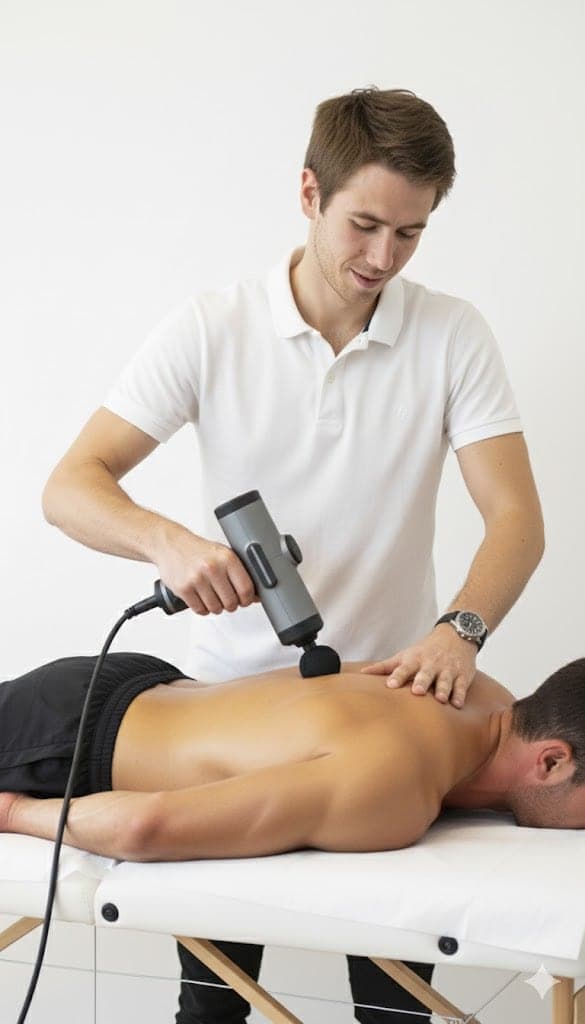
Chris
Massage therapist & body mechanics specialist
Norwegian-certified with a Bachelor’s in Physical Education and Nutrition and over ten years of clinical practice, working from a portable table in clients’ homes across the Paphos district.
- Norwegian-certified
- BSc Physical Education & Nutrition
- 10+ years clinical practice
- Based in Chlorakas · all of Paphos district
- No call-out fee anywhere in Paphos district
Last reviewed
This article is general information from clinical practice, not a medical diagnosis. If you have severe, worsening or unexplained pain, numbness, weakness, or pain after an accident, see a doctor first.