
Benefits of Massage for Posture: A Clinical Approach to Lasting Structural Change
In short
Discover how advanced mechanical deep-tissue massage addresses the root causes of poor posture, delivering measurable structural improvements that last. Expert insights from 10 years of clinical practice.
Poor posture isn’t just about aesthetics or your mother’s nagging to “stand up straight.” After a decade of working with clients who’ve exhausted conventional approaches, I’ve witnessed firsthand how chronic postural dysfunction creates a cascade of mechanical failures throughout the body. The rounded shoulders, forward head position, and anterior pelvic tilt you see in the mirror are merely visible symptoms of deeper fascial restrictions, muscular imbalances, and compensatory patterns that have taken years to develop.
Most people approach posture correction backwards. They attempt to consciously hold themselves differently, perhaps buying an ergonomic chair or posting reminder notes around their workspace. This approach fails because it treats posture as a conscious choice rather than what it actually is: the inevitable result of your tissue quality, fascial integrity, and neuromuscular programming. The benefits of massage for posture become significant only when we address these underlying mechanical restrictions that make poor posture biomechanically inevitable.
My approach differs fundamentally from what most people associate with “massage therapy.” With a Bachelor’s degree in Physical Education and Nutrition and ten years specializing exclusively in mechanical deep-tissue work, I don’t provide relaxation sessions. I perform clinical interventions targeting the specific fascial adhesions, trigger points, and tissue densities that mechanically prevent optimal alignment. This distinction matters profoundly for anyone seeking actual postural change rather than temporary relief.
The Biomechanical Reality Behind Postural Dysfunction
Understanding the benefits of massage for posture requires first understanding what creates postural problems. Your body exists in a state of tensional equilibrium—a complex web of fascial connections, muscular tensions, and skeletal positioning that constantly negotiates with gravity. When this system functions optimally, maintaining good posture requires minimal conscious effort. Your tissues support your skeleton efficiently, and your nervous system has programmed movement patterns that reinforce proper alignment.
The problem develops gradually. Repetitive positioning—whether sitting at a desk, driving, or habitually carrying weight on one side—creates adaptive shortening in certain tissue chains while leaving opposing structures lengthened and weakened. A forward head position, for instance, doesn’t exist in isolation. It’s accompanied by shortened suboccipital muscles, hypertonic upper trapezius fibers, restricted thoracic spine mobility, and compromised deep neck flexors. These adaptations become self-reinforcing. The longer tissues remain in a shortened state, the more lasting the structural change becomes at a cellular level.
I’ve treated software developers whose pectoralis minor had contracted so severely that their shoulders literally could not externally rotate to neutral without pain. I’ve worked with office managers whose iliopsoas had shortened to the point that standing upright created immediate lumbar discomfort. These aren’t conditions that resolve through “awareness” or “strengthening exercises.” The tissue itself has remodeled, laying down additional collagen fibers in shortened positions and creating fascial densifications that mechanically restrict movement.
Why Traditional Approaches Miss the Mark
The conventional postural correction paradigm focuses heavily on stretching and strengthening. While these have their place, they fundamentally fail to address the primary limiting factor: tissue quality and fascial restriction. You cannot effectively strengthen a muscle that’s encased in dense, restricted fascia. You cannot productively stretch tissue that’s filled with trigger points and adhesions. I’ve seen countless clients who’ve spent months performing postural exercises with minimal results because the underlying mechanical restrictions were never addressed.
This is where the benefits of massage for posture become clinically significant. Advanced mechanical deep-tissue work doesn’t just relax muscles temporarily—it systematically breaks down fascial adhesions, deactivates trigger points, improves tissue hydration, and restores sliding surface mechanics between tissue layers. These changes create the mechanical prerequisites necessary for postural change to occur and, critically, to sustain itself.
Clinical Benefits of Mechanical Deep-Tissue Massage for Postural Correction
Let me be explicit about what properly executed mechanical massage achieves from a postural perspective. These aren’t subjective improvements or temporary feelings of relief—they’re measurable structural changes that alter how your body organizes itself in space.
Fascial Release and Tissue Rehydration
Fascia—the connective tissue that encases every muscle, organ, and structure in your body—is arguably more important than the muscles themselves when discussing posture. Healthy fascia is hydrated, pliable, and allows smooth gliding between tissue layers. Dysfunctional fascia becomes dense, dehydrated, and creates adhesions between structures that should move independently.
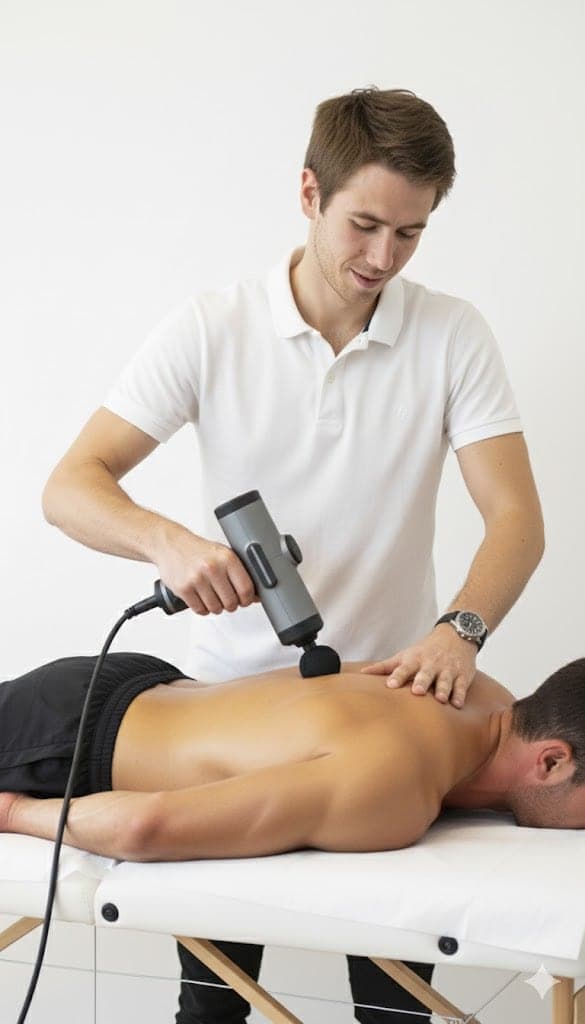
Through my specialized mechanical approach, I can apply precisely controlled pressure that systematically addresses fascial restrictions layer by layer. The machine I use delivers depth and consistency impossible to achieve with hands alone, working into the deepest fascial layers where chronic postural patterns originate. This isn’t painful torture—it’s calibrated exactly to each client’s tissue tolerance, progressively working deeper as tissues release and hydration improves.
The practical outcome? A client with chronically rounded shoulders doesn’t just feel looser temporarily. The fascial restrictions in their pectoralis major and minor, anterior deltoid, and subscapularis are systematically released, mechanically allowing their shoulder girdle to assume a more posterior position. This happens automatically, without conscious effort, because the tissue that was pulling them forward has been fundamentally changed.
Trigger Point Deactivation and Referral Pattern Elimination
Trigger points—hyperirritable nodules within taut bands of muscle fiber—play an enormous role in postural dysfunction that most practitioners underestimate. Active trigger points don’t just cause localized pain; they create referral patterns that feel like pain elsewhere, alter motor control patterns, and contribute to muscular weakness and dysfunction.
I routinely find trigger points in the levator scapulae of clients with forward head posture, creating referral pain down their neck and into their shoulder blade. These trigger points actively pull the scapula into elevation and rotation, mechanically preventing proper postural alignment. Deactivating them—which requires sustained, precise pressure delivered at the correct angle—immediately allows better scapular positioning.
The benefits of massage for posture extend beyond the immediate release. When trigger points are properly deactivated, the nervous system stops receiving aberrant input, motor control patterns normalize, and the muscle can function properly rather than remaining in a protective, shortened state. I’ve measured immediate increases in cervical range of motion exceeding 20 degrees following systematic trigger point work in the suboccipital triangle—changes that directly translate to reduced forward head positioning.
Restoration of Optimal Muscle Length-Tension Relationships
Every muscle in your body has an optimal length at which it can generate maximum force. When muscles become chronically shortened or lengthened due to postural adaptation, they function outside this optimal range, creating weakness, fatigue, and compensation patterns.
Consider the classic upper crossed syndrome pattern: shortened upper trapezius and levator scapulae, lengthened and weakened lower trapezius and serratus anterior. No amount of lower trap strengthening will correct this pattern if the upper traps remain mechanically shortened and fascially restricted. The system is locked into dysfunction.
My mechanical approach systematically releases the shortened structures first, restoring them to functional length. This immediately changes the biomechanical landscape. The lengthened, “weak” muscles often aren’t actually weak—they were simply mechanically disadvantaged, unable to generate effective force from an overstretched position. Once proper length relationships are restored through deep-tissue work, the entire system reorganizes, and “strengthening” often happens spontaneously through normal daily activities.
Enhanced Proprioceptive Awareness and Neuromuscular Re-education
One benefit of massage for posture that surprises many clients is the profound improvement in body awareness. Restricted fascia and chronically tense muscles create distorted proprioceptive input—your nervous system literally doesn’t know where your body is in space accurately.
Following comprehensive mechanical deep-tissue work, clients consistently report feeling “taller,” “lighter,” or that they can “feel where their body is” more clearly. This isn’t mystical; it’s the predictable result of normalizing proprioceptive input from muscles, joints, and fascia. When tissues are functioning properly, the nervous system receives accurate information and can make appropriate postural adjustments automatically.
I had a client, a competitive cyclist, who couldn’t understand why his left shoulder kept creeping toward his ear during long rides despite constant conscious correction. Following systematic release work on his left upper trapezius, levator scapulae, and scalenes, he reported that his shoulder “just stayed down” without any conscious effort. His nervous system, receiving accurate proprioceptive information for the first time in years, automatically adjusted his posture to optimal positioning.
The Mechanical Advantage: Why Traditional Manual Therapy Falls Short
I need to address why I exclusively use a specialized mechanical tool rather than relying solely on hands for deep-tissue work. This isn’t about convenience—it’s about achieving results that are biomechanically impossible through traditional manual therapy.
Precision, Power, and Consistency
Human hands, no matter how skilled, have inherent limitations. They fatigue, they lack the depth penetration necessary to address the deepest fascial restrictions, and they vary in effectiveness depending on the therapist’s physical condition on any given day. When you’re addressing postural dysfunction that’s developed over years or decades, you need tools capable of systematic, repeatable, deep intervention.
The machine I use delivers precisely controlled force at angles and depths impossible to achieve manually. I can work into the posterior cervical musculature, reaching the deepest layers of the multifidi and rotatores that are crucial for cervical stability and posture. I can address the thick, dense fascia of the thoracolumbar junction where so many postural patterns originate. I can systematically release the hip flexor complex—psoas, iliacus, rectus femoris—which often requires working through multiple fascial and muscular layers.
Most importantly, this approach delivers consistent results. My clients don’t experience variable quality depending on whether I’m having a strong day or my thumbs are fatigued. Every session delivers the same level of precision and depth, creating the predictable, cumulative improvements that lasting postural change requires.
Treating Causes, Not Symptoms
The benefits of massage for posture only materialize when we address root causes rather than chasing symptomatic relief. Most massage therapy focuses on where people hurt—the tight upper traps, the sore lower back, the stiff neck. This provides temporary comfort but changes nothing structurally.
My approach begins with comprehensive assessment identifying the mechanical restrictions driving postural dysfunction. Often, these exist far from where symptoms manifest. A client’s chronic neck pain may originate from iliopsoas restriction creating compensatory lumbar hyperextension, which cascades up the spine creating cervical strain. Massaging their neck provides zero long-term benefit because we haven’t addressed the mechanical origin of their postural pattern.
This is why I work through customized treatment plans rather than offering one-off sessions. Lasting postural correction requires systematic work addressing the entire chain of restrictions, typically over multiple sessions with progressive intensity as tissues adapt and improve. This isn’t a massage you purchase casually; it’s an investment in fundamentally changing how your body functions.
Practical Applications: Real Postural Transformations
Let me share specific examples demonstrating how advanced mechanical massage creates measurable postural change. These aren’t cherry-picked success stories—they represent the typical trajectory when clients commit to systematic treatment addressing root causes.
Case Study: Forward Head Posture and Desk Work
I worked with a financial analyst who presented with severe forward head posture—her ear positioned approximately 4 inches anterior to her shoulder when viewed laterally. She experienced daily headaches, neck stiffness, and was developing numbness in her fingers. She’d tried physical therapy, yoga, and ergonomic modifications with minimal improvement.
Assessment revealed massive restriction in her suboccipital triangle, hypertonic upper trapezius and levator scapulae, and completely immobile thoracic spine segments from T1-T6. Her pectoralis minor was so contracted that her shoulders literally could not move posteriorly to neutral without pain.
Over six sessions, I systematically addressed each restriction layer. The mechanical approach allowed me to work deeply into the suboccipitals, releasing years of accumulated tension. I addressed the fascial restrictions in her thoracic erector spinae, progressively restoring segmental mobility. The pec minor required several sessions of graduated release work as it was exceptionally dense and sensitive.
The postural change was dramatic and, critically, lasting. Her forward head position reduced by approximately 3 inches, measured photographically. She reported that maintaining upright posture felt effortless rather than requiring constant conscious correction. The headaches resolved completely. Six months following treatment completion, her posture remained stable—this wasn’t temporary improvement requiring maintenance, but actual structural change.
Case Study: Anterior Pelvic Tilt and Lower Back Pain
A recreational marathon runner consulted me for chronic lower back pain that worsened during long runs. He’d spent thousands on running coaches, orthotics, and physical therapy, all addressing his “weak core” without meaningful results.
His posture revealed severe anterior pelvic tilt—approximately 20 degrees beyond optimal positioning. His hip flexors were so shortened that he couldn’t extend his hip to neutral without lumbar hyperextension. This created constant mechanical stress on his lumbar spine during running, inevitably producing pain.
The hip flexor complex—particularly psoas and iliacus—requires deep, precise work. These muscles lie beneath multiple layers of tissue and attach to structures where improper technique risks complications. The mechanical tool’s precision allowed me to systematically release these muscles safely and effectively, something that would be extremely difficult and inconsistent with hands alone.
After five treatment sessions combined with specific motor control work he could perform once tissue restrictions were released, his anterior pelvic tilt reduced to approximately 8 degrees—within normal range. His lower back pain during running disappeared entirely. He ran a personal best marathon time six weeks after completing treatment, attributing his improvement to the biomechanical efficiency gained from proper pelvic positioning.
Comparing Treatment Modalities: Why Mechanical Deep-Tissue Work Delivers Superior Results
Understanding the benefits of massage for posture requires distinguishing between different approaches. Not all massage provides postural benefits, and some commonly recommended treatments are essentially ineffective for structural change.
| Treatment Modality | Depth of Tissue Access | Postural Impact | Duration of Results | Limitations |
|---|---|---|---|---|
| Swedish/Relaxation Massage | Superficial to moderate | Minimal—temporary relaxation only | Hours to 1-2 days | Doesn’t address fascial restrictions or trigger points; purely symptomatic |
| Traditional Manual Deep-Tissue | Moderate to occasionally deep | Variable—depends heavily on therapist skill and physical capacity | Days to 2 weeks | Inconsistent depth; therapist fatigue limits effectiveness; difficult to access deepest restrictions |
| Foam Rolling/Self-Myofascial Release | Superficial | Minimal—helpful for maintenance only | Hours | Cannot generate sufficient force or precision for structural change; inappropriate for many areas |
| Stretching Protocols | N/A—no direct tissue work | Limited without addressing tissue restrictions first | Temporary unless combined with tissue work | Ineffective when fascia is restricted; can reinforce poor patterns if done incorrectly |
| Mechanical Deep-Tissue (Advanced) | Superficial to deep—all layers accessible | Significant—systematic structural change | Lasting when properly executed | Requires specialized equipment and expertise; not appropriate for all conditions |
This comparison isn’t intended to disparage other approaches—they each have appropriate applications. However, for clients seeking actual postural correction rather than temporary symptom management, the depth, precision, and consistency of mechanical deep-tissue work proves superior in clinical outcomes.
The Physiological Mechanisms: How Massage Creates Lasting Postural Change
For those interested in the biological mechanisms underlying these benefits, it’s worth understanding what actually changes at a tissue level during effective treatment. This knowledge helps explain why proper mechanical massage creates lasting results rather than temporary relief.
Fascial Remodeling and Collagen Reorganization
Fascia isn’t static tissue—it constantly remodels based on mechanical demands. Chronic postural positions cause fascia to lay down additional collagen fibers in shortened configurations, essentially reinforcing poor patterns at a structural level. This process, called fascial densification, creates tissue that’s thick, dehydrated, and mechanically restricted.
Properly applied mechanical force stimulates fibroblasts—the cells responsible for producing and organizing collagen—to begin remodeling these densified areas. The mechanical pressure creates controlled microtrauma that triggers healing responses, promoting collagen reorganization along functional lines rather than dysfunctional shortened patterns.
This process takes time, which is why I work with clients through progressive treatment plans rather than single sessions. Each treatment progressively improves tissue quality, with cumulative changes creating lasting structural improvement.
Neuromuscular Re-patterning and Motor Control
Your nervous system controls posture largely through automatic, subconscious processes. Years of poor postural habits create deeply ingrained motor patterns—your nervous system has literally programmed inefficient movement and positioning as “normal.”
Mechanical deep-tissue work doesn’t just change tissues; it fundamentally alters proprioceptive input to the nervous system. When chronically tense muscles release, when trigger points deactivate, when fascial restrictions resolve, the nervous system suddenly receives dramatically different information about body position and movement capability.
This creates an opportunity for neuromuscular re-patterning. The nervous system can now program new, more efficient motor patterns because the mechanical restrictions that made proper posture impossible have been removed. This is why postural improvements often feel automatic after treatment—clients aren’t consciously maintaining better posture; their nervous system has adopted new, more efficient patterns because it finally can.
Circulatory Enhancement and Metabolic Waste Removal
Chronically tense, restricted tissues have compromised circulation. This creates a self-perpetuating cycle: poor circulation means inadequate oxygen and nutrient delivery, leading to further tissue dysfunction, which worsens circulation further.
Deep mechanical work dramatically improves local circulation through multiple mechanisms. The direct mechanical pressure forces blood and interstitial fluid movement. The release of tissue restrictions removes mechanical barriers to blood flow. The reduction in muscular tension decreases vascular compression.
Improved circulation accelerates tissue healing, reduces inflammatory mediators, and enhances metabolic waste removal. This contributes significantly to the lasting nature of postural improvements—tissues aren’t just mechanically released, they’re functioning better metabolically, making them more resilient to stress and less likely to return to dysfunctional patterns.
Maximizing Benefits: What Clients Must Understand
The benefits of massage for posture are substantial, but clients must approach treatment with appropriate expectations and commitment. This isn’t a passive intervention where you lie on a table and magically emerge with perfect posture. Success requires understanding several key principles.
Commitment to Process Over Quick Fixes
Postural dysfunction that developed over years doesn’t resolve in a single session. While clients typically notice immediate improvements—greater range of motion, reduced pain, feeling “lighter”—lasting structural change requires systematic work addressing the entire chain of restrictions.
I develop customized treatment plans based on each client’s specific postural patterns, tissue quality, and goals. These typically span 4-8 sessions over several weeks, with progressively deeper work as tissues adapt and improve. Clients who commit to this process experience lasting results. Those seeking quick fixes inevitably experience only temporary improvement.
This represents an investment, not an expense. You’re not purchasing an hour of relaxation; you’re investing in fundamentally improving how your body functions, with benefits that compound across every activity in your life.
Active Participation in Motor Pattern Re-education
While the mechanical work creates the prerequisite tissue changes for postural improvement, clients benefit enormously from conscious awareness and simple motor control exercises between sessions. Once tissues are released, the nervous system needs opportunities to program new, efficient patterns.
I provide specific guidance tailored to each client’s needs—this might be simple awareness cues, breathing patterns that reinforce proper positioning, or targeted movement exercises that feel completely different once underlying restrictions are resolved. These aren’t the generic stretching protocols that failed before treatment; they’re precisely chosen interventions that work because we’ve addressed the mechanical limitations that previously made them ineffective.
Environmental and Lifestyle Considerations
Postural patterns exist within the context of your daily life. If your work environment, sleep setup, or habitual movement patterns constantly reinforce poor positioning, maintaining optimal posture becomes unnecessarily difficult even after tissue restrictions are resolved.
I address these factors during consultation, providing specific, practical recommendations for workspace ergonomics, sleep positioning, and movement habits that support rather than undermine postural health. These modifications aren’t complex or expensive—they’re often simple adjustments that have outsized impact once tissue quality is improved.
Addressing Common Misconceptions About Massage and Posture
Significant misinformation exists about posture correction and massage therapy. Let me address the most common misconceptions I encounter from new clients.
“Posture Is About Discipline and Conscious Effort”
This is perhaps the most pervasive and damaging misconception. People believe they have poor posture because they’re lazy or undisciplined, and that correction requires constant conscious vigilance.
The reality: Optimal posture should be effortless. When your tissues are functioning properly, your body naturally assumes efficient positioning because it’s biomechanically easiest. If maintaining good posture requires constant conscious effort, it means mechanical restrictions are preventing proper alignment—your tissues are literally pulling you into dysfunction.
Following comprehensive treatment that resolves these restrictions, good posture happens automatically. Clients consistently express surprise at how effortless proper positioning becomes once the underlying mechanical barriers are removed.
“I Just Need to Strengthen My Core/Back/Shoulders”
Strengthening has its place, but it’s not the primary solution for postural dysfunction. You cannot strengthen your way out of fascial restrictions and trigger points. Attempting to do so often reinforces poor patterns because you’re strengthening muscles that are mechanically disadvantaged or working around restrictions rather than through proper ranges of motion.
The correct sequence: First resolve tissue restrictions and restore proper length-tension relationships. Then, if specific strengthening is needed (which is less common than people assume), it becomes dramatically more effective because muscles can function through full, proper ranges with optimal biomechanics.
“Massage Provides Temporary Relief; Real Change Requires Other Interventions”
This misconception exists because most people’s experience with massage involves relaxation-focused work that indeed provides only temporary symptomatic relief. They’ve never experienced systematic, mechanical deep-tissue work targeting root causes of postural dysfunction.
Properly executed mechanical massage doesn’t provide temporary relief—it creates lasting structural change. The distinction lies entirely in approach, depth, precision, and systematic application. This is why I position my service as fundamentally different from traditional massage therapy. We’re not even performing the same intervention, despite using similar terminology.
The Partnership Approach: How I Work With Clients
My service model differs substantially from traditional massage therapy appointments. I don’t operate on a transactional, one-session-at-a-time basis. Instead, I establish dedicated partnerships with clients focused on achieving specific, measurable outcomes.
Comprehensive Assessment and Treatment Planning
Every new client relationship begins with thorough assessment. I evaluate postural alignment, palpate tissue quality, test range of motion, and identify the specific restrictions and imbalances driving their particular postural pattern. This assessment informs a customized treatment plan targeting their unique needs.
This approach contrasts sharply with generic massage where clients simply specify “neck and shoulders” or “lower back.” We’re not addressing areas that feel tight; we’re systematically resolving the mechanical restrictions that create and maintain postural dysfunction.
Progressive Treatment Intensity
Tissue adaptation is progressive. Attempting to work too deeply too quickly creates excessive soreness and potentially triggers protective guarding responses that limit effectiveness. My approach involves graduated intensity, starting with what each client’s tissues can tolerate and progressively working deeper as tissue quality improves.
The mechanical tool’s precision makes this progression smooth and controlled. I can adjust pressure in fine increments, working exactly at the threshold where we achieve maximum therapeutic benefit without exceeding tissue tolerance. This eliminates the variable quality inherent in manual work where pressure control depends on therapist feel and strength.
Mobile Service and Client Convenience
I travel to clients’ locations with professional equipment, creating a clinical treatment environment wherever is most convenient for them. This eliminates the barriers that often prevent people from maintaining treatment consistency—commute time, scheduling around business hours, difficulty traveling immediately after deep-tissue work.
The convenience factor matters significantly for treatment effectiveness. Clients are more likely to complete full treatment plans when logistics are simplified, and compliance with treatment plans directly correlates with outcomes.
Beyond Posture: Comprehensive Benefits of Improved Alignment
While this article focuses on the benefits of massage for posture, it’s worth noting that postural correction creates cascading improvements across multiple systems and aspects of life. Optimal posture isn’t just about appearance or avoiding back pain—it fundamentally affects how your entire body functions.
Performance Enhancement
Athletes and active individuals experience substantial performance improvements from postural optimization. Efficient alignment reduces energy expenditure during activity, improves force transmission through kinetic chains, enhances breathing mechanics, and reduces injury risk.
I’ve worked with runners who immediately improved their pace at given heart rates following postural correction—their bodies became more mechanically efficient, requiring less energy for the same output. Cyclists have reported improved power output and reduced fatigue. CrossFit athletes have achieved better lifting mechanics and reduced joint stress.
Pain Resolution and Prevention
The relationship between posture and pain is profound. Poor postural alignment creates abnormal joint loading, muscle tension, and nerve compression that inevitably produce pain. Headaches, neck pain, shoulder impingement, lower back pain, hip dysfunction, and knee problems frequently trace back to postural origins.
By addressing root mechanical causes through systematic tissue work, pain resolution isn’t just symptom suppression—it’s genuine correction of the underlying problem. Clients experience not just reduced pain, but complete resolution that persists because we’ve changed the mechanical factors that created pain initially.
Respiratory Function and Energy
Postural positioning dramatically affects respiratory mechanics. Forward head posture and thoracic kyphosis restrict rib cage mobility and diaphragm excursion, compromising breathing efficiency. This creates a subtle but constant energy deficit—your body works harder to achieve adequate oxygenation.
Clients consistently report feeling more energetic following postural correction. They’re not imagining it; improved respiratory mechanics means better oxygenation with less effort, reducing the constant low-grade fatigue associated with inefficient breathing patterns.
Digestive Function and Internal Organ Health
Posture affects internal organs more than most people realize. Chronic postural compression—particularly anterior pelvic tilt and thoracic kyphosis—reduces abdominal space, affecting digestive organ positioning and function. Poor posture can contribute to reflux, constipation, and other digestive complaints through purely mechanical mechanisms.
While I’m not treating digestive disorders directly, several clients have reported improvements in digestive function following postural correction. The mechanism is straightforward: better alignment reduces chronic compression and allows organs to function in optimal spatial relationships.
Frequently Asked Questions About Massage and Postural Correction
How quickly will I see postural improvements?
Clients typically notice immediate changes in how they feel—greater ease of movement, reduced pain, feeling “taller” or “lighter.” Visible postural changes usually become apparent after 2-3 sessions as we systematically address major restrictions. Lasting, stable postural correction typically requires 4-8 sessions depending on severity and chronicity of dysfunction.
The timeline isn’t arbitrary—it reflects the biological reality of tissue remodeling and neuromuscular re-patterning. Rushing this process produces inferior results. Clients who commit to the full recommended treatment plan experience lasting change; those who stop after initial improvement often experience gradual regression.
Is the treatment painful?
Effective deep-tissue work operates at the edge of discomfort but shouldn’t be unbearably painful. I precisely calibrate intensity to each client’s tolerance, progressively working deeper as tissues adapt. The mechanical tool’s precision allows much finer pressure control than hands, making the work more comfortable while achieving superior depth.
Clients typically describe the sensation as “intense but good”—a productive discomfort that feels different from injury pain. Post-treatment soreness similar to workout soreness is common and typically resolves within 24-48 hours as tissues adapt.
How is this different from physical therapy?
Physical therapy focuses primarily on exercise-based interventions—stretching, strengthening, movement pattern training. These approaches have value but often fail to address the primary limiting factor: tissue restrictions that mechanically prevent proper movement and positioning.
My work addresses these tissue restrictions directly, creating the mechanical prerequisites necessary for exercises and movement retraining to be effective. Many clients come to me after physical therapy provided limited results. Once tissue restrictions are resolved through mechanical work, the exercises they were doing suddenly become dramatically more effective.
The approaches are complementary, not competitive. Ideally, tissue work resolves mechanical restrictions first, then exercise-based interventions reinforce and maintain improvements.
Will I need ongoing maintenance treatments?
Most clients achieve stable, lasting results that don’t require regular maintenance. Once tissues are properly released and new motor patterns are established, the improvements persist because we’ve addressed root causes rather than just managing symptoms.
Some clients choose periodic treatments—perhaps quarterly—as preventive maintenance or to address new issues before they become significant problems. This is optional, not necessary. The goal is always lasting correction, not creating dependency on ongoing treatment.
Can postural correction help with specific conditions like herniated discs or arthritis?
Postural optimization frequently reduces symptoms associated with degenerative conditions by improving mechanical loading and reducing abnormal stress. However, I’m not treating diseases—I’m addressing mechanical dysfunction. If poor posture is creating or exacerbating symptoms from underlying pathology, correcting the postural component often provides significant relief.
For any diagnosed medical condition, I work collaboratively with your healthcare providers. Mechanical massage is a powerful intervention for postural dysfunction, but it exists within the broader context of your overall health management.
Why should I choose mechanical treatment over traditional manual therapy?
The mechanical approach delivers superior results through three key advantages: precision, power, and consistency. The tool accesses tissue depths impossible to reach with hands, applies precisely calibrated pressure without the variability of manual work, and eliminates the “off days” inherent in hand-dependent techniques.
More fundamentally, the mechanical approach reflects my commitment to results over tradition. I use the tools and techniques that produce optimal outcomes, not what’s conventional. My clients invest in results, and I’m obligated to deliver those results through whatever methods prove most effective.
Investment in Long-Term Health: The Economics of Postural Correction
I want to address cost considerations directly because they represent an important decision factor for potential clients. My services cost more than typical massage, and this is intentional and justified.
You’re not purchasing relaxation sessions or temporary symptom relief. You’re investing in lasting structural correction delivered through advanced techniques requiring specialized equipment and extensive expertise. The comparison isn’t with spa massage pricing; it’s with the costs of chronic pain management, reduced work productivity, limited activity, and diminished quality of life that poor posture creates over time.
Consider the typical trajectory of someone with chronic postural pain: years of doctor visits, multiple failed interventions, ongoing medication costs, reduced work performance, limited activity participation, and constant discomfort. The cumulative cost—financial, professional, and personal—is substantial.
Proper postural correction through systematic mechanical deep-tissue work short-circuits this trajectory. The investment is concentrated upfront but eliminates the ongoing costs and limitations associated with chronic postural dysfunction. Clients consistently report that the value received far exceeds the financial investment when considered across the months and years of improved function that follow treatment.
I position my service as an investment rather than an expense because that’s the accurate characterization. You’re investing in your body’s structural integrity and functional capacity—assets that pay dividends through improved performance, reduced pain, enhanced activity, and better quality of life for years to come.
Conclusion: Choosing Effective Intervention Over Endless Management
The benefits of massage for posture are profound and lasting—when approached correctly. The key distinction lies between genuine treatment targeting root causes versus symptom management that provides temporary relief while changing nothing structurally.
After ten years specializing exclusively in this work, I’ve witnessed hundreds of clients achieve postural transformations that seemed impossible after other approaches failed. The pattern is consistent: systematic mechanical release of fascial restrictions and trigger points, restoration of proper tissue length-tension relationships, neuromuscular re-patterning, and lasting structural change that persists because we’ve addressed causes rather than symptoms.
This isn’t miracle work—it’s applied biomechanics and clinical expertise delivered through advanced mechanical techniques that access tissue depths and provide consistency impossible with traditional manual approaches. It requires commitment from both practitioner and client, but the outcomes speak clearly: lasting postural correction, pain resolution, performance enhancement, and improved quality of life.
If you’re tired of managing symptoms, if conventional approaches have failed to deliver lasting improvement, if you’re ready to invest in genuine structural correction rather than temporary relief, this approach offers what you’re seeking. Not everyone is ready for this level of commitment, and that’s fine—endless symptom management remains available through conventional channels.
But for those who want actual solutions rather than ongoing management, who value results over tradition, who understand that optimal body function requires addressing root causes systematically—the benefits of advanced mechanical deep-tissue massage for postural correction prove transformative and lasting.
The choice is yours: continue managing symptoms indefinitely, or invest in lasting structural correction that changes how your body functions for years to come. I know which approach delivers the results my clients seek, and a decade of clinical outcomes confirms that decision repeatedly.
Written by
Chris
Massage therapist & body mechanics specialist
Norwegian-certified with a Bachelor’s in Physical Education and Nutrition and over ten years of clinical practice, working from a portable table in clients’ homes across the Paphos district.
This article is general information from clinical practice, not a medical diagnosis. If you have severe, worsening or unexplained pain, numbness, weakness, or pain after an accident, see a doctor first.