Yoga for Back Pain Pegeia: Why Traditional Stretches Fail and What Actually Works
In short
Discover why yoga alone often fails to resolve chronic back pain in Pegeia, and learn the advanced mechanical approach that addresses the root cause of spinal dysfunction for lasting relief.
I’ve spent a decade working with clients in Pegeia who come to me after months—sometimes years—of dedicated yoga practice, still experiencing debilitating back pain. They stretch religiously, hold their downward dogs perfectly, and maintain their warrior poses with admirable discipline. Yet the pain persists, sometimes worsening despite their commitment to these ancient practices.
This isn’t a condemnation of yoga. Rather, it’s a clinical observation based on my Bachelor’s degree in Physical Education and Nutrition and ten years of treating mechanical dysfunction in the human body. Yoga can be valuable for flexibility and mental well-being, but when dealing with chronic back pain rooted in deep fascial adhesions, muscular compensation patterns, and structural misalignments, stretching alone addresses symptoms rather than causes.
Let me explain why your back pain continues despite your best efforts on the yoga mat, and what actually resolves the underlying mechanical dysfunction causing your discomfort.
The Fundamental Problem with Yoga for Chronic Back Pain
When clients describe their yoga routine to me, I listen for specific mechanical details. How does their pelvis tilt during cat-cow? Where do they feel tension in pigeon pose? What compensations appear during spinal twists? The answers reveal a consistent pattern: yoga stretches superficial muscle tissue while deeper fascial restrictions remain untouched.
Understanding the Depth Limitation
The human hand—or your own body weight in yoga postures—can only penetrate tissue to a certain depth. Chronic back pain originates from restrictions buried beneath multiple tissue layers: deep to the erector spinae, within the quadratus lumborum, embedded in the thoracolumbar fascia. These structures require mechanical force beyond what stretching can deliver.
I’ve treated dozens of yoga practitioners in Pegeia whose flexibility actually masks their underlying dysfunction. They can fold forward impressively, but their psoas remains chronically contracted. They demonstrate beautiful backbends while their multifidus muscles stay locked in protective spasm. The superficial mobility creates an illusion of health while deeper structures deteriorate.
The Compensation Cascade
Your body is brilliantly adaptive. When one area cannot function properly due to fascial restriction or muscular dysfunction, adjacent structures compensate. This creates a cascade effect that yoga inadvertently reinforces:
- You stretch your hamstrings repeatedly because they feel tight, but the tightness is compensating for weak, inhibited glutes
- You work on hip flexibility, but the restriction originates in your thoracic spine three vertebral segments above
- You target your lower back with twists and folds, while the actual dysfunction sits in your iliopsoas attachment at L1-L3
Stretching these compensating muscles without addressing the root cause actually perpetuates the dysfunction. You’re treating effect, not cause.
The Clinical Reality of Back Pain in Pegeia
Living in Pegeia presents specific challenges for spinal health. The climate encourages outdoor activity—hiking the Akamas, swimming at Coral Bay, walking the coastal paths—which is beneficial. However, many residents and expats maintain sedentary professions: remote work, retirement activities, or service industries requiring prolonged standing or sitting.
| Activity Pattern | Common Compensation | Resulting Back Pain Location |
|---|---|---|
| Prolonged computer work | Forward head posture, thoracic kyphosis | Mid-back, neck-shoulder junction |
| Swimming (improper technique) | Hyperextended lumbar spine | L4-L5, SI joint |
| Garden maintenance, villa upkeep | Repetitive flexion without hip hinge | L5-S1, thoracolumbar junction |
| Long-distance driving (Paphos-Pegeia route) | Right hip flexor shortening, pelvic rotation | Unilateral lower back, SI joint |
These patterns create specific mechanical dysfunctions that require targeted intervention, not generalized stretching protocols.
Why My Specialized Method Succeeds Where Yoga Cannot
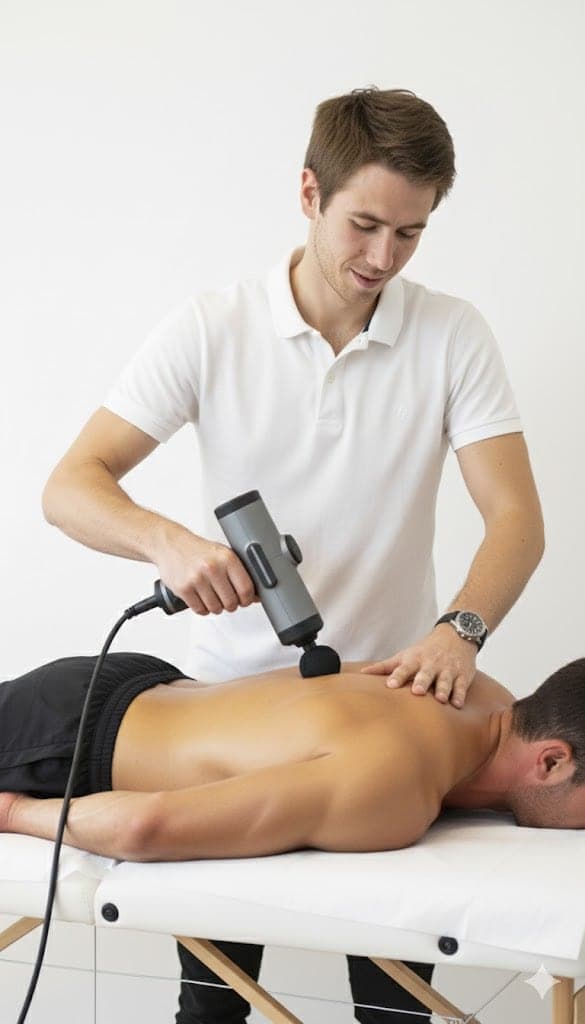
After years of conventional approaches—both performing and receiving them—I developed a methodology that addresses the actual biomechanical causes of back pain. This isn’t traditional massage therapy or guided stretching. This is advanced mechanical deep-tissue intervention using specialized equipment that delivers three critical elements: precision, power, and consistency.
Precision: Targeting the Actual Source
I use a specialized machine that allows me to work with millimeter-level accuracy. When I identify a fascial adhesion at the thoracolumbar junction or a trigger point in the quadratus lumborum, I can apply sustained pressure to that exact location without fatiguing or losing focus. Human hands cannot maintain this level of precision, especially when working at the depth required for lasting change.
Last month, I treated a Pegeia resident who had practiced yoga for three years following a disc herniation at L4-L5. Her flexibility was exceptional, but she still experienced daily pain. Within two sessions, I located the specific fascial restriction in her right psoas that was pulling her lumbar spine into compensatory extension. The restriction was five centimeters deep—unreachable through stretching or manual therapy.
Power: Penetrating Beyond Superficial Layers
The tool I use works deeper than hands can reach, accessing tissue planes that remain untouched by conventional methods. This depth is non-negotiable when treating chronic back pain. The structures causing your dysfunction—deep rotator muscles, fascial planes, tendon-periosteum junctions—require mechanical force that sustained stretching simply cannot deliver.
I adjust the intensity precisely to each client’s needs. For some, this means moderate depth combined with specific positioning to release fascial adhesions. For athletes—I work with several competitive cyclists and runners in the Pegeia area—this means powerfully deep intervention that restructures tissue patterns developed over years of repetitive motion.
This isn’t about causing pain. It’s about reaching the depth necessary for actual structural change. I explain to every client: discomfort during treatment indicates we’re accessing tissue that needs intervention. The body doesn’t register superficial work because superficial work doesn’t address chronic dysfunction.
Consistency: Eliminating Variables
The machine eliminates “off days”, ensuring every treatment delivers equal effectiveness. Your yoga practice varies depending on energy levels, instructor quality, environmental factors, and your own discipline. My method removes these variables. Every session delivers the same precision, the same depth, the same sustained mechanical force necessary for progressive improvement.
This consistency allows me to develop customized treatment plans with predictable outcomes. I can map your specific dysfunctions, address them systematically over multiple sessions, and monitor improvement through objective measures: range of motion, pain scales, functional movement patterns.
The Root Cause Approach: What Actually Resolves Back Pain
I don’t treat symptoms. I identify and address the mechanical causes of spinal dysfunction. This requires understanding body mechanics at a level beyond conventional massage or yoga instruction.
Assessment Before Intervention
When I work with a new client in Pegeia, I begin with comprehensive movement assessment. I observe gait patterns, pelvic positioning, spinal curves, and compensation strategies. I palpate tissue quality through multiple layers, identifying restrictions, adhesions, and areas of dysfunction. This assessment reveals the actual source of pain, which rarely matches where the client feels discomfort.
A common scenario: Client reports right-sided lower back pain. Assessment reveals:
- Left hip internal rotation restriction (5-degree deficit compared to right side)
- Compensatory right lumbar lateral flexion
- Facilitated right quadratus lumborum (chronically contracted)
- Fascial adhesion at right thoracolumbar junction
- Inhibited right gluteus medius (firing at 60% capacity)
The pain is symptom. The left hip restriction is cause. Yoga would stretch the right QL repeatedly, providing temporary relief while the underlying dysfunction continues. My approach releases the left hip restriction, deactivates the compensatory patterns, and restores proper biomechanical function.
Progressive Tissue Remodeling
Lasting pain relief requires tissue remodeling over time. Fascia, when restricted, develops cross-linkages that limit sliding capacity between tissue planes. These restrictions require sustained mechanical force to break down collagen bonds and restore proper tissue architecture.
I typically work with clients through a structured protocol:
Initial Phase (Sessions 1-3): Identify and release primary restrictions. Address compensatory patterns. Establish baseline measurements.
Integration Phase (Sessions 4-6): Retrain proper movement patterns. Address secondary restrictions. Begin performance optimization.
Maintenance Phase (Ongoing): Prevent restriction recurrence. Optimize function for specific activities. Manage stress-induced tension before it becomes dysfunction.
This isn’t an “expense”—it’s an investment in long-term structural health. The alternative is years of managing symptoms through stretching, pain medication, or accepting reduced quality of life.
When Yoga Can Be Valuable (And When It Cannot)
I respect yoga as a practice. After resolving underlying mechanical dysfunction, yoga can maintain mobility and support spinal health. But the sequence matters critically.
Yoga as Maintenance, Not Treatment
Once I’ve addressed fascial restrictions, released compensatory patterns, and restored proper biomechanical function, yoga becomes valuable for maintaining that function. Gentle stretching supports tissue health. Mindful movement reinforces proper patterns. Breathing techniques manage stress that can create muscular tension.
But attempting to use yoga to resolve existing chronic dysfunction is fundamentally mismatched to the problem. It’s like trying to remove a deeply embedded splinter by massaging the surrounding skin. The intention is good, but the method cannot reach the problem.
The Danger of Compensatory Flexibility
I’ve worked with several yoga instructors in the Pegeia area who developed severe back pain despite—or perhaps because of—their advanced practice. Extreme flexibility in some areas masked significant restriction in others. Their bodies compensated so effectively that dysfunction progressed unnoticed until pain became debilitating.
One instructor could perform impressive backbends but had virtually no thoracic extension—all the movement came from lumbar hyperextension and cervical compensation. Years of practice had reinforced a dysfunctional pattern. It took six sessions to release the thoracic restrictions and retrain proper spinal segmentation. She now demonstrates backbends with proper distribution of movement across all spinal segments. Her practice improved, and her pain disappeared.
The Specific Dysfunctions I Treat in Pegeia Residents
Living and working in this region creates identifiable patterns of dysfunction. Understanding these patterns allows me to deliver targeted intervention rather than generalized treatment.
The Expat Desk Worker Pattern
Many Pegeia residents work remotely for international companies. Hours at improperly configured workstations create forward head posture, thoracic kyphosis, and compensatory lumbar extension. The pattern progresses predictably:
- Shortened pectoralis minor and subclavius
- Facilitated upper trapezius and levator scapulae
- Inhibited deep cervical flexors
- Restricted thoracic spine (particularly T4-T7)
- Compensatory lumbar hyperextension
- Tight hip flexors from prolonged sitting
This entire chain creates lower back pain, but the lower back is victim, not perpetrator. I address the thoracic restriction first, release the anterior shoulder structures, retrain scapular positioning, and finally optimize lumbar function. The back pain resolves because I’ve eliminated its mechanical cause.
The Active Retirement Pattern
Pegeia attracts retirees who maintain active lifestyles—swimming, hiking, golf, tennis. These activities are beneficial, but without proper preparation, they create specific dysfunctions:
Swimmers develop anterior shoulder tightness and compensatory lumbar extension. Hikers on uneven terrain develop hip stabilizer weakness and SI joint dysfunction. Golfers create rotational restrictions through repetitive asymmetrical movement.
The Service Industry Pattern
Restaurant staff, hospitality workers, and retail employees often spend hours standing on hard surfaces or performing repetitive movements. This creates:
- Plantar fascia restriction affecting the entire posterior chain
- Tight calves limiting ankle dorsiflexion
- Compensatory knee hyperextension
- Anterior pelvic tilt from standing posture
- Chronic lumbar erector spinae tension
Again, stretching the lower back provides temporary relief while the chain of dysfunction continues from the feet upward.
My Process: From Assessment to Resolution
When you work with me, you’re not booking isolated massage sessions. You’re entering a dedicated partnership focused on lasting resolution of mechanical dysfunction.
Initial Consultation and Assessment
I travel to your location in Pegeia with professional equipment and everything necessary for comprehensive assessment and treatment. The initial session includes:
Movement Evaluation: I observe how you walk, sit, stand, and perform basic movements. These observations reveal compensation patterns and areas of dysfunction.
Postural Analysis: I assess spinal curves, pelvic positioning, shoulder alignment, and head position. Deviations from optimal alignment indicate underlying restrictions.
Palpation Assessment: I systematically evaluate tissue quality through multiple layers, identifying fascial restrictions, muscular tension patterns, and areas requiring intervention.
Range of Motion Testing: I measure joint mobility to quantify restrictions and establish baseline measurements for tracking progress.
This assessment typically reveals 3-5 primary dysfunctions contributing to your back pain. I explain these findings in detail, showing you exactly what’s causing your symptoms and why previous approaches haven’t resolved them.
Customized Treatment Protocol
Based on assessment findings, I develop a specific protocol addressing your unique dysfunction pattern. This isn’t a generic treatment plan—it’s a systematic approach to resolving your particular biomechanical issues.
Treatment sessions focus on:
- Primary Restriction Release: Using the specialized machine, I apply sustained pressure to fascial adhesions and restricted tissue planes, breaking down cross-linkages and restoring tissue mobility.
- Compensation Pattern Correction: I address the muscles and structures that have compensated for primary restrictions, preventing them from recreating dysfunction after primary treatment.
- Biomechanical Optimization: I work to restore proper movement patterns and tissue quality throughout the kinetic chain, ensuring your body functions as an integrated system rather than a collection of compensating segments.
Progress Monitoring and Protocol Adjustment
Every session includes reassessment of key indicators: range of motion, pain levels during specific movements, tissue quality changes, and functional improvements. This data guides protocol adjustments, ensuring we’re consistently progressing toward lasting resolution.
Most clients experience significant improvement within three sessions. Complete resolution typically requires 6-8 sessions depending on dysfunction severity and chronicity. Some clients continue with monthly maintenance sessions to prevent restriction recurrence and optimize performance.
What Makes This Approach Superior to Traditional Methods
I’m direct about this because clarity serves you better than false modesty. My method resolves chronic back pain more effectively than traditional massage, yoga, or physical therapy stretching protocols. This superiority isn’t opinion—it’s based on measurable outcomes with hundreds of clients over ten years.
Depth of Intervention
Traditional massage reaches superficial and intermediate tissue layers. Yoga stretches muscles through their available range of motion. Neither accesses the deep fascial restrictions and chronic tension patterns that cause persistent back pain.
My specialized equipment penetrates these deeper layers with precision and sustained force impossible to achieve manually. This depth is non-negotiable for lasting resolution of chronic dysfunction.
Accuracy of Targeting
General stretching affects broad muscle groups. Even skilled manual therapy cannot maintain pinpoint pressure on specific fascial adhesions for the duration necessary to produce lasting change.
The machine I use allows millimeter-level precision maintained for as long as necessary to fully release restricted tissue. This accuracy means we address actual dysfunction rather than broadly treating areas around it.
Consistency of Results
Your yoga practice varies with instructor quality, your own energy and focus, and environmental factors. Manual therapy varies with therapist fatigue, technique inconsistency, and subjective pressure application.
My method eliminates these variables. Every session delivers the same precision, depth, and effectiveness, producing predictable, progressive improvement.
Root Cause Focus
Most approaches treat symptoms. You feel lower back pain, so treatment focuses on the lower back. This provides temporary relief while underlying dysfunction continues.
I identify and address mechanical causes regardless of where pain manifests. This root cause focus produces lasting resolution rather than temporary symptom management.
Common Questions About Advanced Mechanical Deep-Tissue Treatment
How is this different from regular deep tissue massage?
Traditional deep tissue massage uses hands, elbows, and forearms to apply pressure. This is limited by therapist strength, endurance, and the inability to maintain consistent pressure at depths necessary for chronic dysfunction resolution. My specialized machine works deeper, with more precision, and with perfect consistency—accessing tissue planes unreachable through manual therapy.
Is the treatment painful?
Discomfort during treatment indicates we’re accessing tissue that needs intervention. I adjust intensity precisely to your tolerance while ensuring we reach the depth necessary for results. Most clients describe the sensation as “good pain”—uncomfortable in the moment but immediately followed by relief and improved function. This differs fundamentally from injury pain or damage pain.
How quickly will I see results?
Most clients experience noticeable improvement after the first session—increased range of motion, reduced pain, better movement quality. Significant improvement typically occurs within three sessions. Complete resolution of chronic dysfunction usually requires 6-8 sessions, though this varies based on severity and how long the problem has existed.
Can I continue yoga while receiving treatment?
Yes, but I often recommend temporarily modifying your practice during the initial treatment phase. Once we’ve released primary restrictions and addressed compensation patterns, yoga becomes valuable for maintaining the improvements we’ve achieved. I’ll provide specific guidance based on your particular dysfunction pattern.
Why do you travel to clients instead of having a clinic?
I travel to your location in Pegeia because convenience supports commitment to your treatment protocol. When receiving progressive intervention for chronic dysfunction, consistency matters. Eliminating travel time and logistical barriers means you’re more likely to complete the full protocol necessary for lasting resolution.
I bring professional equipment, a specialized treatment bench, and everything needed for comprehensive assessment and treatment. Your environment is comfortable and familiar, which supports the therapeutic process.
How do I maintain results after treatment concludes?
I provide specific guidance on movement patterns, activities to emphasize or modify, and strategies for preventing restriction recurrence. Some clients continue with monthly maintenance sessions—particularly those with demanding physical jobs or athletic pursuits. Others maintain their results independently using the principles I teach during treatment.
Do you work with serious athletic performance or just pain relief?
Both. Pain relief and performance optimization share the same foundation: proper biomechanical function. Many of my Pegeia clients are recreational athletes—cyclists, runners, swimmers, tennis players—who seek both pain resolution and performance improvement. The systematic approach that eliminates dysfunction also optimizes movement efficiency and power generation.
What if I’ve tried “everything” without success?
I regularly work with clients who have spent years pursuing various treatments without lasting results. The common factor: previous approaches treated symptoms or worked at insufficient depth to address actual mechanical causes. If you’ve genuinely tried “everything” without success, it likely means you haven’t yet received intervention that reaches the depth and precision necessary for your particular dysfunction pattern.
The Investment in Long-Term Spinal Health
I frame this work as investment rather than expense because that distinction matters. An expense is money spent on temporary relief—repeated sessions that manage symptoms without resolving causes. An investment produces lasting value—lasting resolution of dysfunction and optimization of lifelong function.
The Cost of Chronic Pain
Consider what chronic back pain actually costs you:
- Reduced ability to enjoy Pegeia’s outdoor activities—hiking, swimming, exploring the region
- Compromised work performance and career trajectory
- Sleep disruption affecting recovery and cognitive function
- Ongoing expenses for pain management, medication, or repeated ineffective treatments
- Gradual activity restriction and reduced quality of life
- The psychological burden of persistent pain and progressive dysfunction
Most significantly, untreated mechanical dysfunction progresses. The compensation patterns become more complex. The fascial restrictions spread to adjacent structures. What started as occasional discomfort becomes constant pain, then functional limitation, then disability.
The Value of Lasting Resolution
My approach produces lasting resolution through structural intervention. We don’t manage your symptoms—we eliminate their mechanical cause. The value of this outcome compounds over years and decades:
You move better, not just immediately but for the rest of your life. You perform better in activities that matter to you—whether that’s professional work, athletic pursuits, or simply maintaining independence as you age. You avoid the progressive deterioration that chronic dysfunction creates when left untreated.
This is investment in your long-term structural health. The return on that investment—measured in quality of life, maintained function, and pain-free living—exceeds the cost by orders of magnitude.
Taking Action: What Happens Next
If you’re experiencing chronic back pain in Pegeia that hasn’t responded to yoga, stretching, or conventional massage, you now understand why. Superficial approaches cannot resolve deep mechanical dysfunction. Symptom management cannot eliminate root causes.
You have a choice: continue pursuing methods that haven’t worked, accepting progressive deterioration and reduced function, or address the actual biomechanical causes of your pain through advanced mechanical intervention.
I work with clients who value results over familiarity—people willing to invest in lasting resolution rather than repeatedly purchasing temporary relief. If that describes you, we should talk about your specific dysfunction pattern and develop a customized protocol for resolving it.
I travel throughout Pegeia with professional equipment, conducting comprehensive assessments and delivering treatment in your home or preferred location. This eliminates logistical barriers and ensures you can commit fully to the protocol necessary for lasting results.
The pain you’re experiencing isn’t inevitable. The dysfunction causing it isn’t lasting. But resolution requires intervention that matches the depth and complexity of the problem.
Your back pain has a mechanical cause. Identifying and addressing that cause produces lasting resolution. That’s not optimism or marketing—it’s biomechanics, applied consistently over a decade of professional practice.
The question isn’t whether your dysfunction can be resolved. The question is whether you’re ready to pursue the method that actually works instead of repeating approaches that haven’t.
Written by
Chris
Massage therapist & body mechanics specialist
Norwegian-certified with a Bachelor’s in Physical Education and Nutrition and over ten years of clinical practice, working from a portable table in clients’ homes across the Paphos district.
This article is general information from clinical practice, not a medical diagnosis. If you have severe, worsening or unexplained pain, numbness, weakness, or pain after an accident, see a doctor first.